|
Crop Management Considerations for a Potentially Cooler and Drier Spring in 2025
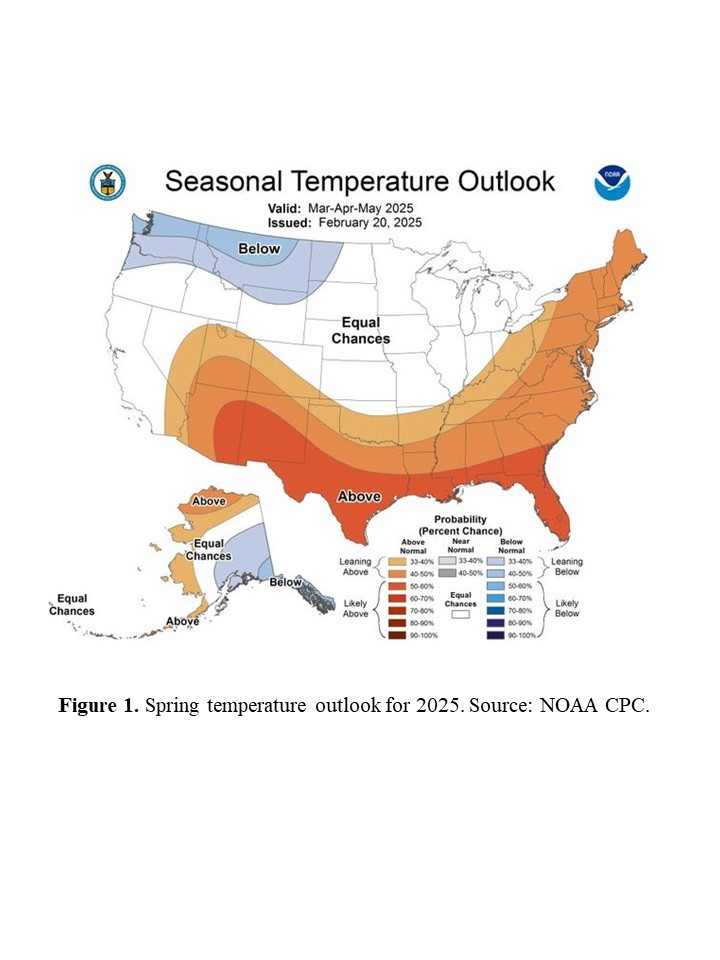
With spring approaching, many growers are beginning to prepare for the season, wondering how early-season weather will impact their management decisions. While it is still too early to predict the exact conditions for this spring, analyzing El Niño and La Niña patterns can provide some insights. According to NOAA, the spring temperature outlook for 2025 in western North Dakota suggests below-average temperatures for most of the west river region (Figure 1).
Impacts of a Cooler Spring
A cooler spring could delay planting and slow early plant growth. Slower crop development early in the season means timely herbicide applications will be crucial to reduce weed competition and promote strong plant establishment.
Additionally, cool and potentially damp conditions may create an ideal environment for soil-borne diseases. In such years, seed treatments, particularly fungicides, can serve as valuable insurance against disease pressure, especially with the likelihood of turbulent weather and heavy showers driven by the jet stream.
A few considerations for planting under less-than-ideal conditions include:
· Check germination on seed bag prior to 2025 planting and adjust seeding rate accordingly.
· If shooting for an early planting, consider ordering a seed vigor test to help which lots to plant early.
· Consider treating seed with a fungicide.
Persistent Drought Conditions
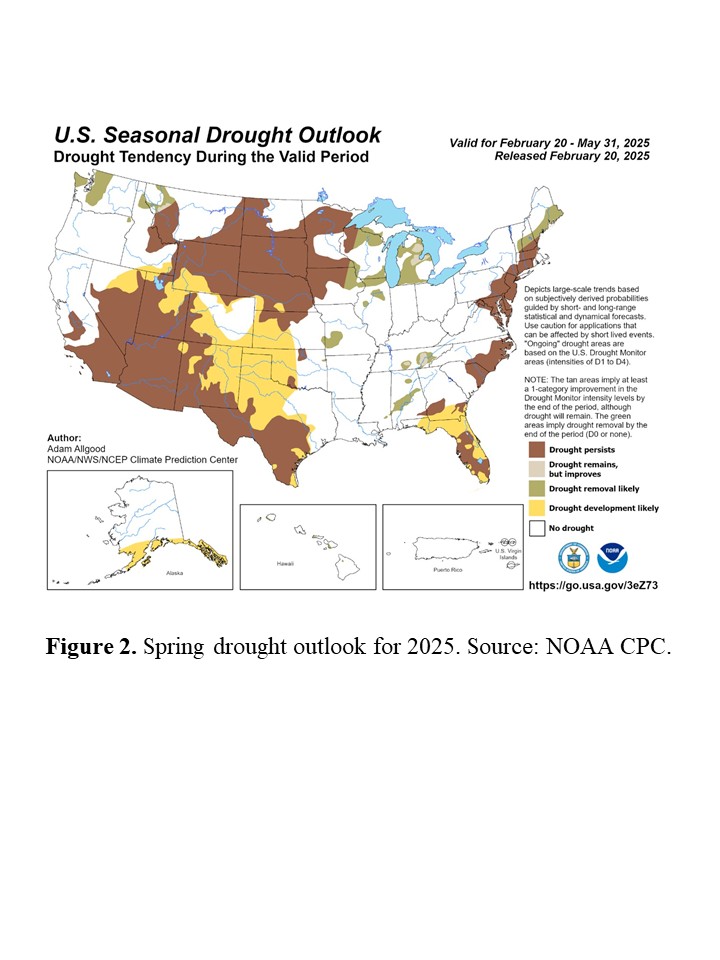
NOAA also predicts that drought conditions will persist in western North Dakota through spring (Figure 2). Given the dry conditions from last season and the minimal, powdery snow accumulation this winter, moisture availability will remain a concern.
Considerations for Nutrient Management
With continued drought conditions, thoughtful nutrient management will be key to maintaining profitability despite reduced yield potential. Here are some important considerations:
· Focus on economic recommendations: Fertilizing for maximum yield may not be feasible or cost-effective in droughty years. Adjust nutrient applications based on expected economic returns.
-
Soil Testing: Conduct yearly nitrate-N tests to guide nitrogen management. Zone-sampling across fields is crucial, as nitrate-N levels can vary significantly.
-
Field-Specific Sampling: Avoid relying on a single 'representative' field each field should be sampled individually.
-
Nitrogen Management: Urease and nitrification inhibitors can help reduce nitrogen losses from denitrification in dry years.
-
Phosphorus (P) and Potassium (K) management: Since these nutrients are immobile in the soil, their levels do not fluctuate significantly from year to year. However, drought conditions can exacerbate deficiencies.
- Fertilize based on crop removal rather than attempting to build soil P and K levels in the short term.
- Banded or in-furrow P application maximizes efficiency, allowing for a 1/3 rate reduction for wheat compared to broadcast application.
- Prioritize K applications for corn, forage crops, and canola before wheat.
Herbicide Carryover Concerns
Drought can also slow herbicide breakdown due to decreased microbial and chemical degradation. Additionally, the prospect of cooler weather and cooler soils in the spring can slow down herbicide degradation further.
A few environmental and management factors in western North Dakota that could put stakeholders at risk of herbicide carryover include:
· Limited rainfall or snow accumulation between last summer and this spring.
· Predominantly sandy soils and/or lower organic matter content.
· Herbicide applications last year in a way that increases carryover risk (e.g., late or "double-up" applications).
These factors can potentially affect crop establishment in the spring. Be sure to check product labels for crop rotation intervals to avoid carryover issues.
In years like this, every cent counts. While uncertainty remains, planning ahead for these conditions will help growers stay on top of potential challenges and make the best management decisions for the season ahead.
|