Drought: Early Weaning is a Management Option
|
|
|
|
Douglas Landblom,
Dickinson Research Extension Center
The 2021growing season drought, which actually began during the summer of 2020, severely impacted crop and pastureland production.
|
|
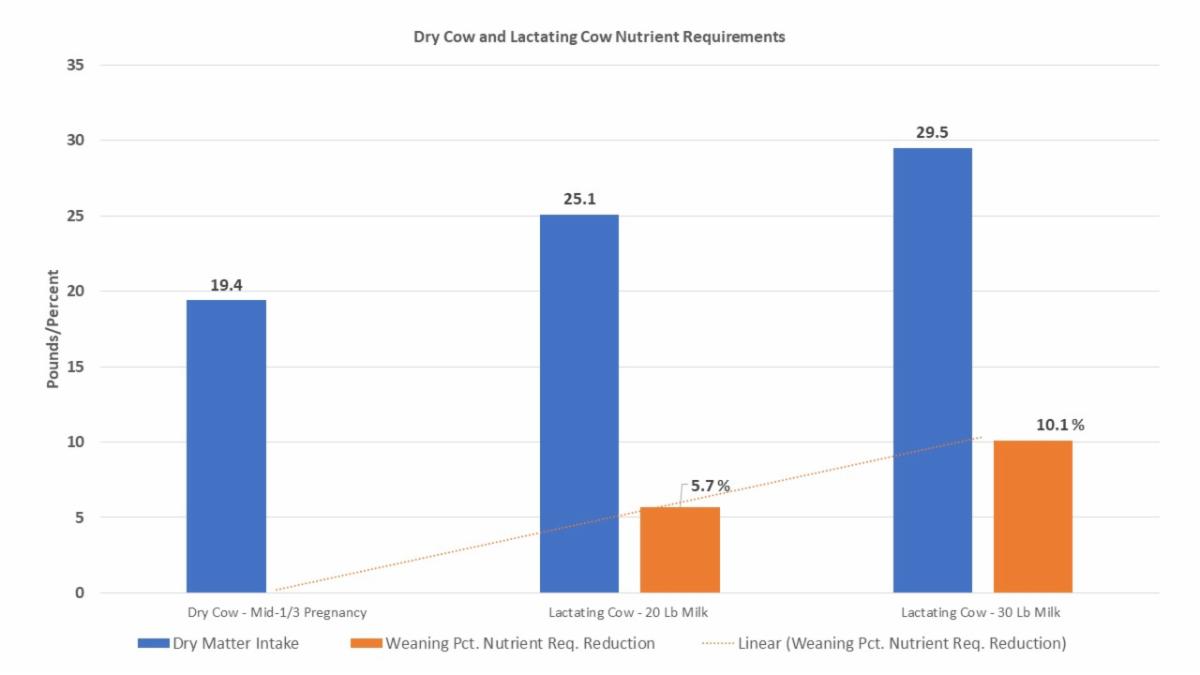
Except for isolated areas of the state where nearly normal precipitation was recorded, yields were reduced 40-60% and in some cases even more. Nonetheless, drought is not uncommon in North Dakota and managing for drought is an important consideration. Calving in the northern Great Plains region is a spring event from March through April. Although, a smaller number of cow-calf producers have shifted calving later into the May-June period. Regardless of when calving occurs, severe drought will certainly have a negative effect on forage production and subsequently the number of cow-calf pairs a given range resource will support. A research question asked was: “If I wean calves from my cows 90 days sooner than the normal (mid-August compared to mid-November) will early weaning result in a measurable reduction of forage disappearance?” From the standpoint of nutrient requirements, it is logical to assume that the nutrient requirement of a non-lactating cow is less than a lactating cow nursing a calf weighing 350-400 pounds at the time of early weaning. The attached chart shows a comparison between the nutrient requirement value of a dry pregnant 1433 lb. mature non-lactating cow to two cows of the same weight, but with different daily lactation potentials (Milk Production: 20 lb./day vs. 30 lb./day). Terminating lactation among cows producing 20 lbs. of milk/day reduces reduces nutrient requirements 5.7% and for a cow producing 30 lbs. of milk nutrient requirements are reduced by 10.1%. Peterson et a., (1987) and Arthington and Minton (2004) conducted research evaluating early weaning among cows fed hay in drylot and reported a reduction in harvested feed dry matter (DM) intake after calves were weaned. And since appetite declined, a portion of the terminated lactation energy was shunted from milk production to body storage, which was measured as an increase in body condition score (BCS). Considering these studies, our research question was to determine the value of early weaning as a drought management strategy to reduce native range pasture disappearance.
A three-year study (Johnson et al., 2015) was conducted at the Dickinson Research Extension Center comparing forage disappearance from mixed-grass native range pastures using triple replicated cow-calf groups that were early weaned (EW) mid-August and cow-calf groups and that were weaned at the normal mid-November weaning date (NW). Cow and calf weights, and cow body condition scores were collected at the start of the study each year.
So, what were the results? Precipitation was average to slightly above average during the three years of the study. Precipitation measured during the study was 19.1, 16.3, and 17.6 inches. Prior to the initiation of grazing the average standing forage production over the three years was 1,889 and 1,764 lbs./acre, respectively, for the EW and NW pastures. Ending residual forage measured after grazing ended was 1,348 and 1,054 lbs./acre, respectively, for the EW and NW pastures resulting in disappearance of 541 and 710 lbs./acre, respectively, for the EW and NW pastures. Forage disappearance was greatest for the NW pastures (P = 0.017). Certainly, the measured disappearance was not all due to grazing, because other processes contribute to disappearance such as wildlife, trampling, grasshoppers, and others. However, the measured change is a conservatively estimated 36% reduction in forage disappearance due to EW (combination of lactation termination and calf pasture removal). Cow BCS also improved as a result of EW. Early weaning cows improved 0.58 BCS units, whereas the BCS of NW cows declined 0.72 BCS units resulting in a margin of 1.3 BCS change (P < 0.001), which is highly significant. Using EW as a management tool for a 90-day grazing period from mid-August to mid-November, 36% of the available forage is estimated to be conserved. Removing calves early in this research was equivalent to having an additional 1.1 month of grazing/animal unit remaining and conserved over a 90-day grazing period. This measured forage savings due to EW is beneficial for managing potential ensuing drought or to be stockpiled for future drought management.
Another good EW question is, “What do I do with my calves after they are EW, because I do not want to be feeding calves when I’m finishing up haying and combining?” Research addressing this question will be presented in the next Research Update.
References:
Arthington, J. D. and J. E. Minton. 2004. The effect of early calf weaning on feed intake, growth, and postpartum interval in thin, Brahman-cross-bred primiparous cows. Prof. Anim. Sci. 20:34-38.
Johnson, P. S., K. C. Olson, R. N. Gates, H. H. Patterson, M. Hubert, D. Landblom, J. J. Kincheloe, H. A. Richter, and A. V. Grove. 2015. Early weaning reduces rangeland herbage disappearance. Crop, Forage and Turfgrass Mgmt. https://doi:10.2134/cftm2014.0090.
Peterson, G. A., T. B. Turner, K. M. Irvin, M. E. Davis, H. W. Newland, and W. R. Harvey. 1987. Cow and calf performance and economic considerations of early weaning of fall-born beef calves. J. Anim. Sci.64:15-22.
|
|
The NDSU Extension does not endorse commercial products or companies even though reference may be made to tradenames, trademarks or service names. NDSU encourages you to use and share this content, but please do so under the conditions of our Creative Commons license. You may copy, distribute, transmit and adapt this work as long as you give full attribution, don’t use the work for commercial purposes and share your resulting work similarly. For more information, visit www.ag.ndsu.edu/agcomm/creative-commons.
County commissions, North Dakota State University and U.S. Department of Agriculture cooperating. NDSU does not discriminate in its programs and activities on the basis of age, color, gender expression/identity, genetic information, marital status, national origin, participation in lawful off-campus activity, physical or mental disability, pregnancy, public assistance status, race, religion, sex, sexual orientation, spousal relationship to current employee, or veteran status, as applicable. Direct inquiries to Vice Provost for Title IX/ADA Coordinator, Old Main 201, NDSU Main Campus, 701-231-7708, ndsu.eoaa@ndsu.edu. This publication will be made available in alternative formats for people with disabilities upon request, 701-231-7881.
|
|
|
|
|
|
|