|
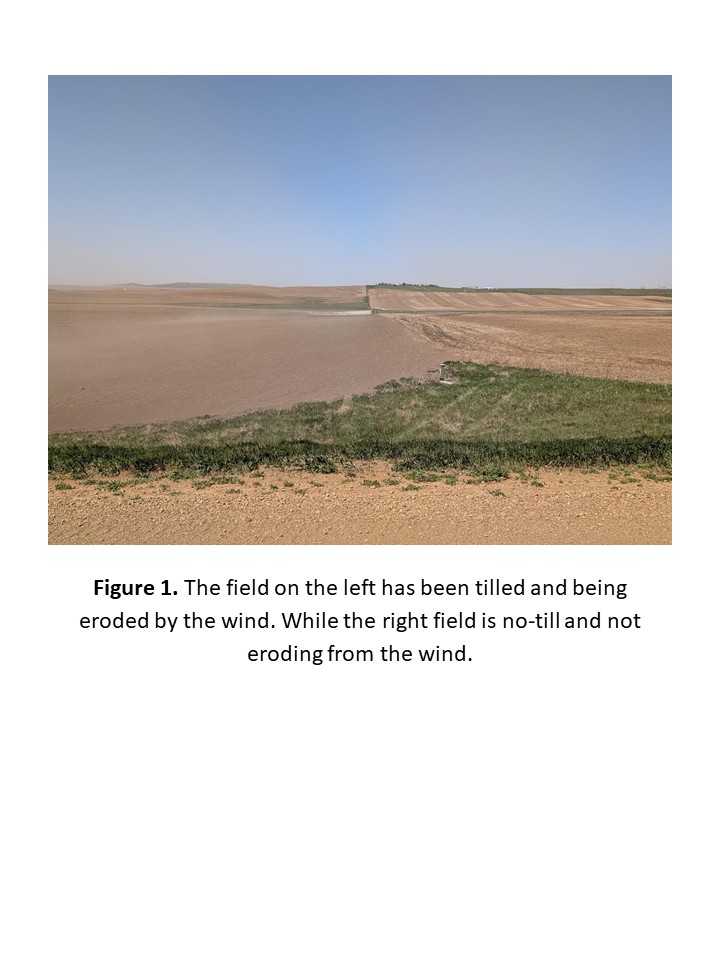
North Dakota is blessed with some of the best soil on Earth. However, we live in a windy state, where the average wind speed is around 12 mph. Last Thursday was extremely windy. That afternoon, I went to the Menards on the west side of Dickinson, and looking west reminded me of the 1930s Dust Bowl pictures from one of the soil conservation classes I took more than 20 years ago.
Erosion is a natural process, but excessive erosion can eat away at topsoil and render soils unproductive. I’ve seen soil tests indicating less than 1% organic matter. It takes roughly 500 years to form an inch of topsoil, yet poor soil management can destroy that in a year or less.
Some field pH’s in North Dakota have increased to nearly 8. Many of these acres are due to years of erosion and the topsoil is no longer truly topsoil, but a mixture of subsoil carbonates and what topsoil is left.
Growing up in Pembina County in the 90’s, I remember most fields being divided into 40 acre chunks by evenly spaced shelterbelts every 40 rods. When I went to college in the early 2000s, many of those shelterbelts were removed because they were dying. However, rarely were they replaced. Fast forward a couple decades, and there are even less shelterbelts.
Several factors influence soil erosion: wind erodibility, ridge roughness, climate, slope length and steepness, and vegetative cover.
Wind erodibility is influenced by soil texture and aggregate size. Simply put, smaller particles erode more easily because it takes less wind energy to move them. That’s why a silted-in ditch is mostly made up of sand and silt — the clay particles have blown away to who-knows-where and could be sitting at the bottom of the Atlantic Ocean.
The ridge roughness factor accounts for how smooth the soil surface is. Rough surfaces create turbulence at the soil-air interface, reducing erosion. Smooth surfaces, on the other hand, allow wind near the surface to gain momentum and strength, making it easier to detach and move soil particles.
We can’t do much about the climate. Winters are long, summers are awesome, and it’s windy here.
Slope length and steepness are heavily impacted by fetch distance. When shelterbelts were removed, we didn’t just double or quadruple the slope length — we dramatically increased erosion potential. This relationship is logarithmic, meaning doubling the slope length can increase erosion potential tenfold.
Vegetative cover is another major factor and is heavily influenced by crop selection. Low-residue crops like beans are more susceptible to erosion, while high-residue crops like wheat stubble do a much better job anchoring soil. Cover crops add even more residue and keep the soil food web running later into the season and promote soil health improvement.
No-till systems can still experience erosion events, but like last Thursday occur under rare extreme events. Still over time, no-till can build soil health and organic matter.
Tillage can help with various agronomic issues. The first is weed control. Herbicide resistant weeds are still controlled with tillage. Tillage can dilute the soil acidity issue we see in long-term no-till fields. However, the soil pH improvement is short lived and to ultimately neutralize soil acidity an acidic acre requires a lime application. Our research has shown that at least 2 tons of calcium carbonate/ac is needed to improve soil pH.
If you’re using a tillage system and doing fall tillage, I’d encourage you to stay away from vertical tillage. It’s becoming increasingly popular, but it leaves the soil surface smooth, almost like a wind tunnel through the winter, increasing the risk of soil loss from erosion.
Vertical tillage has a place for seedbed preparation shortly before planting, sizing large residues, and helps control weeds; but as a fall tillage practice, it often falls short from a conservation standpoint. Chisel plows, by comparison, leave the soil rougher and create larger aggregates that resist erosion better.
Tillage direction also matters. Tilling perpendicular to our dominant northwest winds reduces erosion far more effectively than tilling parallel to the wind. Parallel ridges can act like a wind tunnel and encourage erosion.
At its core, erosion is the detachment, transport, and deposition of soil particles. It’s a natural process. We have ways to reduce and stop erosion. Doing so will protect our soil resources and help feed the world.
|