|
The Northern Plains has two species of sweetclover that have been introduced from the Mediterranean basin and southwest Asia and have become adapted to a wide range of soil and climatic conditions, it is drought tolerant and winter hardy, but does not tolerate acid soils.
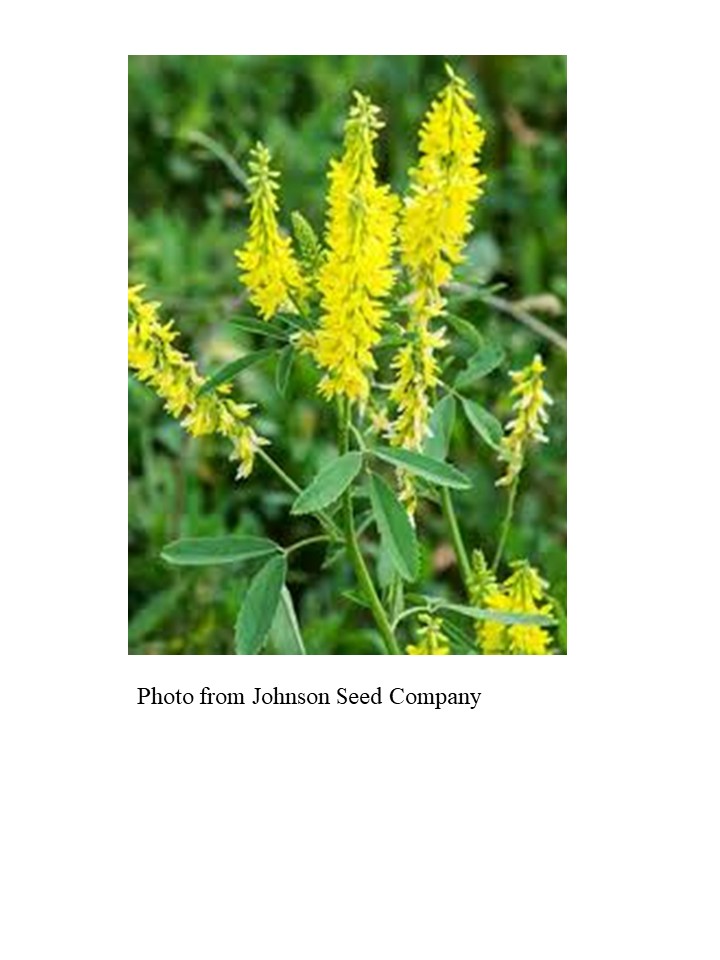
Yellow sweetclover, Melilotus officinalis, is a little shorter, has larger, earlier yellow flowers, larger leaflets, and more common.
White sweetclover, Melilotus alba, is a little taller, has coarser stems, smaller, later white flowers, smaller leaflets, and less common but grows over a larger region.
The two sweetclovers have numerous similarities and are biennial, dicot, strongly scented, weedy, herbs. The first year aerial growth from seed develops a rosette of leaves, with a thin, short stem of less than 12 inches tall with few leaves. The second year aerial growth is erect stem highly branched with tough fibrous stems that are difficult to dry. Leaves are trifoliolate leaflets, with edges of short teeth almost to base. Stems and leaves have no hairs. Root system is a semi woody taproot with extensive lateral roots. Inflorescence is an axillary raceme. Flowers are perfect, irregular, typical 5 petaled legume structure, and fragrant. Pollination is by bees and other insects. The numerous hard seeds last in the seed bank for several years.
Dicoumarol is the toxin that causes hemorrhagic disease in animals by preventing vitamin K regeneration by competitively inhibiting epoxidase enzyme resulting in depletion of available vitamin K preventing normal coagulation of blood resulting in severe hemorrhage in the subcutaneous tissue or body cavities of animals that have consumed improperly cured sweetclover hay.
Sweetclover plants have high concentrations of coumarin which gives the freshly cut hay the pleasant vanilla-like fragrance and the slightly bitter taste. The tough succulent stems of sweetclover are difficult to properly dry even when conditioned. The wet stems in large bales permits the survival of large quantities of soil fungi (not airborne mold) in the sweetclover stems. The fungal growth in the partially cured stems converts coumarin to hydroxycoumarin and then into dicoumarol.
All plant parts that have been improperly cured and put up for hay or silage will be toxic and contain some level of dicoumarol with concentrations that range from 10 ppm to 165 ppm or more. Levels at 10 ppm are only marginally toxic and levels at 20-30 ppm are toxic. Low levels of dicoumarol concentrations require a longer time of ingestion to cause problems.
Grazed live sweetclover plants contain no dicoumarol, however, they can cause legume bloat.
Sweetclover poisoning occurs when livestock ingest improperly cured sweetclover hay. The tough succulent stems of sweetclover plants create an extremely difficult situation for fully drying the cut plants for hay; the valuable leaves drop off when they are well dried and the tough dried stems alone are not quality feed. Sweetclover hay with some leaves should be treated as containing some level of dicoumarol.
Another aspect of this problem to consider is when some weedy sweetclover plants are growing in a grass or alfalfa hay field, a few animals in the herd will be exposed to ingestion of that portion of the delivered forage containing sweetclover plants with dicoumarol concentrations.
Subacute forms of the disease show no or few symptoms when the animals have ingested toxic sweetclover hay for a long enough period for the quantity of dicoumarol to inhibit the epoxidase enzyme from replacing the depleted supply of vitamin K but the internal hemorrhage has not started. However, when that animal has a wire cut, some surgery like dehorning or castration, or birth of a calf, the inevitable results are intractable bleeding due to inhibition or retardation of blood coagulation.
Acute forms show symptoms of anemia, lameness, trouble breathing, weakness, neurologic abnormalities, still births, or abortion as a result from severe hemorrhage in subcutaneous tissue or body cavities.
Treatment includes transfusion of 20 ml/kg b.w. of whole blood or 10 ml/kg b.w. of plasma to supply coagulation factors and/or red blood cells. Administer vitamin K at a dosage of 1-5 mg/kg b.w. on a daily basis for a week or more.
Prevention would include not feeding sweetclover hay, do not feed sweetclover hay as the only forage source, and stop feeding sweetclover hay at least 1 month prior to calving, dehorning, and castration.
|