|
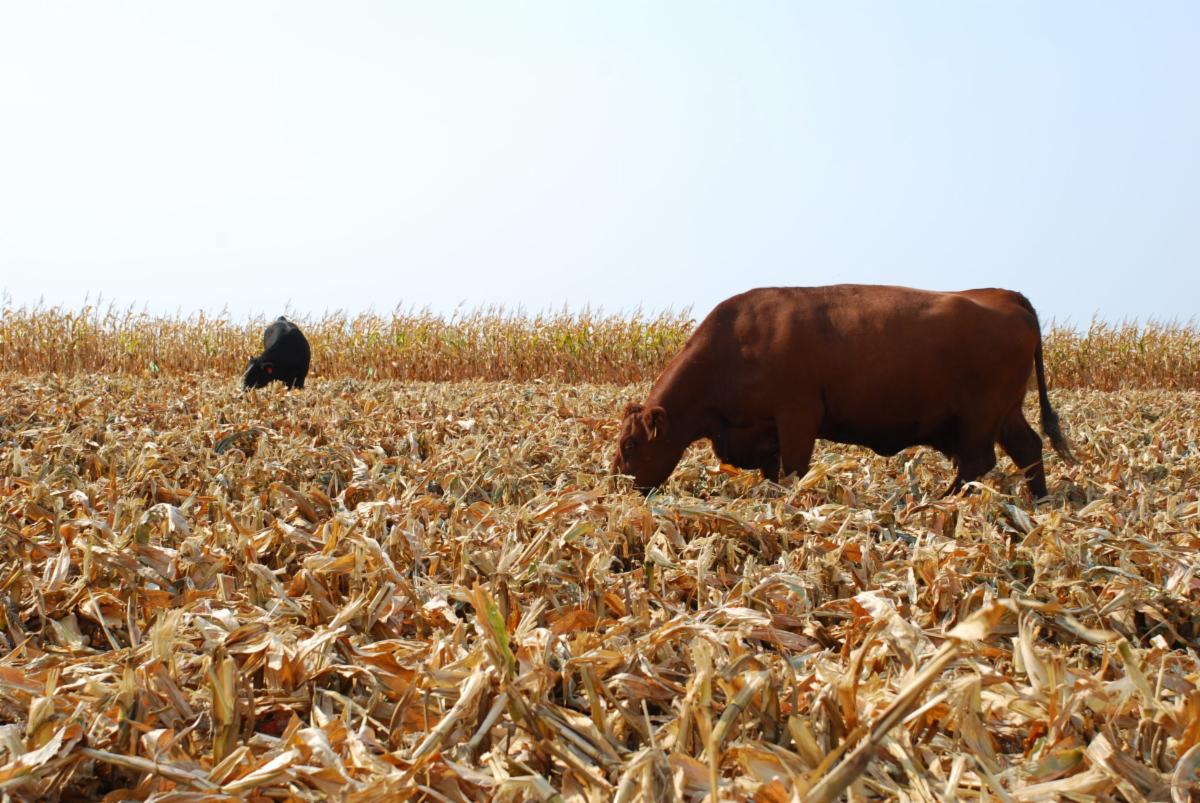
For beef cattle producers who also grow corn for grain, grazing residues is an excellent way to extend the grazing season for non-lactating cows after weaning. Corn residue nutritive quality can be highly variable and changes as grazing progresses from first exposure to the end of the grazing period. Initially, soon after harvest the nutritional quality of corn residue is at its greatest and progressively deteriorates with advancing season. And when cattle are grazing, cattle by nature select the better-quality residue (leaves and husks) and grain that is lost from the combine during harvest. Crude protein (CP) of leaves and husks range from 2.8 to 7.0% whereas the CP of cobs and stalks range from 2.8 to 3.7%. As grazing and weathering progresses, forage quality declines and protein supplementation becomes necessary.
Not only does protein quality of the corn residue decline, but the vitamin and mineral status can be compromised as well. When grazing residues, it is a good practice to provide trace mineral salt and a vitamin/mineral package to ensure the cattle are receiving adequate vitamins A, D, and E as well as a mineral complex: calcium and phosphorus and microminerals: iron, copper, sulfur, potassium, iodine, manganese, selenium, and zinc.
Fencing can be an issue, since many fences have often been removed from cropland. Where fences no longer exist, temporary electric fences using poly-wire, high-tensile steel wire are a cost-effective option, or virtual fencing using GPS collars can be used also. Portable fencing can also be used to establish perimeters and confine groups of cows to field locations for better residue utilization and manure distribution. The cost for each fencing method will be variable depending on the method selected.
Adequate water may not be established on cropland where corn is grown, in which case, water may need to be hauled. Winter in the Northern Great Plains will require a water heater to protect the water from freezing. If an electric power source is available, then electric tank heaters can be used. However, in remote locations where electricity doesn’t exist, propane tank heaters are an excellent method for keeping water from freezing. Both fiberglass and metal tanks are available for remote locations and should be covered except for a drinking area of suitable size to allow cows to drink.
Corn grain can be rapidly digested in the ruminant animal. In situations where there is a sizable amount of downed corn or ear drop, there is a potential for cattle to over consume corn and develop an acidosis condition and founder. Surveying corn fields and estimating the amount of downed corn and dropped ears is important, because when these conditions exist cattle need to be conditioned to corn grain before they are turned-out into corn fields with a large amount of grain available. In this case, grain conditioning is necessary, whereby cows start consuming 0.5 lb. of corn/cow/day and then gradually increase until they are consuming upwards of 5.0 lbs. of corn/cow/day without any adverse problems. Once conditioning is completed, the cows are ready to graze corn fields with a large amount of corn on the ground. Since bloat can also be a problem with ruminant animals, it is advisable to provide bloat guard blocks.
Taking a few preliminary steps to ensure successful grazing of corn residue cow winter maintenance cost can be reduced significantly without compromising calf vigor at calving or cow rebreeding performance after calving.
Photo from Kansas Forage and Grassland Council
|