|
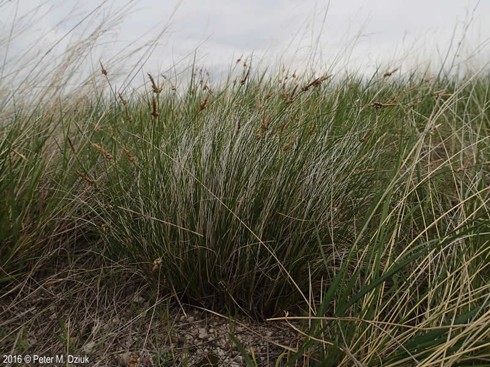
Upland sedges are not related to grasses but they look similar to grasses and are called grass-like (graminifolious) except the sedges have triangular solid stems and 3-ranked leaves in a whorl (rather that 2 ranked as in grasses). Upland sedges grow in dry soils unlike most sedges that grow in wet soils. Two of the commonest upland sedges are described below.
Threadleaf sedge, Carex filifolia, is a native, long-lived perennial, cool-season, short graminoid, monocot, that can grow on sandy, shallow, and silty ecological sites with the greatest basal cover on the shallow sites. Threadleaf sedge resumes leaf and stalk growth early from root stock buds and rhizome buds when liquid water becomes available in the soil.
New leaves are usually visible by 8 April and new stalks are visible between 13 and 29 April. Leaf growth is at 28% height on mid April, 78% height on mid May, 98% height on mid June, and 100% maximum height on 22 June.
Stalk growth is at 61% height on mid May, 93% height on mid June, and 100% maximum height on 22 June. The stalk is at boot stage between 13 and 29 April, mean first flower occurs on 5 May, with a 5 week flower period from early May to the first week of June. Seeds are developing from early May, reach mature stage between 9 and 13 June, and start being shed on 17 June.
Leaf dryness starts in late June and continues through July, and August into September. Tillers drop below the phosphorus requirements of lactating cows during mid May. Crude protein content of tillers is at 13% during early June, at 11% during early July, drops below the requirements of lactating cows during mid July, remains above 8% during mid to late July, remains above 7% during August, and remains above 6% during September.
A network of short rhizomes are connected by an extensive fibrous root system that are tough and wiry because of increased strength from the black pigment, melanin, which is resistant to decay, and is effective at holding the prairie soil in place.
Needleleaf sedge, Carex duriuscula, is a native, long-lived perennial, cool-season, short graminoid, monocot, that can grow on sandy, shallow, silty, and thin claypan ecological sites. Needleleaf sedge resumes leaf and stalk growth early from rhizome tiller buds. Long dark brown rhizomes produce single tillers at progressive intervals.
New leaves are usually visible by 8 April and new stalks are visible by 29 April. Leaf growth is at 26% height on mid April, 71% height on mid May, 97% height on mid June, and 100% maximum height on 1 July.
Stalk growth is at 71% height on mid May, 92% height on mid June, and 100% of maximum height on 1 July. The stalk develops through the boot stage, reaches head emergence by 2 May, mean first flower occurs on 12 May, with a flower period from May to mid June. Seeds are developing from mid May, reach mature stage by 28 June, and start being shed within a few days.
Leaf dryness starts early July and continues through July and August. Tillers drop below the phosphorus requirements of lactating cows early in the growing season. Crude protein content is adequate during June into early July, and remains below the requirements of lactating cows after mid July.
An extensive fibrous root system fans outward as it grows downward from multiple rhizome nodes spaced at 1 to 3 inch intervals.
The upland sedges are a valuable forage source on the Northern Mixed Grass Prairie.
https://www.ndsu.edu/agriculture/ag-hub/publications/dickinson-rec-2018-annual-report
|