Conservation in the Kootenays
Monthly eNews
| | KCP respectfully acknowledges that our work and lives are situated in the traditional, ancestral, and unceded territories of the Ktunaxa, Secwépemc, Sinixt, and Syilx Okanagan peoples who have stewarded this land, water and all living things since time immemorial, and whose values and cultures continue to inspire and guide stewardship of this region. | | |
2026 KCP Fall Gathering
October 15 & 16, Nelson
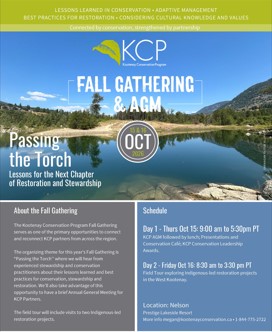
KCP is excited to host this year’s event in Nelson, on the theme of “Passing the Torch: Lessons for the Next Chapter of Restoration and Stewardship”. This year’s gathering is designed to honour the legacy and capture the extensive knowledge of senior restoration and stewardship professionals in the region — ensuring that decades of applied research, field experience, and collaborative learning are effectively transferred to the next generation. The event will be held at the Prestige Lakeside Resort, starting at 9 am for KCP's AGM, followed by engaging morning presentations beginning at 10:30 am, a catered lunch at 12 pm, and continuing with afternoon sessions including youth perspectives on conservation and the Conservation Café. This will be followed by a slideshow and the Conservation Leadership Awards ceremony. Saturday’s field tour will be a full day outing to two ecologically and culturally significant conservation properties – Waterloo Eddy Regional Park and Norns Creek Fan – where we will learn about forest and riparian restoration, salmon reintroduction, and more. Registration is now open to all!
Click here for more information and to register.
Searchable Resource Directory
Kootenay Connect Priority Places
Over seven years, across seven landscapes, Kootenay Connect Priority Places focused on addressing the dual crises of decreasing biodiversity and intensified climate disruption in the Kootenay region. From 2019 to 2026, dozens of reports, maps, and videos were developed as part of this project, highlighting important research and work done on the ground, including ecosystem restoration and monitoring, biodiversity inventories, habitat enhancement and conservation of at-risk species. We are pleased to announce that these resources are now available in a searchable database, making it very easy to find the information you are seeking.
Find more details here or access the Resource Directory.
RDCK Local Conservation Fund
Technical Review Committee Member, Kootenay Lake or Slocan Valley
The Regional District of Central Kootenay (RDCK) in partnership with Kootenay Conservation Program (KCP) is seeking qualified members for the RDCK Local Conservation Fund (RDCK LCF) Technical Review Committee (TRC). The volunteer role of the TRC is to make recommendations on allocating annual funding for conservation projects for RDCK Electoral Areas A, D, E, F and H. Preference will be given to those who reside in this region and have experience in water conservation and climate change. Applications are accepted until September 30.
Click here for the full volunteer posting.
Columbia Valley Local Conservation Fund - Call for proposals now open!
Deadline: October 30
KCP in partnership with the Regional District of East Kootenay (RDEK) provides funding for projects that benefit conservation in the area from Spillimacheen to Canal Flats through the Columbia Valley Local Conservation Fund (CVLCF). For more information about the CVLCF, you can watch this video or go to this webpage. You can also watch this recording of an informative KCP webinar for vital information about how to apply for funding through the Local Conservation Funds. The closing date for project submissions is 4:30 pm MT on October 30.
Click here for more information and how to apply.
RDCK Local Conservation Fund - Call for proposals now open!
Deadline: October 30
KCP in partnership with the Regional District of Central Kootenay (RDCK) provides funding for projects that benefit conservation in the RDCK Electoral Areas A, D, E, F, and H (view the map) through the RDCK Local Conservation Fund (RDCK LCF). For more information about the RDCK LCF, you can watch this video or go to this webpage. You can also watch this recording of an informative KCP webinar for vital information about how to apply for funding through the Local Conservation Funds. The closing date for project submissions is 4:30 pm PT October 30.
Click here for more information and how to apply.
| | | |
Province of BC
Request for Review and Feedback: Draft Wetland and CIAS Guidance Under Development
The Ministry of Water, Land and Resource Stewardship (WLRS) invites feedback on a suite of draft standards, guidance documents, assessment tools, and data resources currently under development to support wetland management and activities occurring in and around streams under the Water Sustainability Act. Several documents are expected to become preferred or pilot standards for use in wetlands-related permitting and mitigation planning. Topics and deadlines are as follows: Changes In and About a Stream (CIAS) Best Management Practices: Deadline Sept 4; Draft Wetland Environmental Mitigation Guidance: Deadline TBD; Wetland Data Tools and Resources: Deadline Dec 31; Wetland Ecosystem Services Protocol (WESP-BC): Deadline Spring 2027; Wetlands Identification and Delineation Manual: Ongoing feedback welcome. WLRS appreciates any feedback you can provide, and welcomes continued input as these materials evolve. Comments can be submitted using the document-specific surveys and comment forms or directly via email to PermittingSolutions@gov.bc.ca.
Click here for all the draft documents and surveys / comment forms.
Province of BC
Invitation to Comment on Forest Operations Map: Kootenay Boundary - until September 9
The public is invited to review and comment on the BC Timber Sales Kootenay Forest Operations Map, showing proposed road construction, road deactivation, and cutblock development under Forest Stewardship Plan #1030 within Forest Development Units in the Selkirk and Rocky Mountain Forest Districts. The map will be valid for the operating period from September 11, 2026 to August 11, 2029. During this period, the Timber Sales Manager may invite applications for Timber Sale Licenses for the harvesting of cutblocks shown on the map and apply for road permits to construct roads shown on the map, including in the Duncan Lake area. Comments will be accepted until September 9 at midnight, and may be submitted via email to TKO.Ref@gov.bc.ca. The map is also available for public review and comment online, or in-person by appointment (call 250-825-1100) Monday to Friday 8 am to 4:30 pm PT at BCTS Kootenay Business Area office, 1907 Ridgewood Road, Nelson.
Click here for the Kootenay Forest Operations Map.
Invasive Species Council of BC
BC Fish Finders 2026 iNaturalist Project - until September 21
Calling all anglers and nature lovers! This summer, you can help protect waterways in B.C. by taking photos of fish and sharing your observations through the BC Fish Finders 2026 iNaturalist project. Photos submitted through iNaturalist can help improve knowledge of where native and invasive fish are being seen, support early detection of invasive spread, and contribute to a better understanding of aquatic ecosystems in BC. Submit all observations of your best catch to the project on iNaturalist until September 21st.
Find more info and sign up here.
Province of BC
Cranbrook Forest Landscape Planning - public engagement open until September 25
Residents in Cranbrook, Kimberley, Fernie, Sparwood, Elkford and surrounding areas are invited to share their input about the development of the Cranbrook Forest Landscape Plan, to guide forest-management decisions in the area. The plan focuses on improving forest management for the 1.2-million-hectare Cranbrook Timber Supply Area. Public input is being collected through a public survey until September 25. Forest landscape plans are being developed through collaborative planning with First Nations and engagement with forest licensees, local communities and other stakeholders in each local area. The partnering First Nations in the Cranbrook plan are the Shuswap Band, ʔaq̓am, yaqan nuʔkiy, Yaq̓it ʔa·knuqⱡiʾit First Nation, and the Ktunaxa Nation Council. Engagement with forest licensees, subject-matter experts and the public is a key part of every forest landscape plan.
Learn more and provide feedback via the survey here.
Arrow Lakes Caribou Society
Central Selkirk Caribou to Remain in Pen Until Mid-September
The Arrow Lakes Caribou Society is holding the 15 caribou in the Central Selkirk Caribou Maternity Pen at the request of the Ministry of Water, Land, and Resource Stewardship until mid-September. Typically, the caribou are released from the pen around mid-July, however, that timeline has been extended this year. This holding period is to allow for First Nations consultation and a decision to be made on potential management options for this herd moving forward. There are three options being considered: Continuing recovery efforts for the Central Selkirk herd in their native range; Transferring the penned Central Selkirk caribou to the Jasper National Park Conservation Breeding Centre, or; Releasing the penned caribou back into the Central Selkirk herd range with no further maternity penning or predator management. The estimated timeline for a decision is mid-September, which will allow the penned animals to breed in the wild if they are released from the maternity pen under option 1 and option 3, or to breed at the Jasper Conservation Breeding Centre under option 2.
Find more details here.
Creston Valley Wildlife Management Area
Seasonal Road Closure: biannual migration of Northern Leopard Frogs
With the amazing bi-annual migration of the Northern Leopard Frogs comes a reminder to the public within the Creston Valley, that all motorized vehicle access to Duck Lake (at the north end of Channel Road) is interrupted as of August 15. The dike will re-open to motorized vehicle access on October 16. The bi-annual closure is necessary to help recover the last population of endangered northern leopard frogs in BC. The frogs particularly like to forage on the warm road surface in the evening and at night during the fall migration between the Duck Lake Nesting Area (wetland unit south of Duck Lake) and the Old Goat River Channel (that flows into Duck Lake) and are very vulnerable to mortality caused by vehicles. During this period, people are welcome to walk or bike (non-motorized) on the dike. Please keep all pets leashed at all times. The Creston Valley Wildlife Management Area (CVWMA) thanks you for your cooperation and for giving the frogs a break.
Click here for more information about this seasonal closure.
Environment and Climate Change Canada
Canada launches new Expert Taskforce on Natural Capital Accounting and Nature Financing
Last month, federal government officials announced the establishment of the Expert Taskforce on Natural Capital Accounting and Nature Financing. Bringing together experts in nature conservation, Indigenous-led conservation, finance, economics, business, and public policy, the Taskforce will provide independent advice to the Government of Canada on how to better measure, value, and account for nature in decision-making. The creation of the Taskforce builds on Prime Minister Mark Carney’s announcement of A Force of Nature: Canada’s Strategy to Protect Nature, which includes an investment of $3.8 billion to protect and restore nature across the country. Over the coming months, the Taskforce will develop recommendations aimed at mobilizing private investment for nature-positive outcomes while advancing the use of natural capital accounting to better reflect the value of nature in public and private decision-making.
Click here for more information.
Ktunaxa Nation
The Ktunaxa Nursery Restoring BC’s Interior
In a fertile valley north of Cranbrook, the Ktunaxa Nation has come up with a solution to reclaim green spaces from industry such as mines operating in its territory, which also provides benefits to the local economy. Since 2020, Nupqu, Canada’s largest Indigenous-led plant nursery, has distributed about 700,000 seedlings a year at reclamation sites and conservation lands in the Southern Rocky Mountain Trench, replenishing mountainsides that have been altered, or are in the midst of being altered, by development. Nupqu grows between 60 and 80 native species per year, including yarrow, red osier dogwood, rosy pussytoes, black huckleberry, Rocky Mountain juniper and shrubby penstemon. Then there are the grasses: the rough and Idaho fescues, blue and Alaska wildryes and June grass. This story by Nelson-based writer Anna Dulisse, is featured in the Tyee.
Read the whole story here.
Wildsight
Sharing recreation trails with wildlife
As outdoor recreation increases in our mountain communities, an important question arises: how do the animals that live here respond to sharing those same trails? According to Kootenay-based wildlife biologist Clayton Lamb, there isn’t a simple answer. Wildsight staff chatted with Lamb about his latest research examining how recreation trails influence the movements and behaviour of large mammals around the trail network near Fernie. His study reveals that while some species can adapt by changing where or when they are active, others—particularly elk and grizzly bears—tend to avoid heavily used trails altogether.
Read the whole story here.
Yellowstone to Yukon
How to stitch a massive wildlife corridor through the Rocky Mountains
In the Elk Valley, Highway 3 slices through a narrow section of the Rockies where the animals are funneled into a tight corridor of survival, just 70 km wide. More than 300 collisions between vehicles and large mammals occur here each year, and the animal death toll is so high that two large morgues are stationed along the section for the battered carcasses. In 2020, a broad coalition launched the Reconnecting the Rockies project: conservation groups, Indigenous nations and the B.C. Ministry of Transportation and Transit, as well as industry partners like Teck Coal (now Elk Valley Resources), with the mission of reducing wildlife-vehicle collisions and restoring connectivity on Highway 3 by engineering a system of wildlife crossings. Experts say the system of crossings should pay for themselves within 20 years. In Radium, efforts focus on how bighorn sheep can cross Highway 95 without getting killed. In 2022, the Shuswap Band established their Guardians program. Trained monitors began daily highway patrols to warn drivers when sheep are on the road, and keep tabs on the herd’s health and behavior. This story by Jane Palmer is featured on the U.S.-based non-profit conservation and environmental science news platform Mongabay.
Read the whole story here.
Columbia Shuswap Invasive Species Society
Whirling Disease Prevention
Whirling disease was first detected in BC in December of 2023 in the Columbia River Watershed. Containment and prevention of this disease is now critical. Best practices for preventing the spread of whirling disease are as follows: Never move fish or fish parts between water bodies; Use fish cleaning stations and dispose of fish parts in local solid waste systems, and do not dispose of fish parts down a drain; ‘Clean, Drain, Dry’ all watercraft and equipment; Decontaminate all watercraft and equipment leaving waterbodies in the Columbia River Watershed; ‘Pull the Plug’ when transporting watercraft, it’s the law.
Find more information here.
Goldeneye Ecological Services & Environment and Climate Change Canada
Help find Black Swifts in Southeastern BC
Black swifts are one of Canada's most mysterious and least understood birds. They nest in small niches on steep, wet cliff faces behind or beside waterfalls, within canyon systems, near perennial seeps, and in wet inland caves. Their inaccessible nesting habitats, high-altitude foraging behaviour, and infrequent nest visits to provision their young make breeding sites exceptionally difficult to locate, limiting our understanding of the species' distribution, habitat requirements, and conservation needs. Goldeneye Ecological Services, in collaboration with Environment and Climate Change Canada's Canadian Wildlife Service, is seeking all observations of black swifts in southeastern BC, to help locate breeding sites and improve our understanding of this endangered species. If you've seen Black Swifts (and the sighting hasn't already been submitted to eBird), please send your observation—including the location, date, number of birds observed, their behaviour, and any photos or videos, if available—to info@goldeneyeecological.ca. Every observation contributes to improving our understanding and conservation of one of British Columbia's most elusive birds.
BC Nature
Contribute your fungus finds and observations to MycoMap BC
MycoMap BC has quickly become the fastest-growing project of its kind, drawing attention across North America and beyond. Together, participants are building a robust fungal biodiversity dataset for BC—one that will help us better understand our BC mushrooms, assist taxonomists in sorting out unnamed species, and support fungal conservation by tracking how fungi respond to environmental change. You can learn more about MycoMap BC and how to contribute by watching a recorded webinar hosted by Liam Ragan from BC Nature and Elora Adamson from Mycomap BC.
Click here for more information, and here to access MycoMap BC on iNaturalist.
Province of BC
Biodiversity Forum for Local Governments
Calling all local governments. You are invited to share your biodiversity stewardship work on the new B.C. Biodiversity Stewardship Initiatives Map. This is a pilot year for participants of the B.C. Biodiversity Forum for Local Governments. All local government staff are welcome to join. To learn more or request access, please email BiodiversityForumforLGs@gov.bc.ca.
Goldeneye Ecological Services
Have you seen a badger or badger burrow in the East Kootenays?
Goldeneye Ecological Services is seeking reports of American Badgers and badger burrows, particularly from higher-elevation areas of the East Kootenays, from Spillimacheen to Cranbrook. While badgers are typically associated with valley-bottom grasslands, recent observations suggest they may occur in higher-elevation habitats more frequently than previously understood. If you have seen a badger, a badger burrow, tracks, or other signs of badger activity, we'd love to hear from you. Photos, dates, and GPS coordinates are especially helpful. Your observations will contribute to ongoing research and conservation efforts aimed at supporting the recovery of this endangered species and improving our understanding of movement corridors in the region. Please send observations to info@goldeneyeecological.ca.
Click here for more info.
Salmo Watershed Streamkeepers Society
Salmo River angler surveys
With fishing season on the Salmo River continuing until October 31, the Salmo Watershed Streamkeepers Society (SWSS) is asking for your help. SWSS is conducting a voluntary, anonymous angler survey to better understand fishing pressure, angler preferences, and the overall health of the Salmo River fishery. Survey responses will provide valuable local information to support future fisheries management and conservation efforts. SWSS has over 20 years of population monitoring data for rainbow trout and bull trout, as well as temperature and discharge records, but are lacking angling information. Please help them spread the word by sharing this survey with other anglers who fish the Salmo River – information collected will also help assess whether the river is attracting increasing numbers of anglers from outside the West Kootenay, and how this may influence fishing pressure. Thank you for helping us better understand and protect this important fishery.
Access the survey here.
Central Kootenay Invasive Species Society
Nature for Neighbourhoods program - until late October
If you live in the Regional District of Central Kootenay (RDCK) Areas A, D, E, F, or H, you can earn cash rewards for removing invasive plants like spotted knapweed, common tansy, and Scotch broom from your property. Register your property with the Central Kootenay Invasive Species Society (CKISS), and download the Crowdsorsa app – available until the end of October. Upload before-and-after videos of your work through the app, and get paid for your hard work. You can do the work yourself or have a friend, neighbour, or family member get paid to do the removal. Registration is open.
Click here for more details and to sign up.
Province of BC, Genome BC, Environment and Climate Change Canada
Help monitor and learn from pikas
Pikas help scientists such as Michael Russello and Leigh Anne Isaac track climate-driven changes in alpine environments. Warming temperatures and unpredictable snowpack may threaten pika populations or force them to find more suitable habitat either upslope or at higher latitudes. Scientists are tracking the resilience and adaptability of pikas, and documenting pika sightings provides vital data on changes in their distribution. Both the American (Ochotona princeps) and Collared (O. collaris) pikas are considered sentinel species for detecting climate-driven changes in alpine environments. There is great potential to use genomic tools to monitor American and collared pikas and protect them from climate change effects. Community involvement is a key part of the project. If you’re in B.C. or the Yukon, report your pika sightings directly on the Pika Patrol app.
Click here for a poster with more information.
| | | |
KBA Photo Contest
Until October 15, Local KBAs
For the 4th year in a row, the Key Biodiversity Area (KBA) Canada team is inviting photographers of all levels to participate in their photo contest and help showcase the natural beauty and importance of Canada’s KBAs and the biodiversity that calls them home. KBAs are places that contain remarkable concentrations of rare or vulnerable species and ecosystems, according to specific globally recognized criteria. Photos submitted to the contest should be taken from KBAs or Candidate KBAs, or feature species or ecosystems that are having KBAs identified for them. This year’s contest has an all-star line-up of nationally renowned judges, as well as a brand-new Indigenous Storytellers category. The contest asks Canadians to help shine a spotlight on our increasingly at-risk natural heritage, and the people at the heart of stewarding these places for future generations.
Click here for the full contest details and here to submit a photo.
Meadow Creek Spawning Channel Open House
September 12, Meadow Creek
Save the date for the annual Meadow Creek Spawning Channel Open House. This free event is hosted by the Fish & Wildlife Compensation Program (FWCP), in partnership with the Province of BC. Talk to biologists and learn more about kokanee and the Kootenay Lake Nutrient Restoration Program. In addition to the open house, the spawning channel is open daily for viewing during the spawning season from 10 am to 2 pm. Talk to biologists and learn how the FWCP funds projects that support the kokanee population in Kootenay Lake. The spawning channel is located 4 km west of Meadow Creek at the north end of Kootenay Lake. Please be aware that if there are too many bears in the area, the channel may be closed to the public by the Province of BC at any time. For more about the open house, please email fwcp@bchydro.com. The open house is from 10 am to 2 pm PT.
Click here for more information.
Beyond Protected Areas: How OECMs Reveal Canada’s Invisible Conservation Network
September 17, Online
This webinar is free for members of the Land Trust Alliance of BC (LTABC). Across Canada, vast areas of land are quietly delivering meaningful conservation outcomes – within working forests, private lands, and institutional properties. This session will explore how OECMs (Other Effective Area-based Conservation Measures) can recognize and elevate these efforts, helping land trusts and partners unlock new pathways to conservation, build partnerships, and accelerate progress toward 30x30 - without changing how land is managed. The webinar will be presented by Kristyn Ferguson, Managing Director of Ontario Conservation Accelerator. She has had the privilege of leading several of the largest private land conservation projects in Canada, and is one of the leading experts in the nation on the use of the OECM tool. From 11 am to 12 pm PT / 12 to 1 pm MT.
Click here for more details and to register.
Shoreline Homeowner Workshop
September 23, Kaslo
Join Friends of Kootenay Lake Stewardship Society (FoKLSS) to discover simple actions that can improve lake health while protecting your shoreline and even your property value. Hosted in partnership with the Kootenay Lake Partnership and developed with guidance from Yaqan Nukiy, this workshop will cover practical topics including maintaining natural shorelines, reducing erosion, supporting native plants, improving water quality, and managing invasive species. Learn easy, actionable tips you can use right away. You'll also have the chance to connect with others who care about the future of Kootenay Lake. Whether you've lived on the lake for years or simply care about its future, everyone is welcome. From 5 to 6:45 pm PT at the Langham Cultural Centre.
Click here for more details and to register, and here to see a poster.
Native Bee Study Group
September 23, Online
This monthly discussion hosted by the Native Bee Society of BC is an opportunity for connecting and learning about native bees with others throughout the province. There is a unique theme each month. Share knowledge and learn from others—experts and beginners are very welcome. The format is a show and tell style, and anyone who is interested in participating can create a slide on the shared google slides deck to share with the group (link sent with registration). Photos can also be sent to bcnativebees@gmail.com, with a subject line of "Native Bee Study Group". From 7 to 8:30 pm PT / 8 to 9:30 pm MT.
Click here to register.
Launch of the 3rd Edition of Standards for the Practice of Ecological Restoration
September 24, Online
The Society for Ecological Restoration (SER) has published the third edition of its International Principles and Standards for the Practice of Ecological Restoration, widely recognized as the most comprehensive guidelines for the practice of ecological restoration. Join authors of the newly published third edition of the SER Standards for a discussion of what has changed and why, from a sharper definition of ecological restoration to more rigorous measurement and expanded guidance across the full project cycle. This session has three authors presenting for half an hour followed by half an hour of audience questions. From 7 to 9 am PT / 8 to 10 am MT.
Click here for more details and to register.
3rd Annual Cottonwood Creek Cleanup
September 27, Nelson
Join Friends of Kootenay Lake Stewardship Society (FoKLSS) for the 3rd Annual Cottonwood Creek Cleanup, in celebration of BC Rivers Day. The cleanup will start at Kootenay Lake and work upstream. Meet at the Lakeside Walk Bridge, just before the Recycling Depot, at 11 am. Wear sturdy, weather-appropriate clothing and rubber boots as some of the cleanup will be in the stream. FoKLSS will provide snacks. The cleanup will continue until 1 pm PT.
Find more details and the event waiver here.
Goat River Watershed Celebration
September 27, Creston
The Regional District of Central Kootenay (RDCK) is hosting this free, family-friendly event celebrating BC Rivers Day, as part of their larger effort of water sustainability planning in collaboration with Yaqan Nuʔkiy. Connect with local community groups, enjoy hands-on activities, and spend an afternoon celebrating and learning about the Goat River. Make a river friendship bracelet, explore a 3D model of the Goat River Watershed, and enter the colouring contest. Visit booths and activities from organizations including Living Lakes Canada, Kootenay & Boundary Farm Advisors, and Wildsight. More details coming soon! From 12 to 4 pm PT at Creston & District Community Complex.
Find more details here.
Shoreline Homeowner Workshop
September 27, Nelson or online
Join Friends of Kootenay Lake Stewardship Society (FoKLSS) to discover simple actions that can improve lake health while protecting your shoreline and even your property value. Hosted in partnership with the Kootenay Lake Partnership and developed with guidance from Yaqan Nukiy, this workshop will cover practical topics including maintaining natural shorelines, reducing erosion, supporting native plants, improving water quality, and managing invasive species. Learn easy, actionable tips you can use right away. You'll also have the chance to connect with others who care about the future of Kootenay Lake. Whether you've lived on the lake for years or simply care about its future, everyone is welcome. At the Nelson United Church (or online) from 4 to 5:45 pm PT.
Click here for more details and to register, and here for a poster.
Water Connections: Data & Stewardship
September 28, Online
Join Watersheds Canada, DataStream, Atlantic Water Network, and Water Rangers for this free 'Water Connections' online workshop that will bring together watershed groups, community organizations, and partners to explore how water monitoring data can support meaningful stewardship action. The workshop will feature short presentations on stewardship tools, data management, data communication, equipment maintenance, and stewardship examples. This will be followed by a discussion time to share current actions, identify support needs, and explore opportunities for stronger regional coordination and shared resources. From 9 to 11am PT / 10 to 11 am MT.
Find more information and register here.
eDNA: Environmental DNA Theory and Implementation
October 1 & 2, Revelstoke
Environmental DNA (eDNA) is a proven and globally accepted method that is increasingly being used for survey of aquatic taxa. This highly effective, cost-efficient, and non-invasive method relies on the detection of genetic materials in aquatic ecosystems using laboratory analysis of water samples to detect DNA from the target taxa. Taught by professional biologist Jared Hobbs, this course is for anyone attempting to implement the eDNA methods. Jared has over 30 years of applied experience designing and leading species assessment and conservation projects at both the local and provincial scale. Since 2014, he has been applying eDNA methods into his standard practices, leading, or supporting delivery of over 80 eDNA projects in BC, Alberta, the Northwest Territories and Yukon. Initially his eDNA projects were focused on species-at-risk; more recently his focus has expanded to also include projects focused on fish and invasive species.
Click here for more details and to register.
Overview of Fish & Wildlife Compensation Program’s Grant Intake
October 2, Online
Join the Fish & Wildlife Program (FWCP)’s virtual information session to find out more about their grants and how to align your project idea with the core elements and regional action plans. Get answers to your questions and tips to help you succeed. From 10 to 11 am PT / 11 am to 12 pm MT.
Click here for more info and to register.
Conversational Ktunaxa Language Course
October 5 to December 21, Online
Join Alfred Joseph, highly respected Ktunaxa Elder and past chief of the Akisqnuk Nation, and Mara Nelson, whose family is from Yaq̓it ʔa·knuqⱡiʔit and whom has extensive experience in the classroom with students, for 12 weeks of Ktunaxa Conversational Language Learning. This course is designed for learners who have taken an introductory course, or have a basic understanding of elements of the Ktunaxa language. This course is open to everyone – both Indigenous and non-Indigenous participants who wish to learn to uplift language revitalization. The course runs for twelve Monday evenings from 6 to 8 pm PT / 7 to 9 pm MT.
Find more details and registration info here.
Whitebark & Limber Pine Canadian Conference
October 14 & 15, Radium Hot Springs
Join the Whitebark Pine Ecosystem Foundation of Canada (WPEFC) this fall! This event will bring together researchers, restoration practitioners, Indigenous knowledge holders, students, and community members who share a commitment to conserving these remarkable high-elevation species. The theme is Collaboration for Recovery: Active Management in a Changing Climate, and active restoration, innovative research, and collaborative approaches to conserve these keystone species in a changing climate, will all be explored. Day one will feature presentations, workshops, and discussions on the latest research and restoration efforts. Day two will head into the field for hands-on learning and exploration of active whitebark and limber pine restoration projects. WPEFC looks forward to gathering the community working to restore and protect these iconic ecosystems. Email WPEFC at info@whitebarkpine.ca to help plan or organize this or future conferences.
Click here for more information and to register.
2026 KCP Fall Gathering
October 15 & 16, Nelson
KCP is excited to host this year’s event in Nelson, on the theme of “Passing the Torch: Lessons for the Next Chapter of Restoration and Stewardship”. This year’s gathering is designed to honour the legacy and capture the extensive knowledge of senior restoration and stewardship professionals in the region — ensuring that decades of applied research, field experience, and collaborative learning are effectively transferred to the next generation. The event will be held at the Prestige Lakeside Resort, starting at 9 am for KCP's AGM, followed by engaging morning presentations beginning at 10:30 am, a catered lunch at 12 pm, and continuing with afternoon sessions including youth perspectives on conservation and the Conservation Café. This will be followed by a slideshow and the Conservation Leadership Awards ceremony. Saturday’s field tour will be a full day outing to two ecologically and culturally significant conservation properties – Waterloo Eddy Regional Park and Norns Creek Fan – where we will learn about forest and riparian restoration, salmon reintroduction, and more. Registration is now open to all!
Click here for more information and to register.
CMI’s Annual Researchers Forum
October 22 to 23, Rossland - proposals due by September 4
The Columbia Mountains Institute of Applied Ecology (CMI) will hold its annual Researchers’ Forum in Rossland this year. This event travels the Columbia Mountain region to gather members of the scientific community, Indigenous and provincial land managers, stewardship groups, naturalists and community members to provide updates on ecological projects taking place in the area. This is a chance to share and get caught up on everything from new restoration projects and their associated community initiatives, to ecosystem monitoring, research, field trials, and land stewardship initiatives. This gathering has an informal atmosphere where everyone is invited to attend, mix, and mingle during a day of presentations and social events on Thursday, including a dinner and evening plenary, and field tours on Friday. Anyone interested in offering a 5, 10, or 15-minute presentation, bringing a poster, or leading a local field trip should submit their proposal(s) by September 4.
Find more information and register here.
4 Seasons of Indigenous Learning Course
Fall 2026 to Spring 2027
Beginning in the fall and running until the spring each year, this course serves to support participants in deepening their understanding of Indigenous knowledge and perspectives while strengthening connections with the local land and supporting more respectful, reciprocal relationships. You can register for Seasons 1, 2, 3, 4, or 5 of the course modules and presentations, or join for the seven Indigenous learning presentations only. These seven sessions are offered by an incredible group of Indigenous Leaders, Elders and Educators from across Turtle Island (North America). For 2026/2027, presenters include veteran broadcast-journalist Shelagh Rogers, who is member of the Métis Nation, with family roots in Red River, Manitoba, and Faro Burgoyn, who sits on council for the ʔakisq̓nuk First Nation, part of the Ktunaxa Nation. KCP Partner organizations receive a 25% discount; please email megan@kootenayconservation.ca for the discount code.
Click here for more information and to register.
International Symposium of the North American Lake Management Society
November 3 to 6, Kelowna
With the annual North American Lake Management Society (NALMS) conference coming to Canada this year, the BC Lake Stewardship Society encourages everyone to consider attending the NALMS International Symposium in Kelowna this fall, the most water-scarce region of Canada. The theme is ‘Swimming Upstream: Tackling Environmental Challenges through Partnership, Innovation, & Science’. Early Bird registration closes on September 11.
Click here for more information and to register.
Camera Trap Survey Design and Data Management
November 11 to 14, Revelstoke
The number of projects employing camera traps to understand ecological phenomena is growing rapidly – as are the number of statistical tools to analyze the resultant data. Consequently, the management and analysis of camera trap data can seem complex and overwhelming. This course aims to guide participants in effective ways to store, manipulate and analyze camera trap data. Course content includes data storage and exploration best practices, and introductions to the major methods used to analyze camera trap data – all using real world camera data. The course will give participants the tools to manage, analyze and share camera trap data in an approachable and practical way. Participants can register for Day 1 only, or the entire course.
Click here for more details and to register.
Kootenay Lake Summit 2026: Collaboration in Conservation
November 15, Nelson
Join the Friends of Kootenay Lake Stewardship Society (FoKLSS) for their annual Kootenay Lake Summit. This year’s theme is ‘Synergy: Collaboration in Conservation’, celebrating the powerful impact that partnerships and collaboration can have in creating meaningful change. Join community members, lake users, organizations, and stewards from across the watershed for an evening of connection, learning, conversation, and inspiration. The Summit will feature keynote speaker Juliet Craig, MSc, RPBio, Program Director of Kootenay Conservation Program, along with interactive activities, a locally catered dinner, live music, and opportunities to connect with others who care about the future of Kootenay Lake. The Summit will take place at the Prestige Lakeside Resort from 3 to 8 pm PT.
Click here for more details and to register, and here for a poster.
| | | |
Canadian Wildlife Habitat Conservation Stamp Program: Wildlife Habitat Canada
Deadline: October 18
The Canadian Habitat Conservation Stamp Program (STAMP) provides 1 year funding from $1K to $150K to eligible organizations for projects that support habitat conservation, waterfowl and wetland habitat research, and conservation networking. Note that this grant requires a minimum 1:1 funding match ratio. Eligible projects must take place between April 1, 2027 and March 31, 2028.
Find more information and apply here.
Fish & Wildlife Compensation Program Columbia Region multi-year grants
Deadline: November 2 (Notice of Intent due September 11)
The Fish & Wildlife Program (FWCP)’s annual grant intake is open for current FWCP-funded projects in year one or more of a multi-year project. FWCP funds projects that conserve and enhance fish and wildlife in watersheds impacted by BC Hydro dams. Grant applications for new projects in the Columbia Region will not be accepted in 2026, as the board paused applications for new projects this year due to increasing delivery costs, with plans to resume the intake of grant applications for new projects in 2027. If you are eligible to apply for an annual grant this year, note that the mandatory Notice of Intent (NOI) is due September 11, with an NOI information session on August 6. Apply by Monday, November 2 at 4 pm PT / 5 pm MT.
Click here for more info, and here for the Columbia Region Guidance document.
Columbia Valley Local Conservation Fund - Call for proposals now open!
Deadline: October 30
KCP in partnership with the Regional District of East Kootenay (RDEK) provides funding for projects that benefit conservation in the area from Spillimacheen to Canal Flats through the Columbia Valley Local Conservation Fund (CVLCF). For more information about the CVLCF, you can watch this video or go to this webpage. You can also watch this recording of an informative KCP webinar for vital information about how to apply for funding through the Local Conservation Funds. The closing date for project submissions is 4:30 pm MT on October 30.
Click here for more information and how to apply.
RDCK Local Conservation Fund - Call for proposals now open!
Deadline: October 30
KCP in partnership with the Regional District of Central Kootenay (RDCK) provides funding for projects that benefit conservation in the RDCK Electoral Areas A, D, E, F, and H (view the map) through the RDCK Local Conservation Fund (RDCK LCF). For more information about the RDCK LCF, you can watch this video or go to this webpage. You can also watch this recording of an informative KCP webinar for vital information about how to apply for funding through the Local Conservation Funds. The closing date for project submissions is 4:30 pm PT October 30.
Click here for more information and how to apply.
TD Friends of the Environment Foundation Grant
Deadline: December 15
The TD Friends of the Environment Foundation supports a wide range of environmental initiatives, with a primary focus on environmental education and green space programs. Eligible projects include schoolyard greening, park revitalization, community gardens, park programming and citizen science initiatives. Organizations eligible to receive funding include registered Canadian charities, educational institutions, municipalities, and Indigenous groups/communities.
Click here for more information and to apply.
Climate Emergency Grant Program
Deadline: Ongoing until funding is committed
The Climate Emergency Grant Program supports First Nations in BC to respond to urgent environmental emergencies affecting ecosystems and species in their territories. This program is intended to enable timely action when urgent environmental threats arise and require immediate intervention. Eligible project types include wildfire recovery, drought relief, flooding, landslides, and at-risk aquatic species rescue. Funding through the Climate Emergency Grant Program provides a minimum of CAD $25K per project, with a total budget of $300K available each fiscal year to support all approved projects. Projects must be completed within a one-year timeframe, as multi-year initiatives are not eligible under this program. Applications are accepted on a rolling basis until available funds are fully allocated.
Find more information and apply here.
Investment Agriculture Foundation of BC Beneficial Management Practices
Deadline: Ongoing until funding is committed
The Beneficial Management Practices (BMP) of the Investment Agriculture Foundation of BC provides funding for projects and plans to improve a farm's environmental and sustainability goals. Through targeted investments, the BMP program supports producers by helping them reduce costs, improve operational efficiency and enhance long-term farm and ranch viability. Specific categories of BMP funding include biodiversity, riparian and grazing, and more. Applications will open for some categories on March 4 and are accepted until funding is fully subscribed.
Click here for more details and to apply.
Small-scale Ecosystem Grants
Deadline: Ongoing until funding is committed
Do you have a small-scale project, that can be completed in two years or less, that helps improve ecological health and native biodiversity in the Basin? Small-scale Ecosystem grants are available to enhance a terrestrial and/or aquatic ecosystem, such as wetlands, fish habitat, forests or grasslands. Eligible applicants include registered non-profits, local governments and First Nations in the Columbia Basin Trust region. Applications are accepted on a first-received, first-served basis and are assessed as they come in and continue until all funding for the program has been committed. Contact the Trust to enquire about your project, email Melissa Johnson at ecosystems@ourtrust.org.
Click here for more information and to apply.
Climate Change Grants, Peter Gilgan Foundation
Deadline: Ongoing
The Peter Gilgan Foundation's Climate Change Grants support nature-based solutions, low-emission and renewable technologies, green building and living, and community resilience. Understanding that greenhouse gas emissions are the driver of climate change, they prioritize projects with the potential to enable large-scale emission reductions in Canada. For the nature-based solutions category, the Foundation supports initiatives that protect and restore priority ecosystems, support Indigenous lands and protected areas, enhance natural infrastructure in our built environment, and/or decarbonize Canada’s agriculture and forestry sectors. The Foundation accepts applications for 3 types of grants: project grants, capacity-building grants, or general operating grants. Climate change grants typically range between $50,000 and $150,000 per year. There are no deadlines for the climate change program; expressions of Interest are accepted on a rolling basis.
Click here for more information and to apply.
Grassland and Rangeland Enhancement Program
Deadline: Ongoing
If you have an idea that will maintain or enhance grassland resources while meeting conservation, environment and recreation objectives, this program could help support it. This program is delivered by the Kootenay Livestock Association. The Grassland and Rangeland Enhancement Program (GREP) aims to promote the stewardship of grassland resources, maintain and enhance biodiversity and long-term fish and wildlife productivity in public grassland ecosystems, and improve compatibility between livestock management and recreation use.
Click here for more information and how to apply.
Columbia Basin Trust - Non-Trust Granting Directory
Resource for download
The Columbia Basin Trust recognizes that many projects require collaboration, additional partners and substantial funding. To assist with this, they’ve created a database of granting agencies and government grant programs that you can refer to, and made it available for download on their website.
Click here for more information and click here to download the directory.
| | | |
Neighbours United
Community Canvasser, anywhere in BC
Neighbours United is a community-driven charity that brings people together in rural, small, and suburban areas to support policies that protect the people and places we love. Neighbours United is hiring up to three community canvassers to have conversations with everyday people about the impacts of current forestry management practices on forests and communities. If you love listening, storytelling, and talking with people, consider joining the team. This a part-time position of approximately 15 hours per week, from September to the end of December, with the possibility of extension. Applications accepted as soon as possible.
Find more information and apply here.
RDCK Local Conservation Fund
Technical Review Committee Member, Kootenay Lake or Slocan Valley
The Regional District of Central Kootenay (RDCK) in partnership with Kootenay Conservation Program (KCP) is seeking qualified members for the RDCK Local Conservation Fund (RDCK LCF) Technical Review Committee (TRC). The volunteer role of the TRC is to make recommendations on allocating annual funding for conservation projects for RDCK Electoral Areas A, D, E, F and H. Preference will be given to those who reside in the Kootenay Lake area (Electoral Areas A, D, E, and F) or the Slocan Valley (Electoral Area H) and have experience in water conservation and climate change. Applications are accepted until September 30.
Click here for the full volunteer posting.
Columbia Basin Environmental Education Network
Wild Voices Community Educator
Are you a forester or geographer? A biologist or mountain guide? A historian or holder of traditional knowledge? Do you have some unique knowledge, skill, or expertise you can share with students? If so, Wild Voices for Kids, a program of the Columbia Basin Environmental Education Network, would like to connect with you! Each educator brings their own unique knowledge of environment or natural history, adds their passion for education, and creates classroom or field-based programs that will both captivate students and satisfy the learning objectives of teachers. For more information, see link below, or email the Wild Voices program manager at education@cbeen.org.
Click here for more information.
Elk River Alliance
Volunteers wanted: Restoration, Monitoring & Outreach, Elk Valley
Elk River Alliance (ERA) relies on passionate and dedicated community members to help them make a difference. This year ERA needs you more than ever to help with fundraising, outreach, and restoration efforts in the field. Contribute to building a more science-conscious Elk Valley community by helping with education and outreach. ERA’s Cottonwood Restoration Program aims to plant native species on shorelines to stabilize the river bank and restore fish and wildlife habitat. Volunteers are needed to transplant plants and restore the ecosystem, as well as to conduct high-quality assessments of streams within the watershed.
Click here for more information.
| | | | |
For a comprehensive list of up-to-date job postings, check the CBEEN Job & Volunteer Board, an excellent resource for Kootenay conservation career and volunteer opportunities.
| | |
Factors influencing early post-wildfire vegetation and implications for invasive plant management in the interior of British Columbia
Virginia V. Oeggerli, Tara G. Martin, Suzanne W. Simard, and Jennifer Grenz (Association for Fire Ecology, 2026)
This study examined how wildfire severity, landscape features, and pre-existing invasive plant infestations influence vegetation recovery after the 46,000-hectare McKay Creek Wildfire in interior B.C.. Two years after the fire, native plants were still more abundant than non-native plants across study sites, and elevation was found to be a stronger factor influencing vegetation patterns than burn severity or previous invasive plant presence. However, high-severity burns and lower elevations were associated with increased non-native annual plants, highlighting the importance of post-fire monitoring and early detection efforts to prevent invasive species establishment as wildfire impacts increase.
Access the report here.
Forestry disturbances facilitate habitat loss for endangered southern mountain caribou in the Columbia Mountains, Canada
Gabe Schepens, Annie Loosen, et. al. (Biological Conservation)
The ultimate cause of population declines is habitat destruction, yet protection is stymied by the absence of current habitat quality maps across the habitats of southern mountain caribou herds. The researchers identify drivers of habitat selection and predict key habitats for five southern mountain caribou herds in the Columbia Mountains, BC, one of which became extirpated during this analysis. Seasonal caribou migrations show differences in elevation, canopy closure, and biogeoclimatic zones. Caribou select old growth forest (>140 years) during calving, and forest stands greater than 75 years old in all other seasons. They identified a threshold forestry road density value where relative probability of use declines to half. Effective conservation of southern mountain caribou requires consideration of forestry-related disturbance and seasonal variation in caribou habitat use to accurately identify and protect key habitats. Protecting mature and old-growth forests and restoring roads are urgently needed measures to maintain caribou in this landscape.
Access the report here.
A Shared Path to Watershed Security: A Proposed Watershed Security Strategy for British Columbia
First Nations Fisheries Council
Given growing pressures to B.C.’s watersheds, the First Nations Water Caucus has recently (July 2026) revised the Watershed Security Strategy, which was originally co-developed by delegates from the First Nations Water Caucus and the Province of B.C. and was strongly informed by watershed and water stewardship initiatives across the province. With support from the First Nations Leadership Council, this update is being shared as a reference, tool, and framework that can be adapted and used by First Nations, governments, watershed organizations, stewardship groups, industry, agricultural interests, and communities across B.C. The purpose of sharing this work is to support collaboration, encourage collective action, and contribute to healthy watersheds that sustain communities, ecosystems, economies, and future generations. The hope is that sharing this Strategy can help facilitate collaboration, uplift a shared vision, and support new and existing watershed stewardship efforts.
Access the Watershed Security Strategy here.
Bigger Fish to Fry: How Responsible Fishing Prevents the Spread of Invasive Fish
East Kootenay Invasive Species Council
Did you know that your fishing practices can make the difference between protecting our waters and unintentionally spreading invasive species? Join Kyle Scott, Education & Outreach Assistant with the East Kootenay Invasive Species Council (EKISC), for this webinar recording which explores the impacts of aquatic invasive species and the important role anglers play in preventing their spread. Learn how invasive fish impact native ecosystems, recreation, and local economies, and how to identify, report, and properly handle invasive fish, as well as best practices before, during, and after fishing to help keep our waters healthy. Whether you're a seasoned angler or just getting started, this presentation will provide practical tools and knowledge to help you become a steward of our lakes and rivers.
Access the recording here.
American Bullfrogs are Bullies: An Info Session on American bullfrogs and the threat they pose to the East Kootenays
East Kootenay Invasive Species Council
American bullfrogs are not just a familiar “croak in the night” - in the wrong place, they become powerful invaders with serious ecological consequences. Join Maja, Education & Outreach Assistant at the East Kootenay Invasive Species Council (EKISC), for an engaging information session exploring American bullfrogs and the growing concern they present in the East Kootenays. Their presence can disrupt entire aquatic ecosystems, reducing biodiversity and putting pressure on species that are already sensitive to habitat change. Whether you're a landowner, outdoor enthusiast, or simply curious about local wildlife, this session will help you better understand one of the East Kootenays’ emerging invasive species challenges and how community awareness plays a key role in protecting biodiversity.
Access the recording here.
Modeling road mortality risks to BC’s Western Toads (Anaxyrus boreas)
Marcy Mahr, Noah Marshall, et. al.
A recent study by ecologist Marcy Mahr and other researchers, published in the Canadian Journal of Zoology, highlights how roadkill drives global amphibian declines, though its long-term impacts are rarely documented. By studying western toads near a BC highway, the researchers found that even a small increase in traffic resulting from future development and recreational pressures directly raises toad deaths. The high sensitivity to traffic levels and rapid transition from healthy to endangered raises concerns for similar populations worldwide. To protect them and similar species, building "toad tunnels" under highways must become a top priority.
Read about the study here.
Pronounced Genetic Structure Associated With Differences in a Reproductive Trait and Climatic Barriers in Canadian Populations of the Western Toad (Anaxyrus boreas)
Jayna C. Bergman, Juan Enciso-Romero, et. al.
Bergman and her team of researchers from the University of Ottawa ventured through ponds, wetlands and lakes across BC and Alberta to collect genetic samples from toads and tadpoles. After analyzing tissue samples from more than 30 sites, researchers learned that in addition to their different geographic distribution, Canada’s calling and non-calling western toads are genetically distinct. Testing also surprisingly revealed the existence of a third and previously undescribed genetic group of western toad that inhabits the southern Canadian Rocky Mountains in southwestern Alberta and southeastern BC. The researchers say additional studies will be needed to confirm if the new group’s range extends south into Montana, and whether or not they behave more like their calling or non-calling toad relatives.
Find the report here in the Journal of Diversity and Distributions, and a related article here.
Broad-scale models of a foundational alpine insect: Implications for grizzly bear ecology and conservation
Erik Peterson, John S. Waller, et. al.
Alpine regions provide temporary habitats for many species and support complex food webs. These ecosystems are poorly described and threatened by anthropogenic stressors. The army cutworm moth (ACM) migrates great distances to aggregate in talus slopes of the Rocky Mountains during summer months. Their high energy content is attractive to grizzly bears, which ascend mountains to consume them. From 2019 to 2021, the researchers implemented two survey techniques to elucidate grizzly bear-ACM interactions across 40 peaks in Glacier National Park, Montana. They also determined that ACM occurrence was the most influential predictor of grizzly bear foraging. Their models can help park managers develop access management strategies to limit recreational impacts on moth-foraging grizzlies. Given the importance of talus characteristics for ACM occurrence, finer-level talus characterization is needed for this foundational alpine insect, which is consumed by a variety of other species, in addition to grizzlies.
Read the full report here, and a related article here.
Guide to Species at Risk in the Slocan Valley & Bonanza Biodiversity Corridor
Slocan Lake Stewardship Society & Slocan River Streamkeepers
Ecologists Ryan Durand and Tyson Ehlers, working with the Slocan Lake Stewardship Society & Slocan River Streamkeepers through the Kootenay Connect Priority Places Initiative, created a Guide to Species at Risk in the Slocan Valley & Bonanza Biodiversity Corridor. The 137-page report introduces most of the species at risk (SAR) known to occur in the Slocan Watershed, focusing on the more obscure and understudied species. It is based on the collective knowledge of local biologists who have studied the watershed for decades, and a concentrated effort over the last 7 years of this Kootenay Connect Priority Places project to collect and summarize all known SAR records. This initial guide is intended to be a living document to build upon, share and provide guidance to all communities, residents, tenure holders and stewardship groups.
Click here to view the guide.
Kootenay Connect Priority Places Impact Report
Kootenay Conservation Program
Kootenay Connect Priority Places has been addressing the dual crises of decreasing biodiversity and intensified climate disruption in the Kootenay region, for seven years, across seven landscapes. Applying leading-edge practices, the initiative has supported a team of over 40 local partners and specialists with habitat-based projects in priority ecological corridors across the Kootenays. Species recovery depends on habitat recovery: these efforts have improved the overall capacity of wetlands, riparian areas, grasslands, and forests to withstand, recover and bounce back from stressors and major disturbances. This report shares the impact of Kootenay Connect Priority Places. It celebrates the remarkable work of local champions and partners—working together for the place we all call home, now and for the future.
Click here to view the Impact Report.
KCP Stewardship Solutions Toolkit
Resource updated with growing number of stewardship listings
Since 2019, KCP's Stewardship Solutions Toolkit, an easy-to-access stewardship resource for landowners and land managers in the Kootenays, has been available both in print and online. We keep this resource up to date, and encourage you to access all the available stewardship "solutions" (i.e. services and resources) available in each of the 14 Conservation Neighbourhoods. Visit the website, select your location on the homepage map, and you'll be brought to the growing list of stewardship options available in your region.
Visit the Stewardship Solutions website.
| | | | | |