|
You run a garage, a café, a small engineering business. Orders are uncertain. Costs keep arriving. You’re watching the bank balance.
Government offers help to recruit a young person.
There’s training, an adviser, perhaps a subsidy…
… would you take someone on?
Alan Milburn’s NEETs report asks how we help young people into employment. It’s a pan-government answer. A sort of modern Beverage Report, without the caffeine.
Running through every small employer’s mind there’s another question.
Will there be enough business to keep them employed, because… employment is about the economy… stupid.
-
A college can train someone.
-
An adviser can help with an application.
-
The NHS can provide support.
-
An employer…
… still has to decide there is a job worth creating and enough income to sustain it.
Four out of five businesses employ fewer than ten people. Taking on one inexperienced youngster, is a substantial commitment.
Someone must explain the job, check the work, correct mistakes and provide encouragement.
In a small firm, that someone may also be serving customers, chasing invoices and doing the work that pays everybody’s wages.
An employer can see the potential in a young person and still wonder whether the business can afford to give them a start.
Milburn recognises some of this. His proposals include hiring incentives, help for smaller employers and measures intended to reduce the cost of taking young people on.
Those could help turn a possible appointment into an actual one, but … subsidy has an end date. The wage bill carries on.
What does the employer expect the order book to look like when the money runs out?
Government has considerable influence over that calculation. Tax, employment costs, regulation, access to finance and the reliability of public investment… all affect decisions about recruiting.
Ministers need to consider their combined effect. A grant from one department can arrive alongside costs and uncertainty created elsewhere.
The NHS is being pressured to sack experienced staff and will now be pressured to employ novices.
Yesterday, our biggest defence supplier BAE Systems announced it's making 1,000 people redundant... what price an apprenticeship with them, now?
The employer experiences the totality of policy.
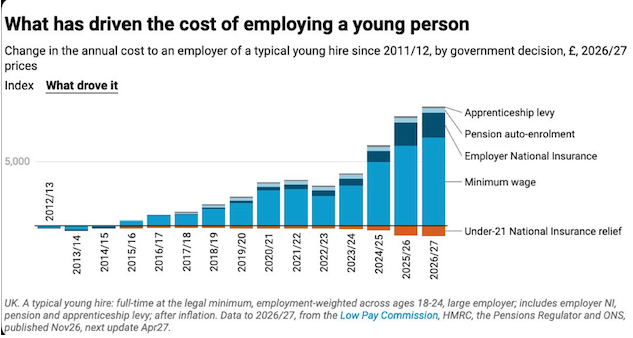
Let’s not forget… by April 2027, employing a 23-year-old on the minimum wage for a 37½-hour week will cost about £29,500 annually in wages, employer NI and minimum pension contributions…
… roughly twice the 2017 cash cost, before Employment Allowance relief.
We’ve been announcing youth employment schemes for nearly fifty years.
In 1978, Labour’s Albert Booth introduced the Youth Opportunities Programme.
In 1999, Blair ducked youth unemployment by sending half of young people to uni.
By 2000, he was offering the unemployed; personal advisers, training and subsidised employment.
There is plenty of experience to examine;
-
Which schemes created lasting jobs?
-
How much depended on a growing economy?
-
What happened when employers’ confidence weakened?
Dunno…
Training has enduring value. Young people need skills, experience and opportunities to demonstrate what they can do. They also need employers with real, actual work to offer.
There are things we can do now…
… hospitals purchase catering, cleaning, maintenance and much else. Councils, defence and other departments sustain enormous supply chains.
Where a public contract creates a dependable workload, it also creates an opportunity to train the people who will deliver it.
Put proportionate apprenticeship and youth employment commitments into suitable contracts.
Allow major suppliers to deliver through smaller subcontractors. Pay suppliers promptly and give them enough certainty to plan…
… check who starts, what they learn and whether they remain in paid employment.
Milburn proposes this. It deserves early attention because the work and the funding can be identified together... do it now.
His wider programme runs towards 2036, potentially across three parliaments, AI, redundancy, wars, techno-hacks and goodness knows what.
It asks departments, councils, colleges, employers and the NHS to sustain a shared undertaking through all these changing political and economic conditions.
…Sir John Harvey-Jones’s advice about concentrating only, on three things at once comes to mind. HMG has to find the bandwidth to…
-
Cut the waiting lists.
-
Increase defence spending.
-
Build homes.
-
Reform social care.
-
Tee-up the EU for round-two
-
Improve productivity.
-
Re-dis-organise the NHS, and...
... add a ten-year reconstruction of how government helps young people into work.
It ain’t gonna happen.
Ask employers what would give them confidence to open the door.
I’ll tell you; it’s still the economy, stupid.
A spotty nineteen-year-old will be a twenty-nine year old, married with two kids, by the end of Milburn’s programme.
Who will give them their first job, and…
... what will make that employer confident enough to do it?
|