DoM Monthly Newsletter – January/February 2024 | | |
|
DoM Annual Spring Party is Back!
We will start the day on June 18th with the virtual Awards Extravaganza and we will come together in the evening to celebrate at the Prince George!
| | | |
|
|
Dalhousie Clinical Faculty Census
The Faculty of Medicine is kicking off the Dalhousie Census campaign for clinical faculty members. Your participation in this census has a significant impact to our representation as a broader faculty.
Your information will be confidential.
| | |
|
Administrative Professionals Week - April 22-26
We would like to thank our admin teams for your hard work, dedication and commitment to our patients. You are the lifeline for the physicians you support by staying organized, planning ahead, coordinating and a hundred other amazing things to keep our divisions running smoothly. So on this day, and every day, we want you to know how deeply appreciated you are and we can't thank you enough for everything that you do!
| |
|
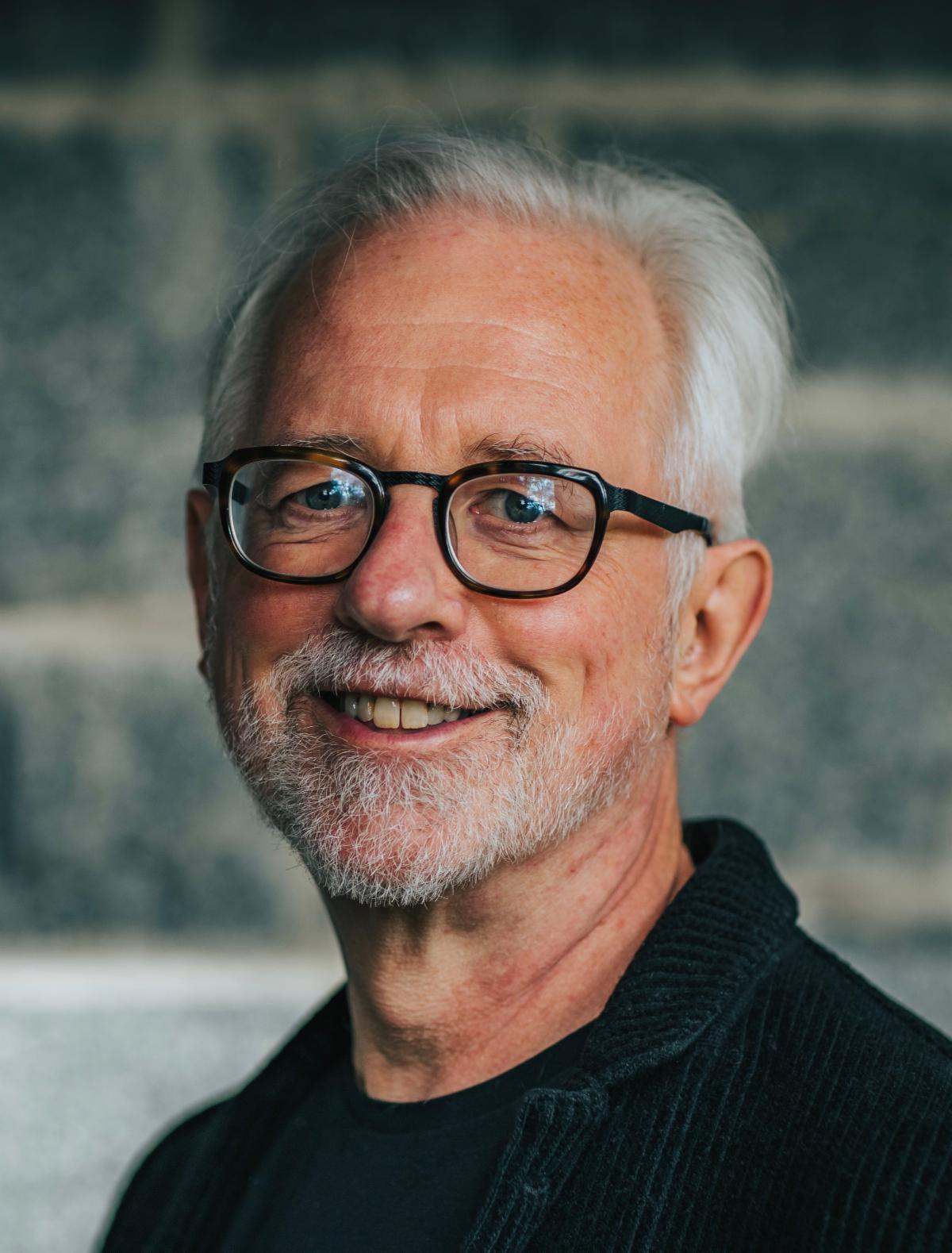
Please join us in congratulating Dr. Kenneth Rockwood for receiving the Canadian Society for Clinical Investigation’s (CSCI) Award for Clinician Scientist Lifetime Achievement. This award is given to a Canadian MD or PhD medical scientist who has made significant contributions to new knowledge and is generally recognized in their field as an expert, innovative, and at the forefront of research endeavours.
Dr. Rockwood, a professor of medicine in geriatric medicine and community health & epidemiology at Dalhousie University, is internationally recognized for his work. Dr. Rockwood’s Clinical Frailty Scale is used globally, and he has made a significant contribution to scientific literature with hundreds of peer-reviewed articles and contributions in leading medical research journals. Additionally, he is a Canadian Institutes of Health Research investigator and an active staff physician.
Dr. Rockwood will be presented with the award at the CSCI-CITAC Annual Joint Meeting 2024, which will be held in collaboration with the International Congress on Academic Medicine (ICAM) and the Association of Faculties of Medicine of Canada (AFMC). The in-person conference is scheduled to take place in Vancouver, British Columbia, from April 11th to 15th, 2024.
Congratulations Dr. Rockwood!
| |
|
|
Welcome to You
Amanda MacKay has assumed the role of the DoM Education Office Team Lead. Amanda came to NSH in November 2012 as the Program Admin for Medical Oncology. In March of 2019, Amanda took on the newly created Regional Education Coordinator role with the DoM Education Team. She will now lead the central DoM Education Coordinators that support our learners. Congratulations Amanda!
Melanie Horne, Secretary D, joined the Division of Rheumatology February 27, 2024 in a long term assignment
Naheen Quayyaim, Secretary D, joined the Division of Hematology April 2, 2024
Miranda Purcell, Secretary E Division Assistant, will join the Division of Rheumatology April 29, 2024
Kristin Zinck, Secretary E Division Assistant, will join the Division of PM&R May 27, 2024
Amanda Allen, Secretary F, will join the Division of Cardiology May 27, 2024
Jessica Power, Secretary D, will join the Division of Respirology May 6, 2024
Kharleigh-Wrae Ward, Secretary D, will join the Division of Cardiology June 14, 2024 in a long term assignment
Alannah Howell, Secretary E, Division of Dermatology March 11, 2024
Brenda Dunphy, Secretary E, Division of Endocrinology June 3, 2024
| |
|
On behalf of the DoM Awards & Recognition Committee
Department of Medicine Awards
Due: May 10
DEPARTMENT OF MEDICINE AWARDS
1. How do I make a nomination?
2. Letter templates are available
Go to:
https://medicine.dal.ca/departments/department-sites/medicine/for-faculty-staff/department-awards.html
How to make a nomination and get letter templates
FACULTY
- Brian M. Chandler Lifetime Achievement Award in Medical Education
- DoM Clinical Excellence Award
- DoM Excellence in Leadership Award
- DoM Excellence in Medical Education Award
- DoM Excellence in Quality & Innovation Award
RESIDENTS & FELLOWS
- DoM Outstanding Trainee Award
- Outstanding Resident Award
- Resident Research Excellence Awards
- Resident Research Publication Awards
STAFF
- DoM Excellence in Administration Award
Additional DoM Awards
There are also Department awards where the awardee is selected by a defined process, including:
- Academic Advisor of the Year Award in Core Internal Medicine
- Chief Medicine Resident - Halifax
- Chief Medicine Resident - Medicine Teaching Unit (MTU)
- Chief Medicine Resident - Saint John
- Division of General Internal Medicine Elizabeth Mann Resident Award
- DoM Grand Rounds Award of Merit
- DoM Grand Rounds Guest Speaker
- DoM Grand Rounds Overall Excellence Award
- DoM Research Lifetime Achievement Award
- Dr. I.M Szuler Award for Excellence in Undergraduate Internal Medicine
- Dr. Scott J. Murray Award
- Excellence in Summer Grand Rounds
- Excellence in Undergraduate Teaching
- Fastest EPA completion (Trigger finger award) Faculty – Halifax
- Fastest EPA completion (Trigger finger award) Faculty – Saint John
- Fastest EPA completion (Trigger finger award) Resident
- Highest Number EPA Completion Faculty – Halifax
- Highest Number EPA Completion Faculty – Saint John
- Highest Number EPA Completion Resident
- Medical Oncology Undergraduate Achievement Award
- Meritorious Service Award - 25 Year Service Award
- Outstanding Academic Performance Award - PGY1
- Outstanding Academic Performance Award - PGY2
- Outstanding Academic Performance Award - PGY3
- Stephen Couban Outstanding Faculty - Resident's Choice Award
Did you know?
You can view upcoming awards:
Document features:
- Awards from various organizations
- Awards categorized by type
- Web links for more information
- Award recipients
- Filters to quickly search content
Questions? Contact Domeducation@nshealth.ca
Share your award with the
DoM Awards & Recognition Committee
If you have received an award or are submitting a nomination on behalf of any member in the Department, please advise the DoM Awards & Recognition Committee by emailing domeducation@nshealth.ca.
Nominate today!
| |
2024-25 Departmental Application Deadlines
| |
|
The Department of Medicine is now accepting faculty applications for academic promotion to be considered in the 2024-25 academic year. The departmental deadline for application submission is May 31, 2024. Information about the application process will be distributed to faculty with continuing academic appointments via email – please contact Heather.Fraser@nshealth.ca if any questions about the process or application document requirements.
More information about promotions at Dalhousie University can be found at: https://medicine.dal.ca/for-faculty-staff/promotion_tenure.html
| |
We had a successful Core IM CaRMS match, filling our 23 seats as well as 2 Visa Trainees for our Halifax, NS Regional, Saint John and NB Regional sites. | |
Quality Day
Tuesday, May 28, 2024
Call for Submissions - Deadline: April 30th
Open to all DoM Faculty, Residents, Undergraduate Students, Graduate Students, Research Fellows/Staff and Allied Health Professionals.
The DoM Quality Improvement Steering Committee (QISC) invites you to submit an abstract for consideration for DoM Quality Day that will take place on Tuesday, May 28, 2024. The event will provide an exciting opportunity for DoM faculty/teams, including allied health professionals and residents/trainees, to showcase their Quality Improvement (QI) initiatives and share their project successes with other attendees. More details about the event will be shared in the coming weeks.
Please complete the attached Abstract Submission Form and return it to Theresa.Steele@nshealth.ca by April 30, 2023.
Late submissions will not be accepted.
There will be prizes awarded each for best presentation and best poster.
| |
|
Quality Improvement (QI) projects involve data measurement and systematic changes to processes in order to improve clinical care delivery, patient safety or quality of programs/services.
Examples:
- Developing a standardized order set to reduce catheter-associated line infections
- Determining guidelines adherence for the assessment of adrenal incidentalomas
- Reducing medication-related adverse events using a visual point-of-care education tool
- Improving access to endoscopy services using a telemedicine-based assessment
Links:
What is Quality Improvement in Healthcare? By Dr. Mike Evans. https://www.youtube.com/watch?v=jq52ZjMzqyI
IHI Seven Outstanding Student and Resident QI Projects. http://www.ihi.org/education/IHIOpenSchool/blogs/outstanding-student-and-resident-quality-improvement-projects
| |
|
Nova Scotia Health Quality Improvement
Need help deciding whether your project is Quality Improvement or Research?
The NS Health Quality Improvement & Safety Portfolio provides a navigation tool to help inform whether you require submission to the NS Health Research Ethics Board by evaluating your responses to a series of questions about your project.
NSH Quality Improvement and Research Navigation Tool
https://quality-improvement.nshealth.ca/surveys/?s=TRA34A8E8J
Quality Improvement 101 By Nova Scotia Health (5 min video)
https://stream2.nshealth.ca/2023/02-03-QI-101-Final/
| |
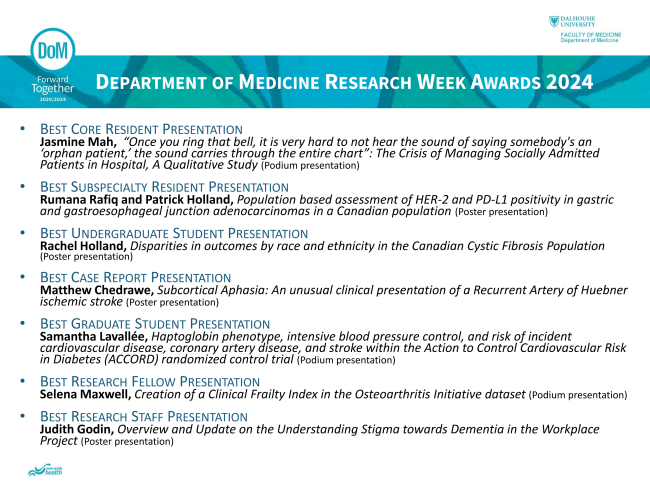
Research Week Award Winners
Thank you to everyone who participated!
| |
 | 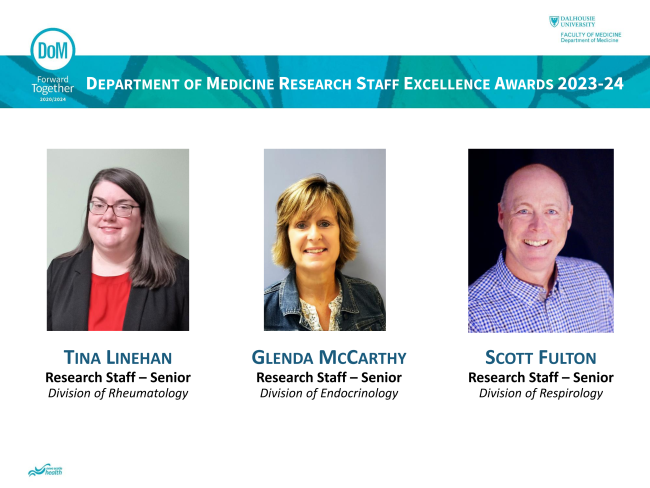 | |
Research Staff – Scott Fulton, Division of Respirology
Scott Fulton is a research coordinator working in the Respirology Clinic at the Queen Elizabeth II Health Sciences Centre. Scott trained as a Respiratory Therapist through the Queen Elizbeth II Health Sciences Centre Allied Health Services Program and began his career in research in 2001 at the IWK Health Centre. There he worked on a variety of pediatric respiratory clinical trials and the development of non-invasive measures of cardiac output and respiratory function in children. In 2003 he began work at his current position. He continues to work on a variety of clinical trials and investigator driven research with a focus on interstitial lung disease, COPD and community lung health.
Outside of work, Scott enjoys spending time with his wife and two children and coaching basketball and volleyball.
Research Staff – Tina Linehan, Division of Rheumatology
Tina was born and raised in Labrador City, NL. She graduated from Acadia University with a Bachelor of Arts (Political Science) and Dalhousie University with a Master of Public Administration. Tina started working with the Division of Rheumatology in July 2004 and has worked on numerous drug trials and investigator driven studies. She enjoys travelling, reading, podcasts and watching British tv shows.
Research Staff – Glenda McCarthy, Division of Endocrinology
Glenda graduated from Mount St. Vincent University in 1986. Her career started as an Office Manager in an Endocrinology Private Practice. Her role as Office Manager included working as a Research Coordinator and her first clinical trial was conducted in 1991. In 2001, Glenda was hired by Endocrinology Research at NSHA (formerly CDHA) and she remains there today. She is very proud to have been part of clinical trials that have brought life changing medications to market and studies that have led to standard of care changes across North America and beyond. Her role may have changed throughout the years - initially Research Coordinator, then Team Lead and now Research Manager but she remains involved in all aspects of Endocrinology’s clinical trials. As Research Manager, Glenda is proud to have been able to create a comprehensive set of Standard Operating Procedures that guide the practices in Endocrinology Research. Glenda believes that the Team approach to research is the key to their success!
| |
Study Participation Opportunity:Tele-POCUS | |
|
The Accelerated Remote Cardiopulmonary Tele-POCUS by Augmented Intelligence In COVID-19 Assessment (ARCTICA) study.
This study has two main parts:
Part A: learning POCUS skills via
· Virtual education models
· One online teaching session
· Practical tests on volunteers (friends and family members)
Part B. integrating acquired POCUS skills into routine patient care using the Reacts app and a Lumify device
· Obtain verbal consent from your patients to include a tele-pocus session with your usual physical exam.
· Conduct 6-10 tele-pocus consultation calls (minimum 3 for heart, 3 for lung) with a local POCUS expert who will provide assistance with image acquisition and diagnosis.
Read more
| |
|
Attention ALL Department Members:
Keep an eye on your email for the call for nominations to fill vacancies on our DoM Committees. Please consider nominating yourself or a colleague!
| |
|
Curiosity is one of the most powerful tools we can bring to bear on personal and professional conflicts. It can help us understand others, find creative and mutually beneficial solutions, and get to the root of our conflicts. It can also help us regulate our own emotions and stay calm during stressful situations.
Often, our first impulse in a conflict is to assume. This is compounded by the fact that people in conflict are not always transparent about what is driving their behaviour. (I often call this “concern laundering,” where a more palatable concern stands in for one that is difficult to express or own.) Adopting a curious stance in these moments helps us get to the crux of the matter. We can get curious on our own, and remind ourselves that our first question should always be “why would a reasonable, rational person do this?” We can also be curious in conversation, and ask questions before we make assertions. This can generate creative solutions that meet the underlying needs of all involved parties.
Curiosity is also very helpful internally. Sometimes, conflict can evoke shame or other negative feelings in a leader. We might wonder how we let things get to this point, worry that we lack the requisite skills, or perceive a threat to a core identity. If we can get curious about our own reactions and feelings, we can mitigate the impact of shame - as one psychiatrist told me, it’s almost impossible to feel shame and curiosity at the same time!
| |
|
We all have preferences as leaders, ways of leading others that come naturally and are comfortable to us. However, leadership is most effective when it is agile, and meets the needs of the situation and the follower.
One way of classifying situations and followers comes from the work of Paul Hersey and Ken Blanchard. Followers have a high or low degree of maturity (also called willingness or readiness), and situations are high or low task (this refers to the importance of the task in question). Effective leaders know the readiness of their followers, and can ascertain when tasks require close supervision, or if they are more suitable for delegation.
This results in four distinct styles. Directive situations are suited for high task and low relationship situations; these followers often lack the skills they need to succeed, so they need to be told exactly how to proceed and will require feedback. Coaching situations are high task and high relationship; these followers are often eager, but need relational support to develop even further. Supporting situations are low task and high relationship; the follower has all the skills they need to succeed, but lacks confidence. Lastly, delegating situations are low task and low behaviour; often relationships are firmly established and don’t require attention, and the followers have the skills and mindset required to succeed.
Often, leaders tend to over rely on one or two styles and so don’t always match the situation in question. But if a person can handle delegation and receives direction, they may feel micromanaged; if someone who needs direction is coached, they miss out on a critical learning opportunity. And importantly, matching your style to the situation in question is the most efficient way to lead.
| |
|
QUICK REFERENCE /
RECURRING CONTENT
| |
Mental Health & Well-Being | |
When you take care of yourself, you take care of others. | | | | |