NOTE: For those who are not NHC members, we have extended access to our Member Brief for a limited time. If you’re not a member and would like to continue receiving our Member Brief, as well as other NHC member benefits, please click here to join today. | | Weekly update from the National Housing Conference | | News from Washington | By Brittany Webb | | |
Housing coalition calls for release of $1B funds
A dozen community development organizations sent a letter asking for the release of over $1 billion of funding for housing sitting in available funds. The coalition penned the letter to National Economic Council Director Kevin Hassett, noting that the funding has already been appropriated for the Community Development Financial Institutions (CDFI) Fund, the Capital Magnet Fund, and the Emergency Capital Investment Program. The letter emphasizes the vital role that CDFIs play in the overall housing and community development landscape, filling in funding gaps that conventional markets cannot reach and generating $12 of investment for every dollar spent. The Fund has faced significant challenges under the Trump Administration, which first sought to eliminate it entirely, but was quickly defended by bipartisan housing groups and members of Congress.
The funds currently sitting stagnant could build or rehabilitate an estimated 100,000 homes, according to the housing groups writing the latest letter asking for the funds to be released.
“While everyone is trying to find solutions to high housing costs, there are $1 billion sitting at Treasury waiting to be deployed that would help with this national issue,” said Sarah Brundage, NAAHL President and CEO. “One easy and noncontroversial action the Administration could take today to have an impact on affordable housing is to release the $1 billion held up at the CDFI Fund so that CDFIs and developers can get to work building and preserving affordable housing in communities nationwide as intended by Congress.”
| | | |
FHFA updates insurance requirements for condos
The Federal Housing Finance Agency (FHFA) announced that it is simplifying its insurance guidelines for condominiums backed by Fannie Mae and Freddie Mac (the Enterprises), looking to promote affordability as many insurance rates climb. The change retires a previous requirement for roofs of condo buildings to be insured at full replacement cost value, allowing less strict cash value coverage for condos of certain sizes. It also caps the maximum deductible for master property insurance of condos at $50,000. According to FHFA, the changes provide an appropriate balance of risks and costs for buildings.
“Lower insurance costs and mortgage rates shrink the monthly payment of a new mortgage, giving new homebuyers confidence that they can afford the American dream,” said FHFA Director William Pulte.
The changes were applauded by lenders, with some caveats. The Mortgage Bankers Association and the Community Home Lenders of America expressed support of the specific roof fix, but noted concerns about other parts of the guidelines that impose project review requirements and higher replacement reserve requirement for capital expenditures. Guidelines from Fannie Mae and Freddie Mac were updated to reflect the changes.
| | | |
Senior HUD Officials to Address Attendees
On April 8, NHC will host its Solutions for Housing Communications convening at the National Press Club in Washington, DC.
Federal Housing Commissioner and HUD Assistant Secretary for Housing Frank Cassidy, along with HUD Assistant Secretary for Fair Housing and Equal Opportunity Craig Trainor, will join NHC President and CEO David Dworkin for separate fireside chats focused on distinct topics.
Commissioner Cassidy’s conversation will explore federal housing policy affecting single-family, multifamily, and manufactured housing, and highlight actions the Federal Housing Administration is taking to address current housing challenges. Assistant Secretary Trainor’s discussion will discuss America’s civil rights legacy as the nation approaches its 250th anniversary, as well as the Administration’s current priorities for fair housing and civil rights enforcement.
| | |
Federal Housing Commissioner and
HUD Assistant Secretary for Housing
Frank Cassidy
| | |
HUD Assistant Secretary
for Fair Housing and Equal Opportunity
Craig Trainor
| | |
Sponsorships Available
Elevate your organization's profile and actively participate in the conversations that are shaping the future of housing by sponsoring NHC’s Solutions for Housing Communications convening. We offer sponsorship levels tailored to fit every organization’s needs, starting at $1,000. Click here to learn more.
| | |
Attorneys general sue HUD over fair housing
A coalition of 16 attorneys general filed suit against the U.S. Department of Housing and Urban Development (HUD), challenging recent federal guidance that significantly weakens fair housing enforcement across the country. The lawsuit, filed in the U.S. District Court for the Northern District of California, opposes HUD guidance issued in September 2025 that seeks to decertify state and local agencies participating in the Fair Housing Assistance Program (FHAP) if they enforce housing protections beyond the federal baseline, threatening both funding and ability to refer complaints. The attorneys general allege the guidance violates the Administrative Procedure Act and the U.S. Constitution, noting that the federal law establishes a floor, not a ceiling, for protected classes. The Fair Housing Act, enacted in 1968, prohibits discrimination based on race, color, national origin, religion, sex, familial status, and disability—but states and localities often adopt additional protected classes such as gender identity, veteran status, and source of income.
“HUD is attempting to impose vague, ideologically motivated and unlawful conditions on program funding,” said Illinois Attorney General Kwame Raoul. “If these actions are left unchallenged, discrimination in housing is almost certain to increase.”
HUD Secretary Scott Turner responded sharply on social media stating, “Leftist state attorneys general have run to a San Francisco courthouse in a desperate attempt to obstruct President Trump’s America First Agenda through political lawfare. (...) As Secretary, I will continue enforcing the Fair Housing Act as written and intended. That is to ensure equal rights under the law, not extra rights for politically favored groups.”
HUD has gutted its own enforcement apparatus, firing the whistleblowers who warned the public of lack of enforcement at HUD.
| |
Banking regulators issue Basel III proposal
The Federal Reserve Board (the Fed), Federal Deposit Insurance Corporation (FDIC), and the Office of the Comptroller of the Currency (OCC) announced three new proposals to update bank regulatory frameworks, including Basel III, global systemically important banking organizations (GSIBs), and the U.S. standardized approach. In a Board Memo and fact sheet, the agencies outlined the specifics of the proposals. The Basel III changes would simplify the risk-based capital framework for Category I and II depository institutions, applying a single set of risk-based capital calculations, the “expanded risk-based approach,” compared to the two they are currently required to calculate.
The GSIB surcharge proposal would revise the calculation of the capital buffer requirement for GSIBs, seeking to better measure systemic risk. Finally, the standardized approach proposal would modify the U.S. standardized approach in the capital rule, which applies to most U.S. banks, seeking to improve calibration and risk sensitivity.
In the Board Memo, the Fed argued that “Both the Basel III and the standardized approach proposals would increase banks’ incentive to engage in mortgage origination and servicing by increasing the risk-sensitivity of requirements associated with residential mortgages, including by removing the capital deduction for certain mortgage servicing assets.”
“Together, these changes would strengthen our overall capital framework, which would remain robust under the new regime,” said Michelle Bowman, the Fed’s vice chair for supervision. “An important benefit of these proposals is that they would reduce incentives for traditional lending activities — like mortgage origination, mortgage servicing, and lending to businesses — to migrate outside of the regulated banking sector.”
Comments on the proposals are due by June 18.
| |
FOMC maintains current rate, Powell probe momentarily halted
The Federal Open Markets Committee (FOMC) voted to maintain the current target federal funds rate at 3.5-3.75%. The release notes that the decision was made based upon low job gains, inflation being slightly elevated, and further economic uncertainty due to conflict in the Middle East. Stephen Miran was the only governor to vote against the decision, preferring to lower rates by a quarter point.
"In the near term, higher energy prices will push up overall inflation, but it is too soon to know the scope and duration of the potential effects on the economy," Fed Chair Jerome Powell said during a press conference
Meanwhile, the probe investigating Powell was momentarily halted by a federal judge who cited a lack of evidence to support the case. The case centers around the rehabilitation of the Federal Reserve headquarters in D.C., which has experienced cost overruns. Powell has been repeatedly pressured by the Trump administration to lower the target federal funds rate.
Chief U.S. District Judge James Boasberg rejected subpoenas issued to the bank. “There is abundant evidence that the subpoenas’ dominant (if not sole) purpose is to harass and pressure Powell either to yield to the President or to resign and make way for a Fed Chair who will,” Judge Boasberg wrote. “The Government has offered no evidence whatsoever that Powell committed any crime other than displeasing the President.”
U.S Attorney for D.C. Jeanine Pirro painted the decision as arbitrary and undermining, and plans to appeal. The investigation into Powell further sparked pushback from members of Congress, including Senator Thom Tillis (R-N.C.), who stated he would not confirm a new Fed Chair at the end of Powell’s term until the investigation is resolved.
| | | |
HUD headquarters move scrutinized
The Government Accountability Office is proceeding with its review of HUD’s intended move out of Washington, D.C., even as employees are beginning to be relocated. HUD announced it was relocating its 3,000 employees out of its headquarters at the Robert C. Weaver building in 2025, citing extensive repairs needed to Weaver as justification for the move. HUD reported an estimated cost of $609 million in deferred maintenance needed for the D.C. headquarters. The agency now has estimated its intended move to the National Science Foundation building in Virginia to cost $70 million.
The relocation from the capital faced challenges both from the American Federation of Government Employees representing HUD employees and legality concerns cited by lawmakers. HUD and Ginnie Mae are required by statute to have their principal offices in the District, prompting HUD to place some employees in another office space located within the city in order to comply. Union leaders have expressed serious concern over proper authorities and oversight, while HUD has argued that the expedited move saves taxpayers hundreds of millions of dollars.
| |  | |
Dumais to head SAHF
Theresa Finney Dumais will take over as President and CEO of Stewards of Affordable Housing for the Future (SAHF), beginning her tenure on March 23. Dumais most recently served as Vice President of Government & Industry Relations at Freddie Mac, and brings two decades of housing experience ranging from program implementation to strategic guidance. She was unanimously chosen by SAHF’s Board of Directors.
“At a time when housing is at the forefront of national policy discussions, SAHF’s voice has never been more important,” said Dumais. “I have long admired the organization’s leadership in advancing housing supply, preservation, sustainability, and resident service solutions across the country, and I am honored to step into this exciting role. I look forward to working alongside our extremely talented members, staff, and partners to protect long-term affordability and expand access to quality, affordable homes nationwide.”
| | | |
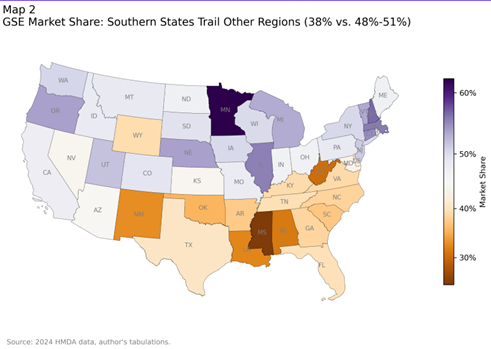
GSE market share is lowest in the South
The Center for Mortgage Access’s GSE Market Share Report reveals stark regional disparities in government-sponsored enterprises’ participation in home purchase mortgages. The figure below shades U.S. states by GSE percent market share—dark orange for the lowest shares (mid-20s) and dark purple for the highest (above 60). Southern states average just 38%, a gap that the HOPE Policy Institute has linked to high denial rates, secondary market barriers, and credit challenges for many borrowers across the broader southern region. The region in the West averages 48%, and the Northeast and Midwest each average 51%. The lowest-share states cluster in the Deep South: Mississippi, West Virginia, Alabama, Louisiana, and New Mexico rank at the bottom, while Minnesota, Oregon, and much of New England rank at the top.
| | |
The Furman Center published a new land use reform tracker cataloging state and local policy changes aimed at easing housing production barriers, such as allowing accessory dwelling units, duplexes, and multifamily construction in single-family zones. It tracks over hundreds of reforms since 2019 across dozens of states, highlighting a wave of upzoning to boost supply in high-cost metros like California, Oregon, Maine, and Montana. The tool is accompanied by a resource library showing actions across states to address housing supply.
An NPR segment reports that both Congress and President Trump are promising action on housing affordability but are advancing distinct strategies to get there. The discussion explains that lawmakers on Capitol Hill are emphasizing measures shaped by their views on supply constraints, regional market pressures, and budget trade-offs, while the administration is leaning into its own preferred mix of federal incentives and regulatory changes. The piece underscores that these divergent approaches could produce significantly different outcomes for renters and homeowners depending on where they live and how exposed they are to rising housing costs.
The Asset Builders Alliance white paper Building Financial Assets for Residents in LIHTC Communities argues that LIHTC’s scale in a major, underused platform to help more than 3 million renter households—disproportionately renters of color—turn ongoing rent payments into assets and financial resilience. It presents six modeled scenarios, based on stakeholder interviews and financial analysis, showing residents can build roughly $2,000-$6,000 in savings over five years through rent-based incentives, bonuses, and capitalized reserves, with success driven by trusted, transparent, resident-centered program design rather than any single funding source. The paper urges HFAs and owners to launch pilots using existing tools, adopt a flexible menu of models, leverage technology to cut administrative burden, and align policy across levels of government so asset-building can scale across LIHTC properties.
A blog post from Urban Institute addresses how recent housing legislation could dissuade investors from building rental housing. While policymakers have targeted institutional investors as a key driver of high housing costs, they represent a small share of the market and are not a primary cause of rising prices. The legislation restricts large investors’ ability to acquire additional homes, steering them away from the build-to-rent model due to costly requirements to sell properties after several years. As a result, the bill could reduce annual rental housing production by an estimated 72,000 units and undermine some of its broader supply-expansion goals.
| | |
Monday, March 23
The Future of Fannie Mae and Freddie Mac | AEI, 4:30 PM – 6:30 PM ET
2026 National Community Investment Conference - San Francisco Fed, March 23-March 26
Tuesday, March 24
Advocate 2026 | National Apartment Association, March 24-March 25
Wednesday, March 25
Introduction to the 515 Process and Application | 2026 Rural Rental Housing Preservation Academy, 11:00 AM – 12:30 PM MT
Thursday, March 26
The Flip Side of Affordability: Raising Wages Across the Country | Center for American Progress, 2:00 PM – 3:00 PM ET
Friday, March 27
Basel III Endgame Re-Proposal Update | MBA, 12:00 PM – 1:00 PM ET
| | The National Housing Conference is a diverse continuum of affordable housing stakeholders that convene and collaborate through dialogue, advocacy, research, and education, to develop equitable solutions that serve our common interest. | | Defending Our American Home since 1931 | | Copyright © 2024. All Rights Reserved. | | | | |