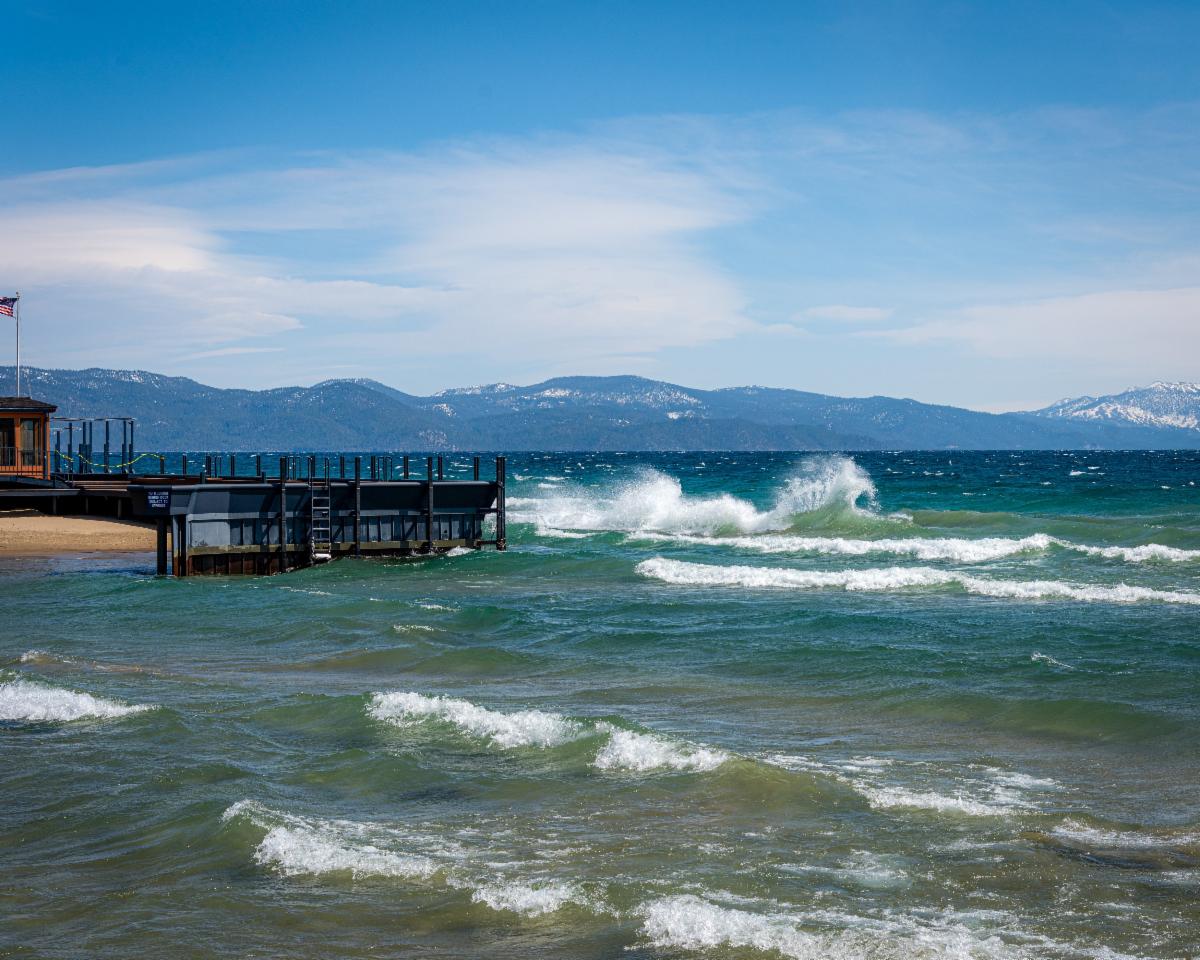
Along with the bliss of being on Lake Tahoe during a hot summer’s day, there are potential hidden dangers lurking. You are probably aware of the fickle weather in the mountains, where conditions can change quickly and present a hazard to the unprepared. But there are other, lesser known dangers, that can also place a swimmer, paddleboarder, or boater in jeopardy.
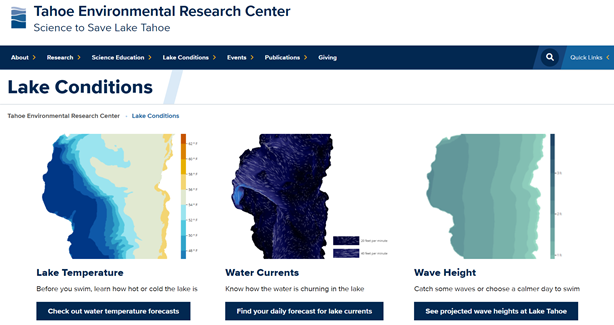
This week, UC Davis TERC launched a new online Lake Conditions tool to provide real-time and projected information for water temperatures, wave heights, and water currents. This tool is a website that directly links TERC’s measurement stations to a smartphone or computer and provides forecasts across the lake for up to three days into the future.
|
|
The real-time data come from TERC’s Nearshore Network of stations located along the shoreline all around the lake. These stations are funded and supported by TERC donors, lakeshore property owners, and the Lahontan Regional Water Quality Control Board. The stations have provided valuable research data for the last eight years and are providing lake users with the most current, up-to-the-minute lake conditions information. Water temperature data from the middle of the lake are also provided from research buoys operated in partnership with the NASA Jet Propulsion Laboratory. |
|
The forecast conditions are from computer models developed by TERC researchers. The model for lake temperatures and currents is a complex three-dimensional model that TERC has used on many lakes around the world to better understand complex motions and water quality challenges. Another model, first developed by the U.S. Army Corps of Engineers, was adapted to forecast the wave heights across Lake Tahoe.
What are the special hazards to be aware of at Lake Tahoe?
|
|
|
During strong, persistent winds the lake may experience an “upwelling.” This is when cold, water from deep in the lake rise on the upwind side of the lake, while the warm surface water is pushed downwind. Fortunately, during such windy and rough conditions, very few people venture out on the lake. The real danger comes after the wind subsides and people get back in the water. Because the lake is so massive, the cold upwelled water can remain at the surface for several days before returning to the lake bottom. This may come as an unwelcome and dangerous surprise to people expecting normal summer conditions when diving off a boat. To make matters worse, very strong currents are often generated as the lake returns to its initial state.
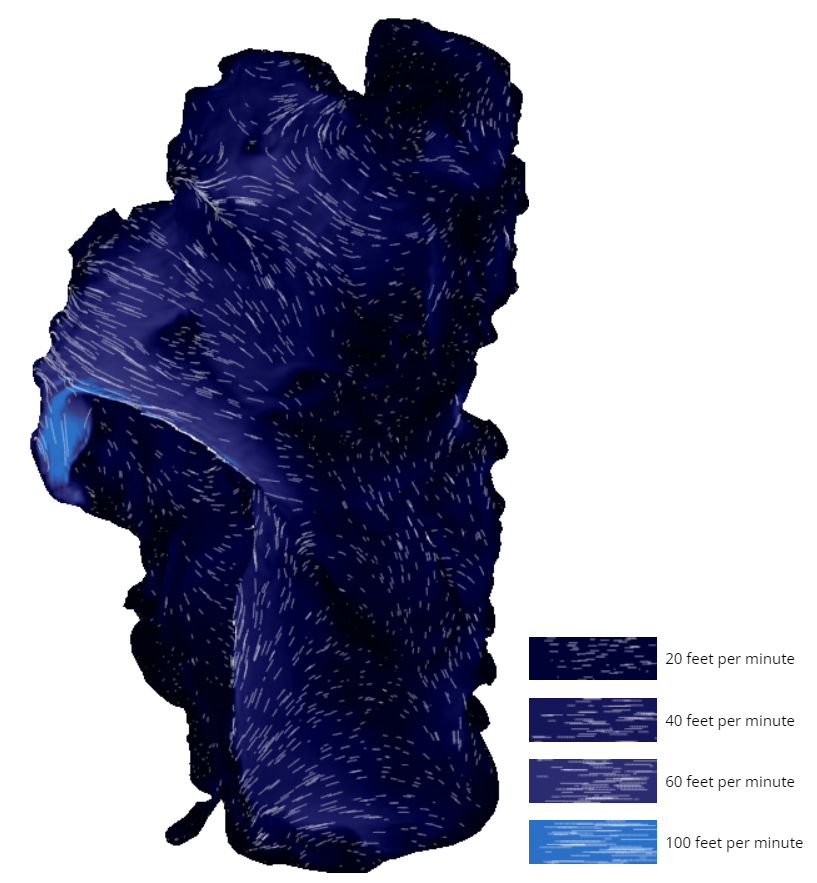
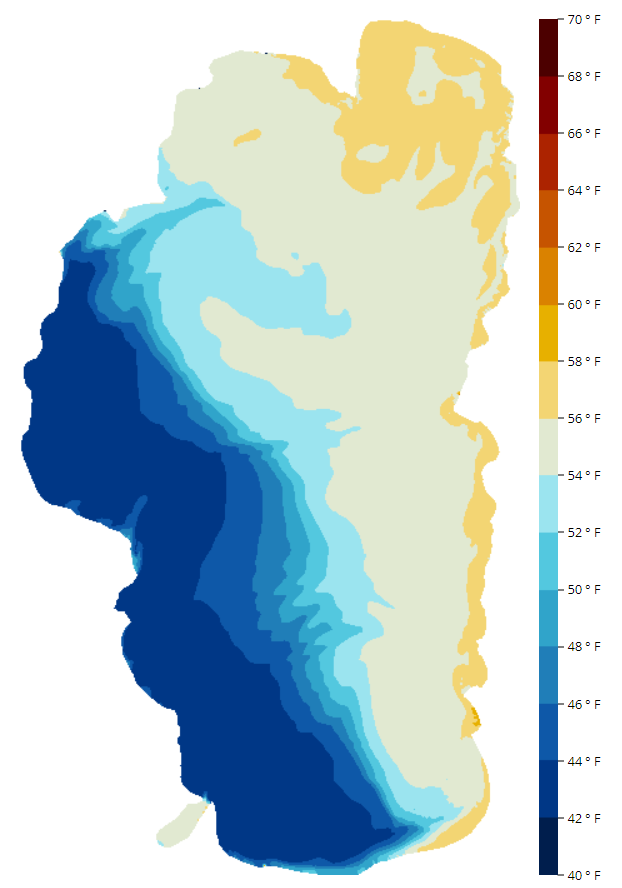
The images below show what can happen. The map on the right shows the modeled surface water temperature under calm conditions shortly after an upwelling event. While most of the lake is a brisk 55 oF, the water in the southwest quadrant is a dangerous 42 oF. At that temperature, a person in the water could lose dexterity in minutes and lapse into unconsciousness in less than 30 minutes. The map on the left shows the corresponding surface current patterns. The lightest blue coloration indicates currents of over 1 mph. That may not seem very fast, but imagine falling off a paddleboard into 42 oF water and, while trying to catch your breath, you notice your paddleboard being carried away at 2 feet per second.
|
|
High velocity (>0.7 mph) jets and cold (<42 °F) water
temperatures following an upwelling event in Lake Tahoe.
Figures provided by Sergio Valbuena
|
|
For future predictions, TERC’s new online tool utilizes National Weather Service forecasts as an input to the 3-D model and the wave model. Checking these forecast conditions before you venture out could save your life or at least, make you better prepared. So could wearing suitable protective gear. It is always good to know what to expect before you venture out, so be sure to check out the new site at https://tahoe.ucdavis.edu/lake-conditions.
|
|
An incredible team of UC Davis Computer Science students comprising Sam Maksimovitch, Julian Nguyen, Suryakiran Santhosh, and Simperpal Whala, created this life-saving resource as part of a two-quarter project with TERC. The models were developed by TERC graduate student Sergio Valbuena and alum Dr. Patricio Moreno. Heather Segale helped coordinate the project, and Dean Bunn and Brian Donnelly from the UC Davis College of Engineering assisted with IT infrastructure. It was a true team effort.
The funding for developing the website was generously provided by the Tahoe Fund.
Enjoy the summer at Lake Tahoe safely!
|
|
Share this story on Facebook or Twitter:
|
|
|
|
|
|
|