Strategic Planning Corporation
Weekly Economic Update
| | |
This past weekend we completed our two presentations of "The Next Crash Is Coming!" We had two good groups of folks join us and they also asked some really good questions that gave opportunity for understanding more of how markets work and how to work markets.
And the key points that I hope most everyone came away with are:
- It never pays to panic in life - about anything!
- Time in the market is worth more than timing the market
- And, just like it makes no sense to jump out of a perfectly good airplane when you run into severe turbulence, it makes no sense to jump out and in of the market when there is financial turbulence to deal with
Part of what we do at Strategic Planning Corporation is help people put together prudent portfolio mixes of stock and bond funds (ETFs) so they can participate in the returns that may be available for investors in the financial markets. What we can't do is guarantee any sort of result. We can look at historical gains and losses of markets over time and get some sense of how they perform, but how they will act in the future is not in our skill set. In fact, it isn't in anyone's skill set!
So since it isn't possible to predict how markets will respond to the myriad of stimuli that assault it everyday, we don't try to position you to gain on every whim of a market move. We work to help you determine the range of returns that you would like to earn, and most importantly, the level of volatility that will allow you to rest easy and stay invested through the good times and the bad times as appropriate for your circumstances. Keep in mind that investing involves risk, including the possible loss of principal, and actual results may differ from expectations.
And that really leads to what we aim to do for our clients. Yes, we prepare income tax returns and coach our clients on how to best position themselves to potentially maximize their income and reduce their tax burden. Yes, we help clients analyze their family's need for protection with insurance or self-insurance in the event of an untimely death, disability, extended care situation, or property loss. We look at cash flow and debt and help you develop a track to run on to accumulate the funds you need to meet your goals at retirement and all along the way with things like housing, education, travel, etc.
We even help you if you run into a scam that seems ready to overrun you and create havoc in your life! But what we really do most is coach you to do what's prudent for your circumstances. Going back to that first point that we hope everyone came away with from our latest workshops, we coach you to stay calm and avoid panic! Irrational behaviors resulting from a panic over something, particularly something you can't control like the market's performance, often derail a financial plan for a family and it can be devastating or at least painful from which to recover.
So when you think about what you can get most from a financial advisory relationship, think about the coaching aspect of helping you make decisions all along the way, even to the point of how you want your affairs handled if you were to become incapacitated and when you leave this earth. Like we say, we want to be your trusted financial partner that you can call on at any time for help. We so enjoy working with all our clients and look forward to helping even more people over the coming years and decades of providing financial counsel and service.
When you think about who you're gonna call - it's not Ghost Busters! Call us and we'll come a runnin'!
Enjoy the rest of this week's read.
| | Want to access our Podcast for current and past episodes? You can use this QR Code to go to the website where you can find the full archive of all podcasts beginning with the most recent to oldest. Enjoy! | | |
Weekly Economic Update
for the Week of
October 19, 2026
Quote of the Week:
"To love anything good at any cost is a bargain."
~ Wendell Berry
| | |
The Week in Brief
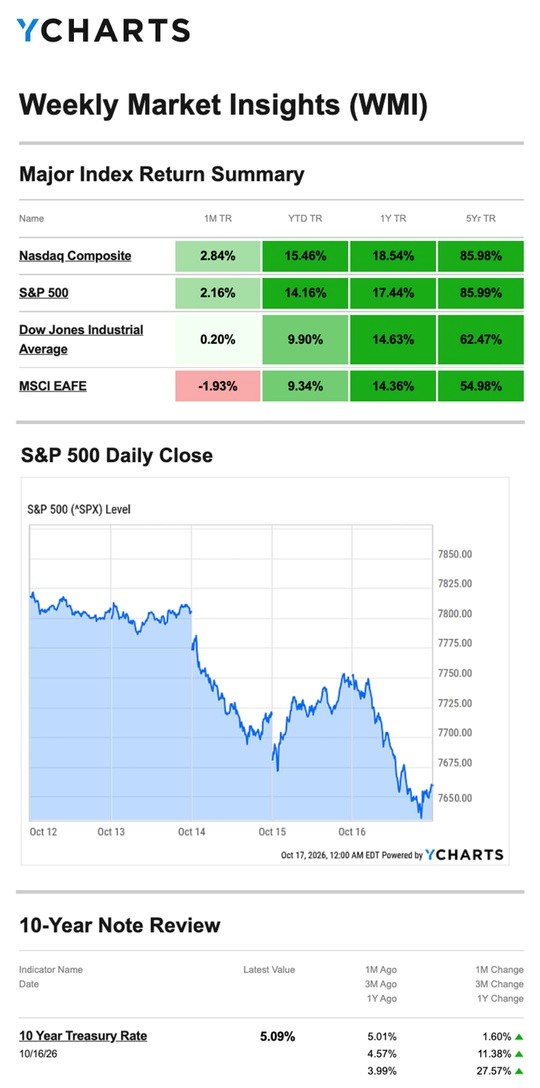
Stocks were under pressure last week as corporate earnings results, rising oil prices, and AI valuation anxieties unsettled investors.
The Standard & Poor’s 500 Index lost 1.95 percent, while the Nasdaq Composite Index declined 4.48 percent. By contrast, the Dow Jones Industrial Average gained 0.67 percent. The MSCI EAFE Index, which tracks developed overseas stock markets, rose 0.96 percent.1,2
Tough Week for Tech
Markets traded in a tight range over the first two days of the week as investors awaited a slew of Q3 corporate earnings results, mostly from big financial services companies, later in the week. That first batch of earnings announcements came in Tuesday, with mostly strong results, but high investor expectations kept markets from moving much.3
Then midweek, investors appeared to rotate out of AI names as they digested a warm retail inflation report. Those two factors shifted sentiment, and stocks trended lower. However, the Dow Industrials proved more defensive, ending the session essentially flat.4
On Thursday, AI stocks were under pressure again as investors appeared to favor more value-oriented names.5
As the week wrapped up, oil prices rose to their highest level since May, while sellers targeted AI- and tech-related names. The Nasdaq found some support at the close but still had its worst week since June.6
| | Source: YCharts.com, October 17, 2026. Weekly performance is measured from Monday, October 12 to Friday, October 16. TR = total return for the index, which includes any dividends as well as any other cash distributions during the period. Treasury note yield is expressed in basis points. | |
Inflation Jitters
Fresh retail and wholesale inflation reports were out last week. Both came in hotter than expected, which put the spotlight on the Fed’s meeting in late October.
The Consumer Price Index report, out Wednesday, showed inflation rose 3.7 percent in September, higher than the 3.6 percent economists expected. And Thursday’s Producer Price Index report showed wholesale inflation hit 6.6 percent year over year—the highest level in four years.7,8
This Week: Key Economic Data
Monday: NAHB Housing Market Index.
Tuesday: Housing Starts. Pending Home Sales.
Thursday: Weekly Jobless Claims. Leading Indicators. Kansas City Fed Survey.
Friday: Purchasing Managers’ Index (PMI)—Manufacturing. PMI—Services. U. Michigan Consumer Sentiment Survey (final).
Source: Investor’s Business Daily - Econoday economic calendar: October 16, 2026.
The Econoday economic calendar lists upcoming U.S. economic data releases (including key economic indicators), Federal Reserve policy meetings, and speaking engagements of Federal Reserve officials. The content is developed from sources believed to provide accurate information. The forecasts or forward-looking statements are based on assumptions and may not materialize. The forecasts are also subject to revision.
This Week: Companies Reporting Earnings
Tuesday: GE Aerospace (GE), Netflix, Inc. (NFLX), RTX Corporation (RTX), Intuitive Surgical, Inc. (ISRG), Capital One Financial Corporation (COF), 3M Company (MMM), General Motors Company (GM), Northrop Grumman Corporation (NOC)
Wednesday: Meta Platforms, Inc. (META), Tesla, Inc. (TSLA), Lam Research Corporation (LRCX), Philip Morris International. (PM), Texas Instruments Incorporated (TXN), International Business Machines Corporation (IBM), Abbott Laboratories (ABT), NextEra Energy (NEE), AT&T Inc. (T), CME Group Inc. (CME)
Thursday: The Procter & Gamble Company (PG), Union Pacific Corporation (UNP), Western Digital Corporation (WDC), Valero Energy Corporation (VLO), Lockheed Martin Corporation (LMT), Newmont Corporation (NEM), Spotify Technology (SPOT)
Friday: American Express Company (AXP)
Source: Zacks, October 16, 2026. Companies mentioned are for informational purposes only. It should not be considered a solicitation for the purchase or sale of the securities. Investing involves risks, and investment decisions should be based on your goals, time horizon, and risk tolerance. The return and principal value of investments will fluctuate as market conditions change. When sold, investments may be worth more or less than their original cost. Companies may reschedule their earnings reports without notice.
| | |
FEATURE ARTICLE
Why Shooting for the Moon Will Likely
Lead to Below Average Results
Investor Minute
| | |
You've probably heard the quote, "Shoot for the moon. Even if you miss, you'll land among the stars."1 It's from Norman Vincent Peale, one of the most famous proponents of the power of positive thinking. The underlying idea is that you should set an extremely ambitious goal and then if you don't reach it, you'll still do very well.
But, as uplifting as this strategy sounds, it's usually not true. Research has shown that setting the bar for success unreasonably high most often results in below average performance.
The idea for exploring how extremely high goal setting affects outcomes came to economist Matt Burgess when he saw previous research on the efficiency of commercial fishing fleets. This earlier work found that fisheries performed best when boats stopped searching for fish once they reached higher-than-average catches.2
Burgess and his team looked at a wide range of scenarios, from starting a business to landing a job to hunting for a house. They found that optimal satisfaction came from setting the bar above average, but not excessively so. In fact, those who were overambitious fared worse on average than those who were under ambitious by the same margin.
For example, a baseball batter who swings for the fences on every pitch is likely to do worse (and be less satisfied) than a batter of equal ability whose goal is to simply get on base.
The researchers further found that social media is a significant factor in people setting their goals impractically high. The problem is that everyone tends to post only their greatest successes (many of which are unverifiable or easily emblished), which can distort your view of what constitutes normal.
The findings emphasize the importance of knowing the full range of possibilities, not just those bragged about on social media.
You've probably already realized how this insight could apply to saving and investing for retirement. Over the long-term, someone who is satisfied with good but realistic returns will do much better and be generally more content than someone who’s constantly chasing the next big thing.
In fact, research has shown that if your performance is on par with the S&P 500, you are already doing better than average. This is because the short-term behavior of the typical investor causes him or her to underperform the broad indexes.3
The idea is not to settle for less because that's the easiest thing to do. But rather to pursue a realistic goal where you can identify and reach all the steps needed to accomplish it. Just dreaming big and hoping it happens isn't an actionable plan. Swinging for the fences with your risk capital is speculating, not disciplined investing.
Knowing this, your trusted advisor starts with your life goals and circumstances and builds a financial plan that will help allow you to navigate along your unique path. By following it you are better equipped to achieve financial health today as well as a fully funded retirement tomorrow.
Sources:
1. https://www.goodreads.com/quotes/4324-shoot-for-the-moon-even-if-you-miss-you-ll-land
2. https://www.theguardian.com/science/2026/may/29/dont-shoot-for-the-moon-aiming-for-above-average-is-key-to-success-maths-suggests
3. https://www.forbes.com/sites/wesmoss/2026/01/27/how-the-average-investors-returns-compare-to-the-market
| | |
Weekly Tip
A thought to consider!
Eat the Rainbow, Reap the Benefits
One of the easiest ways to ensure a well-rounded diet is to think in terms of colors. Different colored foods contain different nutrients, and eating a wide variety means your body gets more of what it needs. Here's a quick guide:
- Red foods: contain lycopene, a powerful antioxidant linked to heart health and reduced cancer risk.
- Orange and yellow foods: rich in carotenoids, which support healthy eyes and mucous membranes.
- Green foods: offer anti-cancer compounds and are an excellent source of folate.
- Blue and purple foods: contain anthocyanins, antioxidants that may help protect cells and reduce the risk of stroke and heart disease.
- White foods: are known for antiviral and antibacterial properties, and many, like bananas, are a great source of potassium.
Tip adapted from HealthLine.com9
What to Look for on a Nutrition Label
Nutrition labels contain helpful information that can guide you toward healthier eating. But do you know how to read one correctly? The serving size is the first thing you will see on a nutrition label; this shows how many calories a serving contains.
The following section is the nutrients. This section helps you determine a food's nutritional value. Pay close attention to saturated fat and added sugar. Lastly, you have the % Daily Value (DV), the percentage of each nutrient in a single serving relative to the recommended amount.
Tip adapted from Heart.org10
| | |
Riddle of the Week:
No matter how little or how much you use me, you change your view of me every month. What am I?
Last Week's Riddle:
I’m tall when I’m young and short when I’m old, usually indoors and sometimes on fire. What am I?
Last Week's Answer:
A candle.
| | |
Thank you for reading this newsletter. We want to be the financial partner you need . . . the financial partner you can trust. Call on us at (336) 668.4338 for anything we can do to help you.
Please feel free to forward this article to family, friends, or colleagues. You may use the "Forward email" link at the bottom of this page. If you would like us to add them to the list, please reply to us with their address and we will contact them and ask for their permission to be added. Thank you.
Sincerely,
R. Michael Flanders, CLU, CFP®
Certified Financial Planner™professional
Strategic Planning Corporation
mike@SPCinvesting.com
www.SPCinvesting.com
(336) 668-4338
| | |
Blueprint Financial Advisors (“Blueprint”) d/b/a Strategic Planning Corporation is an investment adviser registered under the Investment Advisers Act of 1940. Please note any trade orders received via email or voicemail cannot be honored. Any disclosed data was obtained from third parties deemed by us to be reliable. Nonetheless, we have not verified the results and cannot be assured of their accuracy. This message (including any attachments) is confidential and may be privileged. If you have received it by mistake please notify the sender by return email and delete this message from your system immediately. Any unauthorized use or dissemination of this message in whole or in part is strictly prohibited. Please note that emails are susceptible to change. Electronic communications through Blueprint Financial Advisors systems are the property of Blueprint Financial Advisors. Blueprint Financial Advisors LLC reserves the right to monitor, audit, record or otherwise retain electronic communications at any time for appropriate business usage, standards and compliance with applicable laws and regulations. Anything in this email should not be viewed as investment advice.
All expressions of opinion reflect the judgment of the authors as of the date of publication and are subject to change. Past performance is not indicative of future results. Investment return will fluctuate so that an investment may be worth more or less than the original cost at the time of withdrawal.
Past performance is not indicative of future results. The material above has been provided for informational and educational purposes only and is not intended as legal, tax, or investment advice or a recommendation of any particular security or strategy or of any particular strategy or investment product. The investment strategy and themes discussed herein may be unsuitable for investors depending on their specific investment objectives and financial situation.
Information obtained from third-party sources is believed to be reliable though its accuracy is not guaranteed.
Information contained on third party websites that Strategic Planning Partners may link to is not reviewed in their entirety for accuracy and Strategic Planning Partners assumes no liability for the information contained on these websites.
An index is an unmanaged portfolio of specific securities. The performance of which is often used as a benchmark in judging the relative performance of certain asset classes. It should not be assumed that past performance in any way relates to future results. An investment cannot be made directly in an index. An index does not charge management fees or brokerage expenses, and no such fees or expenses were deducted from the performance shown.
Investing Risk: Investing involves risk, including possible loss of principle.
Dow Jones Industrial Average: A stock market index composed of 30 of the largest companies in the United States.
MSCI EAFE Index: Serves as a benchmark of the performance of major international equity markets, as represented by 21 major MSCI indexes from Europe, Australia, and Southeast Asia.
Nasdaq Composite Index: A market capitalization-weighted index of more than 2,500 stocks listed on the Nasdaq stock exchange. It is a broad index that is heavily weighted toward the important technology sector.
S&P 500 Index: A widely used U.S. equity benchmark. It contains 500 U.S. stocks chosen for market size, liquidity, and industry group representation.
| | |
CITATIONS:
1. WSJ.com, October 16, 2026
2. Investing.com, October 16, 2026
3. CNBC.com, October 13, 2026
4. WSJ.com, October 14, 2026
5. CNBC.com, October 15, 2026
6. WSJ.com, October 16, 2026
7. WSJ.com, October 14, 2026
8. CNBC.com, October 15, 2026
9. HealthLine.com, July 21, 2026
10. Heart.org, February 19, 2026
| | | | |