Decoding Health Insurance Open Enrollment Mistakes

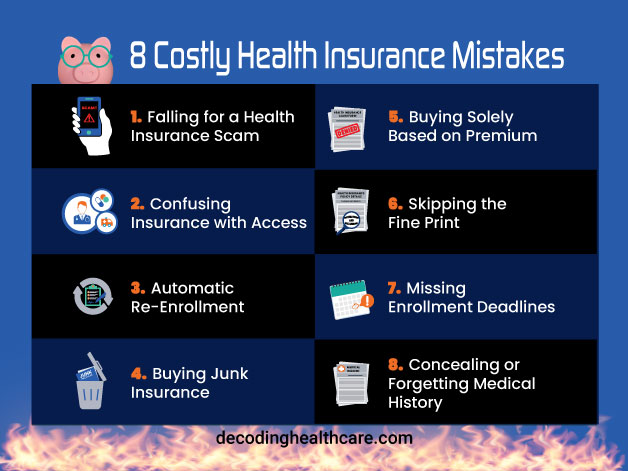
The decisions you make during annual open enrollment largely determine how much you will pay for health care in 2027. We've identified 8 common mistakes that lead to coverage gaps, exposure to high healthcare costs, and surprise bills for care you thought was covered. The first item on our list is exponentially worse because it can damage much more than your finances.

Choosing health insurance is one of the biggest financial decisions you'll make all year. With health insurance literacy, you'll navigate this challenge with confidence. We've created a series of helpful, independent articles to help you. We do not sell insurance but aim to promote your financial wellness.


Open Enrollment Articles from Decoding Health Care:


We've also added an evolving glossary, health insurance information and guides, and cost calculators to Decodinghealthcare.com to help you compare plans and calculate income and subsidies.


Decoding Health Insurance Book

Get the Whole Picture! 


Our book, Decoding Health Insurance and the Alternatives: Options, Issues, and Tips for Saving Money, by Lauren R. Jahnke, MPAff, is a comprehensive, non-partisan consumer guide to understanding the current U.S. system for health insurance and getting health care. It includes many practical tips to help you save money, whether you have insurance or not.


Marketplace Open Enrollment Starts November 1st!   


The upcoming ACA Marketplace open enrollment period for 2027 coverage runs from November 1, 2026, through January 15, 2027, in most states, with a December 15 deadline for coverage starting on New Year's Day. Consumers navigating the marketplace this year should prepare for several big changes, including higher overall average premiums and more insurance company exits than entries, which means some enrollees may need to choose a new plan if their current insurer leaves their area. 


Additionally, maximum out-of-pocket limits are increasing to $12,000 for individual plans (some plans may be lower) and subsidy eligibility rules for lawfully present immigrants have narrowed. Also, adults 30 or older seeking Catastrophic plan coverage will face stricter hardship exemption requirements. (The looser requirements announced earlier in the year are not taking effect.) 


On the positive side, higher benchmark plan premiums may naturally lead to larger tax credits that help insulate lower- and middle-income enrollees from price jumps, while contribution limits for Health Savings Accounts are increasing to $4,500 for individual coverage and $9,000 for families. And a few additional states are introducing state-funded subsidies to provide extra financial relief to their residents alongside federal assistance. Because plan options and individual subsidy amounts are shifting, active plan comparison will be especially critical for this open enrollment period.  


Read the article for more details

Before You Pay: How "Presumptive Eligibility" Can Cut Hospital Bills 


Recent reporting by KFF Health News highlights a powerful tool for preventing medical debt known as "presumptive eligibility." This allows hospitals to use electronic data to automatically screen and grant charity care rather than forcing patients through cumbersome paperwork. While laws like Oregon's pioneering screening mandate have dramatically expanded financial aid there, investigations in other regions show a more complicated reality. For example, in Los Angeles County, many nonprofit hospitals still bill patients first or fail to refund out-of-pocket payments. And in Texas, which has one of the highest rates of medical debt, navigating hospital financial aid remains an uphill battle for many consumers. As more states push for automatic aid rules, healthcare consumers facing steep bills should always ask providers about charity care policies and request a financial screening.


Read the article for more details

State Programs Wipe Out $1.1B in Medical Debt


A growing number of states are offering a powerful financial safety net for residents burdened by unpaid medical bills, with at least five states erasing a combined $1.1 billion in medical debt in 2026 alone through partnerships with the non-profit organization Undue Medical Debt. Programs in states like California, Michigan, Connecticut, and New Jersey—along with specific health systems like Indiana's Parkview Health—are purchasing and canceling qualifying debt in bulk, automatically providing relief to hundreds of thousands of families without requiring complex applications. As more state and local leaders join these relief initiatives, consumers can check with their state health departments or local hospital networks to see if they qualify for similar debt forgiveness programs.


Read the article for more details


Monthly Money-Saving Tip

The Hidden Catch Behind Pharmacy Discount Coupons 


While manufacturer-sponsored drug coupons or discount cards can offer instant relief at the pharmacy counter, they can sometimes carry hidden costs for insured patients. If you have commercial health insurance, using a manufacturer coupon for a brand-name drug might save you money today, but insurers often have rules—such as "copay accumulators"—that prevent that coupon value from counting toward your annual deductible.  


That means you could end up paying more out-of-pocket later in the year once the coupon runs out. Before accepting a coupon, consider whether a cheaper generic is available and how it impacts your deductible. And note that federal rules prohibit Medicare and Medicaid beneficiaries from using manufacturer-sponsored discount coupons altogether.


Read the full analysis from KFF Health News to learn what to watch out for. 


Relevant Resource Share

Navigating Your Medicare Benefits: The 2027 Medicare Guide Is Out 


If you or a loved one are approaching age 65—or already enrolled in Medicare—keeping tabs on annual Medicare coverage changes is essential. The government mails the official Medicare & You handbook to eligible people every fall to serve as the definitive guide to Medicare benefits, rights, and upcoming policy changes for the new year. This gives Medicare beneficiaries time to review it before Medicare Open Enrollment, which runs from October 15 through December 7 


Reviewing it early helps consumers understand their choices regarding Original Medicare, Medicare Advantage, and prescription drug coverage. During Open Enrollment, current beneficiaries can review, switch, or drop their health and prescription drug plans for the upcoming year. To look up specific options, compare costs, and vet plans side-by-side, you can also use the official Medicare Plan Finder tool. 


Did you find this newsletter helpful? Share it!

X Share This Email
LinkedIn Share This Email

Did someone send this newsletter to you and you want to subscribe?


Feedback & Sponsorship

If you have feedback or ideas for future newsletters or blog topics you want us to research and decode for you, please let us know!

If you have a product or service that promotes medical financial literacy or health and wellness, and you want to get in front of our audience, contact us.

Contact us at info@decodinghealthcare.com


Need to make your voice heard regarding healthcare legislation?

Call your Senator 866-426-2631


About Decoding Health Care

We are consumers just like you! As small business owners and entrepreneurs, we understand the difficulty of navigating the medical system while protecting your finances from the impact of high medical bills. We are here to help by teaching you to reduce out-of-pocket costs, shop for estimates and lower prices, negotiate lower medical bills, and save money on healthcare expenses with or without insurance.


Decoding Health Care provides independent and educational information and does not endorse any specific insurance plans or other health coverage products.