|
As you walk the Arboretum grounds in January, you will find an abundance of flora and fauna that are inspiring subjects for sketching. The native trees, grasses, and perennials are now in their simplest, least colorful, and most dormant state. But underground, there is unseen activity as rhizomes and roots soak in the nutrients broken down from last year's leaves and prepare for another growing season.
My focus this month is the stark beauty of the Arboretum in winter. Andrew Wyeth said, "I prefer winter and fall, when you feel the bone structure of the landscape—the loneliness of it, the dead feeling of winter. Something waits beneath it; the whole story doesn't show."
Standing at the back door of the Visitor's Center, face the South Meadow and turn right on the South Meadow Loop. Veer right at the Native Bee House and into the woods. As you descend to the bottomland along the Blockston Branch, take a good look at the forest. The view is clear, the understory is mostly leafless, and the bones of the landscape are revealed. This flowing winter landscape of gently rolling hills and dales, studded with bare tree trunks and laced with creeks and ephemeral ponds, is subtle, beautiful, and poetic.
Yet even in the most drab season, there are evergreen plants visible right now on the forest floor. Let's find something to sketch!
At the first bridge over Blockston Branch, stop to observe the floodplain. Amid the leaf litter, you will find the scattered green heart-shaped leaves of golden groundsel (Packera aurea), also called ragwort. As the weather warms, more leaves will join them and form ground-hugging rosettes from which grow stems about a foot and a half tall, topped with clusters of small yellow daisy-like flowers. In April and May, the spring woodlands in the flood plain will simply glow with golden groundsel flowing like rivulets of gold.
Look carefully at the water’s edge in the sunniest, dampest spots of the floodplain. You may find, poking through the muck and leaves, the pointed green leaf tips of sprouting eastern skunk cabbage (Symplocarpus foetidus). We will revisit this fascinating plant to see it blooming in February.
Continue straight over the bridge on the Upland Walk. As you reach slightly higher ground, look to your right and left in the leaf litter. If you spy clusters of green, oval-shaped puckered leaves with a pointed tip, about 3 inches long, you will have discovered the cranefly orchid (Tipularia discolor). In fall and winter, this orchid sends up its leaves to take advantage of the sunlight while there is no leaf canopy and makes chlorophyll to nourish itself. Gently turn over the leaf to see its rich purple underside. These leaves will fade and disappear in spring, and in July–August a single stem will emerge and bloom with delicate flowers that resemble craneflies.
As you walk, look for two evergreen ferns scattered throughout the upland woods. Ebony spleenwort (Asplenium platyneuron) is a narrow arching fern with a dark red-brown rachis (stem). Christmas fern (Polystichum acrostichoides) is a fuller, leathery clumping fern.
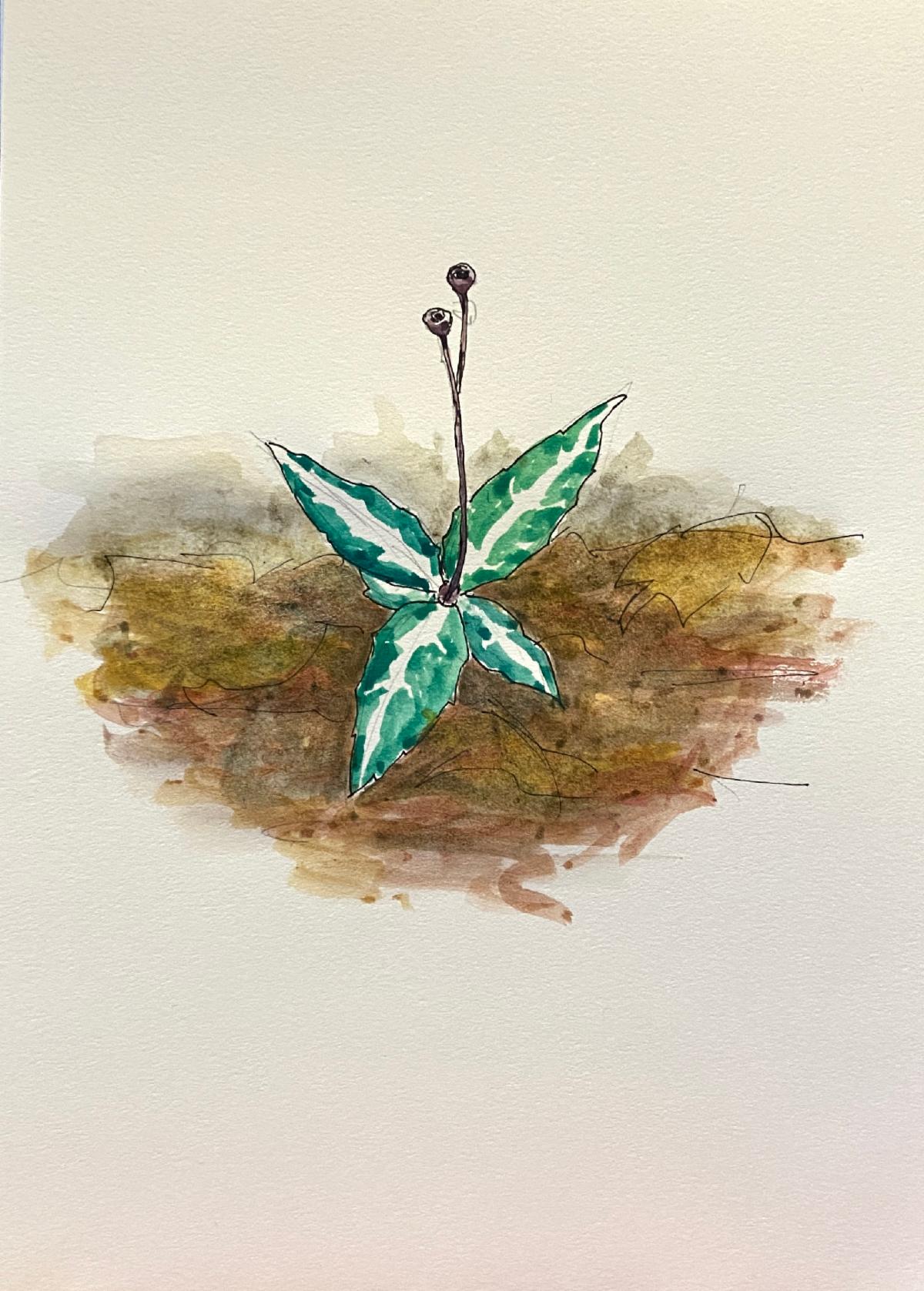
Another evergreen woodland perennial found along the Upland Walk is striped wintergreen, or pipsissewa (Chimaphila maculate). Bearing leathery lance-shaped leaves 1–3 inches long, dark green with a white stripe, these striking little plants stand no more than 6 inches tall and are easy to find. The leaf edges have widely spaced teeth, and the stems tend to be deep red to burgundy with two pairs of smaller leaves at their base and a whorl of three larger leaves at the top of the plant. In June through August, 1-inch nodding white, waxy flowers bloom on a tall stem that grows from the center of the leaf whorl. The flowers are pollinated by insects, then set seeds that are dispersed by the wind.
Even more evergreen plants are just waiting to be discovered in the understory of the winter woods, including partridge berry, ground pine, and a variety of bright green mosses. Keep looking and observing. What else can you find to sketch?
Words and drawing of striped wintergreen by Diane DuBois Mullaly
Fine artist/Maryland Master Naturalist
|