Weekly update from the National Housing Conference | |
News from Washington | By Brittany Webb
| | |
ACTION Campaign collecting signatures in support of AHCIA
The ACTION Campaign, in conjunction with businesses and organizations representing over 2,400 national, state, and local affordable housing stakeholders, has organized a sign-on letter urging Congress to support and advance the bipartisan Affordable Housing Credit Improvement Act (AHCIA) of 2025. AHCIA would expand and strengthen the Low-Income Housing Tax Credit (Housing Credit).
The letter touts that AHCIA would, amongst other provisions, increase Housing Credit allocation by 50%, lower the 50% bond financing threshold to 25% for 4 Percent Credits, enable production of nearly 1.6 million additional affordable homes, generate over $271 billion in wages and business income, and raise approximately $94 billion in tax revenue. Organizations interested in signing the letter can do so on ACTION’s website.
| | | |
Secretary Turner spotlights Opportunity Zones
U.S. Department of Housing and Urban Development (HUD) Secretary Scott Turner visited affordable housing developments located in Opportunity Zones (OZs) in Northwest Arkansas and Charleston, S.C., to spotlight the role of OZs in spurring community revitalization and economic mobility. In Charleston, he was joined by Senate Banking Committee Chairman Tim Scott (R-S.C.), while in Arkansas, Congressman Steve Womack (R-Ark.), Chairman of the House Appropriations Subcommittee on Transportation, Housing and Urban Development, accompanied him.
“One of our top goals on the [Senate Banking] Committee is housing and affordability, and I'm thankful that we have a partner who's on the job every single day, leading the way from Washington, and many people in the local community, on the job, every single day, helping us take care of our own communities,” Chairman Scott said.
The site visits included a roundtable discussion with local leaders, developers, and nonprofit partners, along with a visit to a materials design facility at the University of Arkansas that will explore innovative wood products, including an affordable housing prototype. Turner reiterated his department’s goal of streamlining HUD programs and his top three priorities of addressing housing affordability, homelessness, and disaster recovery.
| | | |
Partnering with NHC’s Housing Visionary Awards Gala and its distinguished honorees elevates your organization’s visibility, deepens engagement, and opens the door to valuable networking with over 500 influential housing leaders and stakeholders.
We offer sponsorship levels tailored to fit every organization’s needs – starting at $3,500 up to $50,000. Depending on your sponsorship level, benefits could include:
- Additional Gala tickets.
- A Gala Tribute Book ad.
- Listing in the Gala Tribute Book.
- Listing in printed and electronic marketing materials.
- Acknowledgement in opening and closing media presentations.
- Prominent listing of company logo, name, and website link on the event website.
- Recognition in Gala opening remarks.
- Recognition as a Networking Reception sponsor or as a Dessert Reception sponsor.
Tribute Book ads are available from $750 for a quarter-page to $2,500 for a full-page placement. Tickets are $1,000, but NHC members at or above the Full membership level receive half-price tickets.
For more information, please contact NHC's COO Amanda Mitchell at amitchell@nhc.org.
| | | |  | | |
New leadership at Ginnie Mae announced
The Government National Mortgage Association (Ginnie Mae) announced Joseph Gormley as its new Executive Vice President and Chief Operating Officer. Gormley enters the new roles after serving in several senior positions at HUD including as Deputy Assistant Secretary for Single Family Housing at the Federal Housing Administration and Chief of Staff to the Deputy Secretary. He also held key roles at the Independent Community Bankers of America, the Mortgage Bankers Association, and the Financial Industry Regulatory Authority.
As Executive Vice President and Chief Operating Officer, Gormley will manage Ginnie Mae’s strategic initiatives, operational functions, and risk-management efforts in order to ensure the efficiency and sustainability of its programs.
“I am honored to join Ginnie Mae and contribute to its important mission,” said Gormley. “I look forward to working with the dedicated team at the agency to strengthen and enhance the role of the MBS program in serving homeowners and renters across the country.”
HUD Secretary Scott Turner applauded Gormley’s accession. “I am very happy to see Joe Gormley take the helm at Ginnie Mae as Executive Vice President and Chief Operating Officer,” said Secretary Turner. “With Ginnie Mae’s central role in mortgage financing, his leadership will bring stability and strength to this segment of the housing market.”
| | | |
HUD announces new funding for Native American veterans' program
HUD Secretary Scott Turner has announced the availability of $2.2 million in new funding under the Tribal HUD-Veterans Affairs Supportive Housing (HUD-VASH) program. The HUD-VASH program provides rental assistance to Native American veterans at risk of experiencing homelessness in tribal communities. Secretary Turner made the announcement after touring the Oneida Tribe reservation in Wisconsin alongside Oneida tribal leadership.
The additional funding comes from unspent Fiscal Year 2017 funds and are now available for grants to Tribes and Tribal Designated Housing Entities (TDHEs).
“For about a decade, the Oneida Tribe has utilized HUD-VASH to support Native American veterans with a specialized set of tools and resources,” said Secretary Turner. “Today’s announcement of newly available funds will help expand this impactful program to more Native American veterans across the country.”
Oneida leadership has lauded the expansion, touting the HUD-VASH program’s importance in tribal communities. “Across the country, tribes continue to have unmet needs on reservations, and projects such as VASH move tribes closer to closing the gap,” said Oneida Nation Chairman Tehassi Hill.
| | | |
VA ends VASP despite industry concerns
The U.S. Department of Veterans Affairs (VA) has published a circular outlining the winddown of the Veterans Affairs Servicing Purchase (VASP) program. Effective May 1, 2025, the VA will no longer accept new submissions and will rescind the VA Home Retention Waterfall. However, active VASP Trial Payment Plans (TPPs) will be allowed to continue through August 31, 2025, and the VA will purchase successfully completed loans, subject to funds availability.
The VASP program was established to help veterans who fell behind on their mortgage payments keep their homes after the abrupt cancellation of a pandemic-era mortgage relief program, which left roughly 40,000 veterans at risk of foreclosure. Following the late 2023 cancellation of the pandemic-era program, the VA halted foreclosures for a full year. Since establishing the VASP program in May 2024, over 17,000 veterans have been enrolled.
Industry leaders have expressed strong concerns about the lack of an alternative plan to VASP, such as a permanent partial claim option, and the impact it will have on veteran homeowners.
In an interview with HousingWire, NHC’s President and CEO David Dworkin said that there is “no good reason to foreclose on a borrower when a workout is possible.” He added that a borrower facing a temporary crisis should be allowed to move missed payments to the end of the loan term without penalizing a lender. It is a “well-established strategy with a track record of success,” Dworkin continued, adding that he doesn’t understand “why we would ever want to see a veteran lose their home if it can be avoided.”
Bob Broeksmit, President and CEO of the Mortgage Bankers Association (MBA) released the following statement: “The work must start immediately to strengthen the VA’s loss mitigation toolkit, and that includes implementing a permanent partial claim option, a foreclosure avoidance tool that is widely used in every other government loan program. MBA is eager to continue to work with the VA and Congress to protect veterans and ensure that they can utilize the housing benefit they earned through their service.”
| | | |
NHC advocates to strengthen and streamline the HOME Program
Earlier this month, House Financial Services Housing and Insurance Subcommittee Chairman Mike Flood and Ranking Member Emanuel Cleaver issued a request for input from stakeholders and experts on the HOME Investment Partnership (HOME) program and Community Development Block Grant (CDBG) program. Building on HOME recommendations that NHC and other industry and housing finance agency stakeholders provided to HUD in an August 2022 letter, NHC submitted several recommendations in response to the Chairman and Ranking Member’s request.
NHC’s top priority is to advance policies that increase the supply of and access to affordable housing. “The HOME program is critical to the production and preservation of affordable rental and homeownership opportunities in rural, urban, and suburban communities, and provides states and local participating jurisdictions (PJs) with much needed flexibility to meet their unique housing needs,” said NHC President and CEO David Dworkin in the letter.
The recommendations include:
- Preserving or enhancing funding for the HOME program
- Maintaining or enhancing the flexibility of uses for funds and local control
- Streamlining regulations and addressing duplicative and overly burdensome program requirements
- Reducing barriers to entry, and
- Maximizing alignment with the Low-Income Housing Tax Credit (LIHTC) program.
NHC is grateful to Chairman Flood and Ranking Member Cleaver for their leadership on this issue, and for providing stakeholders with the opportunity to provide input.
| | | |
Record PAB Cap projected for 2025
The national cap on Private Activity Bonds (PABs) is projected to reach a record $48.3 billion in 2025, driven by updated IRS population data and an inflation-adjusted per capita multiplier of $130, a $5 increase. This represents a $2.4 billion increase over 2024 and significantly expands the financing potential for affordable housing developments that rely on tax-exempt bonds to qualify for 4% Low-Income Housing Tax Credits (LIHTCs). As a result, the total national LIHTC allocation will rise to $1.1 billion, in 2025, a 4.9% increase from 2024.
| | | |
Over 9 million could face homelessness without federal rental assistance
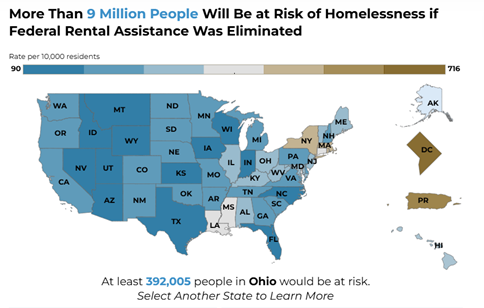
According to analysis by the National Alliance to End Homelessness, more than 9 million people receiving federal rental assistance could be at risk of homelessness if key federal rental assistance programs are terminated. While elimination of all programs is unlikely, the analysis highlights the critical role that housing programs play in keeping people housed and the consequences of potential budget cuts. Currently, only one in four eligible households receives rental assistance due to chronic underfunding of the programs. Maintaining housing for those currently in the program is noted as less costly than having to address spikes in homelessness.
| | |
A letter from the National Council of State Housing Agencies (NCSHA) to HUD Secretary Scott Turner outlines recommendations for streamlining HUD program administration and regulations in order to cut costs, decrease delays, and speed up affordable housing development. The proposals include reforms to Davis-Bacon regulations, environmental reviews, "Build America, Buy America" requirements, Section 3 workforce and contracting provisions, streamlining of consolidated plans and annual plans, and more. NCSHA also included program specific proposals for the HOME Investment Partnership program, Housing Trust Fund, Section 8 Project-Based Rental Assistance, Housing Choice Voucher program, FHA single-family and multi-family insurance programs, Ginnie Mae, and HUD IT systems. “Federal housing programs are critical to the affordable housing work HFAs and other providers perform,” the letter said. “Targeted regulatory modifications would strengthen these programs by providing state and local administrators more flexibility, streamlining requirements, increasing efficiency, and expanding their reach. Further, regulatory changes would better align program rules to ease administration when properties rely on multiple sources of funding.”
The Wall Street Journal reports that existing-home sales dropped by 5.9% in March compared to February, falling to an annual rate of 4.02 million units. This marks the sharpest monthly decline in over two years and the slowest March sales pace since 2009. High mortgage rates and a record-high median home price of $403,700 deterred buyers, despite a 19.8% increase in inventory from March of 2024. While new home sales rose due to builder incentives and a shift toward lower-priced homes, affordability challenges and economic uncertainties continue to suppress overall housing market activity.
National Mortgage News reported on the potential of funding cuts to NeighborWorks America by the Department of Government Efficiency, prompting a strong response from NeighborWorks supporters. NeighborWorks, which helps finance affordable housing and community development, is a congressionally chartered nonprofit that has historically received bipartisan support. In response to the potential cuts, NeighborWorks has highlighted its impact, noting that its funding supports thousands of affordable housing units and helps create jobs. The organization emphasized its role in stabilizing communities and aiding underserved populations, and housing advocates and lawmakers have pushed back, arguing that defunding such a critical organization would undermine national efforts to address housing challenges.
A report from Redfin indicates that home sellers are increasingly providing concessions to homebuyers, with 44.4% of U.S. home sales including them in the first quarter. This marks an increase from the previous year and is near the record high 45.1% observed at the beginning of 2023. Sellers are offering concessions because the housing market has shifted to favor buyers due to high prices, elevated mortgage rates, economic uncertainty, and a higher supply of listings. Buyers are often seeking these concessions not just for minor issues like repairs but primarily to help afford the home itself. Economic concerns are also impacting transactions, leading to 13.4% of pending home sales being canceled in March.
| | Renew your NHC membership today! | | Watch this video to learn more about how NHC represents diverse leaders across the housing spectrum, including lenders, homebuilders, affordable housing advocates, real estate professionals, housing development corporations, housing finance agencies, and more, to address today's pressing housing issues. | | |
Your involvement is essential to addressing today’s housing challenges, and NHC relies on active members to maximize our impact and remain a leader in tackling today’s housing issues.
NHC membership offers exclusive networking opportunities, access to our weekly Member Brief, and other key housing resources such as our Housing Resource Center, Paycheck to Paycheck database, and Employer Assisted Housing Toolkit. We look forward to working with you to address America's housing challenges.
| | The National Housing Conference is a diverse continuum of affordable housing stakeholders that convene and collaborate through dialogue, advocacy, research, and education, to develop equitable solutions that serve our common interest. | | Defending Our American Home since 1931 | | Copyright © 2024. All Rights Reserved. | | | | |