|
Where would the NHS be without a row?
There is always a cack-handed something. An old wheeze dressed up in a new frock.
The latest? The bread and butter of the NHS... hospital referrals, are fast becoming a dog's breakfast.
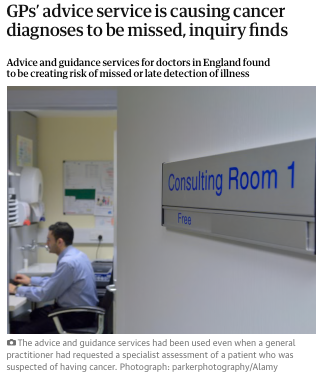
A Pulse survey of 712 GPs suggests around a quarter of referrals are coming back as unsolicited Advice and Guidance.
GP refers a patient. Hospital replies with advice;
Do another test… try another treatment… wait six weeks… … come back if things get worse.
NHSE says A&G is not supposed to be a way of rejecting referrals. GPs increasingly think that is exactly what it has become, and I think they are probably right.
There’s plenty to argue about.
The survey is self-selecting. Pulse accepts it is not scientific. The 26% should not be presented as a national NHS statistic, but…
…it’s not the real issue. The real issue is what happens next.
For decades the referral pathway has been straightforward.
-
Patient sees GP.
-
GP wants a specialist opinion.
-
Patient usually joins the outpatient queue, sees a consultant and either...
... goes home happy, or starts a care pathway and becomes another number on another waiting list.
A&G changes that.
The patient may never see the specialist. Or, the advice may eventually result in a referral, anyway.
Either way, there is still a consultant somewhere in the process.
With or without the patient sitting in front of them, someone has to review the information and make a clinical judgement, and…
…that time is neither free nor abundant.
A&G may avoid a full outpatient appointment, but human A&G still consumes scarce specialist time…
… which raises an intriguing question.
If A&G is becoming the default gateway into hospital care, perhaps the really important development is not A&G at all.
Perhaps it is what comes next… AI&G.
Making Advice and Guidance effectively compulsory starts to make much more strategic sense if the next step is to automate it.
Is it doable? Yes. Easily.
Hospitals are likely to be among the first parts of the NHS able to use artificial intelligence seriously, at scale.
They have something extraordinarily valuable…
- Knowledge.
- Years of referrals.
- Clinic letters.
- Test results.
- Diagnoses.
- Treatment decisions.
- Outcomes.
Thousands upon thousands of previous patients whose journeys through the hospital contain patterns no individual consultant could possibly remember.
AI can mine that institutional memory in seconds.
Send a cardiology referral and an AI system could check symptoms, previous investigations, blood results, medicines and local protocols against thousands of similar cases, in seconds.
Accept…redirect … do another test… try this treatment… urgent review.
No consultant need initially see it. AI&G could take seconds.
Progress? Mmmm... in many respects, yes.
AI should be able to improve referral quality, identify missing information, route patients to the right specialist and spot people who need urgent attention, but there is an important distinction.
Using AI to decide where a referral should go is one thing.
Using AI to decide whether a patient is allowed to be referred at all, is quite another.
The first is productivity. The second starts to look like rationing.
Hospitals are under relentless pressure to control demand, reduce waiting lists and protect scarce specialist capacity.
An AI gateway capable of screening thousands of referrals cheaply and instantly will be irresistible. They exist now...
... the question many will ask, 'why aren't we using them now?'
At first it will be called decision support. A consultant will remain responsible.
Then consultants may review only a sample, and then…
… just the difficult cases.
Eventually… the specialist may no longer be the hospital’s front door. The algorithm will be.
There are other questions.
-
Can the GP override it?
-
Who carries the risk if the AI says no?
-
Does the waiting-time clock start?
-
If the patient deteriorates, who owns the decision, and perhaps most importantly…
… is demand actually disappearing?
Or, are we simply moving it?
A patient removed from a hospital queue and returned to a GP has not necessarily been treated.
They’ve simply changed queues.
That's why the present argument about whether 26% of referrals are being bounced back may soon look rather quaint.
The NHS is arguing about Advice and Guidance delivered by consultants.
It should also be thinking about what happens when the advice is delivered by machines.
AI may revolutionise diagnosis. It may transform administration, but …
…the next great debate could be much more fundamental.
Not what AI knows, but…
… who it lets through the door.
Have the best weekend you can
|