|
|
L.A. Breast Chronicles
Breast Health News
....That Can't Be Missed
April 3, 2020
|
|
Mission Statement: The principles of breast health care are constantly evolving. The mission of this E-newsletter is to share current and breaking news about breast cancer screening, diagnosis, and treatment that every health care provider should know, with editorial comments added for further clarity. Please feel free to share with your friend, family, and colleagues. For questions, comments, or requests for new topics, just email
LABreastChronicles@drholmesmd.com
.
Dennis R. Holmes, MD, FACS
Breast Cancer Surgeon & Researcher
|
|
 |
The War Against COVID-19: My Call For Effective Federal Leadership
by Dennis R. Holmes, MD, FACS
|
Enough already! That’s my response to the growing national crisis facing healthcare providers who have placed their health and well-being, and their lives on the line in efforts to care for those effected by COVID-19. An often-heard metaphor is that healthcare providers are on the frontline of the national war against coronavirus. However, unlike other U.S.-fought wars, what is sorely lacking in the current war is a coordinated, federally directed effort to ensure that healthcare providers are adequately equipped with personal protective devices, ventilators, and medications to take on the imminent challenge. Instead, the current federal effort is comparable to sending the armed forces into battle without boots, guns, or bullets! It is objectionable that healthcare providers find it necessary to use makeshift personal protective devices and “MacGyver” ventilator equipment, and it should not be tolerated any longer. It is unacceptable that States are forced to compete in bidding wars between themselves and against the federal government for essential medical equipment and supplies to keep their citizens safe.
Expecting healthcare providers to fabricate medical equipment and supplies would be tolerable if there were no other options. However, there are other options:
1) The proper distribution of the Strategic National Stockpile. The Strategic National Stockpile is the nation’s largest supply of life-saving pharmaceuticals and medical supplies for use in a public health emergency severe enough to cause local supplies to run out. When state, local, tribal, and territorial responders request federal assistance to support their response efforts, the stockpile ensures that the right medicines and supplies get to those who need them most during an emergency.
2) The federally mandated manufacturing of medical equipment and supplies by companies capable of large-scale manufacturing. This authority resides in the presidency through the
Defense Production Act of 1950
, which empowers the executive branch to demand specific companies to manufacture essential equipment and supplies to protect and preserve national security.
The Defense Production Act has the ability to concentrate our national industrial effects on solving the national short-fall of essential medical equipment and supplies, which includes the purchase or building of plants, infrastructure, and raw materials to support such manufacturing, while also guaranteeing a market for the purchase of manufactured products. By financing business expansion, the Defense Production Act also has the ability to address another major casualty of the Coronavirus pandemic—the widespread loss of American jobs! For example, under federal pressure, a precursor of the Defense Production Act led ship builder, Henry Kaiser, to accelerate World War II ship manufacturing from one ship every 365 days to one ship every day! Furthermore, the
World War II effort led to the creation of 17 new civilian jobs
to support the war economy.
Last week the president activated the Defense Production Act in response to the pandemic. However, instead of demanding specific industries to initiate large-scale production of COVID-19 test kits, personal protective devices, ventilators, and other essential items, he simply encouraged U.S. companies to voluntarily contribute to the Coronavirus war effort. That’s like sending an email to your friends inviting each to bring a bucket of water to extinguish your house fire. The lack of presidential leadership here is glaring. How ironic it is that we are now more than two months into this growing international crisis, and we are still dependent on China for life support. The problem is further magnified by the national lack of COVID-19 testing which has led to the irrational rationing of COVID-19 testing of potentially effected individuals.
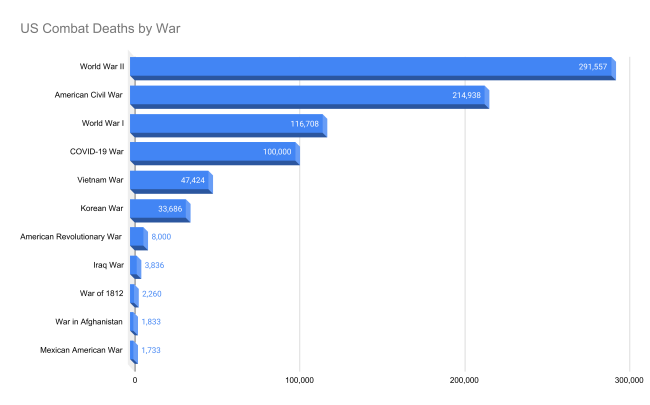
In the best case scenario, COVID-19 will kill 100,000-240,000 Americans. That’s more American deaths than the total number
U.S. combat fatalities
in the American Revolutionary War, War of 1812, Mexican-American War, World War I, Vietnam War, Korean War, Iran War, and the Afghanistan War---combined! Each of these wars was a defining moment in our nation’s history that created an indelible mark on our national psyche, forever changing the fate of the generations to follow. Imagine the impact of 100,000 American COVID-19 war fatalities in a single year. Actually, you don’t have to imagine. Last Friday there were 1000 Coronavirus-related deaths in the United States in a single day! And, according to epidemiologists, we haven’t hit the peak yet. At that pace, 365,000 Americans will die from COVID-19 over the next twelve months.
The ongoing national crisis calls for federal leadership and coordination that are proportionate to the challenge before us. Only then can healthcare providers effectively fight and win this war, while also maintaining their health and well-being. Mr. Trumps often congratulates himself for supporting our troops. In this war, healthcare workers are our troops!
---
CONTINUE READING to learn how your healthcare providers can help to keep themselves safe...
|
|
|
|
Keeping the Coronavirus from Infecting Health-Care Workers:
What Singapore’s and Hong Kong’s success is teaching us about the pandemic
by Atul Gawande
The message is getting out: #StayHome. In this early phase of the
coronavirus
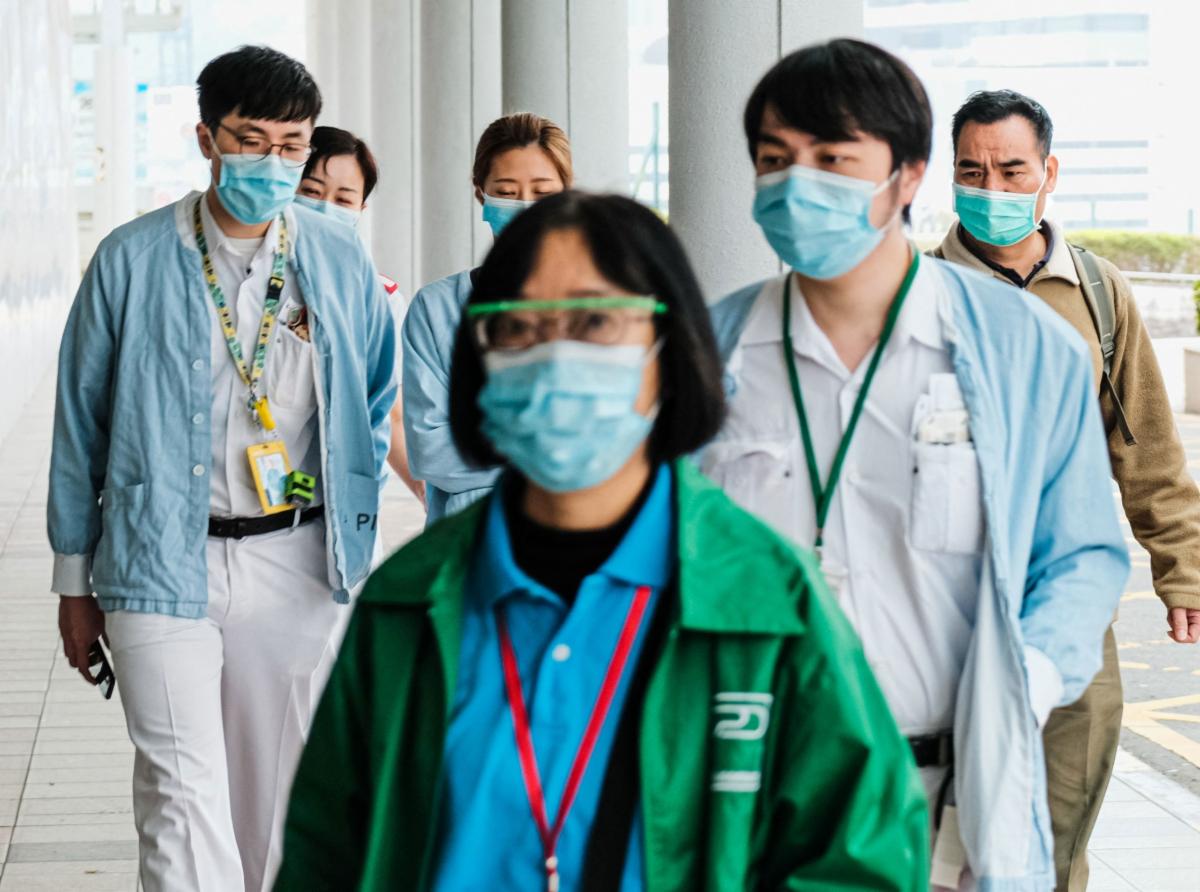
pandemic, with undetected cases accelerating transmission even as testing ramps up, that is critical. But there are many people whom the country needs to keep going into work—grocery cashiers, first responders, factory workers for critical businesses. Most obviously, we need health-care workers to care for the sick, even though their jobs carry the greatest risk of exposure. How do we keep them seeing patients rather than
becoming
patients?
In the index outbreak in Wuhan, thirteen hundred health-care workers became infected; their likelihood of infection was more than three times as high as the general population. When they went back home to their families, they became prime vectors of transmission. The city began to run out of doctors and nurses. Forty-two thousand more had to be brought in from elsewhere to treat the sick. Luckily, methods were found that protected all the new health-care workers: none—
zero
—were infected.
But those methods were Draconian. As the city was locked down and cut off from outside visitors, health-care workers seeing at-risk patients were housed away from their families. They wore full-body protective gear, including goggles, complete head coverings, N95 particle-filtering masks, and hazmat-style suits. Could we do that here? Not a chance. Health-care facilities don’t remotely have the supplies that would allow staff members to see every patient with all that gear on. In Massachusetts, where I practice surgery, the virus is circulating in at least eleven of our fourteen counties, and cases are climbing rapidly. So what happens if you are exposed to a coronavirus patient and you don’t have the ability to go full Wuhan? My hospital system, Partners HealthCare, has already sent more than a hundred staff members home for fourteen days of self-quarantine because they were exposed to the coronavirus without complete protection. If we had to quarantine every health-care worker who might have come into contact with a covid-19 patient, we’d soon have no health-care workers left.
Read the complete new article...
|
|
Governor Newsom’s Executive Order Expands Telehealth Services
|
|
If you are voluntarily or involuntarily quarantined or simply prefer to go out in public, you might have the option of a telehealth visit with your doctor. Real-time telemedicine permits a live interaction between a health professional and patient using secure, HIPAA-compliant audio and video communication.
Under the Governor's new ruling, effective immediately, covered health care providers may use popular applications that allow for video chats, including Apple FaceTime, Facebook Messenger video chat, Google Hangouts video, Zoom, or Skype, to provide telehealth without risking non-compliance during the Coronavirus pandemic. Previously, some of these methods were considered HIPAA non-compliant and unacceptable for medical communications.
My practice now offers “face-to-face” Updox VideoChat office appointments, a HIPAA-compliant telehealth service which you may access through your personal desktop computer, laptop, tablet device, or cell phone. To participate in a VideoChat office visit, my office will send to you a connection weblink via email or text message. Simply select the weblink to “Join the VideoChat", respond to the prompts to turn on your camera and microphone, and seconds later you will be able to see and speak with me from the privacy of your home.
|
|
|
|
Dennis R. Holmes, MD, FACS
Breast Cancer Surgeon and Researcher
Editor, L.A. Breast Chronicles
Patient Appointments: 1-800-203-5515
Good Samaritan Hospital Office
1245 Wilshire Blvd
Suite 303
Los Angeles, CA 90017
|
|
|
|
|
|
|