|
Dear Presidents’ Alliance Member,
In this week’s Member Update:
- Dream Act of 2025 Reintroduced
- Policy Changes Impacting Refugees and Other Displaced Populations
- Public Charge Comment and Opportunity – Deadline Approaching
-
Litigation Update: Presidents’ Alliance v. Bondi
-
New Calls to Investigate Colleges and Universities Supporting Undocumented Students
- Prepare Your Noncitizen Students for Post-Graduate Employment-Based Pathways
- College Corner for K-12 Counselors and Educators
- Immigration in Brief
- Calendar of Events
- Top Reads
| | |
Dream Act of 2025 Reintroduced
On December 4, Senators Dick Durbin (D-IL) and Lisa Murkowski (R-AK) introduced the bipartisan Dream Act of 2025, which would allow noncitizens who came to the United States as children and meet certain requirements to earn permanent residence. The updated bill expands eligibility to Documented Dreamers, a long-standing priority of the Presidents’ Alliance. However, it also retains section 505 of the 1996 Illegal Immigration Reform and Immigrant Responsibility Act (IIRIRA), the provision that has long created barriers for states seeking to expand in-state tuition to undocumented students. Additional updates include a requirement that applicants resolve any assessed federal tax liability and a provision allowing two years of Armed Forces service to satisfy the bill’s educational requirements.
The Presidents’ Alliance issued a statement in support of the bill’s reintroduction.
| | |
Policy Changes Impacting Refugees and Other Displaced Populations
USCIS Internal Memo on Review of Admitted Refugees. USCIS has issued a directive calling for a comprehensive re-review of more than 200,000 refugees admitted between January 20, 2021, and February 20, 2025. The memo also places an immediate halt on processing green card applications for refugees who entered during this period, pending completion of the review. The directive has several significant implications, including the potential termination of refugee status for principal refugees and their derivatives, the denial of green card applications for individuals who arrived during the covered period, and the revocation of previously issued green cards following reassessment. Refugees already undergo some of the most rigorous vetting of any immigrant group, and there has been no clear public explanation for why such a sweeping review is needed. This move is likely to be challenged in court.
Pause on Asylum Decisions and Immigration Benefits for Nationals of 19 Travel-Ban Countries. A separate USCIS memo issued on December 2 institutes a nationwide pause on all asylum decisions, with interviews continuing but no approvals or denials being issued while the agency conducts a broader review. The same memo also halts all immigration benefit applications, including green cards and naturalizations, filed by nationals of the 19 countries included in the June 2025 travel ban, including Cuba, Venezuela, Haiti, and Afghanistan. Agencies are additionally pausing citizenship ceremonies for these nationals, and USCIS will re-evaluate pending and, in some cases, already approved permanent residence applications for individuals from these countries.
Suspension of Visa Issuance to Afghan Nationals. On November 28, the State Department announced in a social media post that it would suspend visa issuance to holders of Afghan passports.
Shortened Validity for Employment Authorization Documents. USCIS has updated its Policy Manual to reduce maximum EAD validity from 5 years to 18 months for refugees, asylees, individuals granted withholding of removal, and many applicants with pending asylum or adjustment cases, requiring more frequent renewals and security vetting.
The Presidents’ Alliance is tracking these changes and encourages member institutions to reach out to us at federalpolicyteam@presidentsalliance.org with questions or to share impacts experienced on your campus.
| | |
Public Charge Comment and Opportunity – Deadline Approaching
Following USCIS’s November 19 NPRM to rescind the 2022 public charge regulation, the 30-day comment period closes on December 19. As currently proposed under the NPRM, immigration officers would regain broad discretion to consider receipt of a wide array of public benefits, beyond the limited cash and long-term care assistance covered under the 2022 rule. The Presidents’ Alliance is a member of the Protecting Immigrant Families (PIF) Coalition, which has provided a sign-on opportunity for organizations and institutions, a coalition comment letter, and a template if you want to submit your own comments. We are also assessing whether to file an independent comment to highlight the specific impacts on immigrant and other noncitizen students and their families.
| | |
Litigation Update: Presidents’ Alliance v. Bondi
The hearing on the government’s motion to dismiss in Presidents’ Alliance v. Bondi, which challenges the unlawful revocations of student visas and terminations of SEVIS records, took place yesterday, December 9, before Judge Patti Saris. Originally scheduled for October, the hearing was postponed due to the government shutdown and followed the Presidents’ Alliance’s response to the government’s motion to dismiss filed in August.
We will provide an update as soon as the court issues an order.
| | |
Prepare Your Noncitizen Students for Post-Graduate Employment-Based Pathways
As campuses near the end of the semester, many noncitizen students in temporary or precarious immigration statuses are considering their immigration options post-graduation. Regardless of their program completion dates, you can connect students now with trustworthy, comprehensive resources on existing employment-based immigration pathways via the Legal Pathways that Work (LPTW) resource hub. Below are just some of the many resources and tools available to help you and your students navigate both preparation for and conversations around work visas.
| |
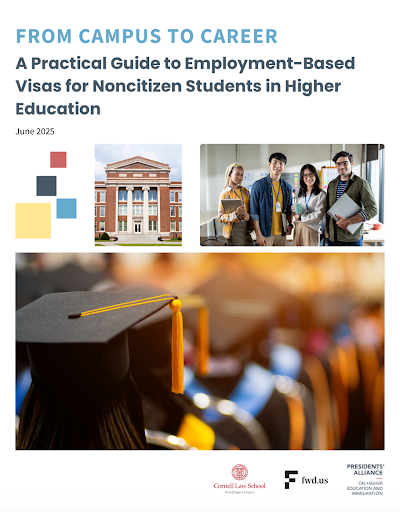
From Campus to Career: A Practical Guide to Employment-Based Visas for Noncitizen Students in Higher Education
Students and higher education professionals navigating nonimmigrant and immigrant employment-based visa options after graduation can refer to our guide developed in partnership with FWD.us and Path2Papers. It provides clear guidance on what students can do during their academic journeys, especially early on, to strengthen their eligibility upon entering the workforce.
| | |
How To Approach Your Employer For Visa Sponsorship
Soon-to-be graduates and alumni seeking employment can find guidance on how to ask current or prospective employers about visa sponsorship via our guide developed in partnership with Informed Immigrant.
| | |
Free Legal Consultations for Students & Graduates in Precarious Statuses Residing in Texas
The Legal Pathways that Work (LPTW) initiative is also offering free virtual legal consultations to current students and graduates meeting the following criteria:
-
Reside in Texas;
-
Be a Dreamer (with or without DACA), Temporary Protected Status (TPS) recipient, or Humanitarian Parolee; AND
-
Hold an associate degree or higher, OR be currently enrolled in an undergraduate program.
| | |
Consultations focus on employment-based visa options and include screening for all potential pathways to lawful status.
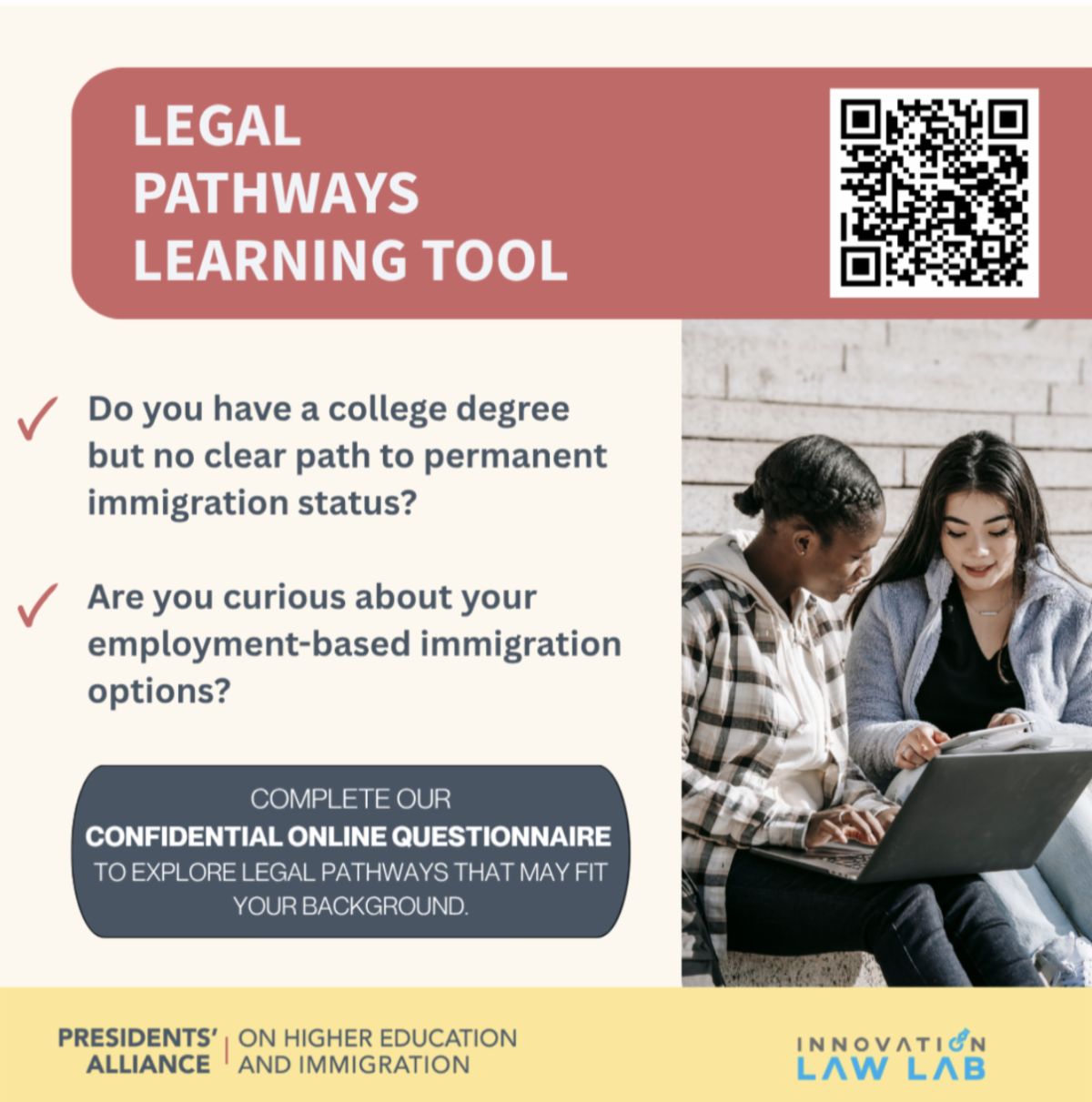
How It Works: Eligible students and graduates should first complete our Legal Pathways Learning Tool – a confidential online questionnaire developed by immigration legal experts. It helps users explore possible employment-based pathways and determine next steps. Those who meet our program criteria will then have access to the legal consultation request form.
| | Please Note: Due to our program’s limited capacity, we are currently unable to offer free legal consultations to enrolled undergraduate students outside of Texas, international students, those with pending or approved green cards, or individuals seeking advice outside of employment-based immigration. | |
College Corner for K-12 Counselors and Educators
Our final College Corner meeting of 2025 brought together admissions leaders from across the country alongside K–12 counselors and educators dedicated to supporting undocumented students. Key themes included admissions practices, institutional supports, navigating policy shifts, advising students, and counseling guidance. As we look ahead to 2026, we are excited to continue bringing together higher education professionals and K–12 leaders to deepen our collective understanding of how to best support undocumented students nationwide. Our first meeting of the new year will kick off in February. A special thank-you to our wonderful partners, Breakthrough Central Texas and FirstGen Empower, for helping make College Corner possible. For more information about College Corner or to join the conversation, please contact Dr. Felecia Russell, Director of Higher Ed Immigration Portal, at felecia@presidentsalliance.org.
| | |
Immigration in Brief
-
The Presidents’ Alliance signed onto a coalition letter with 130 organizations calling on the administration to reverse its recent asylum and immigration restrictions and abandon discriminatory policies issued after the Nov. 26 attack. The letter urges a recommitment to humane, evidence-based immigration processes.
-
Illinois enacted a new law limiting civil immigration enforcement at state courthouses and expanding protections for residents accessing hospitals, day cares, and colleges. Signed by Gov. Pritzker, the measure also creates a clearer path for individuals to sue if their rights are violated, responding to the administration’s intensified enforcement actions in the Chicago area.
-
FWD.us has launched a new interactive data tool that highlights key changes in the undocumented and temporarily protected population, breaking down the data by state of residence, country or region of origin, and years lived in the United States.
-
The Supreme Court announced that it will take up the case challenging President Trump’s executive order to end birthright citizenship. The Court will hear arguments in the spring and is expected to issue a ruling by the summer.
| | |
Thank you for your support and engagement.
The Presidents’ Alliance Team
| | | | |