|
Daily Transportation News
August 13, 2026
| | | |
Last Chance!
IATR Early Bird Pricing Until Aug 15
Hotel Block Rate Deadline Until Aug 14
AV City: Autonomous Mobility
Las Vegas, Nevada | September 14–17, 2026
Vdara Hotel at ARIA | 2600 W Harmon Ave, Las Vegas, NV
| |
This year’s IATR Conference will be held at the Vdara Hotel, a modern property located in the heart of the Las Vegas Strip. Known for its atmosphere and exceptional location, Vdara provides the ideal setting for an innovative and forward-looking conference experience built around multimodal safe and sustainable transportation.
The Vdara offers an excellent environment for government regulators, transportation professionals, technology companies and industry leaders to connect and collaborate.
After a full day of sessions and networking, attendees can enjoy the comfort of this beautifully designed hotel while remaining just minutes from everything Las Vegas has to offer. For our attendees, Vdara offers an ideal venue for a productive and enjoyable IATR experience.
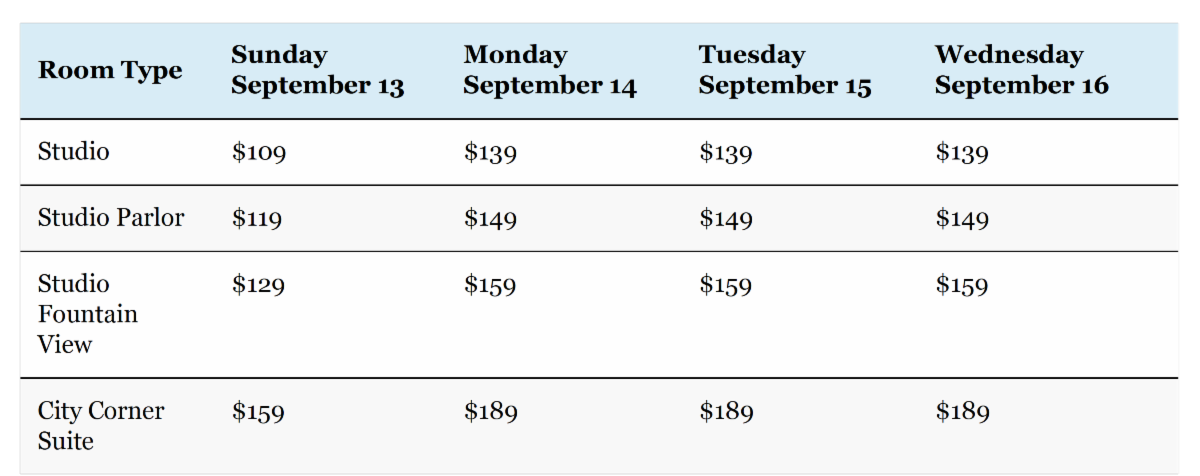
IATR has worked hard to secure the best possible rates for conference attendees, with a variety of room options available. However, the number of rooms in the IATR room block is limited, and the discounted hotel block rate is only available through this Friday, August 14. We encourage attendees to make their reservations soon to take advantage of the conference rate and ensure they have a room at Vdara during the conference.
| |
2026 Conference Hotel Block Pricing
Plus applicable resort fees and taxes
You can click here to access the hotel reservation portal, to see your options, and to book your room.
| | Driverless Cars and Human Error | |
|
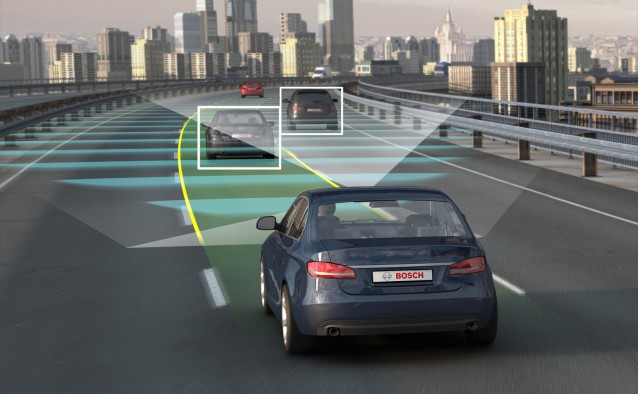
A robotaxi stops awkwardly in traffic. A Waymo gets confused near a construction zone. A child runs into the street and is struck. A fleet of empty autonomous cars circles a residential neighborhood. A self-driving vehicle passes a stopped school bus. The incident becomes a headline, then a symbol, then a warning: See? The robots are dangerous. But this is exactly where skepticism is needed. What if, despite the headlines, driverless cars actually make fewer mistakes, and less deadly mistakes, than human drivers?
Human driving is not a gold standard but more of a mass-casualty system we have normalized. The National Highway Traffic Safety Administration (NHTSA) reported 39,254 traffic deaths in the United States in 2024, with a fatality rate of 1.19 deaths per 100 million vehicle miles traveled. Its early estimate for 2025 was 36,640 deaths, still a staggering number. Distracted driving alone killed 3,208 people and injured an estimated 315,167 in 2024.
Those numbers are so large that they are hard to fathom. A human driver drifts across the centerline, runs a red light, texts through an intersection, falls asleep, or drives home drunk—tragic but familiar. A robotaxi makes a mistake, and it becomes a referendum on the future of the technology.
So, the question isn’t really whether driverless cars are perfect, but whether they are safer than us. The human driver is the control group.
Source: Skeptic
Click Here to Read More
| | Uber Is Retiring South Africa’s Most Popular Ride Option | |
|
Uber is phasing out UberX in South Africa, ending one of the ride-hailing company’s oldest and historically most popular services in one of Africa’s biggest digital transport markets.
The company confirmed that UberX, its standard ride category, will be discontinued as it restructures its South African product offering and seeks to create clearer distinctions between its increasingly crowded range of services.
UberX was among the company’s earliest offerings when Uber entered South Africa in 2013 and subsequently became a central part of its expansion in the country.
Uber told News24 that the proliferation of ride categories over the years had made it increasingly difficult for customers to distinguish between some products, while also reducing the advantage enjoyed by drivers operating higher-specification vehicles.
The company said UberX drivers will not automatically lose access to the platform. Instead, they will be able to take trips through other Uber categories for which their vehicles meet the eligibility requirements.
The move effectively redraws Uber’s South African pricing ladder, with Uber Go occupying the lower-cost end of the market while products including Uber Comfort and Uber Black cater to customers seeking higher-specification vehicles and services.
Uber Go, which generally uses smaller and more fuel-efficient vehicles, first appeared in South Africa in 2017 before being rolled out more broadly in 2021. Uber described it at the time as a lower-cost option alongside UberX and Uber Black.
The significance of UberX’s withdrawal goes beyond the disappearance of another option from the app. As recently as 2023, Uber described UberX as its most popular ride option in South Africa.
Source: Business Insider Africa
Click Here to Read More
| | |
The World Cup Was an LA Public Transit Success. The Olympics Will Be a Much Bigger Test
Two years from now, the Olympics will have just wrapped up with the Paralympics on the horizon. Spectators will know which countries dominated, what athletes made history and, perhaps the biggest question of all, how everyone handled the traffic. Local leaders have pointed to the success of public transit in Los Angeles during the World Cup — a significant, albeit much smaller test run ahead of the 2028 Games — as a sign for what's to come.
Click Here to Read More
Waymo CEO: Vision-Only Self-Driving Safety Curve Flattens “Way Too Early”
Waymo co-CEO Dmitri Dolgov recently gave a very interesting, 49-minute-long presentation at a Y Combinator event. A few days ago, I covered some of his comments from the beginning of the presentation. Getting further into it, this next topic had to be highlighted. Dolgov gets into why the company uses cameras, radar, and lidar for its self-driving vehicles.
Click Here to Read More
Your Next DC Food Delivery Could Arrive Via a WALL-E Like Robot
You may start to notice new workers roving around the sidewalks of the Logan Circle area of D.C. The four-wheeled Coco Robots went into operation in the D.C. neighborhood this past month and has been hustling to get hungry people their orders from Beau Thai. The bots carry everything from pizza to groceries and ice cream.
Click Here to Read More
| |
Autonomous Vehicle Group AUVSI Looks to Make Big Changes to Canadian Industry
A new chapter of a non-profit advocacy group is aiming to advance autonomous vehicle policy and manufacturing in Canada. The Association for Uncrewed Vehicle Systems International (AUVSI) Maple Canada chapter is now live and accepting new members. AUVSI was first formed in the U.S. in 1972, originally known as the National Association of Remotely Piloted Vehicles (NARPV). Today, the non-profit organization includes more than 400 organizations and 7,000 professionals in defence, civil and commercial industries worldwide.
Click Here to Read More
OC Transpo Boss Insists Public Transit ‘Ready’ for Return of Public Servants This Fall
The head of OC Transpo insists the transit system is ready for an influx of riders on the O-Train and buses this fall as public servants and students board the system. The City of Ottawa and OC Transpo are expecting an additional 65,000 trips a week into the downtown area as public servants head to the office four or five days a week and post-secondary students return to Ottawa for the fall.
Click Here to Read More
Enforce the Dangerous Stuff. But the Numbers Say Cars Are Killing Calgarians, Not E-Bikes.
Calgary city councillor Mike Jamieson recently laid out what residents have been reporting: e-bikes, e-scooters, and electric dirt bikes ridden at excessive speeds, without helmets, through parks, playgrounds, and pathways shared with pedestrians and young kids. The City was candid that the technology has outrun the rules, that gaps exist between City bylaws and provincial legislation, and that a review is now underway to sort out what applies to which device and what is actually enforceable today.
Click Here to Read More
| |
Glasgow Taxi Costs Could Rise if New Proposal Is Accepted
Taxi drivers in Glasgow are set to be able to add a surcharge to hires for three months due to high fuel costs. The city's licensing committee has agreed to propose the extra fee following an independent review of the taxi fare scales. A 25p fuel surcharge — and other changes to the scales — will be open to representations once a public notice is published.
Click Here to Read More
Fourteen European Cities Partner with Start-Ups to Test Innovative Mobility Solutions
European city authorities are turning to start-ups to test mobility solutions through a six-month programme designed to help authorities assess new technologies before considering wider deployment. The 2026 Rapid Applications for Transport (RAPTOR) programme will support pilots addressing road safety, active travel, public transport, electric vehicle charging, urban logistics and kerbside management. Each selected startup will receive €60,000, bringing the programme’s total direct funding to €840,000.
Click Here to Read More
'I Had to Push Myself Home in 30C Heat in My Wheelchair for an Hour after London Taxi Scheme Failed'
A disabled councillor was forced to wheel herself home in temperatures exceeding 30°C after she waited more than 90 minutes to be allocated a taxi - only for it to be unsuitable for her mobility needs.
Click Here to Read More
| |
Yulu Scoops $93M to Quadruple E-Mobility Delivery Fleet in India
Yulu is a Mobility-as-a-Service platform with around 50,000 rental vehicles deployed. The company rents two-wheelers out for both goods and people movement, with the majority of its revenue coming from delivery and commerce.
Click Here to Read More
Uber and Hinomaru Kotsu Partner to Launch Autonomous Taxi Pilot in Tokyo in Late 2026
Uber Japan, a subsidiary of U.S.-based Uber Technologies, announced on August 13 that it has signed an operational partnership agreement with Hinomaru Kotsu for the planned autonomous taxi (robotaxi) pilot program in Tokyo. The trial service is scheduled to commence in the Tokyo metropolitan area in late 2026, with Hinomaru Kotsu serving as the licensed operator responsible for vehicle operations management and maintenance, while Uber provides the ride-hailing app and operational support tools.
Click Here to Read More
South Africa: 48 Unlicensed Taxi Drivers Bust in Gauteng Road Safety Crackdown
Gauteng traffic authorities have uncovered a worrying trend in the province’s public transport sector after 48 minibus taxi drivers were caught operating without valid driving licences during a week-long enforcement blitz. The violations were detected during high-impact stop-and-search operations conducted by the Gauteng Traffic Inspectorate (GTI) and the Road Traffic Management Corporation (RTMC) between August 3 and 9 under the province’s RemoveSkorokoro campaign.
Click Here to Read More
| | Eno Center for Transportation Gives Autonomous Vehicles Regulatory Landscape Update | |
Image: Eno Center for Transportation | |
Over the course of the summer, there have been a number of updates in the AV regulatory space as commercial autonomous vehicle deployments expand. These include announcements and ongoing regulatory changes from the National Highway Traffic Safety Administration (NHTSA), updates and discussions at the state and local level, and some movement on the Hill. Key questions around safety standards and expectations, impacts on labor, and the extent to which state and local governments should be preempted from AV regulation remain on the table.
As Congress considers these questions and a potential federal framework for AV deployments, NHTSA plans to move forward with guidance and updates to vehicle standards, and states will likely continue to update and debate their AV regulations, including states that currently do not permit commercial operations. The needs and experiences of cities and localities on the frontlines of deployments should inform the ongoing regulatory processes at both the state and federal level.
On July 30th, NHTSA announced its latest actions to accelerate the development of autonomous passenger vehicles. Under the second Trump Administration, NHTSA has clearly signaled its interest in providing the AV industry regulatory certainty needed to enable expanded deployments. NHTSA has emphasized both its excitement around the potential of the industry and that it is not afraid to call out the industry broadly when it sees issues emerging, such as letter sent out this month calling on autonomous vehicle companies to enhance their first responder interactions, or to utilize its recall authorities. This reflects the industry’s and Administration’s viewpoint that autonomous mobility should move forward quickly while also recognizing that the success of the autonomous vehicle industry is reliant on public trust and safety perceptions. There also appears to be growing awareness from the industry of the importance of creating better relations with first responders and other city officials on the front lines of deployments.
NHTSA has primarily been working to enable autonomous vehicle deployments through updating the Federal Motor Vehicle Safety Standards (FMVSS) to better align with the needs of AVs from a vehicle design standpoint. For example, in June, NHTSA released updates to FMVSS No. 135, removing requirements for foot-operated brakes in autonomous vehicles. NHTSA has indicated that updates to the FMVSS will continue.
Source: Eno Center for Transportation
Click Here to Read More
| |
|
Message from IATR President Matthew W. Daus
At the International Association of Transportation Regulators (IATR), our regulators are at the forefront of addressing both the challenges and opportunities facing the mobility paradigm. Our IATR members, partner organizations, and regulated industries will continue on our shared quest to fulfill the mission of our non-profit educational organization - to bring about Multi-Modal Mobility Innovation for All! This mission can best be accomplished through information sharing, collaboration, identifying and promoting best practices, and educating our membership. These educational updates and electronic media clips are affectionately known as “IATR snips” and endeavor to cover all aspects of mobility around the globe - especially news and developments involving safety, technology innovation, multi-modal integration, automation, sustainability, electrification, accessibility, regulatory modernization, and equity.
If you would like more information about the IATR, you can visit our website at www.iatr.global. Current members can renew their memberships when you log in to your IATR portal on the top right-hand side of our website, or click here. If you forgot your membership password, please email our Membership Director, Eric Richardson, at erichardson@iatr.global.
| | | | | |
|
RENEW YOUR MEMBERSHIP FOR 2026:
Weekly news snippets
Access to the membership database
Videos and files from recent conferences
Discounted rates for future conferences, and more!
Renew your membership at http://www.iatr.global or email info@iatr.global for any questions!
| | | | |