Lower Midwest Drought Early Warning | | | | |
National Integrated Drought Information System
Drought.gov
| | |
Drought Early Warning for Lower Midwest
Parts of the Region Rapidly Worsening Amid
Dry Conditions and Extreme Heat
| | |
Current Drought Conditions
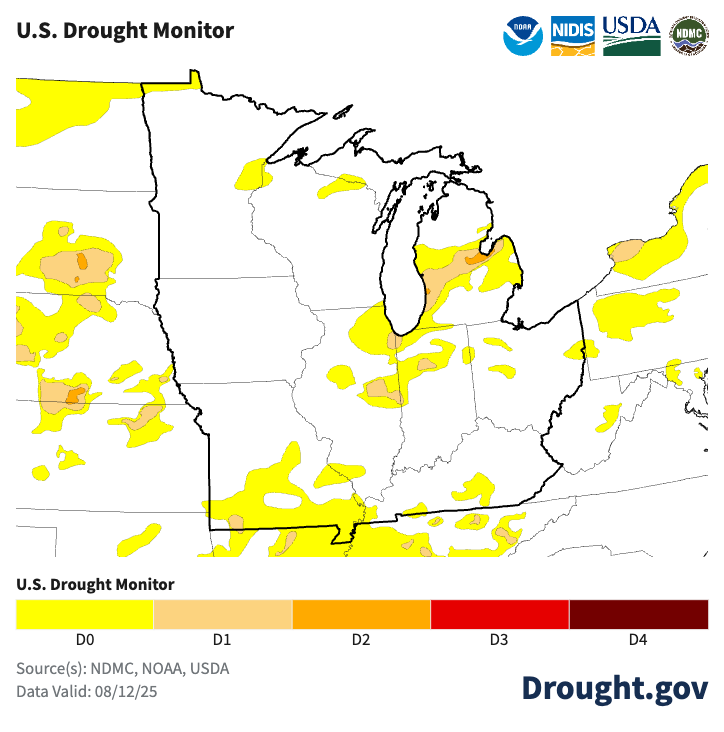
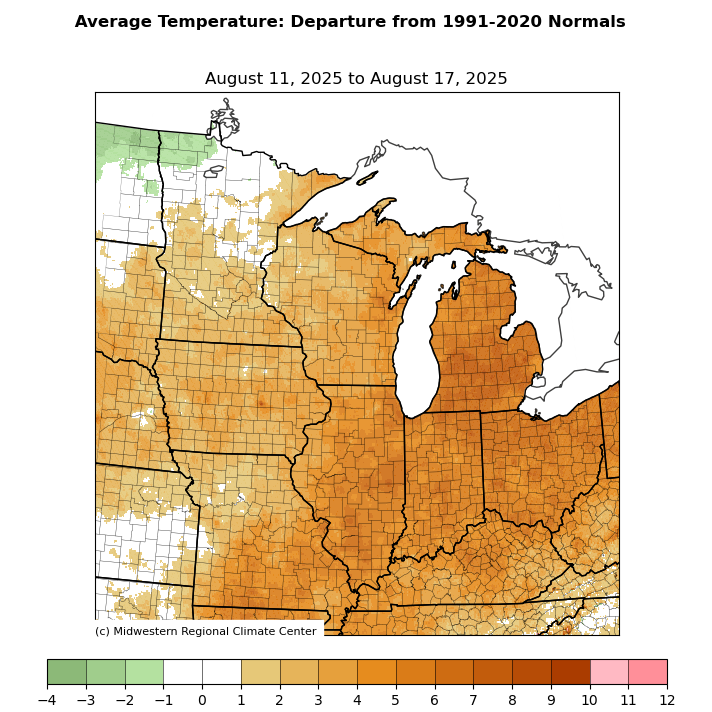
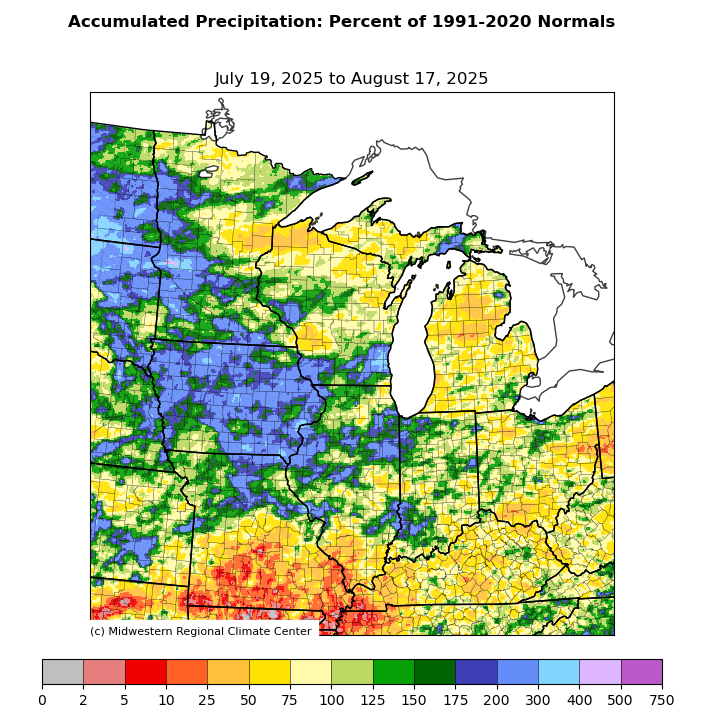
The August 12 U.S. Drought Monitor depicts Moderate to Severe Drought (D1-D2) across central Michigan, where drought has persisted since Fall 2024. The last 30 days were extremely dry and hot across portions of southern Missouri, southern Illinois, and western and central Kentucky, leading to the expansion of Abnormally Dry (D0) conditions in these areas, and Moderate Drought (D1) in southwest Missouri. Last week was particularly hot across the region.
| | |
Numerous impacts were reported within the last 7 days through media and the Condition Monitoring Observer Reports (CMOR) system, a nationwide service provided by the National Drought Mitigation Center, based at the University of Nebraska-Lincoln, developed in partnership with National Integrated Drought Information System (NIDIS) and the U.S. Department of Agriculture.
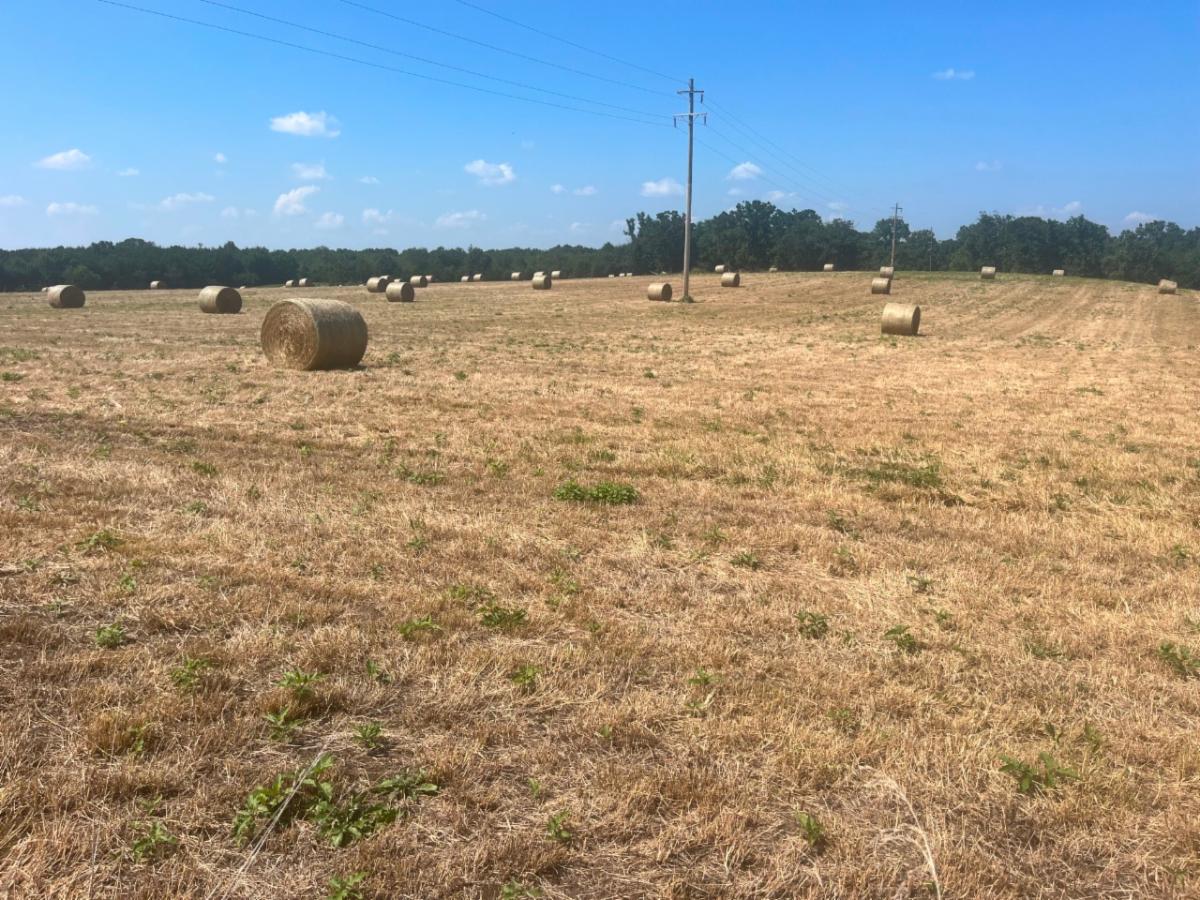
Image at right: Dry pasture in Henry County, Missouri. From August 13, 2025. Submitted through Condition Monitoring Observer Reports (CMOR).
Reported from southwest Missouri:
- Texas County: “Soybeans looked amazing from all the rain early, they are wilted and leaves dropping; grain isn't looking to be filled in pods…pastures are going brown and crunchy, and water in ponds and creeks is dropping fast. We haven't had good rain here in 40 days.”
- Bates County: “We haven't had a good rain since mid June. Ground is cracked, pasture is dead and we are 2-3 weeks away from feeding hay.”
- Lawrence County: “So far it is impacting hay production and increasing livestock stress.”
- Laclede County: “Pastures drying up, everything is brown and crispy.”
Other reports from around the Midwest:
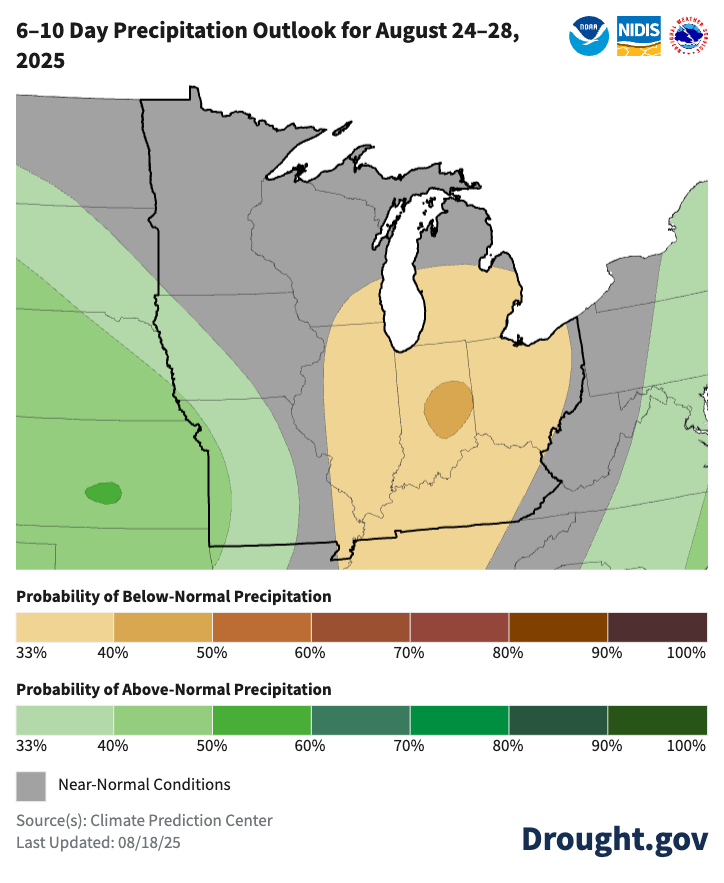
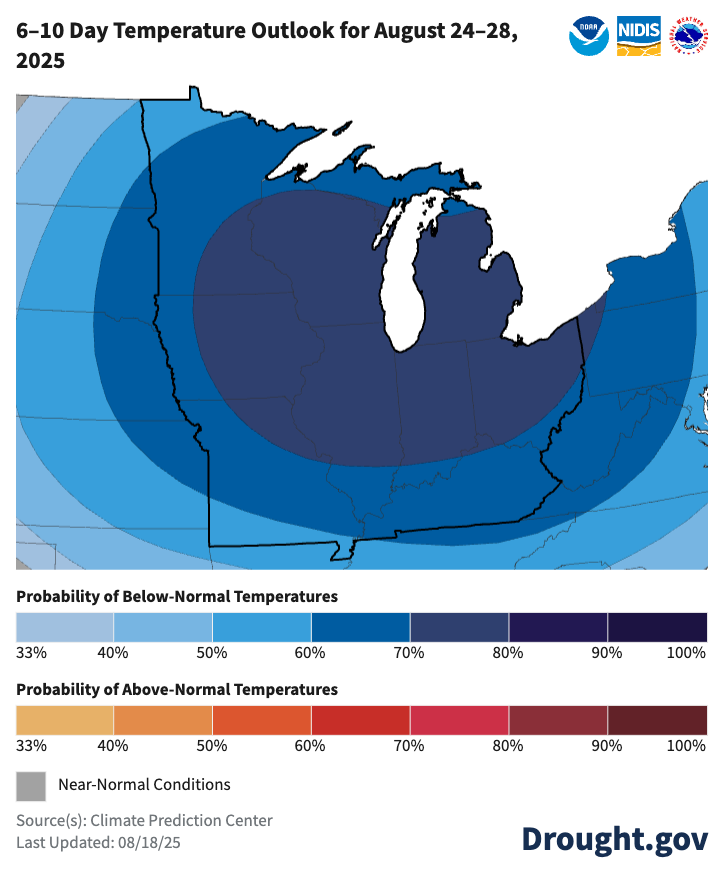
| | The 6-10 day outlooks indicate near-normal to below-normal precipitation across much of the Midwest, with the possibility for beneficial above-normal precipitation in western to central Missouri. There is a high probability for below-normal temperatures across the entire Midwest. Lower temperatures should help alleviate rapidly intensifying drought by reducing vegetative stress and evaporative demand. However, widespread rainfall is needed to slow down the developing drought. | | |
NIDIS will release additional updates in the coming weeks if drought continues to develop. In the meantime, keep up to date on conditions on Drought.gov.
You can also sign up for drought alert emails. Just enter your address, city, or zip code to receive emails when U.S. Drought Monitor conditions change for your location, or when NOAA’s Climate Prediction Center releases a new drought outlook, predicting whether drought will develop, worsen, persist, or improve in your area. Sign up >
| | As conditions evolve, accurate reports on conditions and drought impacts are critical to accurately assess what parts of the region are in drought and what parts are not. Whether your area is currently wet, close to normal, or dry, please consider reporting conditions and any drought impacts you see or hear via the Condition Monitoring Observer Reports (CMOR) from the National Drought Mitigation Center. If you are already a CoCoRaHS observer, we encourage you to submit a Condition Monitoring Report. | | | Upcoming Events & Resources | | Register Now! Drought and Health National Workshop in Saint Paul, Minnesota | | |
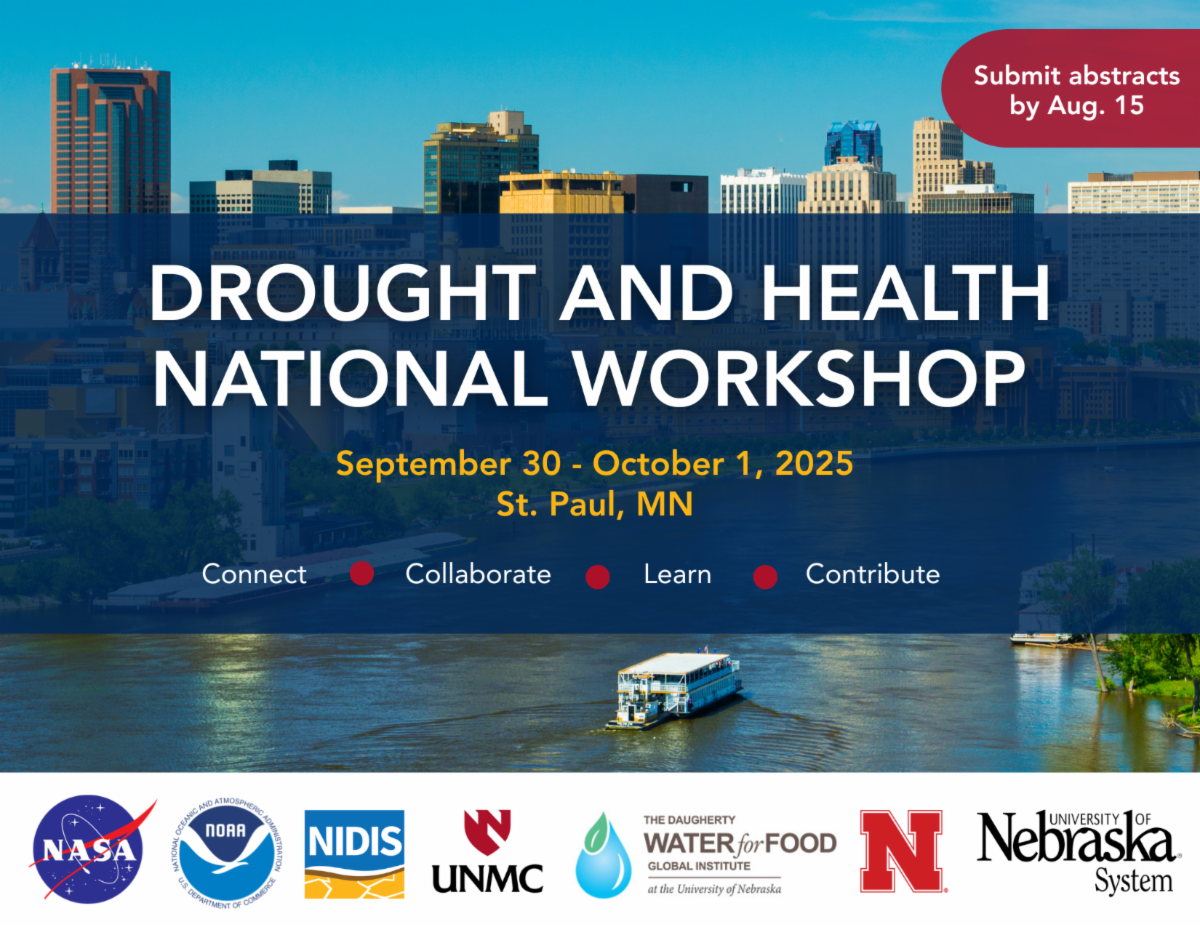
The Drought and Health National Workshop will bring together researchers, public health practitioners, scientists, and emergency preparedness professionals to accelerate the integration of science, policy, and practice at the intersection of drought and health. This workshop is taking place in Saint Paul, Minnesota from September 30-October 1, 2025 and is hosted by the University of Nebraska Medical Center in partnership with NIDIS, NASA, and the Daugherty Water for Food Global Institute. Register >
Do you have innovative research, programs, tools, or case studies that address the intersection of drought and health to share? If so, the call for poster abstracts is open until August 22, 2025. Submit your abstract through the registration form.
| New Report Informs Drought Response and Ecological Resilience to Low Flow Events | |
The Workshop on Drought and Aquatic Ecosystems in the Southeast in January 2025 brought together a diverse group of scientists and managers from diverse fields across the Southeast. A newly released Workshop report provides a comprehensive overview of the discussions, themes, and actionable strategies that emerged including insights on understanding drought/low-flow ecosystem impacts and water resources management in the context of the Southeast;, ecological drought monitoring and response in the near-term; and incorporating drought/low flow in long-term resilience and adaptation planning. Learn more >
| | Upcoming Events & Resources | | Forwarded This Email? Subscribe for Updates | Subscribe to the National Integrated Drought Information System’s Midwest DEWS list to receive drought status updates, webinars, and other drought news for the Midwest DEWS. Or, subscribe to NIDIS’s bi-weekly newsletter, Dry Times, to receive national news, drought research, and events. | | |
Thank you to the Missouri Climate Center, Kentucky Division of Water, and Illinois State Climate Office for their input on this early warning update.
The Midwest DEWS is a collaborative federal, regional, state, and local interagency effort to improve drought early warning capacity and build long-term drought resilience throughout the region. The Midwest DEWS currently includes Illinois, Indiana, Iowa, Kentucky, Michigan, Minnesota, Missouri, Ohio, and Wisconsin.
For additional information contact Molly Woloszyn, CIRES/NOAA/NIDIS.
| | | | |