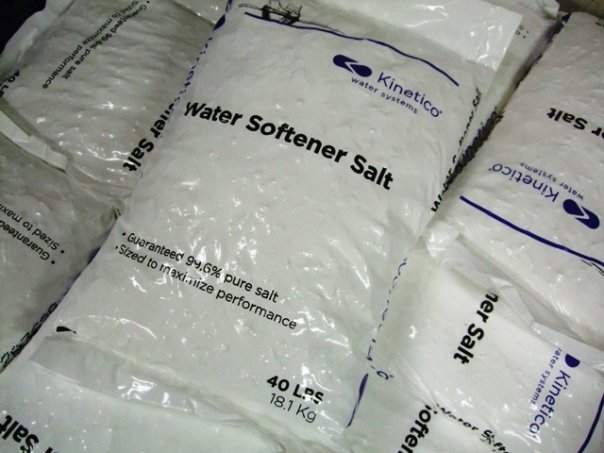
SO MANY DIFFERENT TYPES OF SALT!
Which to use?
As a water softener owner, you can see the salt in your brine tank is running low and it's time to pick up some more.
Like many people, you may be baffled by all of the water softener salt choices you see at the store: crystals, block, table, rock, pellets and cube.
Which is better? solar salt or evaporated salt pellets? What about salt pellets vs. potassium chloride pellets? What should you buy? Which is best?
First of all, only only salt or potassium chloride
specifically designed for water softeners should be used.
Do not use table salt or de-icing salt!
Water softeners and conditioners work effectively with either sodium chloride (commonly referred to as salt) or potassium chloride (actually, a type of salt, also).
Some of the softening salt pellets sold at your local supermarkets, gas stations or home improvement stores contain a high level of water-insoluble matter of impurities. This insoluble matter can cause buildup (bridging) in your brine tank or cause your softener to malfunction. If you notice buildup, the brine tank will need to be cleaned more often. So, as you are shopping for water softener salt, look for labeling on the bag that indicates that you are getting the highest level of purity.
SALT:
Let's first discuss salt (sodium chloride). Salt can come in four different forms:
1. Pellets
2. Cube
3. Crystal
4. Block
Salt pellets and cube salt are generally less expensive than potassium chloride.
Here is a breakdown of the available options:
Salt pellets or cube salt have the highest purity rating of the salts that are listed. The higher the purity of your salt (we prefer 99.6% pure salt), the less water insoluble matter. which means a far less chance of "bridging", "mushing", or insoluble buildup at the bottom of your brine tank that will need to be cleaned out later.
SOLAR SALT:
Solar salt is most commonly sold in the crystal form and is made through evaporating sea water. Solar salt is more soluble than rock salt, but may not work as well as pellets or cube salt when your water hardness level is very high.
ROCK SALT:
Rock salt resembles small rocks or pebbles. Although this type of salt is more economical, and therefore tempting, we don't recommend using it as it contains a high amount of calcium sulfate, which means that it won't dissolve well in water and can cause a lot of maintenance headaches.
BLOCK SALT:
Although not very common in our area, it is available. Block salt should not be used unless your dealer recommends it and raises the water level in your brine tank to ensure that the block(s) are fully submerged for maximum brine formation.
Like most things, it's best to spend a little more up front for higher quality. Purchasing a high quality cube or pellet salt will mean fewer cleaning and maintenance issues and will also help you achieve better results with your water softener.
POTASSIUM CHLORIDE:
There is one last option for your brine tank...potassium chloride. It may be used in place of salt (sodium chloride) in the brine tank to regenerate the softening resin. Potassium chloride is 99.9% sodium free and an alternative for those who are looking to reduce sodium intake.
Be aware that potassium chloride is generally quite a bit more expensive and not as easy to find as regular salt.
If switching from regular salt to potassium, or vice-versa, it may be necessary to adjust dosage setting on your water softener by 10% to ensure proper regeneration of the resin.
Contact your local dealer for assistance.
BRINE TANK MAINTENANCE TIPS:
We recommend that you check the salt level in your brine tank at least twice monthly. The more often your softener regenerates, the more often you'll need to check and add salt to the tank.
For optimal efficiency, we recommend the salt in the brine tank always be at least 3-4 inches above the water level, but less than 1/2 full. A brine tank that is full to the top is more likely to "bridge" or "mush" at the lower level.
When salt levels drop too low, you run the risk of not having soft/conditioned water. Check your salt levels regularly and don't let the salt in the brine tank fall below the level of the water.
Before adding new salt to the brine tank, always be sure to carefully loosen any encrusted salt that may be adhering to the inside perimeter of the tank and make sure any large pieces are broken up.
If the salt has formed one solid mass (known as a bridge), you can carefully break up the mass by pouring hot water over the bridge, making it easier to break up and remove.
If you have any questions about water softeners, types of salt or the hardness in your water:
Contact DuMor Water Specialists, Inc. at 1-800-WEDUMOR.
|