Dear TCCN Providers, Quality Champions and Practice Administrators,
 
On February 21st we announced our 2022 TCCN Subspecialty Quality Program. The continued focus for this year is to renew our commitment to excellence by focusing on moving the needle forward on quality improvement outcomes.
 
One of the requirements for this year’s quality program includes completing the TCCN Behavioral and Mental Health MOC Program or self-assessment (Non-ABP diplomates). We are requiring that 25% of providers in each subspecialty practice (excludes Pathology and Radiology) complete the following:

  • Providers with board certifications maintained through the American Board of Pediatrics (ABP) should complete the ABP’s self-paced MOC part 2 activity, “Emotional Health and Resilience for patients and families with Chronic Pediatric Conditions”. This MOC activity is free to ABP Diplomates and is based on the ABP’s Roadmap project, designed to bring additional awareness and training to providers around emotional, behavioral, and mental health. Please click here for an overview of the MOC program as well as the ABP Roadmap Project Site for additional resources. Following completion of the MOC activity, please sign the attestation and upload a copy of the MOC Certificate of Completion here in order to fulfill the requirement.
  • Providers without a board certification through the ABP should complete the Addressing Emotional Health: A Self-Assessment which includes resource documents from the MOC and 20 assessment questions. Please enter the Self-Assessment answers here and attest to completion of the activity in order to fulfill the requirement. If interested in more information, additional resources can be found on the ABP Roadmap Project Site.


The due date for completion of the Behavioral and Mental Health MOC Program is September 1, 2022.

Why it’s important to focus on Behavioral and Mental Health Education:

  • Research shows that mental health disorders are common in children and adolescents. It is estimated that approximately 50% of Americans will experience a mental health concern at some point in their lives, and most will originate in childhood.1 
  • Problems related to undiagnosed or untreated mental health concerns can have severe consequences and can significantly impact the quality of life for patients struggling with mental health disorders. Children with chronic health conditions are especially vulnerable.
  • Emotional health is tied to health outcomes. Children with mental health comorbidities who receive mental health services have significantly decreased rates of disease severity, exacerbation, lower healthcare costs and utilization.2

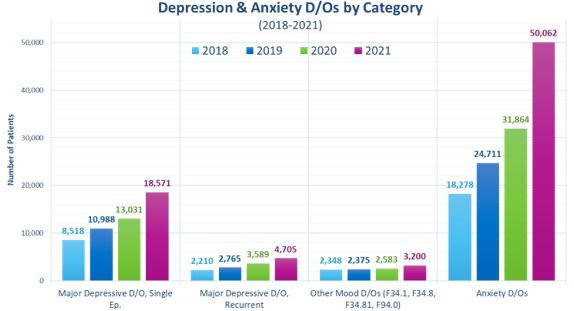
At the TCCN level, behavioral and mental health diagnosis in pediatric patients is increasing within our own communities. The chart below summarizes the increase of anxiety and depression diagnoses within the past four years, with significant increases in major depressive diagnoses between 2020 and 2021.
Why Pediatricians Should Emphasize Continuous Learning in Behavioral and Mental Health:
  • There is a gap between the growing need for intervention and provider’s confidence in diagnosing and treating behavioral and mental health concerns. Among pediatric residents and recent graduates, only 32.8% reported high competence in assessment skills for behavioral and mental health conditions and only 18.9% reported high competence in treatment skills.3
  • 65% of pediatricians, including subspecialists, surveyed by the American Academy of Pediatrics indicated that they lacked training in recognizing and treating mental health problems.4
 
Mental health is a priority. As a network, TCCN is committed to bringing awareness, education, and increased quality of care around behavioral and mental health. Together, we can work to achieve better outcomes to the patients, families, and communities we serve.

If you have any questions regarding these requirements, please reach out to Melissa Yeager at melissa.yeager@tccn-choa.org.

Thanks again for your time and commitment to TCCN.

Brad Weselman, MD
Executive Director          
The Children’s Care Network

 
Footnotes:
1,2 Heyman MB, Sandel A* Resolution #12,-2019 Annual Leadership Forum
3 Green C, et al. Pediatrics. 2020 July; 146 (1):2019-2884
4Horwitz SM, et al. AcadPediatr. 2015 Dec;15 (6):613–20
The Children's Care Network

Phone: 404-785-0101  l  Visit us at www.tccn-choa.org
Please add contact@tccn-choa.org to your list of trusted senders

"Great pediatric doctors and leading children's hospitals improving healthcare and the health of our children, because our children deserve it!"