|
There are plenty of dangers in hurricanes, from high winds to storm surge, but the rescue and recovery efforts hold another serious danger for deputies as they wade through floodwaters and cut through downed trees to search for survivors. “Probably the most hazardous thing that first responders face during and after the storm is electricity,” said Phil McGee, Duke Energy’s Lead Health and Safety Professional for the South Coastal Zone. “You can’t see it, smell it, hear it, or taste it until it’s too late, and then within six-tenths of a second, contact with high voltage lines can kill you. You can’t even snap your fingers that quick.”
Recently, McGee and others from Duke Energy presented a class to members of the High Water Response Team and the Hurricane Deployment Team to give them a better understanding of the dangers of electricity. They also present to many state, county, and city governments who have first responders or other employees who might be in a situation with a line down or damaged high voltage equipment. “What we try to do in these outreach programs is give them an understanding about electricity, what electricity is, how it’s produced. If they come across a situation such as a car hitting a pole and there are wires down, how do you handle that, what do you do?” The answer in almost all cases is to call Duke Energy, because electricity is something you can’t take chances with.
He taught them the basics of how electricity is made. “Making electricity is really simple. You can go home tonight and build your own power plant in the back yard, you just have to get the right equipment.” After a quick science lesson, McGee told them how the voltage – the measurement of electrical pressure pushing through a circuit – changes at different points in the process. “At our power generation plants, we produce 23,000 to 27,000 volts. We run it through a step-up generator that brings it up to 69,000 volts, 115,000 volts, 230,000 volts, all the way up to 500,000 volts.” From there, power is stepped down through transformers to 7,200 volts, which is what is running through roadside power lines. It is then stepped down further to the voltages required for industry or household usage.
A lot of different factors, such as amperage and electrical resistance or insulation, influence how damaging an electric shock can be, but as the many stories and videos McGee shared clearly show, no amount of electrical current running through the human body is entirely safe. Duke Energy crews wear rubber gloves that insulate up to 17,500 volts, and inspect their gloves carefully because the tiniest hole can lead to electrocution. For higher voltage, the only way linemen can work is live-line barehand, where they use an insulated bucket or ladder, don a conductive suit, and match their electrical potential to the line before they make contact.
PCSO recently got personal voltage detectors (PVDs) for deputies to use after hurricanes as they search for survivors amid fallen trees and downed lines. “Deputies can wear it around their neck or clip it to the front of their uniform, and it will tell them if there are any live lines or voltage in the area.” It gives both a visual and audio detection warning, flashing and making a high-pitched sound to tell deputies that there is voltage nearby. If the warning goes off, they need to immediately stop and retrace their steps.
McGee taught deputies about electrical dangers they might not have considered. Deputies might be able to recognize the difference between power lines and coaxial cable for communication lines, but they need to be cautious if they see any line down. “If we have wire with voltage down and it is laying on other cables, they are now energized at the same voltage.” Felled trees and the piles of debris caused by a hurricane can hide fallen power lines. A wire could be touching a chain link fence, and if someone touches the fence they will get shocked.
Another danger to power workers or first responders can come from residential generators. “Backfeed is something you have to really be careful of,” McGee said. Backfeed happens when a generator is incorrectly connected without a properly installed transfer switch. Electricity flows from the generator back to the power grid, so even if Duke Energy shuts off power in that area to make it safe for people to work on infrastructure or perform rescues, an improperly hooked up generator could be sending power back through the line. That’s dangerous for utility workers and rescuers, and it can also cause transformer explosions, and damage to the home if power is restored while the generator is backfeeding.
“Now a lot more people have generators, and very few know how to hook them up safely,” McGee said. “If we tell deputies that the power is out, they should still be aware that if someone has a generator in the neighborhood incorrectly hooked up it can be backfeeding up to 8,000 volts.”
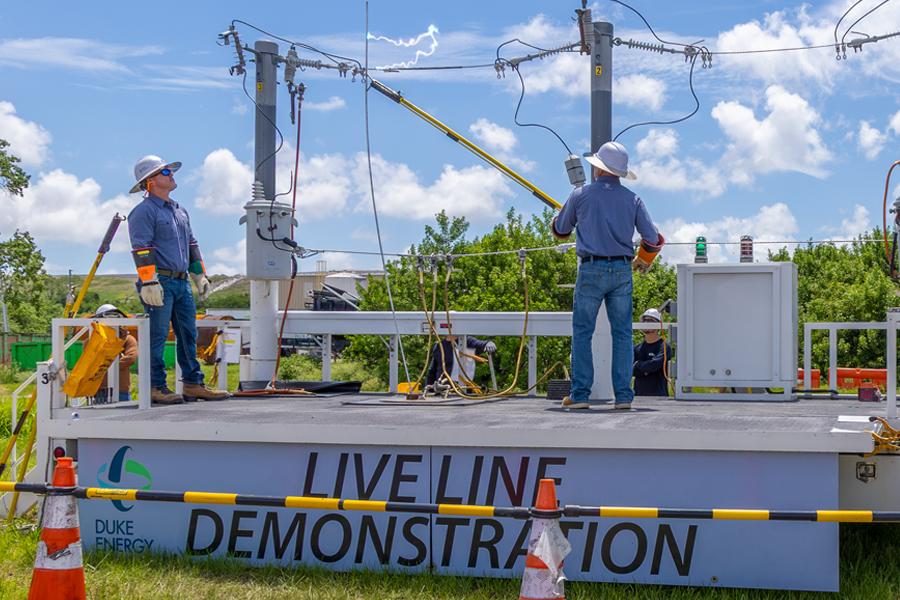
Duke energy workers performed a live demonstration, giving deputies the chance to see what happens when a squirrel (stuffed), ladder, or tree limb interacts with different parts of the power system. A hotdog simulating a finger inside an insulated glove with a pinprick hole showed the extreme danger to line workers if equipment fails.
McGee has decades of experience. He describes himself as an “old hooker” from the set of hooks or spikes he used to wear to help him climb a power pole. He last wore his hooks after Hurricane Katrina. Now he shares his wisdom with the deputies who put their lives on the line to help people after a hurricane strikes. Deputies were able to ask a lot of questions, such as how electricity travels through water. They came away from the training with a healthy respect for the dangers of electricity, and more knowledge about how to safely navigate those dangers to keep the county safe after a storm.
|