|
Dear Friends,
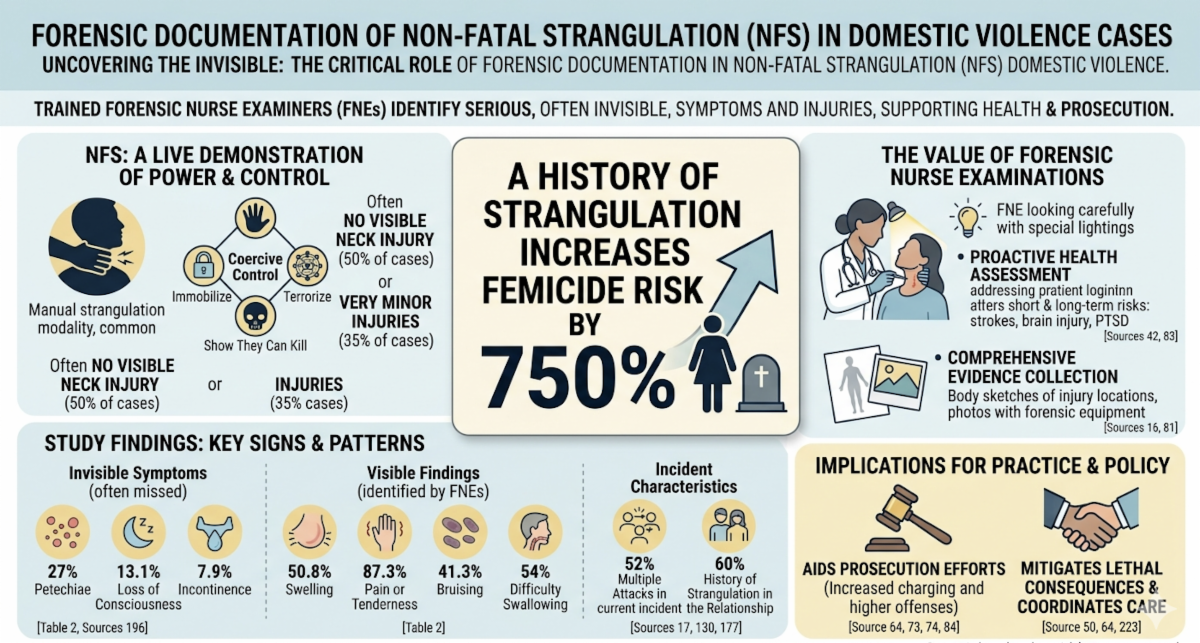
Dreams Do Come True. We welcome you to another edition of the Strangulation Prevention E-News. In this E-news, we are honored to share that after many years of advocacy, and multi-disciplinary collaboration, MORE victims of domestic violence and/or strangulation now have free access to forensic exams by well-trained, trauma-informed and compassionate forensic nurses and it is the FINALLY the prevailing trend. We are grateful to the many physicians and sexual assault forensic nurses who have been the pioneers in this field and providing exams to all strangled victims. For many years, the field has recognized that conducting strangulation forensic exams is best practice for health care providers (Faugno, et al, 2013).
As former prosecutors, we dreamed of the day victims of domestic violence would have the same access to forensic and medical services as victims of sexual assault, as a victim’s right through state and federal statutes. It was not only our dream but a recurrent request from hundreds of survivors from years of focus groups. They told us over and over again that they didn’t want to go a busy hospital. They wanted a safe and private place to go where medical professionals were specially trained to address their unique needs and were kind-hearted. They also wanted to receive medical services without blame, judgement or cost.
As early as 2003, then City Attorney Casey Gwinn decided not to wait any longer for state or federal legislation. At the San Diego Family Justice Center, he launched the first on-site Forensic Medical Unit in the nation for victims of domestic violence and strangulation. It was funded by the Office on the Violence Against Women in partnership Sharp Grossmont Hospital. The Forensic Medical Unit had a medical director, a forensic nurse practitioner and many volunteers to provide forensic and medical services to victims of domestic violence and strangulation. It resulted in more victims receiving medical evaluations, proactive health assessment and services, the identification of life-threatening internal injuries, the documentation for their injuries and accountability.
Today, many Family Justice Centers across America are providing both sexual assault and domestic violence at their centers thereby reducing the trauma victim experience and streamlining the process. One of the most robust Health Clinics at a Family Justice Center is at the New Orleans Family Justice Center. It is called the HOPE Clinic. The Clinic provides exams for victims of domestic violence, sexual assault, elder abuse and human trafficking victims. The Hope Clinic opened in 2019 and provides primary, behavioral health and forensic services. In a matter of weeks, the HOPE Clinic will have their Federally Qualified Health Center (FQHC) status and expand their behavioral and health services to serve children as well.
In 2023, we highlighted the first FIVE states that passed Domestic Violence Strangulation laws (Colorado, Washington, California, Nevada and Oregon). It was historic. Nevada’s law summarized it nicely under Section 217.405: A "strangulation forensic medical examination" is "an examination conducted by a medical provider for the purpose of assessing the health care needs of a victim of a domestic violence battery by strangulation and coordinating the treatment of any injuries of the victim." The law establishes that costs for such examinations "must not be charged directly to the victim" and "must be paid out of the Fund for the Compensation of Victims of Crime, unless there is not sufficient money in the Fund to pay such costs," in which case "the county in whose jurisdiction the offense was committed shall pay any remaining costs." Importantly, the law provides that "the filing of a report with the appropriate law enforcement agency must not be a prerequisite to qualify for a strangulation forensic medical examination."
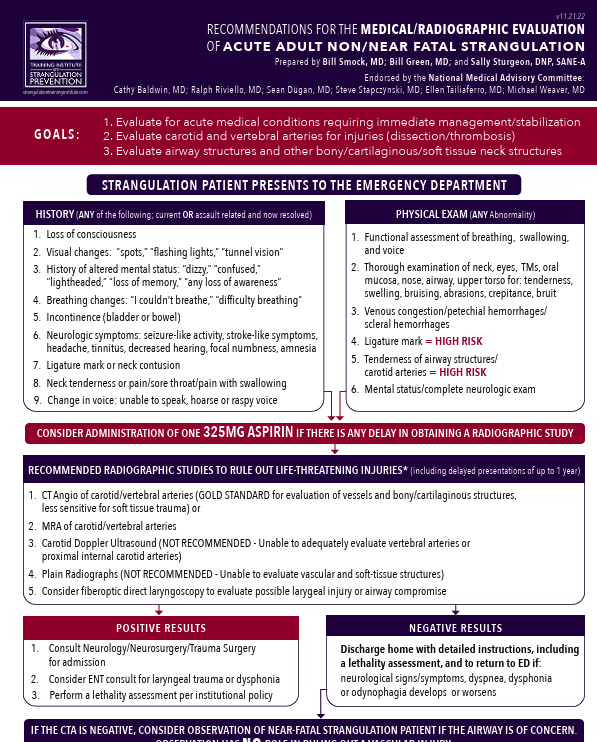
Today, SEVEN additional states have expanded forensic exams to include victims of strangulation either by law, Attorney General Directive or by a state grant (New Jersey, Utah, Virginia, Georgia, North Dakota, Maine and Kentucky). We are also excited to see other states with developing or pending legislation (Georgia, Louisiana and Wisconsin). There is recognition that crime victim compensation funds should be used for forensic medical exams and imaging for both victims of sexual assault and domestic violence (Zwig, et al, 2014). Focusing on strangulation crimes saves lives and improves well being, it is time to catapult our efforts to provide a higher level of care to all victims of strangulation. (De Assis, et al, 2025)
Below you will find links to the state laws and policies providing access to forensic exams, imaging and/or kits to ensure the highest standard of medical care, diagnosis and treatment.
You will also find a list of key sections from various states to assist in your efforts to pass similar laws in your state or even improve your existing law or policy.
As always, we extend our heartfelt thanks to all those supporting survivors of violent crimes. Your actions, small and large, matter.
Always with great Hope,
Gael Strack and Casey Gwinn, Co-Founders
|