|
The Native Hawaiian Place of Learning Advancement Office at UH Mānoa focuses on implementing recommendations from Native Hawaiian reports authored over the last 30 years that guide UH Mānoa in becoming a Native Hawaiian place of learning; a place that is responsive to kanaka (Native Hawaiian) communities and reflective of Native Hawai‘i for ALL people to learn, connect, grow, and heal from:
- Native Hawaiian Student Success
- Native Hawaiian Staff and Faculty Development
- Native Hawaiian Environment
- Native Hawaiian Community Engagement
We cannot do this work alone. It is our mission to foster the potential within each of you to positively contribute to our collective kuleana to make UH Mānoa a Native Hawaiian place of learning. These monthly newsletters are meant to keep you connected, highlight your work and continue to inspire you.
| |
GOALS:
- Native Hawaiian students are holistically supported from recruitment through post-graduation.
- Best practices are gleaned from efforts to support Native Hawaiian students and are applied to student success strategies for all students across the campus.
| |
Welina Pasifika
by Kawehionālani Goto
| |
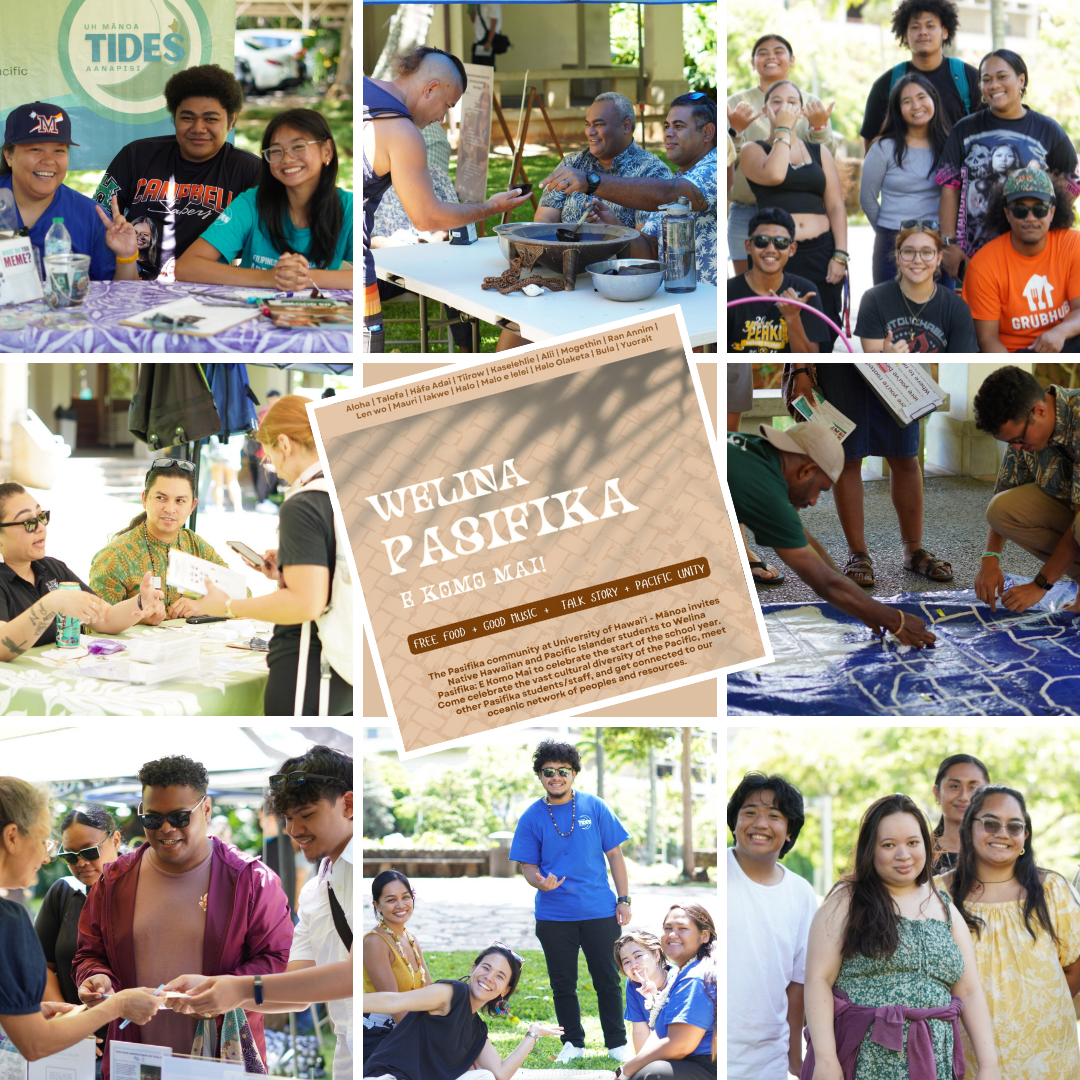
A collage of photos from the 2024 Welina Pasifika event of students engaged in event activities. | |
|
Earlier this semester, the Mānoa campus community celebrated the 2nd annual Welina Pasifika gathering. This event welcomed new Pasifika/Pasefika students joining the UH Mānoa ʻohana, introducing them to the peoples, spaces, and organizations that support students like them across our campus.
As I witnessed the ways students were so intentionally welcomed and cared for that day, I couldn't help but feel cared for too by our cousins and relatives across the Pacific who, for just a moment or for many years, will call our Mānoa campus their home. As we continue throughout this school year, I wonder how the breadth and depth of our cultural differences will (re)connect us so that we may better mālama one another and our resources for a future that is abundant, unified, and rooted in aloha. What are some ways you welina one another and this place?
Mahalo to all the organizations who comprise the oceanic network of peoples, resources, and community who make this event possible. We can't wait for next year!
Learn about last year’s event here!
| |
GOALS:
- Native Hawaiian staff & faculty are holistically supported from recruitment through promotion and leadership development in every unit across the campus.
- All staff & faculty at UH Mānoa are more knowledgeable and culturally rooted in Mānoa and Hawai‘i.
| |
Julian Aguon, "On Earning Hope for the Future" | |
|
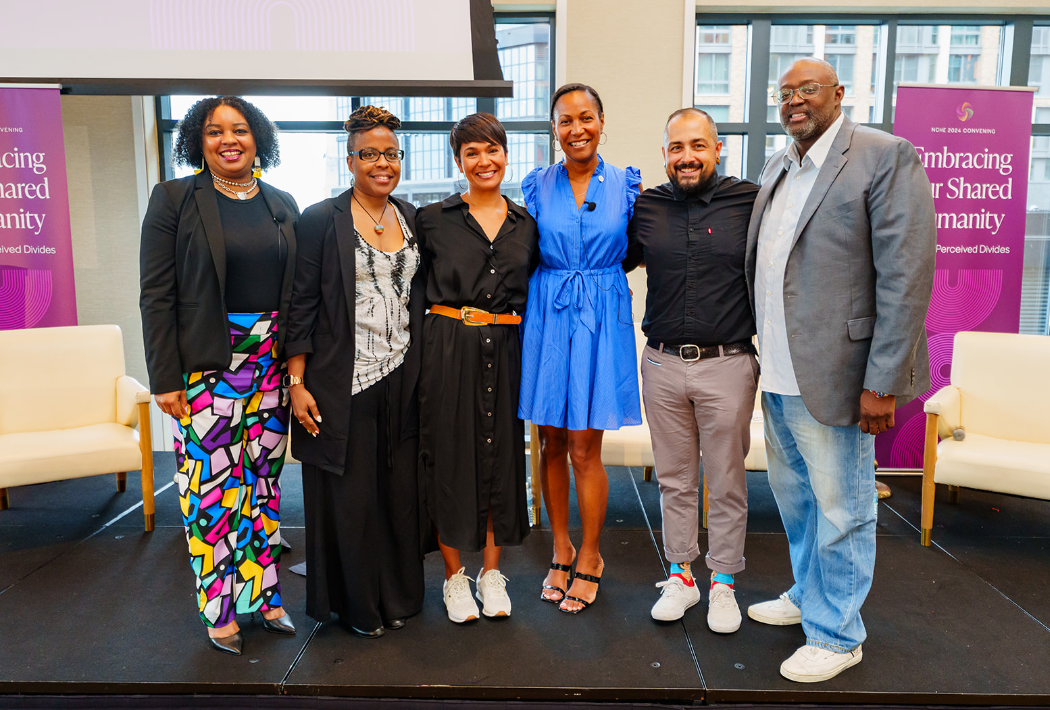
As the Dan and Maggie Inouye Chair in Democratic Ideals, a position administered by the Department of American Studies in the College of Arts and the William S. Richardson School of Law, Julian Aguon gave a talk entitled “On Earning Hope for the Future” at Orvis Auditorium.
Aguon constellates Indigenous activism among the most vulnerable communities in Oceania who are subjected to the effects of climate change and policies. From Papua New Guinea, to the Marshall Islands, to Vanuatu, rising seas are redefining our practices of survival. He importantly reminds us that “only a new story can call a new world into being.” Gently yet urgently, his storytelling expertly revives the art of intimacy in climate conversations that so often are dominated by despair. As he painted vivid images and colors of ceremony, he took pride in retelling cultural practices, proving that beauty is his people’s love language. Because of Aguon’s pilina and close ties with many UH Mānoa faculty and staff, his continued work and writing continues to inspire on-campus narratives of creating new worlds.
As an alumnus of Richardson School of Law, Aguon also spoke about the ways in which Hawaiʻi, in addition to his homeland of Guåhan, has helped to shape his development. Nourished by the winds, rains, and soils of this place, the care and aloha that he has for Hawaiʻi is evident in the time he takes to give back to our UH Mānoa campus and share his inspiring words and work with our community. For faculty and staff who are from outside of Hawaiʻi, or for folks who have ties and homelands elsewhere, Aguon reminds us of the beauty and change capable when we allow ourselves to cultivate personal and even professional relationships with the land.
| |
GOAL:
UH Mānoa campus is a physical, cultural, spiritual, and interactive environment that exemplifies the values of ‘ohana and community, mālama ‘āina, and kuleana; thereby, perpetuating Native Hawaiian values, culture, language, traditions, and customs.
| |
|
Moʻolelo Calendar Project
by Kamakani Albano
| |
|
The NHPoL Moʻolelo Calendar Project website featuring the Hawaiʻi Kuʻu Home Aloha 2024 Keynote.
Photo credit: OCCE, Phil Lampron VISTA Leader
| |
|
The Native Hawaiian Place of Learning Advancement Office is excited to share our Moʻolelo Calendar Project, a social media project that highlights important Native Hawaiian cultural, historical, or commemorative events, from which community members are then invited to share their own moʻolelo (stories) inspired by a monthly prompt related to the featured event. This project was born out of wanting to find connections amongst our diverse communities through learning more about Hawaiʻi.
In September, we honored the life and legacy of Queen Liliʻuokalani, whose leadership, steadfastness, and aloha for her people and nation can inspire stories that remember wāhine (women) in our cultures, families, and communities whose love and leadership propels us to act.
It is my hope that through featuring our various stories, we remember our kuleana (responsibility) to Hawaiʻi and her keiki (children), while breathing life into the connections we have to one another across cultures, ʻāina (land) and genealogies. For more information on this project, visit the UH news story. To share your stories and to see stories that have been shared since the first feature in May, visit our Instagram @nhpolmanoa
| |
GOAL:
UH Mānoa and Native Hawaiian communities are consistently connected and engaged in order that there can be reciprocal teaching and learning for positive impact throughout Hawai‘i.
| |
|
Pilina Circles in Waiʻanae
by Nick Childs
| |
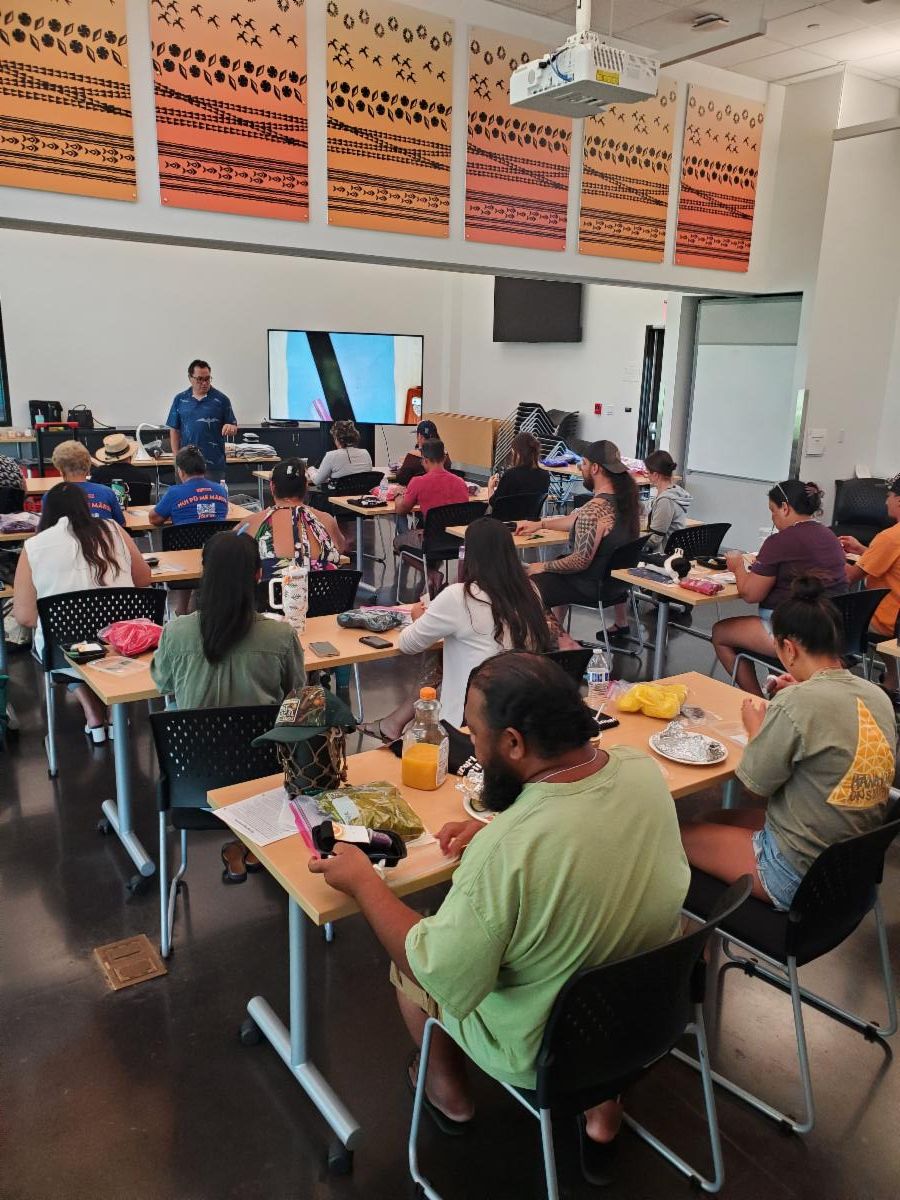
Participants engaged in a hana noʻeau workshop funded by the Kamehameha Schools Kaiāulu grant. | |
|
In partnership with Kamehameha Schools Kaiāulu, and at the invitation of our community, our office is hosting Pilina Circles throughout the Waiʻanae moku! The purpose of this partnership is for us to provide learning opportunities rich in Hawaiian culture, ʻōlelo Hawaiʻi, and ʻāina.
This is so exciting as within our goal of becoming a Native Hawaiian place of learning is one strategic focus area: Native Hawaiian Community Engagement. Part of this kuleana means bringing our methods in repairing the disconnection of pilina between one’s self, one another, and ʻāina outside of UH Mānoa. This semester we are doing this through five Pilina Circle experiences, where community members in Waiʻanae are invited to come together and reaffirm and rediscover their pilina through storytelling and deep listening, enjoy ʻono food, and hana noʻeau.
Our structure of the events is extremely important. Starting with location, accessibility is such a challenge so we are hosting workshops throughout the Waiʻanae moku in common gathering spaces; we need to be where the community is at. This also means timing since most people work during the week so we intentionally schedule our workshop on Saturdays, providing healthy and nutritious breakfast snacks and lunch so people have one less concern for the day.
This past event we provided fresh fish and tofu from a Hawaiian owned, Waiʻanae company, and faces lit up with excitement the moment we mentioned their name to our participants. It goes without saying, and all the food was eaten by the end of the day. We are so often limited in healthy choices, being surrounded by unhealthy fast food, and our community tells us again and again that they are craving a healthy, nutritious, and accessible diet.
After a pilina circle and lunch, we then engage in hana noʻeau, or as some say “hana me ka lima.” In two of our workshops, we have taught how to make niho ʻoki and ulana lauhala from Pūlama Long at Honi Hala. Through this hands-on work, our participants built relationships with the physical act of creating mea Hawaiʻi, reconnecting them with ancestral knowledge while providing a sense of accomplishment contributing to our well being.
When I reflect on these events, one story sticks with me: Following one of our workshops, I was helping a small group finish their niho ʻoki. After finishing lashing the shark tooth, one person shared that their niho ʻoki was something that was now one of their most precious things. The different kinds of relationships being made with self, each other, and ʻāina are starting to make themselves very apparent. With our last workshop on December 14th, my hope is that these opportunities are impactful.
| |
NĀ LAMAKŪ O KE ALOHA ʻĀINA | Nā Lamakū o ke Aloha ʻĀina is our office’s monthly feature that illuminates the light within each person’s contributions to positively shape our UH Mānoa campus as a Native Hawaiian place of learning committed to mālamalama. We feature an individual who exemplifies and demonstrates aloha ʻāina through their actions and involvements on our campus, particularly as leading lights in their own respective communities and disciplines of engagement. Through this interview, we aim to honor the ways in which the featured lamakū’s time at UH Mānoa has shaped and ignited the flame for/within their practices. | |
Nick Childs, this month's lamakū | |
|
Nick Childs
Birthplace/Hometown:
Chek Chue, Hong Kong
High School:
Scripps Ranch High School, San Diego
UHM Degrees:
BA in History (2014)
MA in Political Science (2020)
Current Occupation:
Program Specialist at the
Native Hawaiian Place of Learning Advancement Office
What inspired the path for your academic major?
So I moved to North America after spending most of my formative years living in various countries in Asia and Europe. Being fairly transient, I have always felt some interest in the histories and the politics surrounding international relationships and governance. While in my undergrad, I was exposed to so many amazing professors who helped me discover a passion for engaging with the different relationships between colonial systems and indigenous communities, which in many ways impacts how I approach the work I do today. I am currently furthering my fluency in ʻōlelo Hawaiʻi, and in my study I am reminded of the significance of how these relationships impact the ways I am both taught and receive these contemporary interpretations of learning.
How did your academic major lead you to the work you are currently doing?
After my undergraduate degree, I really wanted to both help people in Hawaiʻi and give back to the communities who put so much into me. I started working as a program specialist serving Nānākuli high school students, and have been working in community ever since. When it comes to leading into my work, studying history and politics has been such a large part of how I try to understand the ways the world influences our relationships. I don’t think my major led me directly to the work I am currently doing, and the work I do today is so influenced by the passion and skills I cultivated which are now a part of my daily practice.
We believe that at the heart of a Hawaiian place of learning is aloha ʻāina: the constant care for and reciprocation with Hawaiʻi's people, places, and practices. How do you see your time at UH shaping the way you aloha ʻāina?
My first supervisor was Paul “Teeny” Pakahanui Richards, and he connected me with members of the Nānākuli community that helped ground me in what aloha ʻāina means: the reciprocal process of caring deeply for the people and places that in turn feed us. Considering that initial foundation, being at UH lends me opportunities to connect with kumu who are rooted in aloha ʻāina, and I feel very privileged as both a haumāna and a malihini that many kumu are so willing to share this knowledge.
What are your future goals in your work?
My immediate work-related goals are to help bring our work at UH into our Native Hawaiian communities. I was brought on to support our work at the university, and since part of the Native Hawaiian Reports speak to what we can do to be more supportive of Hawaiian communities, we are currently piloting what it looks like to bring our Pilina Circles into community. In the future, I would like to continue taking our Pilina Circles into our different mokupuni, moku, and ahupuaʻa, while moving to the next level in training co-facilitators; a goal is for people in their own communities to use this knowledge in building their own community building practice. As a side note: a personaI goal of mine is to elevate my own language fluency in ʻōlelo Hawaiʻi. I feel like this is a kuleana of everyone in Hawaiʻi, including/especially malihini in Hawaiʻi to honour the people, places, and practices of Hawaiʻi and her people.
What does UHM as a Hawaiian place of learning mean to you?
For some on campus, like in our office, UHM as a Hawaiian place of learning means a place that is both responsive to Native Hawaiian students, faculty, staff, and reflective of Hawaiian language, culture, and values for all people to learn from. Considering my own positionality, I am here to support that vision as a pillar to uplift and put energy towards the needs and the wants of Hawaiians on campus, and support all of our campus community to move towards this goal. I am so grateful to all those who have mapped out what a Native Hawaiian place of learning can look like in the Native Hawaiian reports, as they are so helpful in conceptualizing what steps I can take in my role to help us all get there.
| | | | |