The Native Hawaiian Place of Learning Advancement Office at UH Mānoa focuses on implementing recommendations from Native Hawaiian reports authored over the last 30 years that guide UH Mānoa in becoming a Native Hawaiian place of learning; a place that is responsive to kanaka (Native Hawaiian) communities and reflective of Native Hawai‘i for ALL people to learn, connect, grow, and heal from:

  • Native Hawaiian Student Success
  • Native Hawaiian Staff and Faculty Development
  • Native Hawaiian Environment 
  • Native Hawaiian Community Engagement

We cannot do this work alone. It is our mission to foster the potential within each of you to positively contribute to our collective kuleana to make UH Mānoa a Native Hawaiian place of learning. These monthly newsletters are meant to keep you connected, highlight your work and continue to inspire you.

NATIVE HAWAIIAN STUDENT SUCCESS
GOALS:
  • Native Hawaiian students are holistically supported from recruitment through post-graduation.
  • Best practices are gleaned from efforts to support Native Hawaiian students and are applied to student success strategies for all students across the campus.

GRA Kauwela Feature:

Kekuhi at FestPAC and Smithsonian Folklife Festival

by hope matsumoto

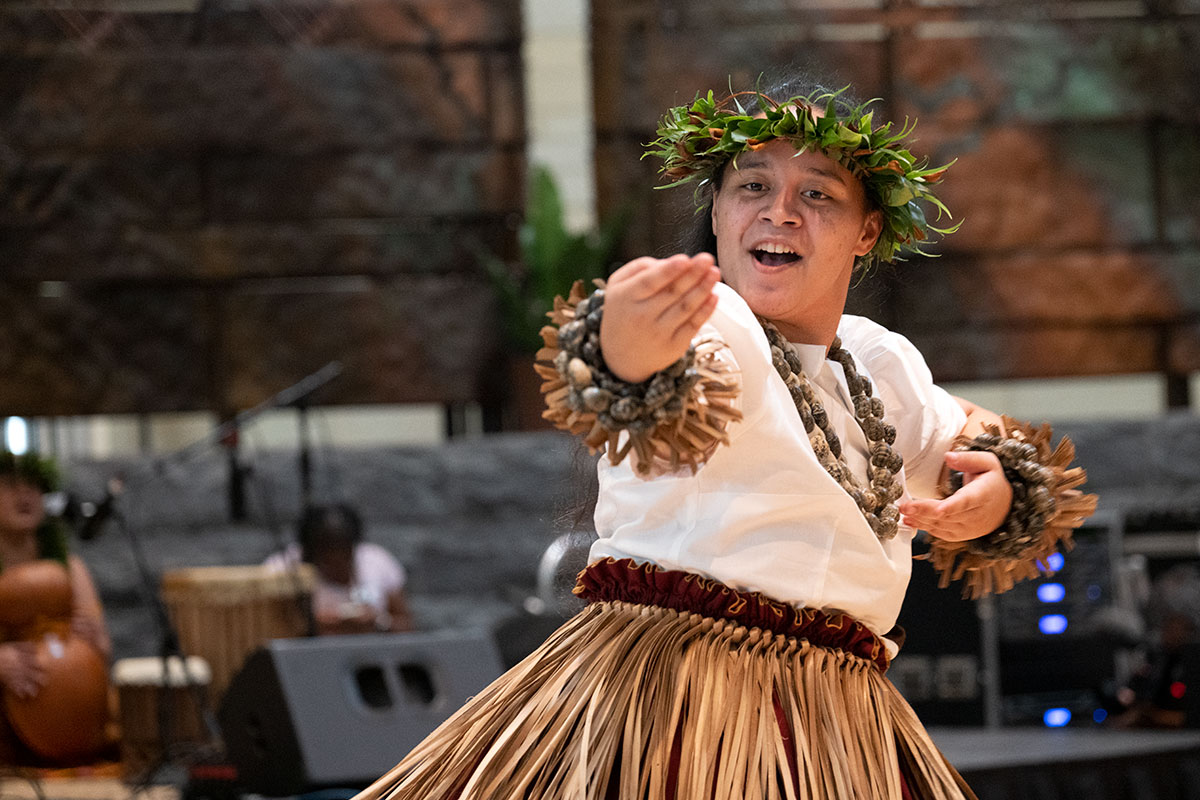
Photo of Kekuhi dancing at the Smithsonian Folklife Festival

 PC: Stephen L. Kolb, Ralph Rinzler Folklife Archives

With the 13th Festival of the Pacific Arts & Culture (FestPAC) hosted in Hawaiʻi and the 2024 Smithsonian Folklife Festival in Washington DC, our office’s GRA and Political Science PhD student Kekuhi had a full summer preparing for these events and travels with Hālau O Kekuhi. Mahalo nui e Kekuhi for talking story and reflecting upon your experiences!


The themes for FestPAC and the Smithsonian Folklife Festival were Hoʻoulu Lāhui: Regenerating Oceania and Indigenous Voices of the Americas, respectively, and as our conversation spanned these two events on opposites sides of the continental US, Kekuhi offered manaʻo on what it means to hold space and what it means to show up for other people. Hawaiʻi hosted multiple nations from around the Pākīpika this summer, and even from the beginning, holding space during the hours-long opening ceremony was testament to the ability to show up for the nations who had dedicated countless hours preparing and rehearsing for that night and throughout the festival.


As our conversation shifted to the Smithsonian, Kekuhi brought up the contrast of what it meant to travel to and perform within the heart of an empire. As she spoke about performing in the heat of the Washington DC sun, she reflected on how the East Coast sun is so different from Hawaiʻi, where we have various elements to help protect and cover us from the intensity of the rays. In acknowledging this difference in ʻāina, Kekuhi then acknowledged the Indigenous people and practices of that area, who have their own adaptations and well-versed methods for surviving that type of heat, especially as the landscape has changed over time.


By weaving threads among our stories, Kekuhi addressed the simultaneity of her experiences this summer through reflecting that a range of emotions are capable of coexisting in our bodies—we feel both grief and joy. We feel the intensity of the sun while remembering the heat of home; Indigeneity is local and global. We show up and we hold space because of the strength of our communities. Mahalo nō e Kekuhi for sharing about your experiences with us and for bringing such important manaʻo into your work!

Summer 2024 Hawaiʻi Youths Abroad Summer Program

by Kamakani Albano

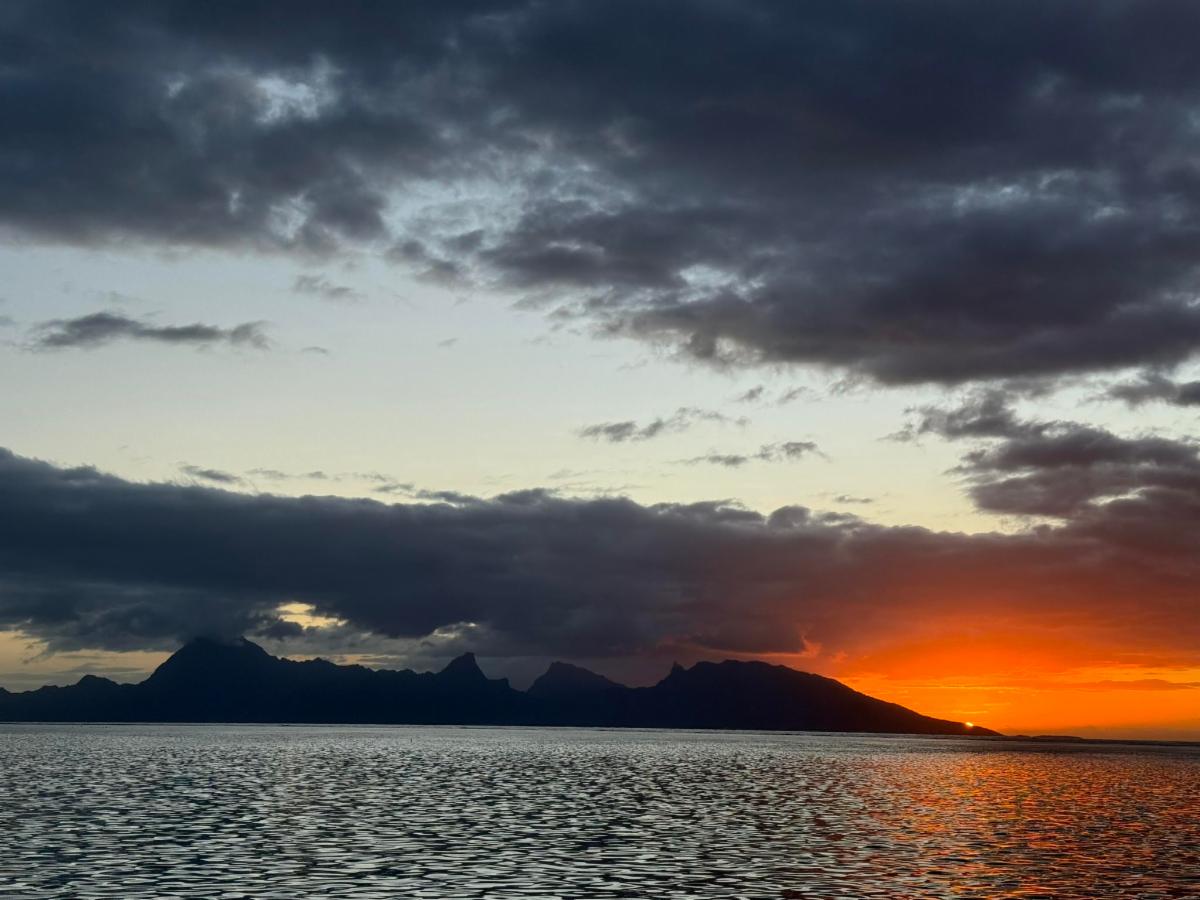
The sun setting off of the island of Moʻorea

PC: Kamakani Albano

To participate in a huakaʻi to the islands of Tahiti, Moʻorea, and Raʻiātea and deepen our genealogical pilina to Māʻohi Nui was an opportunity that I will forever cherish, so I am incredibly grateful to Native Hawaiian Student Services, my fellow haumāna, our kumu, and all supporters of this year’s cohort of the Hawaiian Youths Abroad Program. To be greeted by and meet kūpuna and community leaders of these ʻāina—he alo a he alo—inspires me to think about how we remember our moʻolelo through being physically with ʻāina and listen to our bodies. The power of place names is one important lesson I take with me after returning home, and I continue to beautifully shaken especially by my experience in Raʻiātea, whose ancestral name is Havaii and reminds me so much of home. May remembering our genealogical travels, sharing our stories, learning and speaking our languages, and breathing life to names of fenua continue to guide how we build pilina here in Hawaiʻi. To learn more about my experience in Māʻohi Nui, please visit my blog post. For more information on the Hawaiʻi Youths Abroad, click here.

STAFF & FACULTY DEVELOPMENT
GOALS:
  • Native Hawaiian staff & faculty are holistically supported from recruitment through promotion and leadership development in every unit across the campus.
  • All staff & faculty at UH Mānoa are more knowledgeable and culturally rooted in Mānoa and Hawai‘i.

Cancer Center Employee Appreciation

by Nick Childs

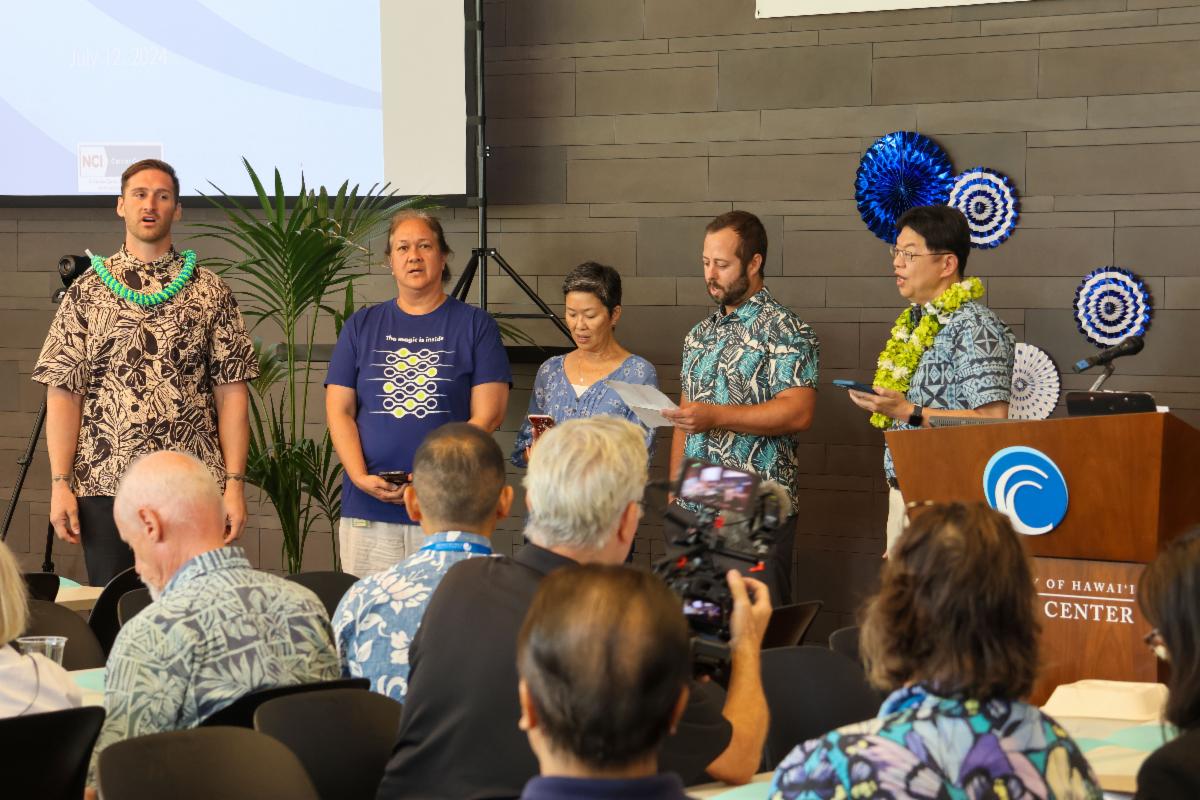
Pictured: Cancer Center members and NHPoL team member, Nick Childs chanting Welina Mānoa

PC: University of Hawai‘i Cancer Center / Gregory Yamamoto

UH, Mānoa’s Cancer Center invited the NHPoL team to celebrate their participation in Cohort Kumukahi and their historic milestone in receiving the extension of their National Cancer Institute designation. Joined by previous Cohort Kumukahi participants Taylor Lowe, Naoto Ueno, Annette Jones, and Lenora Loo, we opened the ceremony by chanting Welina Mānoa to an eager Cancer Center crowd. Following the oli and recognition of our Cancer Center partners, I presented a short history of Welina Mānoa that introduced the community to some of the unique place names and values that exist within our shared ahupuaʻa, emphasizing our connection from Mānoa to the Cancer Center at Kaʻākaukukui. During the highlight of the Cancer Center’s participation, this presentation stressed the importance of the collective response we need to make as a means to provide for Hawaiian well-being while simultaneously being reflective of Hawaiʻi’s language, history, and culture as the steps we are taking to become a Native Hawaiian Place of Learning. We extend a warm invitation to the ready and willing to join us in the October contingent of Cohort Kumukahi, as we need you to make this vision come to fruition.

NATIVE HAWAIIAN ENVIRONMENTS
GOAL:
UH Mānoa campus is a physical, cultural, spiritual, and interactive environment that exemplifies the values of ‘ohana and community, mālama ‘āina, and kuleana; thereby, perpetuating Native Hawaiian values, culture, language, traditions, and customs.

TRHT Changemakers in DC

by Dr. Punihei Lipe

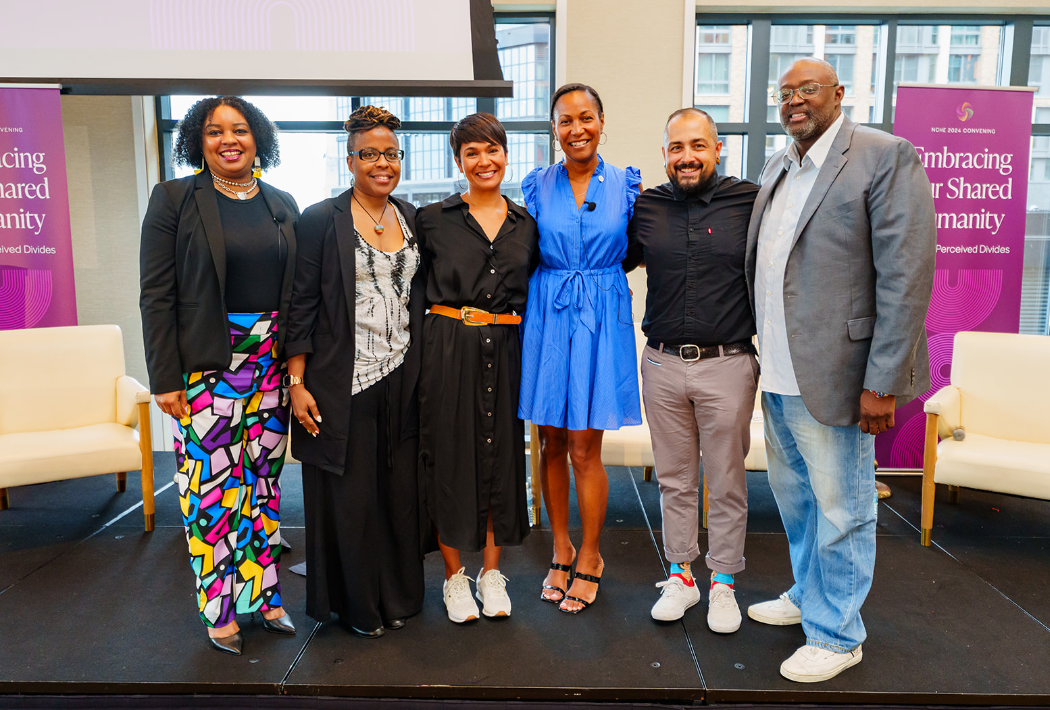
A photo of a panel (from left to right): Ina Robinson, Regina Campbell, Kaiwipuni Lipe, Felicia Beard, Enrique Orozco, Dirk Butler.

My journey with the Truth, Racial Healing & Transformation™ framework started in 2017 when UH Mānoa became a TRHT Campus Center, as a way to support the campus' commitment to becoming a Native Hawaiian place of learning. Since then I have become a student of the framework with the goal of supporting our campus and communities. In June of this year I was so honored to work and learn alongside TRHT change-makers from across Hawai‘i and the United States in a multi-day gathering. I was particularly excited to meet people who have been leading TRHT work in communities and also those who have been part of the Culture of Health Leadership Institutes for Racial Healing. We were able to share strategies, grow our network, and think about how to grow the TRHT movement. On the second day of the gathering I was humbled to sit alongside those pictured in the photograph to share some of the work we are doing in various pillars of the TRHT Framework. Regina spoke on her narrative change work with the Rikers Memory Project, I spoke on our work at UH Mānoa around using Native Hawaiian principles to guide our racial healing, Felicia spoke about her work in transforming the economy at the Community Foundation for Greater Buffalo, Enrique highlighted his work in the separation pillar through the Compañeros in Durango, and Dirk spoke to his work in transforming legal structures in public safety. Check out their work and get inspired! I was and I've brought that energy home with me to serve all of you. 

NATIVE HAWAIIAN COMMUNITY ENGAGEMENT
GOAL:
UH Mānoa and Native Hawaiian communities are consistently connected and engaged in order that there can be reciprocal teaching and learning for positive impact throughout Hawai‘i.

Community Collaboration Annoncement:

NHPoL & Kaiāulu

by Nick Childs

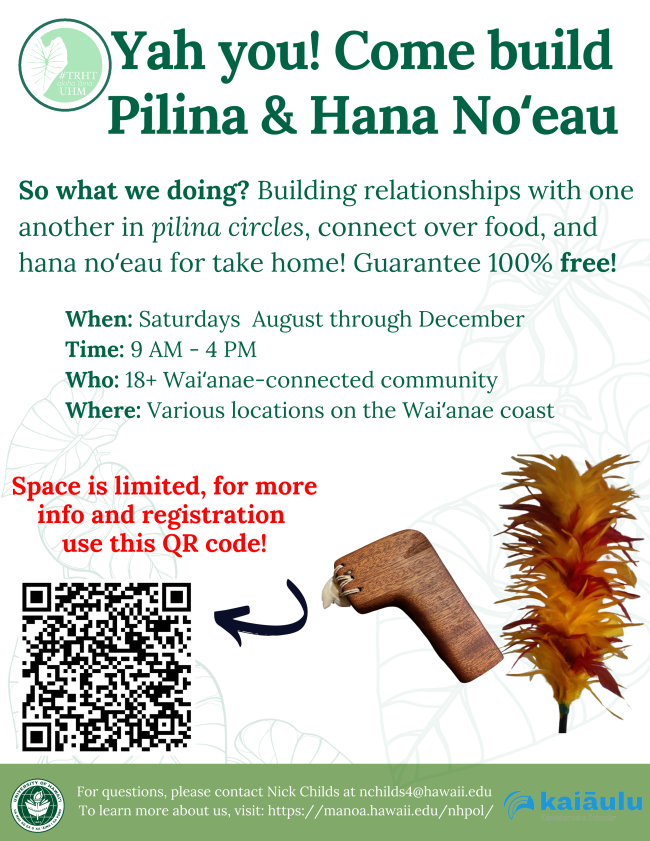
Please use the QR code for more information, and be sure to share with your friends!

E nā hoa! E hele mai and come build pilina with us in Waiʻanae! This fall NHPoL is bringing pilina building events to Waiʻanae, which will introduce you to different pilina (relationship) building processes that strengthen our emotional and spiritual selves and create long-lasting support systems with one another. My own pilina to Waiʻanae started from serving Nānākuli and Waiʻanae high school students in their journey to higher education, and we are going to continue building community with those who live and breathe Waiʻanae! Our day will have you taking part in pilina circles and activities in aloha ʻāina and hana noʻeau led by some of our Waiʻanae-connected ʻohana. 


Our programming takes place between 9am and 4pm at different locations on various Saturdays, from August through December in Waiʻanae. Please take a moment to look at the above flyer, register using the QR code or by using this link, and reach out to me at (nchilds4@hawaii.edu) if you have any questions! Be sure to register ASAP as seats are limited! We are so excited to build pilina with you all!

NĀ LAMAKŪ O KE ALOHA ʻĀINA

Kanaka Highlight Series

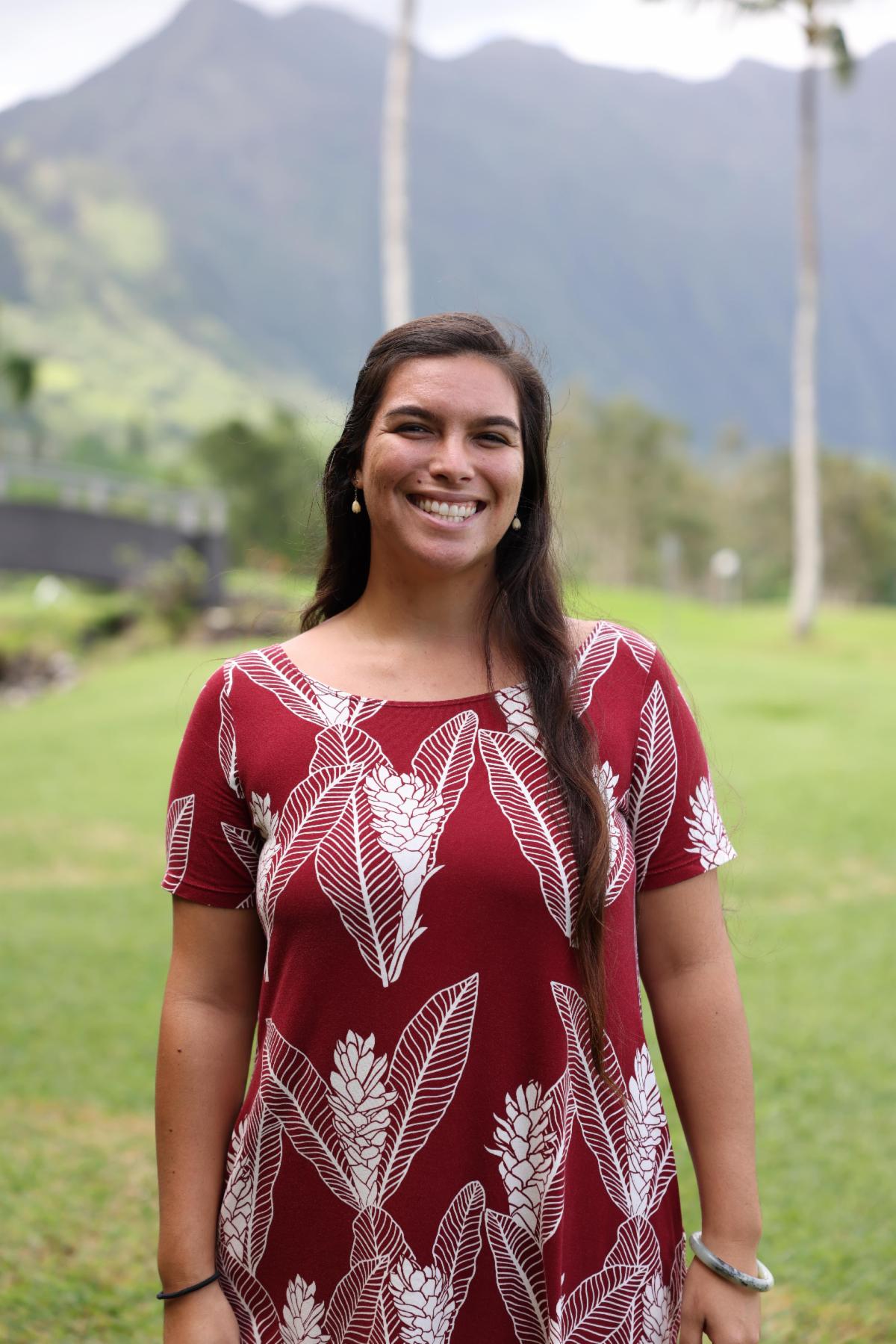
Picture of Kahele Joaquin, the highlighted alumni

Kahele Joaquin


Birthplace/Hometown:

Hilo, Hawaiʻi


High School:

 Ka ʻUmeke Kāʻeo Hawaiian Immersion Public Charter School

2016


UHM Degrees: 

Master of Public Health (MPH),

Native Hawaiian and Indigenous Health specialization

2022


Current Occupation:

Community Coordinator

Hāinu Lāʻau Program, Hui Mauli Ola


What inspired the path for your academic major? 

My inspiration comes from personal growth and the opportunities created by the resources and

community support I had growing up in Hilo. Without the backing of my family, the community

of Keaukaha, and various supportive figures, I wouldn’t be where I am today. I aimed to expand

beyond what I inherited. During the pandemic, while much of the MPH program was online, I

was deeply affected by the disconnection from my community. A role as a graduate assistant in

the School of Social Work helped me reconnect with Hawaiian health perspectives, reigniting my

passion for learning about Native Hawaiian health and healing from a traditional worldview. This

ongoing journey has only strengthened my love for this practice.


What are your future goals in your work? 

My future goals involve creating opportunities for my community to elevate their cultural

practices. I am currently training in hula, hoewaʻa, and mauli ola—key Hawaiian practices of

knowledge. My aspiration is to create a dedicated space for practitioners of these traditions to

gather and share their practices. This space would aim to restore and strengthen their reciprocal

relationships with akua (elemental deities), ʻāina (land), and kānaka (people). In all my

endeavors, my primary goal is to give back to my community.


How do you see your time at UH shaping the way you aloha ʻāina?

Aloha ʻāina has always been a core part of my life and upbringing. It is natural to me. What was

new was getting to know the ʻāina of Oʻahu, such as Mānoa, Waiʻalae, Waikīkī, and Kāneʻohe.

Through learning and engaging with these places, and by studying mele like “Welina Mānoa,” I

developed a deeper connection to and appreciation for the land I was learning about.


What does UHM as a Hawaiian place of learning mean to you? 

Transitioning from a B.A. in Kinesiology and Exercise Science with a focus on Health

Promotion at UH Hilo to studying a Master of Public Health on Oʻahu allowed me to explore a

different health perspective. The Native Hawaiian and Indigenous Health (NHIH) specialization

within the MPH program particularly resonated with me. This program, guided by respected

Native educators, bolstered my confidence in my ability to gain and share valuable knowledge. I

see it as my responsibility to pass on the wisdom I gain to future generations.