The Native Hawaiian Place of Learning Advancement Office at UH Mānoa focuses on implementing recommendations from Native Hawaiian reports authored over the last 30 years that guide UH Mānoa in becoming a Native Hawaiian place of learning. We have four focus areas:

  • Native Hawaiian Student Success
  • Native Hawaiian Staff and Faculty Development
  • Native Hawaiian Environment 
  • Native Hawaiian Community Engagement

We cannot do this work alone. It is our mission to foster the potential within each of you to positively contribute to our collective kuleana to make UH Mānoa a Native Hawaiian place of learning. These monthly newsletters are meant to keep you connected, highlight your work and continue to inspire you.

GOALS:
  • Native Hawaiian students are holistically supported from recruitment through post-graduation.
  • Best practices are gleaned from efforts to support Native Hawaiian students and are applied to student success strategies for all students across the campus.
Native Hawaiian Student Data
By Kawehionālani Goto
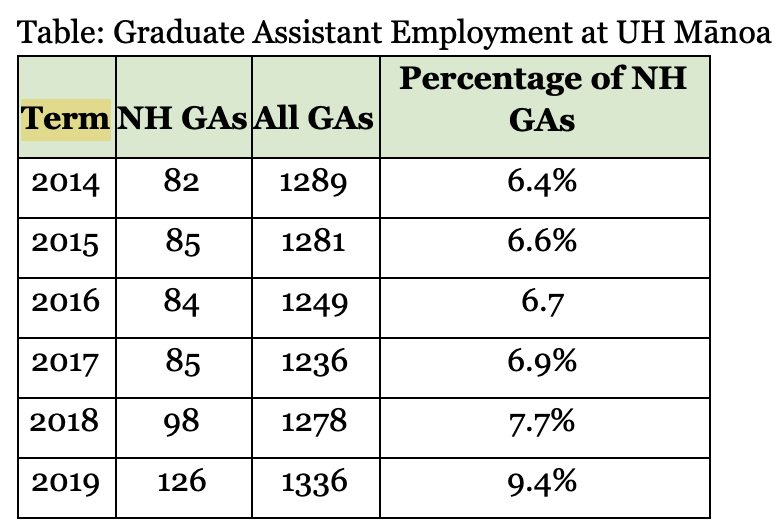
 A table listing the term number of Native Hawaiian graduate assistants total number of graduate assistants and percentage of Native Hawaiian graduate assistants at UHM. Column one is the term and begins with 2014 and ends with 2019.
This month we want to highlight some data related to NH graduate assistants (GA). For example, in the 2019 term, there were 126 Native Hawaiian graduate assistants. These students represent 9.4% of all graduate assistants employed at our university. This data shows an increase in Native Hawaiian graduate assistants compared to previous years. This is exciting to see that they are finding these opportunities. At the same time, we wonder about how they are doing. For example, we ask: 

  • How has GA kuleana changed over the last year? 
  • How is our GAs doing with the additional struggles we are all facing with the pandemic? 
  • What support do they need to continue to do essential job functions at our university? 

We invite you to help us dive into this data by exploring student demographics on our data webpage and by talking with the GAs in your colleges and programs. Mahalo for continuing this journey with us, and we look forward to continuing this exploration with all of you.
GOALS:
  • Native Hawaiian staff & faculty are holistically supported from recruitment through promotion and leadership development in every unit across the campus.
  • All staff & faculty at UH Mānoa are more knowledgeable and culturally rooted in Mānoa and Hawai‘i.
Land Acknowledgement
By Kaiwipuni Lipe
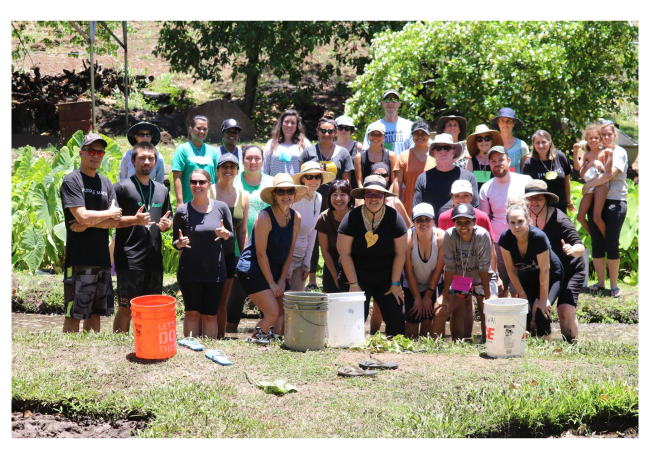
UHM staff, faculty, and community members work together at Ka Papa Lo‘i ‘o Kānewai.
One of the sub-goals within this overarching area in the Native Hawaiian reports is "Educating all." This goal focuses on supporting each staff and faculty member in learning more about Hawai‘i and incorporating that into their work. One way that more staff and faculty have been engaging in this work is through land acknowledgments, a practice that has gained momentum in the last several years. Some countries like Canada and Australia have been using them quite frequently while some areas in the United States are now joining in. To be clear, the topic of land acknowledgments is complex and I like the way this guide by Native Governance Center explains some of those complexities. In Hawai‘i some individuals and organizations have created their own, some have been seeking guidance, and some are very hesitant to acknowledge Hawai‘i's history and current realities. Recently, I have been asked with more regularity for any examples our office might have. Fortunately, a group from the President's Emerging Leaders Program created a land acknowledgment that can be used in totality, in part, or as an inspiration to create your own. Click here to access that land acknowledgment. In addition, we are aware that other units at UH and organizations throughout Hawai‘i are engaging in this process. We encourage you to consider this important step in bringing truth to our spaces and look forward to hearing stories of next steps folks are taking as well. 
GOAL:
UH Mānoa campus is a physical, cultural, spiritual, and interactive environment that exemplifies the values of ‘ohana and community, mālama ‘āina, and kuleana; thereby, perpetuating Native Hawaiian values, culture, language, traditions, and customs.
Aloha ʻĀina Fridays
By Kaiwipuni Lipe
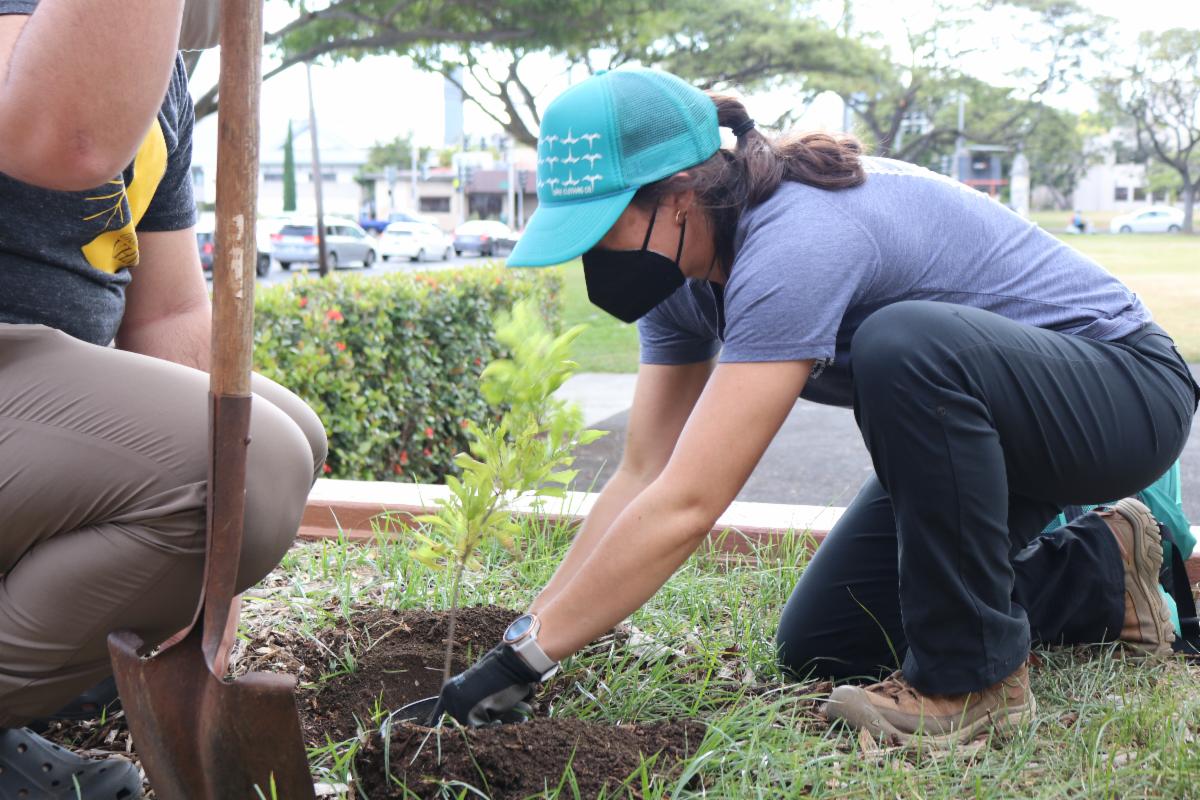
Volunteer plants the Hawaiian shrub ʻaʻaliʻi.
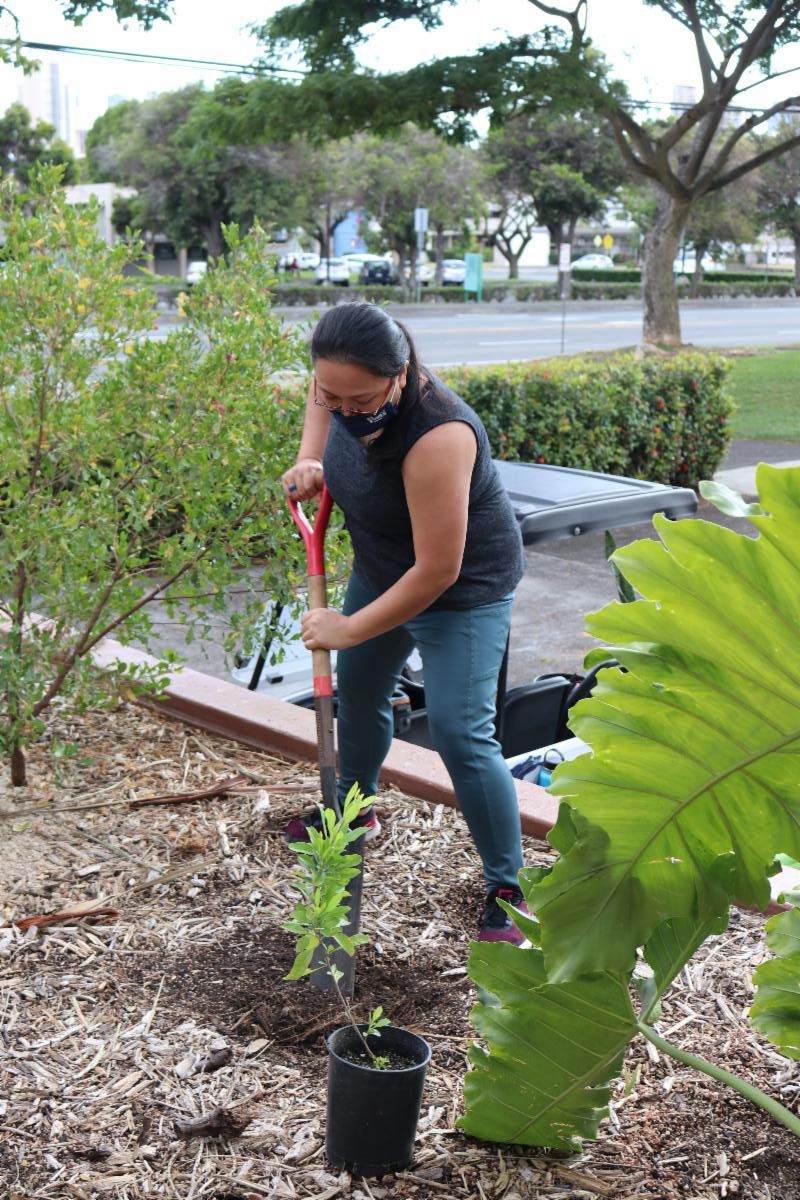
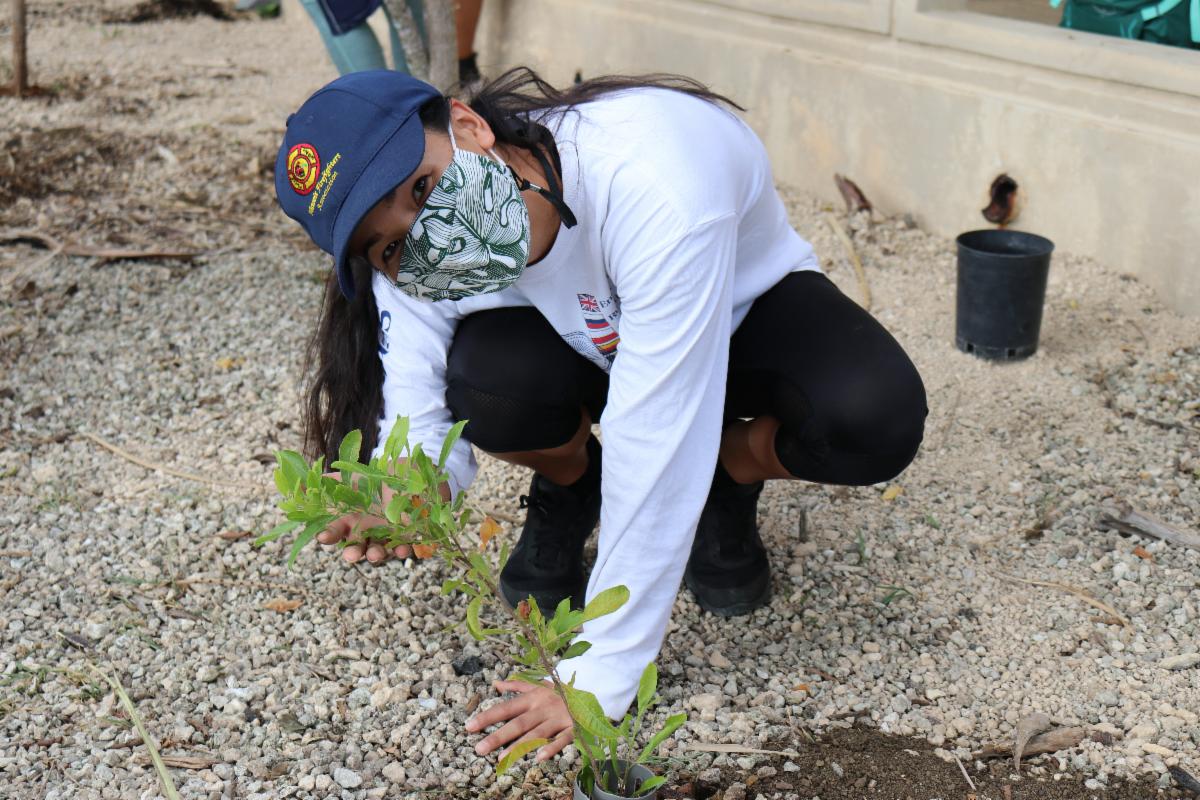
Our April 16th Huli ka Lima i Lalo session in our Aloha ‘Āina Fridays programming took us to an area at the edge of Bachman Hall, in the ‘ili of Pa‘akea, in Mānoa Valley, within the ahupua‘a of Waikīkī, in the moku of Kona, on the island of O‘ahu, in the pae ‘āina of Hawai‘i, in the middle of Moananuiākea. Woohoo! Try say that 10 times fast! The point being, we have the gift of knowing our ‘āina in very specific ways. Moreover, we are gifted with people like Nōweo Kai, UHM's campus arboretum curator, who teaches us about the plants all across our campus. In the most recent gathering, she taught us how to plant ‘a‘ali‘i, a Native Hawaiian shrub. These Huli ka Lima i Lalo sessions continue to help us build a Native Hawaiian environment not only because of the native plants we are bringing back to the area but also because of the pilina we are building with one other and ‘āina and the kuleana that emerges, like the pilina and kuleana we now have with the nine ‘a‘ali‘i we planted. We have one more session with Nōweo this semester and have a few spots remaining. Click here to reserve your space now.
Volunteer digs a hole with a shovel to begin the planting process for the Hawaiian shrub the ʻaʻaliʻi.
Volunteer displays and takes a picture with her ʻaʻaliʻi the Hawaiian shrub.
GOAL:
UH Mānoa and Native Hawaiian communities are consistently connected and engaged in order that there can be reciprocal teaching and learning for positive impact throughout Hawai‘i.
Racial Justice Camp
By Kaiwipuni Lipe
I recently had the opportunity to co-host the Racial Justice Reel Camp for Girls, a partnership among Hawai‘i Women in Filmmaking, the University of Hawai‘i at Mānoa Truth, Racial Healing & Transformation (TRHT) Campus Center, and the Pōpolo Project.
 
The TRHT framework emphasizes bringing our visions of healed and transformed communities to life. In one exercise, we asked camp participants to envision their healed communities: What would they look, sound, feel, taste, and smell like? Even though all these young people (in their early teens through their early twenties) have had their own challenges in our racialized society, they still had powerful visions of their futures. Some even made short films about them!
 
I walked away with a renewed sense of hope and gratitude for young people, especially girls and nonbinary and transgender folks whose stories often don’t get heard. Ultimately, I was reminded of my kuleana to make sure they do. 
NĀ LAMAKŪ O KE ALOHA ʻĀINA
Kanaka Highlight Series
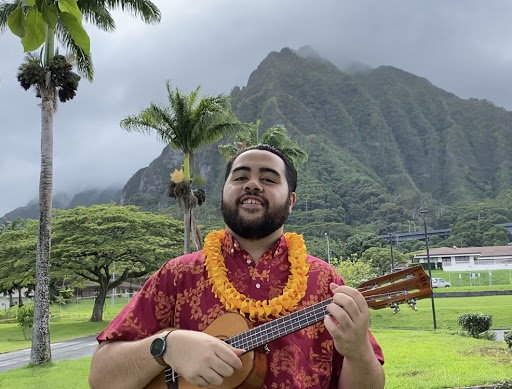
Picture of ʻElia Akaka, the Highlighted Student
ʻElia Kaleiʻohuināpali Akaka

Birthplace/Hometown:
Kāneʻohe, Koʻolaupoko, Oʻahu

High School:
Ke Kula Kiʻekiʻe ʻo Kamehameha ma Kapālama

UHM Degrees acquired and/or being pursued:
Lae Pua ʻIke Hawaiʻi (Pursuing BA Hawaiian Studies) 
Lae Pua ʻŌlelo Hawaiʻi (Pursuing BA Hawaiian Language) 
Maina ma nā Mele (Pursuing Minor in Music)

Current Occupation:
Student employee, Native Hawaiian Place of Learning Advancement Office

1.  What inspired/inspires the path for your academic major?

I believe that our kūpuna Hawaiʻi (Hawaiian ancestors), and native peoples throughout the world, hold fast to values that inform their perspective and understanding of life. One of these values that I consider to be of great importance to the life of indigenous cultures, especially now in the twenty-first century, is being able to find the balance between historically-established native cultural practices and contemporary means of expression. The summation of this process may possibly be expressed in the word adaptation. Within Hawaiʻi’s post-western contact history, we see many examples of native kānaka leaders and aliʻi embracing and using newly-introduced methods and technologies not in replacement of traditional ideas but as supplementation to allow their manaʻo and culture to be shared and to continue to thrive in a changing world. In continuing on to higher education, I have decided to do my undergraduate degrees in ʻŌlelo Hawaiʻi (Hawaiian) and ʻIke Hawaiʻi (Hawaiian Studies), to strengthen my understanding of ʻike kūpuna (ancestral knowledge) and to solidify this kahua (foundation) upon which I may continue to explore new avenues of cultural expression today and into the future.

2.  What are your future goals in your work? 

As an individual majoring in ʻike and ʻōlelo Hawaiʻi, individuals will often assume that my end goal is to become a high school teacher or maybe a professor within this field of study. I have a lot of aloha and gratitude for my educators who allow me to continue on my goal of solidifying this kahua, yet I do not feel that that may necessarily be the route in which I educate and share ʻike that I have been fortunate to learn and have a kuleana (responsibility) to. Some things that I am interested in are mele, Hawaiian music both traditional and contemporary, and illustration and graphic design. I enjoy these means of creation and communication and find that they may sometimes offer a way for the receptor of a mele or an illustration to connect with and understand the message being conveyed beyond verbal means. Currently, I am a member of the Hawaiian music trio ʻŌlauniu, and hope to continue on in performance and practice of traditional mele to retell the moʻolelo (story/history) held within them and to compose new mele to tell the stories of today. Additionally, I plan to continue my education after completing my bachelor degrees in the Art department here at the University of Hawaiʻi with a focus in graphic design. It is because of my educators that I have been inspired to pursue these passions of mine and to use them as a means to share the loina Hawaiʻi (Hawaiian values) that I try to apply to practice in my work. My goal is to contribute to normalizing the idea that while it is in the classroom that many of us may begin and continue to learn more about ʻike Hawaiʻi, it is outside of the classroom that ʻike Hawaiʻi is practiced and thrives.

3.  We believe that at the heart of a Hawaiian place of learning is aloha ʻāina: the constant care for and reciprocation with Hawaiʻi’s people, places and practices.” How do you see your time at UH shaping the way you aloha ʻāina?

As direct descendants of the land itself, our ʻōiwi perspective enforces our understanding that to aloha ʻāina is to care not only for the land itself but also for the people that live upon it. As a member of this kaiāulu (community) of UH Mānoa, I see education as a whole as a means of aloha ʻāina. The saying “to whom much is given, much is expected” applies in the sense that because we have the fortune to learn and to gain ʻike (knowledge), we therefore have a kuleana to use this ʻike to uplift those in our kaiāulu. Using these skills gained through the university–no matter what the degree may be–and applying that to contribute to the betterment of our kaiāulu locally and globally is how I feel that UH contributes to the ways that I aloha ʻāina.

4.  What does UHM as a Hawaiian place of learning mean to you? 

A Hawaiian place of learning to me is centered in aloha ʻāina and in the true understanding of the loina that make Hawaiʻi unique natively and globally. This concept, I believe, should be the foundation of this community that is clearly understood and practiced at all levels of interaction, a standard that is established and defined in the operation of the school from administration to the students. I feel that being physically located in Hawaiʻi is not necessarily enough to consider an institution a Hawaiian place of learning. It is, however, because we are located in Hawaiʻi that we as members of this organization and of this community have the kuleana and duty to be actively mindful and cognizant of cultural native Hawaiian perspectives and reality.