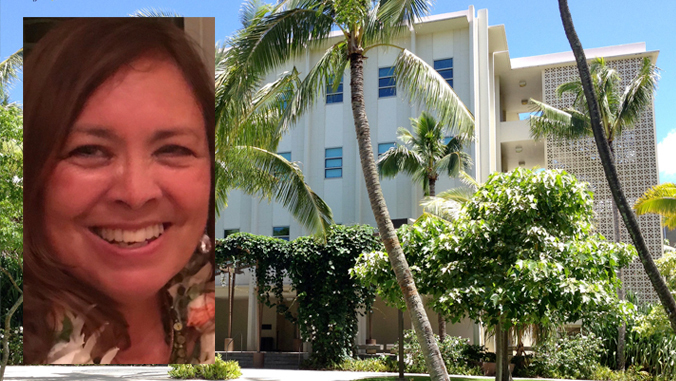
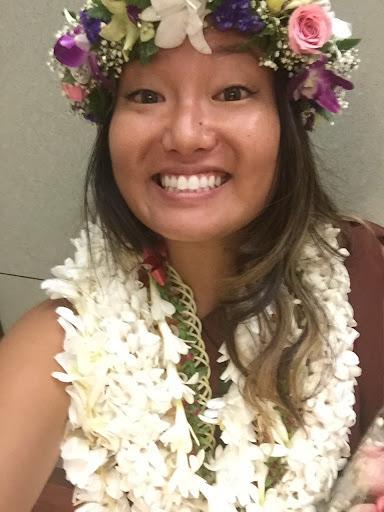
Janelle ʻĀnela Yukiko Ikeda Matsuura
Birthplace/Hometown:
Kāneʻohe, Koʻolaupoko, Oʻahu
High School:
Sacred Hearts Academy
UHM Degrees:
Lae Pua ʻIke Hawaiʻi: (BA Hawaiian Studies) 2015
Laeoʻo Curriculum Studies:
Place-based and Sustainability Education
(currently pursuing MA Curriculum Studies Place-based and Sustainability Education)
Palapala Sustainability
(currently pursuing Graduate Certificate in Sustainability)
Current Occupation(s):
Graduate Assistant in the College of Education PACMED Department
What inspires the path for your academic major?
My first and most important inspiration is my family. From when we were young, my mom made sure that our education was a priority. As a single parent, I know that my mom made a lot of sacrifices so that my sister and I could go to Sacred Hearts. My mom also set the example of the importance of education by earning her Bachelor Degree in English from UH Mānoa. Her dream was to become a teacher, however that was put on hold in order to help my Nanny and Papa with the family auto repair business. After my sister and I graduated from UH, my mom went back to school at night to get a certificate in Business.
As a freshman, I entered UH Mānoa with hopes of becoming an Architect. After the first semester, I quickly discovered that it was not the place for me. The beginning of my undergraduate years were spent as an undeclared major. My mom always encouraged me to pursue a career and major that would make me happy and feel fulfilled. I danced hula and ori Tahiti growing up and always had an interest in different Polynesian cultures. My interest had been fostered through my kumu ʻōlelo Hawaiʻi at Sacred Hearts, Kumu Lehua Cayaban. We went on field trips to Uncle Mark Stride’s farm in Maunawili and Luluku, where I first learned to grow and harvest kalo. I decided to continue learning ʻōlelo Hawaiʻi and ʻike Hawaiʻi through courses at Kamakakūokalani & Kawaihuelani and ended up finding a program that felt like home. I chose the path of exploring Kumu Kahiki, or Comparative Polynesian Cultures, which led me to study abroad in Aotearoa, attending the University of Waikato.
Taking Lāʻau Lapaʻau from Kumu Sydney Kapuahinano Coelho and Kumu Keoki Baclayon reminded me of my Papa. Papa was my first “outside” teacher. He taught me things from gardening to woodworking. I was too young then to understand the importance of all his lessons, but I look back and understand that the lessons he taught me back then have influenced and shaped the way that I think and make decisions. When my Papa was diagnosed with cancer, he decided to use lāʻau lapaʻau and other natural Eastern medicines in addition to the Western medicine approach of chemo, radiation and surgery. He planted noni, nīʻoi and ʻōlena for medicine that still grow and thrive in our yard today. Being able to formally learn Hawaiian medicinal practices felt like my non-traditional learning from when I was a kid was coming full circle. It also opened my eyes to what I believed was and was not “education.” These classes made me rethink what exactly was the definition of education and how we learn.
After graduation, I became the Hawaiian Studies teacher at ʻĀhuimanu Elementary School in Kahaluʻu, Koʻolaupoko, Oʻahu. I taught Kindergarten to 6th grade. Teaching is rewarding, especially in a community so close to my own. I still see my former students shopping at the grocery store or at the mall. I also see them at Castle High School where I volunteer.
My current degree was inspired by my own failing health. In 2017, I experienced digestive problems that were largely ignored by male Western medicine doctors who claimed my pain was due to period cramps. Fast forward to 2019 where my digestive issues had escalated to projectile vomiting, chronic diarrhea and stomach pain. I was miserable and fed up with doctors who didn’t seem to want to help. In 2020, I finally found a doctor who took my concerns seriously and we discovered that, amongst other problems, that I had pesticides in my system. I am very conscious about what I eat and I went down the rabbit hole of documentaries, articles and podcasts about where our food comes from and how our body reacts to chemicals and pesticides. Through this research I began to look into Hawaiian agricultural practices, which are sustainable and chemical free by nature. I realized that if I am experiencing this, then others must be as well. I began to pursue ʻāina-based and sustainability education as a means of educating about sustainable food systems.
*If you are interested in going down the rabbit hole with me, I highly recommend “Poisoning Paradise” on Tubi and “Kiss the Ground” on Netflix. If you listen to podcasts, I recommend “the Doctor’s Farmacy” with Dr. Mark Hyman.
What are your future goals in your work?
In addition to working at UH Mānoa, I volunteer at Castle High School’s Agriculture Program: Hoʻoulu ʻŌpio as an Agriculture Educational Advisor under the direction of Kumu Carlos Severson. Castle is home to a beautiful seven acre farm with a fresh water spring, Kānewai, that feeds the loʻi. In this program, students learn to cultivate and harvest fruits and vegetables such as kalo, ulu, maiʻa, papaya, cacao, corn and lilikoʻi to name a few. The students then plan and execute the marketing and selling of the produce which generates funds for farm equipment and other expenses. Castle also grows Bana grass which is turned into a renewable energy source through their partnership with Suma Farms.
My ultimate career goal is to open an educational farm that hosts field trips for students who attend schools that do not have farms on campus. The farm would also serve as a community food hub to help provide ʻai pono to ʻohana in Koʻolaupoko. My kuleana is to continue to teach mahiʻai to the next generation. Through agriculture and ʻāina-based education, I believe we can weave culture, language, moʻolelo and sustainability into the school system. This farm has been my dream for years and until entering the Place-based and Sustainability Education program through the College of Education Curriculum Studies, I thought it was impossible. While I know that it'll be hard work and finding AG lands will continue to be challenging, I believe that this will ultimately benefit students and the community as a whole.
How do you see your time at UH shaping the way you aloha ʻāina?
Aloha ʻāina is not just a flashy sticker on your water bottle, a cute pālule T or a social media post. Aloha ʻāina is a kuleana and a political advocacy rooted in protecting our ʻāina and natural resources from exploitation and depletion. There are many different definitions of aloha ʻāina. Before embarking on my academic journey at UH, I saw the practice of aloha ʻāina as only actions of mālama ʻāina/mālama honua. My time at UH has taught me that aloha ʻāina can be both preventative and reactive. Laws can be passed to protect our native plants, animals, fish and coral. Aloha ʻāina can also be in reaction to decisions that go against our cultural beliefs. We can use our voices to write testimony, poetry, mele and speeches to protect sacred spaces. We can create art that demands our aquifers are kept clean. I am lucky to have many kumu and professors from UH who are aloha ʻāina advocates that lead and teach us by example. They are strong in their convictions and empower us to use our voices.
What does UHM as a Hawaiian place of learning mean to you?
To me, UHM as a Hawaiian place of learning means that Hawaiian language and ancestral knowledge, beliefs and practices are at the forefront of all University decisions. It is a place where Hawaiian students should be able to thrive. UHM could not be a Hawaiian place of learning without Native Hawaiian kumu. I would like to take this opportunity to mahalo all of the kumu who have paved the way for us to excel in a Western school system: Dr. Summer Maunakea - Advisor/Curriculum Studies, Dr. Julie Kaomea- Curriculum Studies, Dr. Eōmailani Kūkahiko- Curriculum Studies, Kumu Lalepa Koga- ʻōlelo Hawaiʻi, Kumu Sydney Kapuahinano Coelho & Kumu Keoki Baclayon- Lāʻau Lapaʻau, Kumu Noah Keola Ryan - Hawaiian Studies, Kumu Lufi Luteru- Hawaiian Fiberarts and Kumu Jon Osorio- Hawaiian Studies. I recognize that I am extremely fortunate to have been taught by exceptional kumu and that this is not the experience for everyone, especially in different departments.