|
What inspired/inspires the path for your academic major?
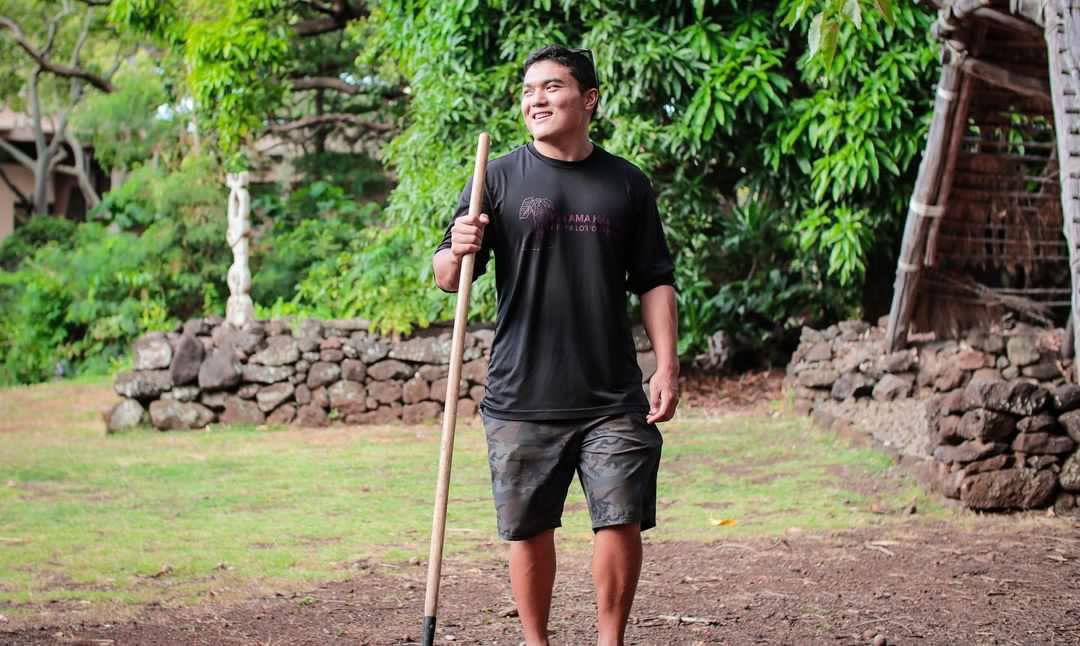
My biggest inspiration for my major is my ʻohana and the ʻāina itself. I would not be here today without the love and support of my ʻohana, but I also believe that to continue to work on the ʻāina, I cannot focus only on what is in front of me at this time; I need to look ahead and think about the future generations. I know it is common to hear “think about the future generations,” but I strongly believe it is important. I want the ʻāina that we cultivate and spend time on to still exist 100 years from now. My hope is that generations from now, our moʻopuna should be able to enjoy the same things that we enjoy, whether it be the rushing cool streams or the sight of Hāloa dancing in the soft breezes. ʻĀina is translated as “that which feeds,” and for me, it feeds more than my stomach; it feeds my soul and passion. I love waking up in the morning and getting to work on the ʻāina, feeling the lepo between my toes, smelling fresh cut grass, and especially the smile on a keiki’s face when they see ʻāina for the first time. All these things inspire me to learn more about our culture so that I may share what I learn with others, and hopefully they feel inspired to learn more about Hawaiʻi and the ʻāina that we live on.
What are your future goals in your work?
My future goal is to mālama the next generation and help them find their inspiration on the ʻāina or the kai. If we want to perpetuate our culture and mālama the lāhui, we need people who genuinely care and are ʻono to learn the teachings of our kūpuna, especially as it relates to food sustainability. I can still remember the first time I learned that there were hundreds of names for our kalo, whereas I thought each one looked pretty similar: a tall plant with a skinny stem and green heart-shaped leaves that has a corm at the bottom. But, when I was told to huki only the Piko ʻUlaʻula and Lihilihi Mōlina rows in a loʻi with over twenty different rows (each row containing a different variety), I needed to learn fast. That’s when I realized there are subtle differences: some hā are more red, some have stripes, some have dots, some lau are more ovate than others, some lau are more turquoise, etc. Then I slowly understood why there are ʻohana of kalo with names like Piko, ʻUlaʻula, ʻEleʻele, and Lauloa. It made me ʻono to learn more about our varieties and understand their names and moʻolelo. I want young Hawaiians to discover their passion and pilina to ʻāina so that we can one day become a food-sovereign people because a sovereign nation needs to be able to provide for itself.
How do you see your time at UH shaping the way you aloha ʻāina?
If it weren’t for Ka Papa Loʻi ʻo Kānewai, I would not be the person I am today. Kānewai created a foundation for me from which I have built my identity and confidence in aloha ʻāina. It is through the teachings of so many great kumu and kuaʻana that I have been able to learn and grow at Kānewai, and it is to these people that I am grateful and blessed. To me, aloha ʻāina and moʻokūʻauhau are closely linked together. The genealogy of Kānewai is a great example of this, as every generation of limahana has been able to perpetuate and build off the work of the previous generation to grow and mālama Kānewai. We often have groups that come to Kānewai with people who had not been back to the University since they were in college 10 to 20 years ago, and they are blown away with how Kānewai looks today. It makes me feel good because I know that I am just one link in the chain of the many stewards of Kānewai, going back to Kaleiheana and beyond. It is very humbling to be on ʻāina, especially one with such a long legacy, and it gives me something to work towards.
What does UH Mānoa as a Hawaiian place of learning mean to you?
I believe that being a Hawaiian place of learning comes with a high level of accountability. To represent Hawaiians means that the University is required to constantly question if enough has been done to support Hawaiian students to succeed in their pursuit of a higher education. This also requires Hawaiians to meet the university halfway and do our best to help one another, as students, because it is already so difficult for some of us to continue our education post-high school. In my personal experience, Kānewai and NHSS have been two of the biggest places to support Hawaiian students, regardless of their majors. It is at these places that faculty can engage with Hawaiian students and support them in their endeavors, whether it be through mentoring, spreading the word about scholarship opportunities, or even the NHSS Summer Institute program, which helps Hawaiian students in affording summer classes. On the flipside, it is at these spaces that Hawaiian students can engage with one another and feel united whether it be with academic or physical work. I strongly believe that if we want UH Mānoa to maintain its status as a Hawaiian place of learning, we need to continue to support these programs, improve their funding, and create more spaces like them on campus.
|