e-Newsletter | August 2, 2024 | |
|
Romancing Ruth: A Guide to Courting in the Early 20th Century
by Annabelle Svahn and Lilly Baumfeld, F.E. Bushee Interns
| |
|
“When you were so rude over the phone the other day, I never wanted to speak to you again and I wished I were dead. Now I live only to take you to the ‘Three Musketeers.’”
What would you think if your suitor wrote that in a letter to you? Well, that’s what Minton Machado Warren wrote to Ruth Graves to express his dedication to her in 1921. He further signed the letter, “your irrepressible lover...”
Read the title story following event announcements!
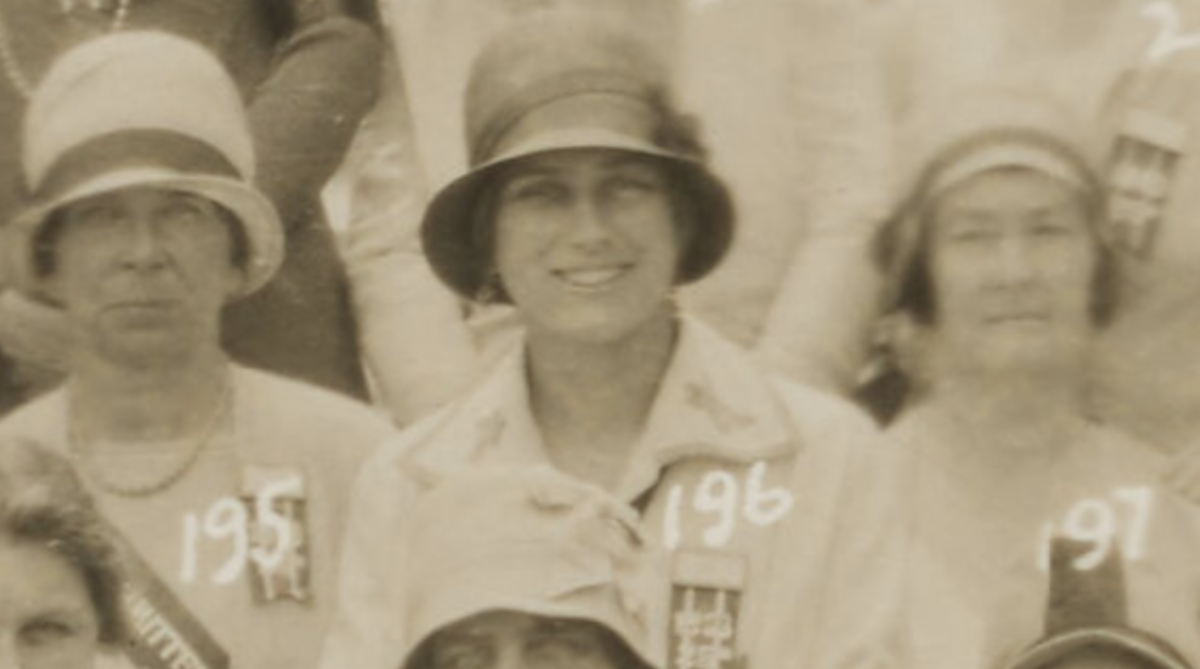
| Ruth Graves (#196) at the Harvard Class 1903 25th Anniversary Wives and Family Field Day. Courtesy of Harvard University. | |
|
Music Mavens at the Museum: A Garden Party Fundraiser in support of the Museum Internship Program
Sunday August 18, 2024, 4:00.p.m. - 7:00 p.m.
| |
|
Conference on Newburyport and the China Trade, 1844-2024
Monday, October 28, 2024 8:30- 4 p.m.
| |
|
Museum of Old Newbury Guided Tours
Thursday - Sunday, 11:00am - 4:00 pm on the hour
| |
Architectural Walking Tours: Newburyport's Fashionable Old Houses
Sundays August 11, August 18, September 8, September 22
10:30 a.m. to 12:00 p.m.
| |
Romancing Ruth: A Guide to Courting in the early 20th Century
by Annabelle Svahn and Lilly Baumfeld, F.E. Bushee Interns
| |
|
“When you were so rude over the phone the other day, I never wanted to speak to you again and I wished I were dead. Now I live only to take you to the ‘Three Musketeers.’”
What would you think if your suitor wrote that in a letter to you? Well, that’s what Minton Machado Warren wrote to Ruth Graves to express his dedication to her in 1921. He further signed the letter, “your irrepressible lover.”
Today we are pleased to bring you another story from the Graves family letter collection. The letters were donated by Tim Kendall, a descendant of the Graves-Pike family of Newburyport, and we have been processing this gift with the help of fellow MOON interns Freddy and Julia and Visitor Services Assistant Ella Suchecki. In our last newsletter article we told the story of Edmund Pike Grave’s untimely death, and the grief of his fiancée, Dulce Huntington. This time we would like to introduce you to one of the other rich characters these letters illuminate, Edmund’s younger sister, Ruth.
| |
Ruth Graves (#196) at the Harvard Class 1903 25th Anniversary Wives and Family Field Day. Courtesy of Harvard University. | |
Ruth stuck out to us immediately as we began to read through this incredible collection. Many letters are addressed to her from a cast of young men, who through their writing we soon got to know well. After the death of her father in 1913, Ruth returned with her family to the United States from Argentina. She attended the Winsor School in Boston for her high school years. The letters reveal that Ruth and her older sister Ellen had a rich social life, attending dances and parties with friends in Boston. The sisters came of age during World War One and Ruth’s letters give insight into the events not only of their daily lives, but also their opinions on the world around them. Ruth volunteered with the Red Cross as a nurse while several of her male friends prepared for war at training academies at West Point and Princeton. | |
|
The most entertaining of the young men who write to Ruth is Kenneth B. Murdock, who we were introduced to as “Galahad.” The letters that we have from Galahad begin in 1918, where he writes to Ruth as an officer candidate at the Naval officer school at Princeton University. He frequently makes literary allusions in his writing, using them as aliases in his letters to Ruth; he signs his letters as the sailor Sinbad, the infamous Roman emperor Nero, King Lear’s “the Fool,” and, of course, the Knight of the Round Table Galahad. Some other names he signs off as include “Shamrock,” (we are still trying to figure out the reference), and “Benedict,” perhaps in homage to Shakespeare’s “Benedick” in Much Ado About Nothing. He includes Ruth in his literary fantasy, addressing his letters to her as “Britomart,” in a mythological reference to the Greek nymph Britomartis. Ruth seems to have enjoyed this literary fixation - she and Galahad wrote poetry back and forth to each other.
After finally, and a little miraculously, finding Galahad’s real name in an undated letter to Ruth, a little digging into who Galahad was outside of his esoteric writings helps his niche literary references and metaphors make a little more sense. According to a tribute published in the New York Times upon his death in 1975, Kenneth B. Murdock was a Harvard University graduate three times over (his BA, MA, and Ph.D), as well as a professor of English Literature at his alma mater, joining their faculty in 1916, and publishing several books on both literature and theology. His referral to himself as a knight of the Round Table is not so far fetched – even foreshadowing his future – as in 1949, he was awarded knighthood in the Royal Order of the North Star by the Swedish government for his lectures at Scandinavian universities in the ‘40s and ‘50s.
| |
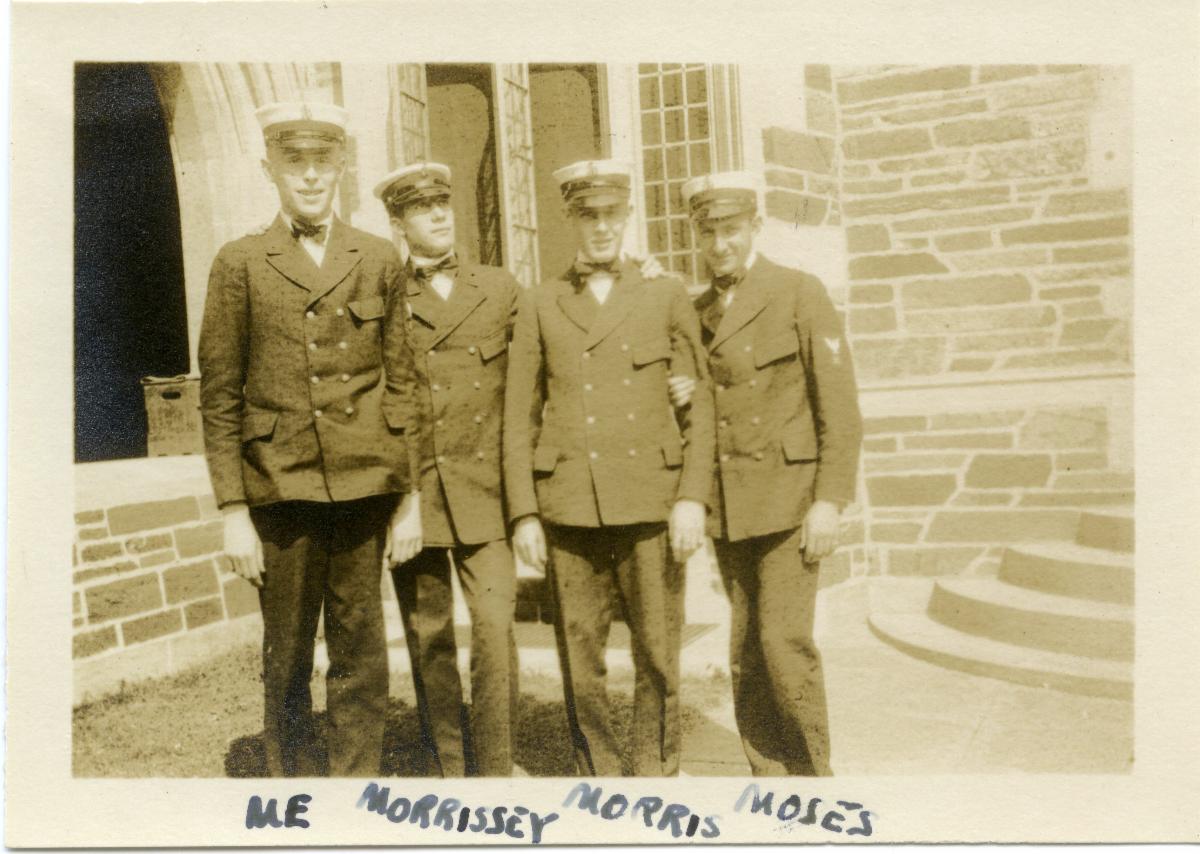
Photo of Kenneth B. Murdock "Galahad" (labeled as "me" in the photo) that he sent to Ruth, during his time at Princeton. | |
In his letters, Galahad discusses the war and his officer training, even including labeled pictures of himself and other friends. He also frequently refers to himself (or, rather, his alter-literary-egos) in the third person. In a letter from 1918, Galahad is looking for a response from Ruth to a date proposal, asking her if she would like to go to the theater with him. He mentions how he did not have much luck reaching her by telephone, but that “with pen and ink I am more confident, and so ask, nay, beseech, whether Saturday afternoon would be a fitting date.” Furthermore, he signs it: “Breathlessly, Galahad.” This preference of written language over spoken seems to fit with what we can see of Galahad’s intellectual – and perhaps endearingly geeky – personality shining through in these letters.
Another letter that stuck out to us was from January of 1919, where Galahad is on a trip to New York. What caught our attention was the fact that he explicitly mentions another one of Ruth’s suitors by name: “Here he [Galahad] goes galloping off to New York, planning a speedy return to see Roger, and, perchance his (Galahad’s or Roger’s) liege lady.” Roger is who we know as Roger Ernst, another of Ruth’s frequent correspondents during this time.
Roger attended Harvard University for both his undergraduate education as well as his law degree, and eventually went on to be a well-traveled lawyer; we have countless lengthy, detailed letters sent from England, for instance, describing his business trips.
Ruth, Roger, and other friends spend at least one summer in Chocorua, New Hampshire, visiting the summer home of Minton Machado Warren’s mother and sister. Minton, who refers to himself affectionately as “Minty” in his letters to Ruth, also wrote many amorous letters to Ruth during this time, including the one from the quote at the start of this newsletter. He was the son of prominent Latin professor Minton Warren.
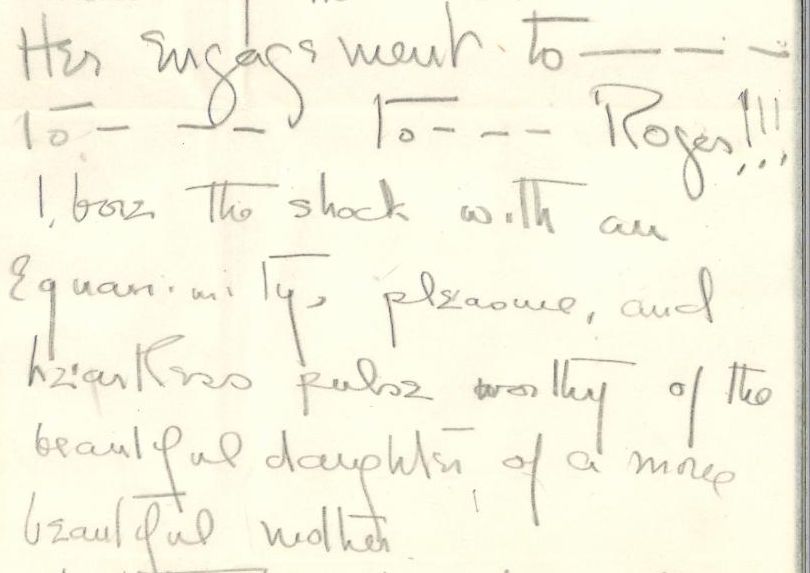
In 1919, Ruth, still in Boston, receives a letter from her friend Lucy, who had already arrived in Chocorua. Lucy writes that upon her arrival, to her surprise, “he” is already there! We speculate the “he” might actually be Roger. In May of 1920 Ruth writes to her mother to recount the details of a luncheon with her dear friend Lucy. Ruth is shocked to learn of “her [Lucy’s] engagement to — to — to — Roger!!!” She writes, “I bore the shock with an equanimity, pleasure, and heartless pulse worthy of the beautiful daughter of a more beautiful mother.”
| |
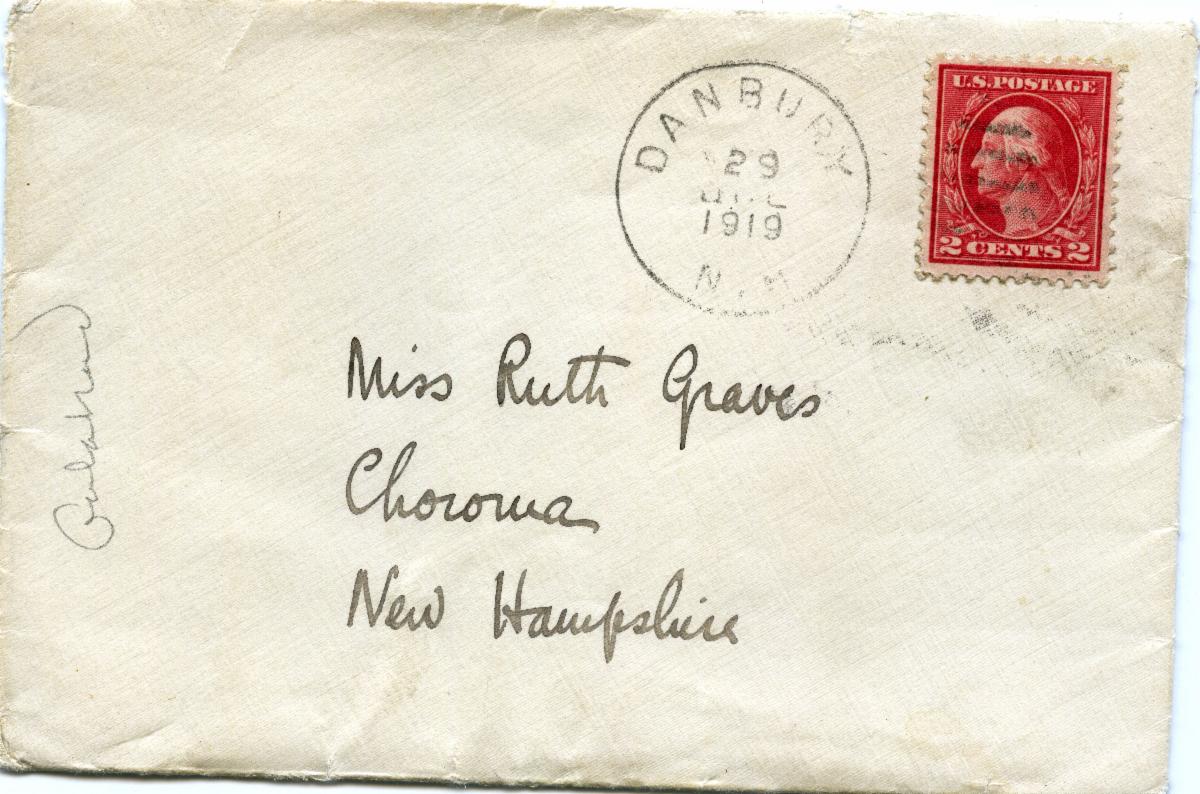
1920 Envelope addressed to Ruth in New Hampshire from Galahad | |
1920 Letter from Ruth to her mother about Lucy's engagement to Roger. | |
|
In this letter, Ruth also tells her mother of her meetings with her other male friends: Kenneth “Galahad,” Minton “Machado,” and A. Morris Crosby. It's apparent all these men were acquaintances and likely spent at least two summer vacations in New Hampshire together, as well as being members of the Harvard Club in Boston. However, beyond these clues we are uncertain how they met and how they originally became acquainted with Ruth. She maintains correspondence with these men simultaneously. Ruth also maintains correspondence with a “Phil H,” for whom we are still looking for identifying information, but who also possibly attends the group's vacations to Chocorua.
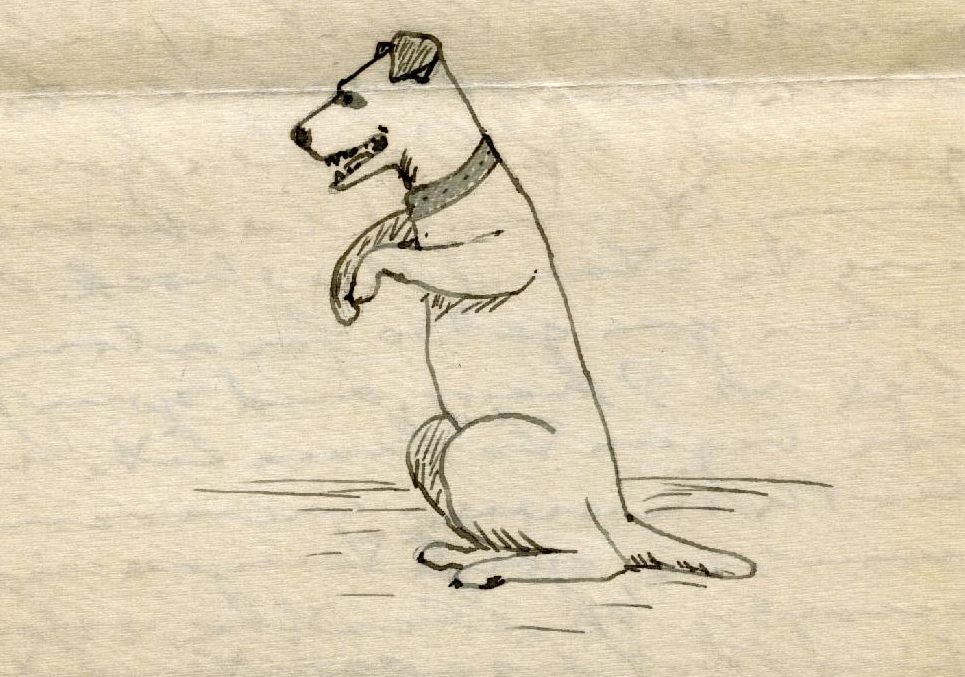
Minton, based on his letters, moves to Washington D.C., living there the same time as A. Morris Crosby, another one of Ruth’s apparent suitors. Crosby also attended Harvard, the likely connection between these men. Crosby writes to Ruth including many sketches of the dog “Jim-Dog,” which we believe he bought from Ruth as a puppy. He also wrote poetry, sometimes about the dog, as well as some passive aggressive jabs at what he characterizes as Ruth’s inconsistent responses. Crosby and Minton must have known each other, for eventually the dog ends up in Minton’s care before he sends it back to Ruth. This anecdote reveals the fun personal stories we can gain from these letters, but Jim-Dog’s fate will continue to be a mystery.
| |
A. Morris Crosby's sketch of Jim-Dog | |
From the letters produced by these funny, passionate, articulate people, we have a glimpse into the romantic world of the early 20th century. With everything from lovers' quarrels to suggestive invitations, the life – or rather, mailbox – of a young Ruth Graves was certainly full of excitement. But this story still isn’t done… Stay tuned for the next newsletter, where we will reveal who Ruth eventually marries in 1926. | |
|
Other Duties as Required...
by Bethany Groff Dorau, Executive Director
| |
|
Images and video in this story are courtesy of Bob Watts, Shelley Swofford, Steve Crosby, and Alex Yablin. This one is from Bob.
When I began working at Historic New England nearly 25 years ago, I was presented with a job description that closed the "Primary Responsibilities" section with "other duties as required". It made me chuckle then as now, since this one line seems to sum up what museum work can involve - literally anything.
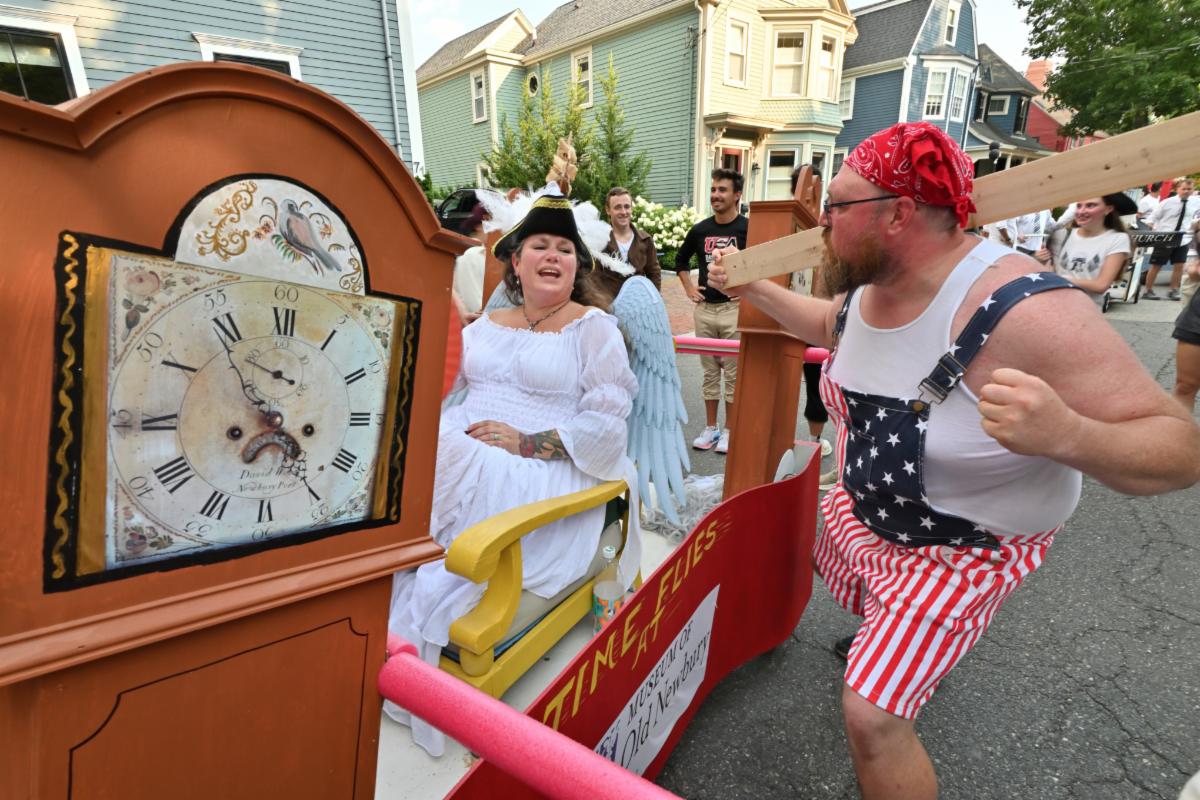
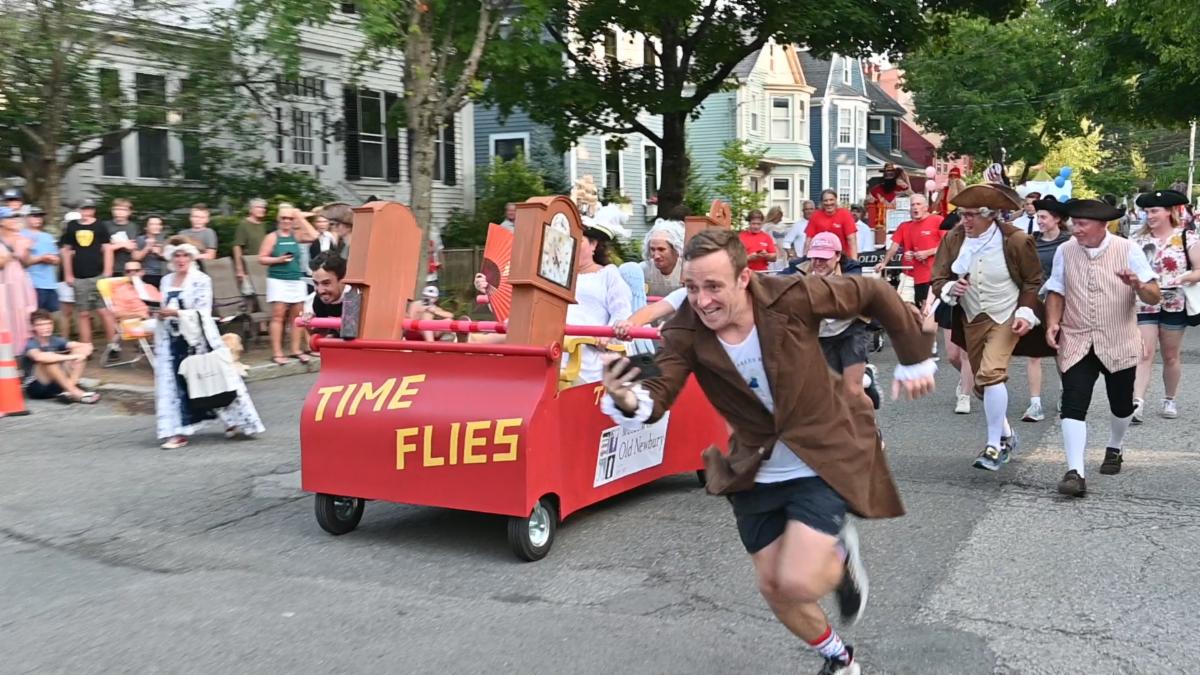
Over the course of my career, I have invoked this line when I found myself called to crawl in a manhole with a video camera on my head, fish a live muskrat out of a rain barrel, sleep on the ground with an ailing sheep, test a stuffed pheasant for arsenic, drive a fire truck...the list goes on and on. I can honestly say that no two days are alike. I would go so far as to say that on any given day I must have at least two outfits at the ready - one for looking like I am the director of a venerable museum, and one for crawling around in an attic. Yesterday I had a three-outfit day, and the third outfit involved flying down Federal Street with a model ship on my head.
Other duties as required.
| |
|
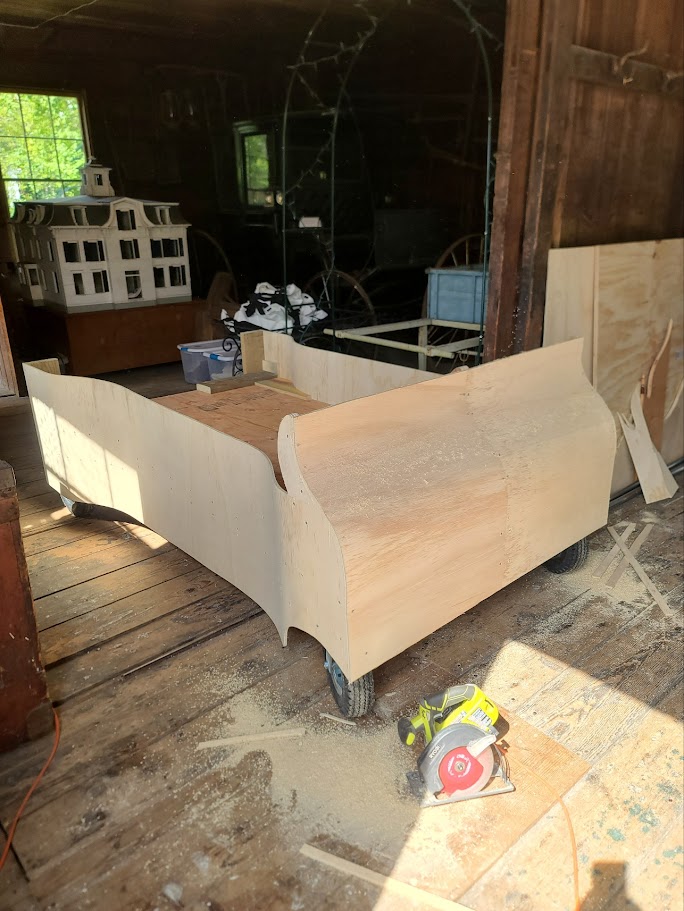
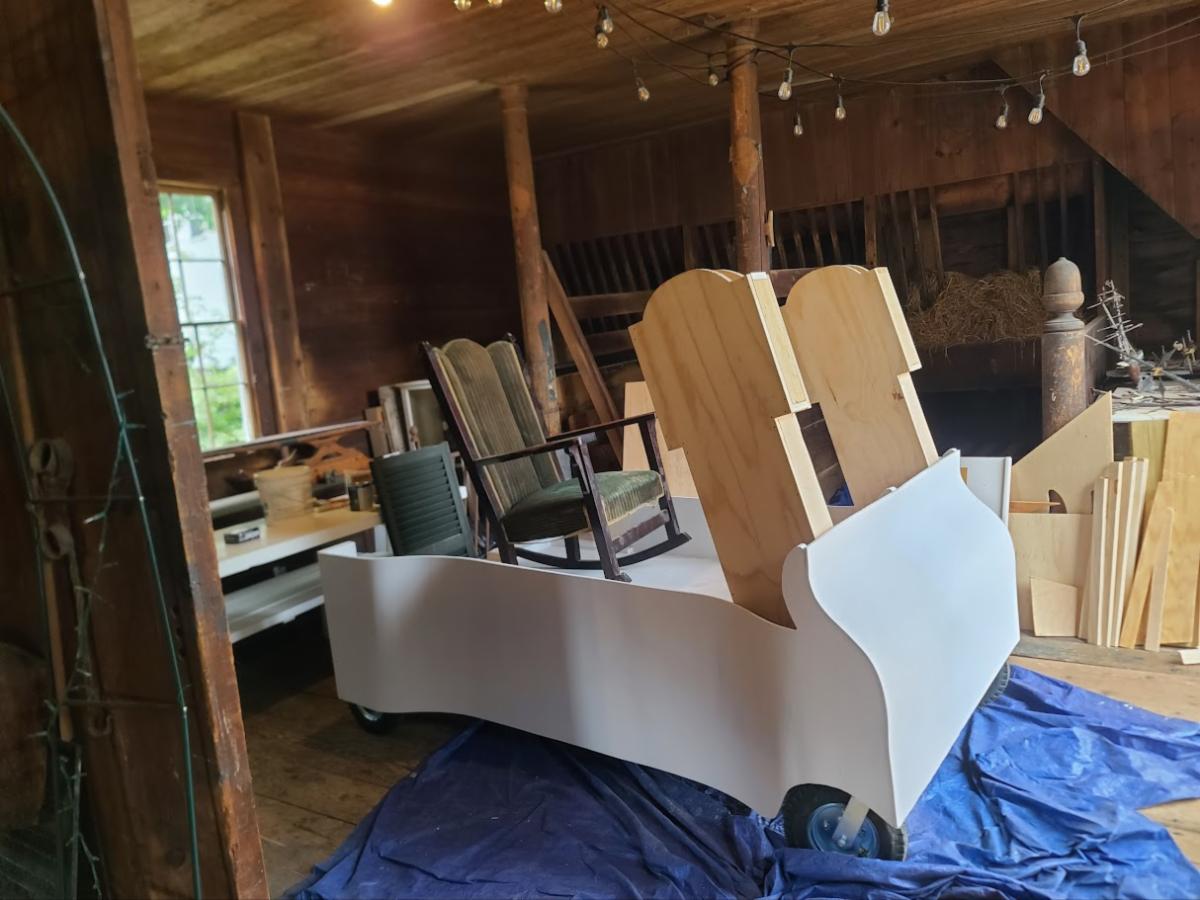
It began with James Brugger, an esteemed board member and friend. He suggested that we should enter a Museum of Old Newbury bed in the Yankee Homecoming Bed Race, organized by the Lions Club. Because another part of museum work involves being chronically short of staff and funding, I gave my wholehearted consent, if it did not cost the museum any money and the work was done by volunteers.
Enter Steve Crosby, preservation carpenter extraordinaire, remembered by many as the man who staged the terrific Halloween tableaux on Marlboro Street for years. James and Steve and I got talking at a party, and we were off to the races, pun intended.
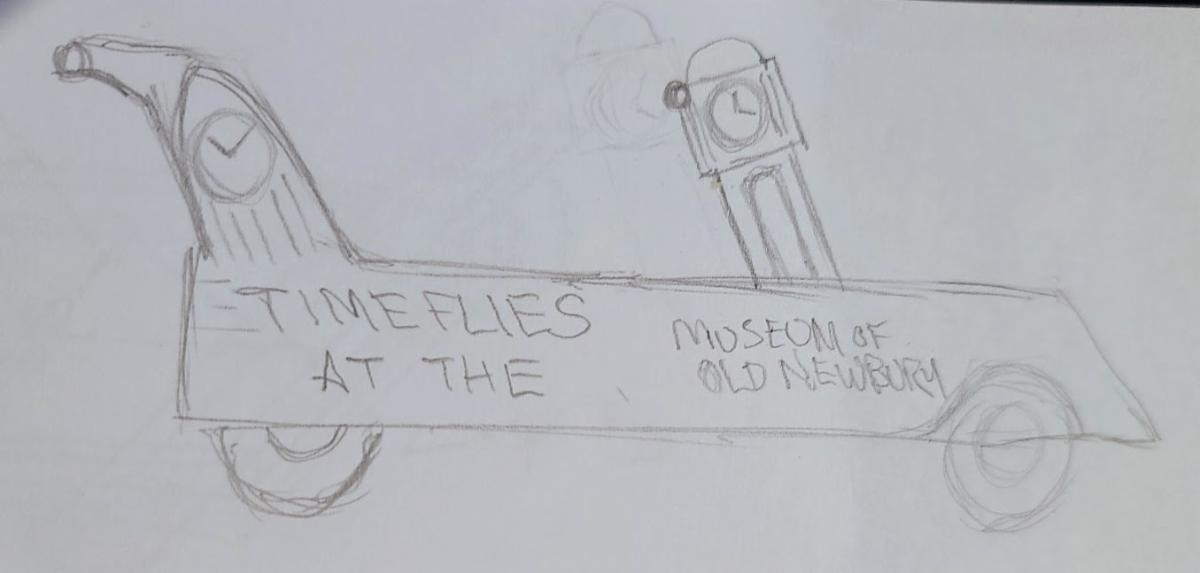
It began with an idea and a drawing...
| |
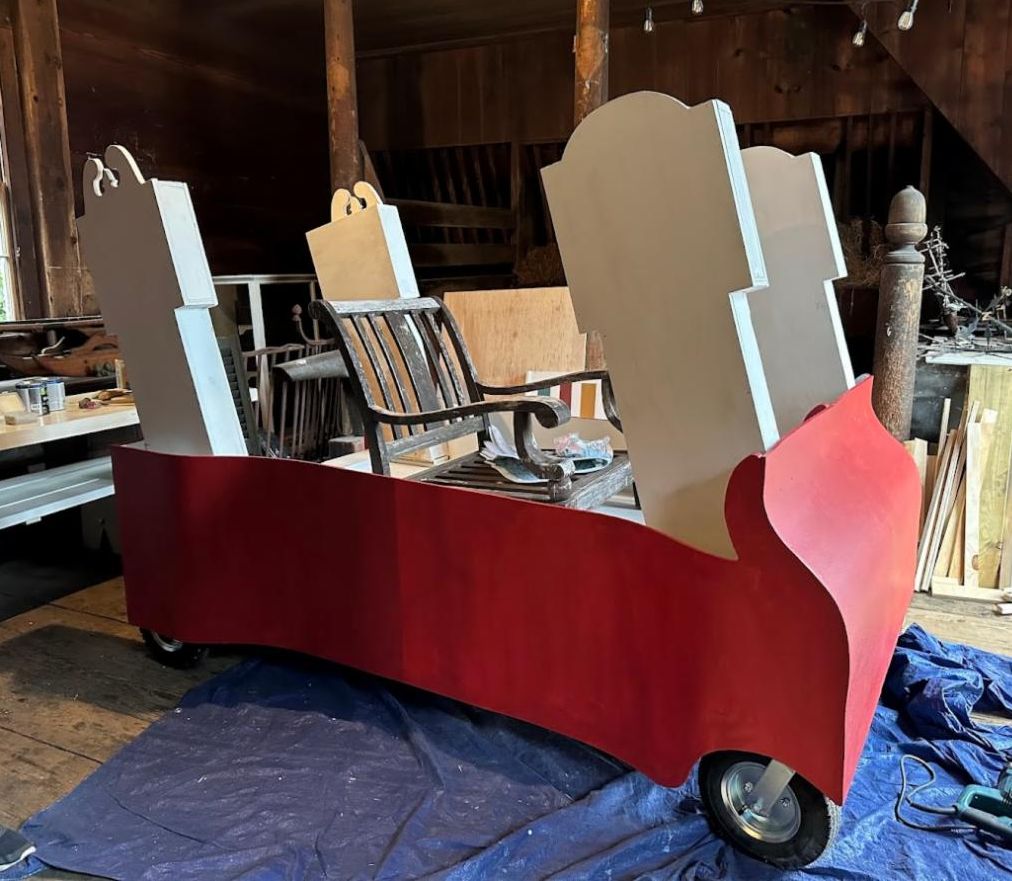
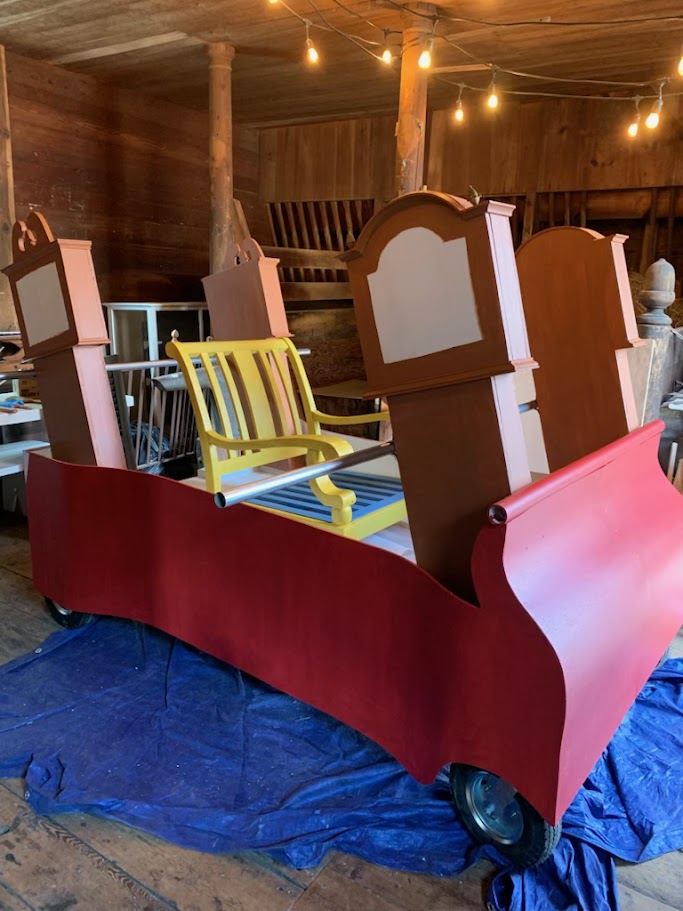
The concept was fleshed out by Steve and James. Supplies were ordered, measurements and weights debated, race rules pondered, and slowly but surely, thanks to Steve's incredible plywood-bending skills, the bed took shape. | |
Now, just in case you are scratching your head at the whole idea of a "bed race", let's back up for a moment. | |
|
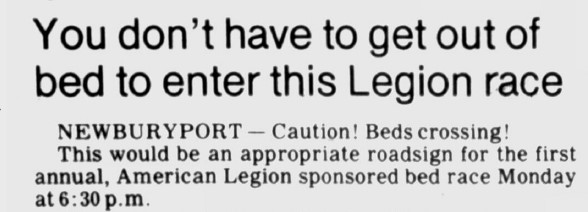
On June 27, 1984, the Newburyport Daily News announced the first running of the beds as part of Yankee Homecoming. The rules were very similar to those of today. The bed must be of a standard size, there could be a maximum of 5 runners, and someone must be in the bed.
In 1984, the bed races started at the corner of State and High Streets, raced down High Street, then down Federal Street, and terminated at Atwood Street. It was twice the current 1/4 mile length. Nobody was sure how it would go, including American Legion commander Alan "Buster" Driscoll. "I didn't think too much would come of it." Driscoll said. It was wildly popular in the end, with over 30 beds registered.
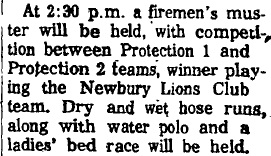
Bed races were not new in 1984, though the "ladies bed races" held in Newbury since the 1950's were very different. In these races, women were tucked into bed, and when an alarm sounded, they had to don full firemen's outfits, run across a field, and spray targets (and sometimes each other) with fire hoses. This was generally held as part of a benefit for a local fire department, as was the case here in this 4th of July event in Newbury in 1969.
| |
|
We are not alone in our fondness for combining beds and racing. Rutgers University has been holding bed races since 1966, the same year that the Knaresborough Round Table in North Yorkshire, England, began holding bed races that covered a grueling 2.4 mile course. Since 1990, Kentucky Derby Bed Races have been held in an indoor track.
With the decline in American Legion membership in the area, the Newburyport Bed Race ended in 1995, but was revived in 2002 by the Lions Club. It has been a steady crowd favorite at Yankee Homecoming celebrations ever since.
| |
|
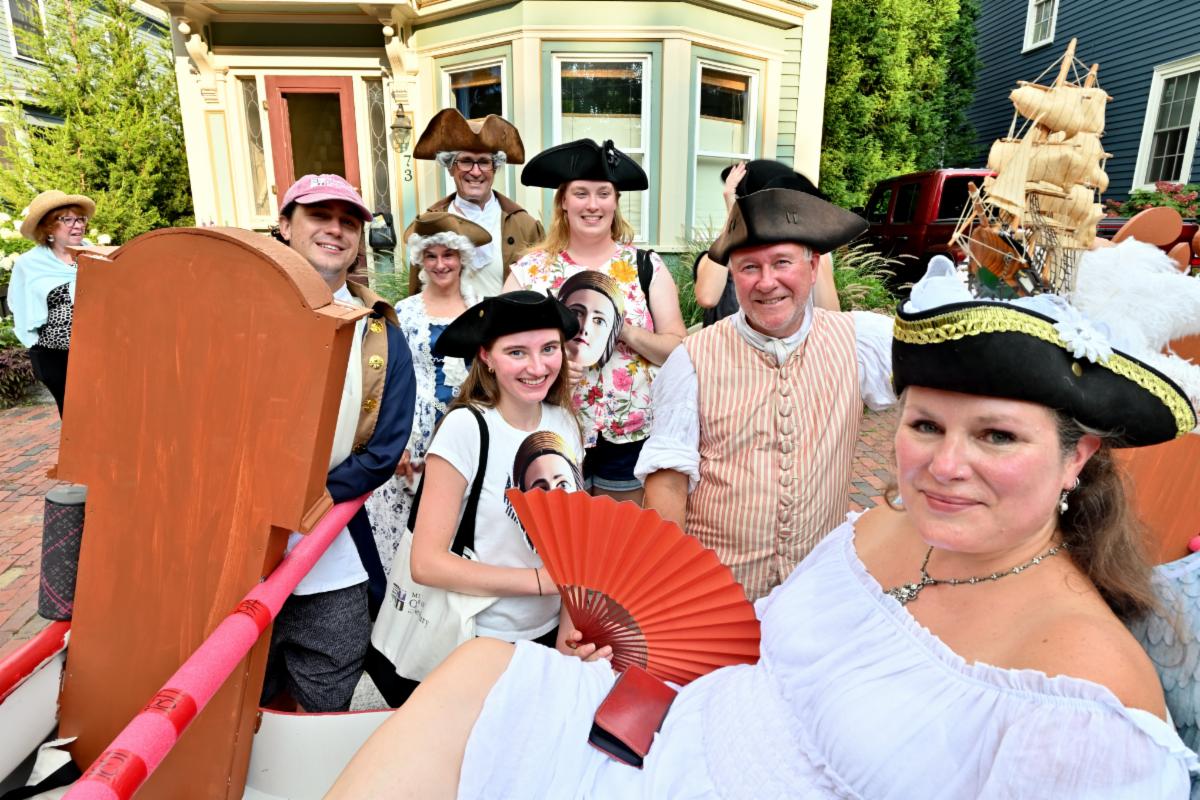
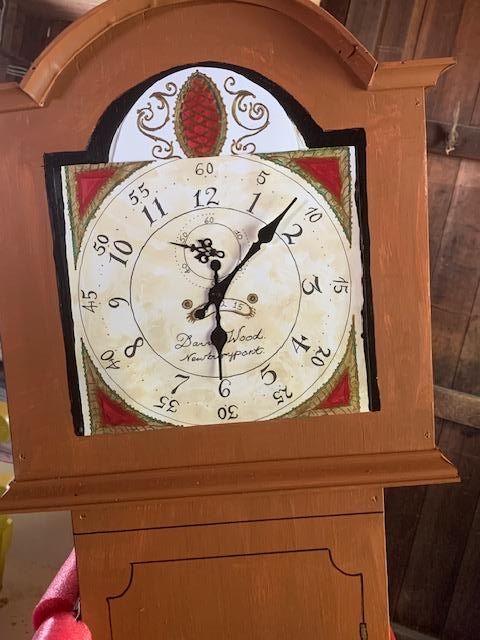
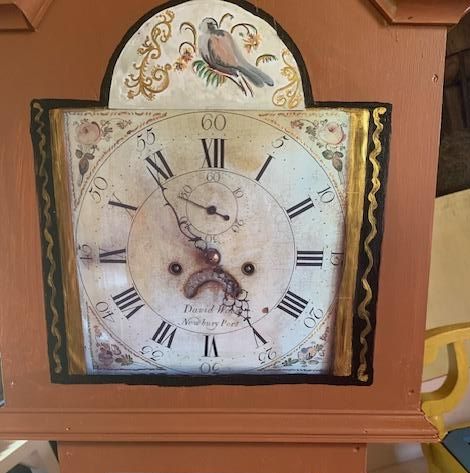
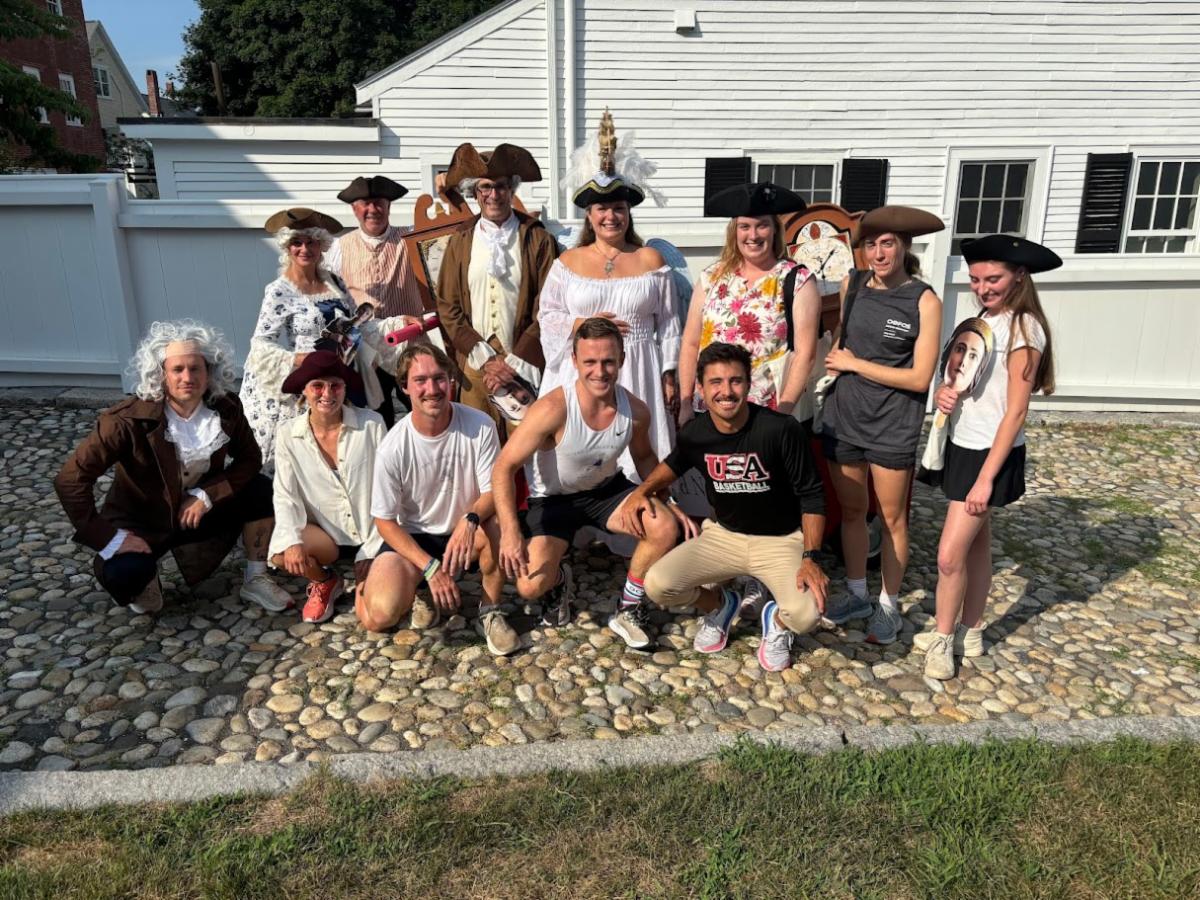
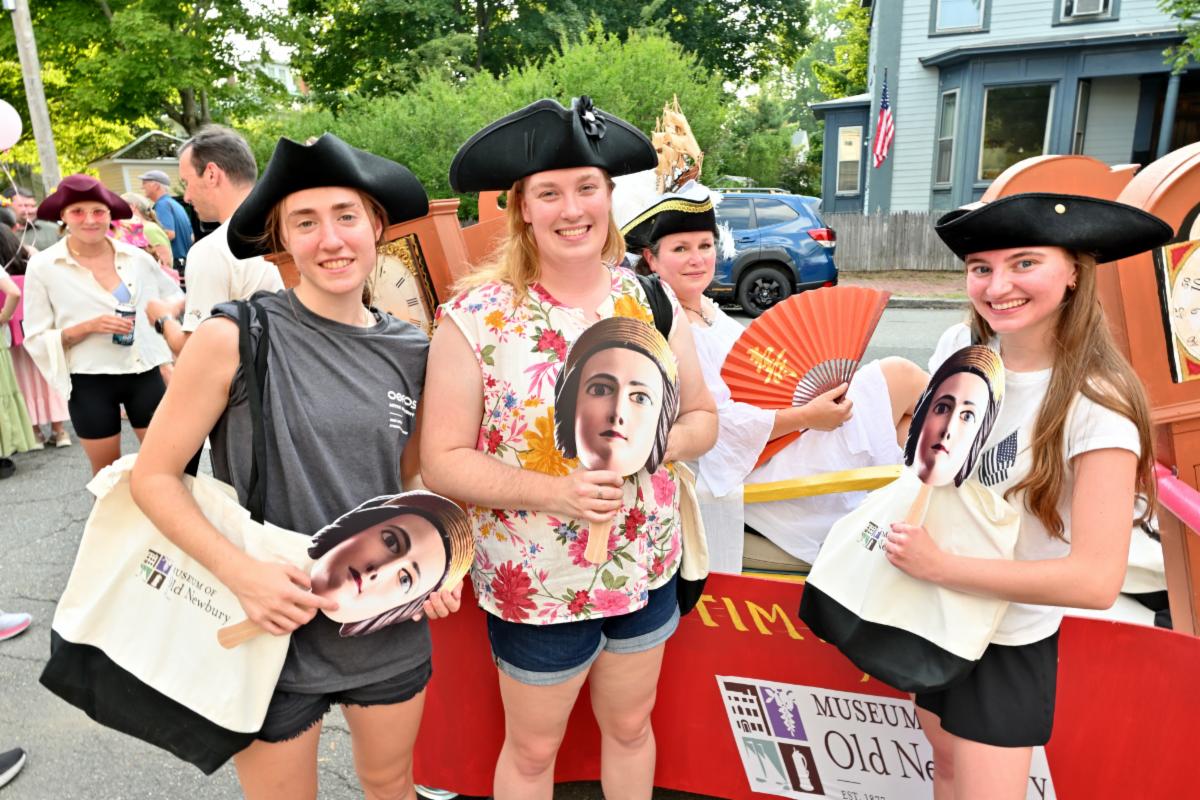
Meanwhile, in the carriage barn of the Cushing House, Steve and James were working tirelessly on the Museum of Old Newbury racing bed. As the process neared completion, other volunteers jumped in. Shelley painted and added the clock faces with Sharon's help. I donated an old porch chair which was cut down, stabilized, and painted. My husband, James, recorded chiming clocks and lent his portable speaker and his tricorn hats. We had fans made out of the memorable face of our beloved Landlocked Lady, a figurehead who never went to sea.
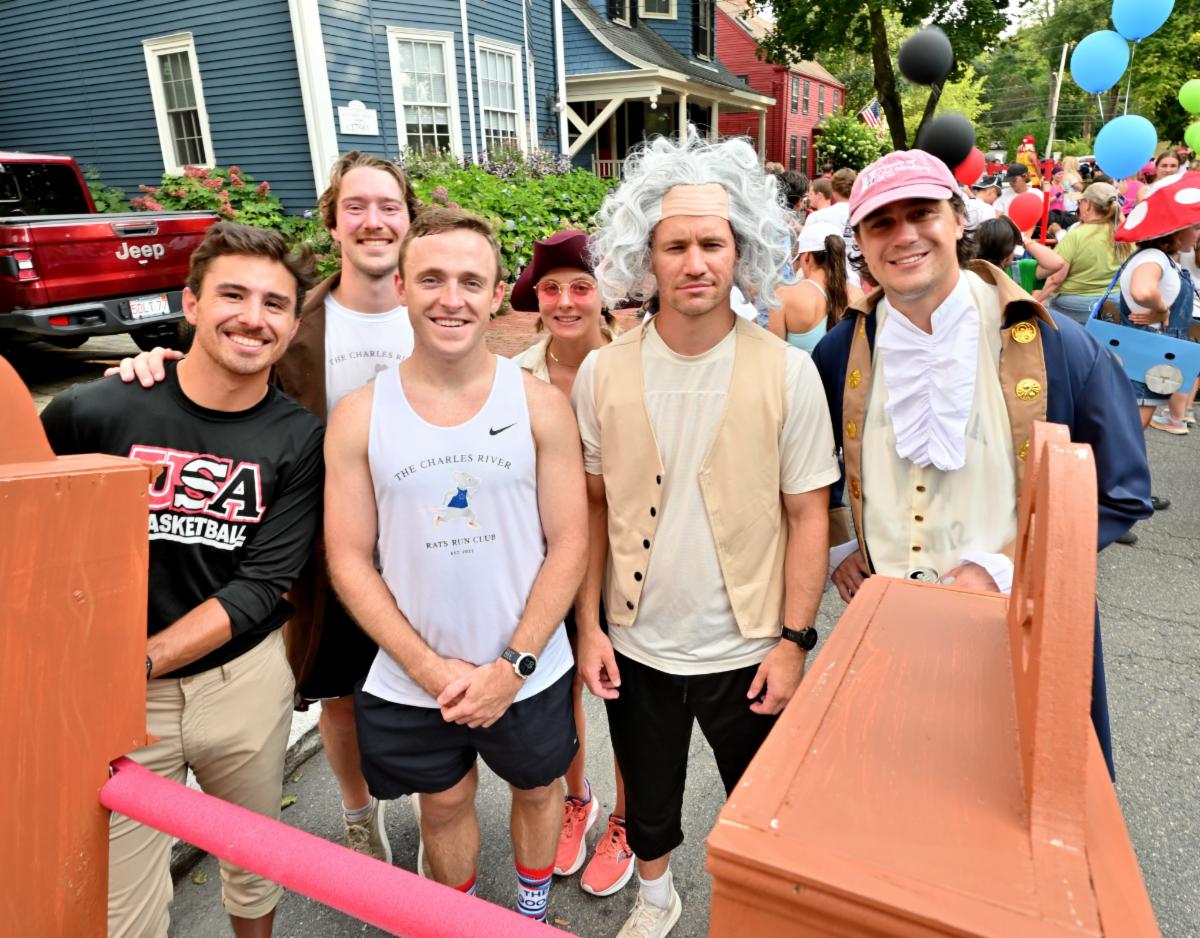
And then there was the small matter of the runners. James secured the services of the Charles River Rats Run Club to speed us to victory. And then, one day before the big race, the bed was declared ready, and a hearty crew of interns, volunteers, and staff took her for a test run. Our archivist brought in a hat with a model ship screwed atop. My entire outfit changed to accommodate that stellar chapeau.
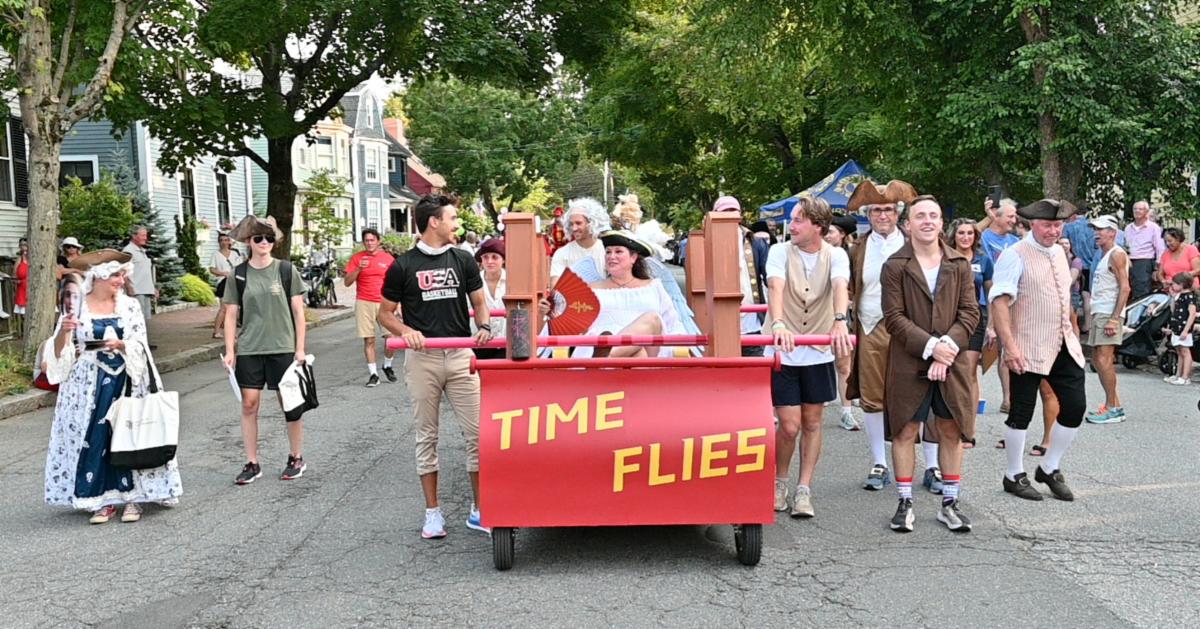
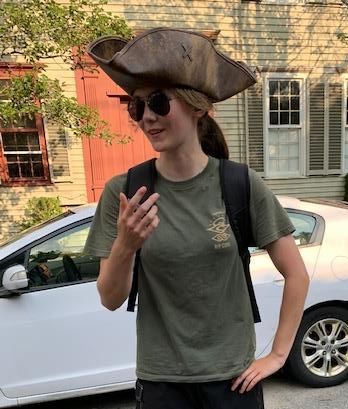
| 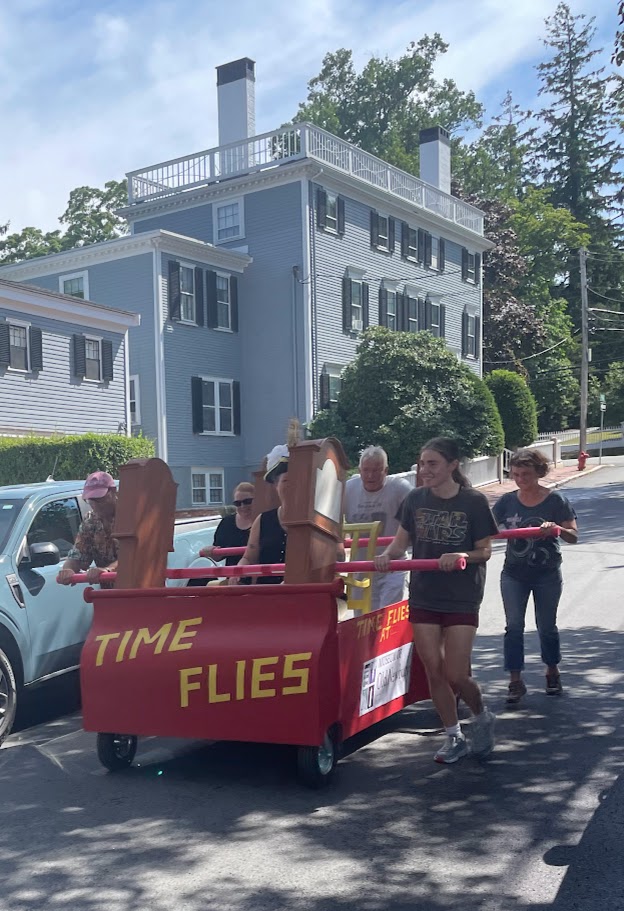 | 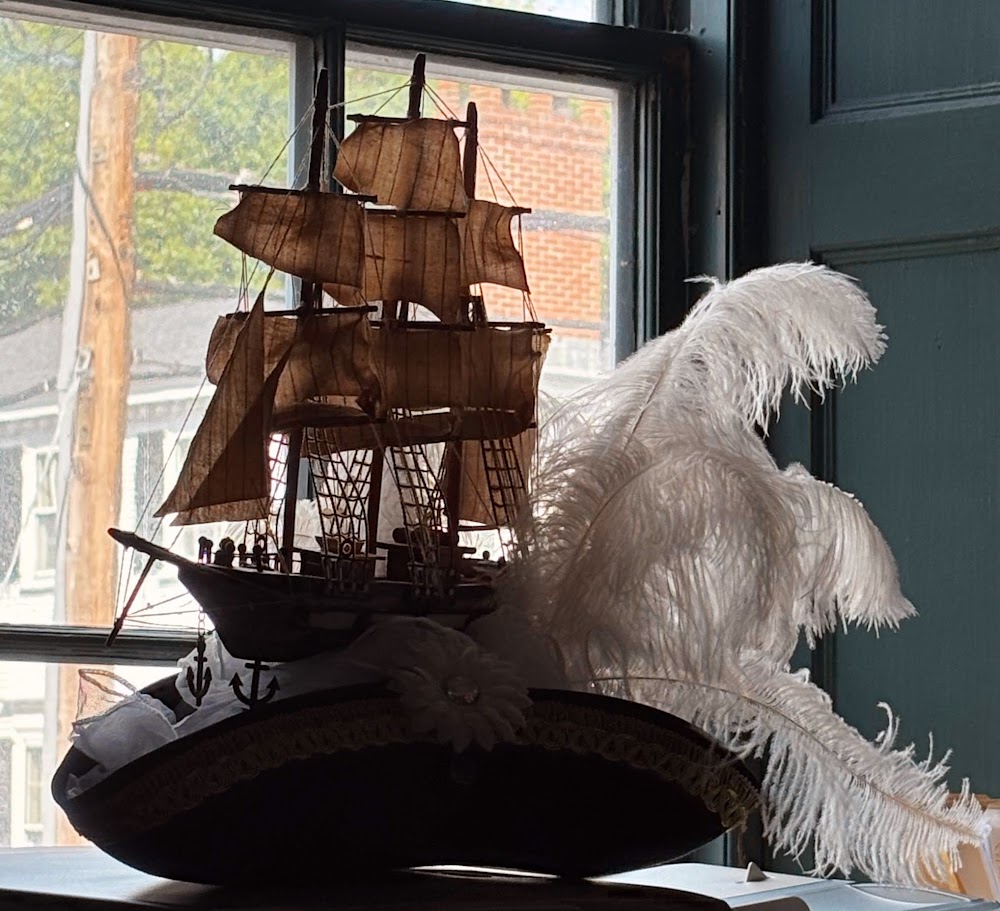 | Race day dawned hot and humid. The interns and staff donned tricorn hats and grabbed fans to hand out. The runners assembled, and Steve and James dressed to the nines, though Sharon outdid us all. I hopped aboard and we walked down to our place at the head of Federal Street. | |
|
After a fun wait while we fraternized and sampled the beverages brought by the runners of several nearby beds, it was our turn.
We were fifth in line to race, and though the lads put in a tremendous effort, in the end, the wheels on the bed went wonky and we had to slow considerably. Still, the sirens blared and the crowds cheered and Old South rang her bells, and we hurtled down the street and it all went by in a flash.
| |
After the race, the runners wheeled the bed back to the museum, trailed by the laughing interns and Shelley in their tricorn hats. James and Steve wandered off to their respective parties, and I walked slowly back up Federal Street in search of my family. | |
|
I will never forget all of us at the starting line singing La Marseillaise in honor of Annabelle's looming departure for graduate school in France, or how Shelley gave me her fan, Sharon her hat, my daughter Meg her dress. I will think of Steve in the carriage barn late at night and early in the morning, and James with his buckle sneakers, always thinking of new things to try.
I will remember each of you who came over for a hug and a high-five, the little boy who asked to touch my wings, the ringing of the steeple bells, laughing with Kristin as we waited for Senator Tarr, Bob behind the camera with his megawatt smile.
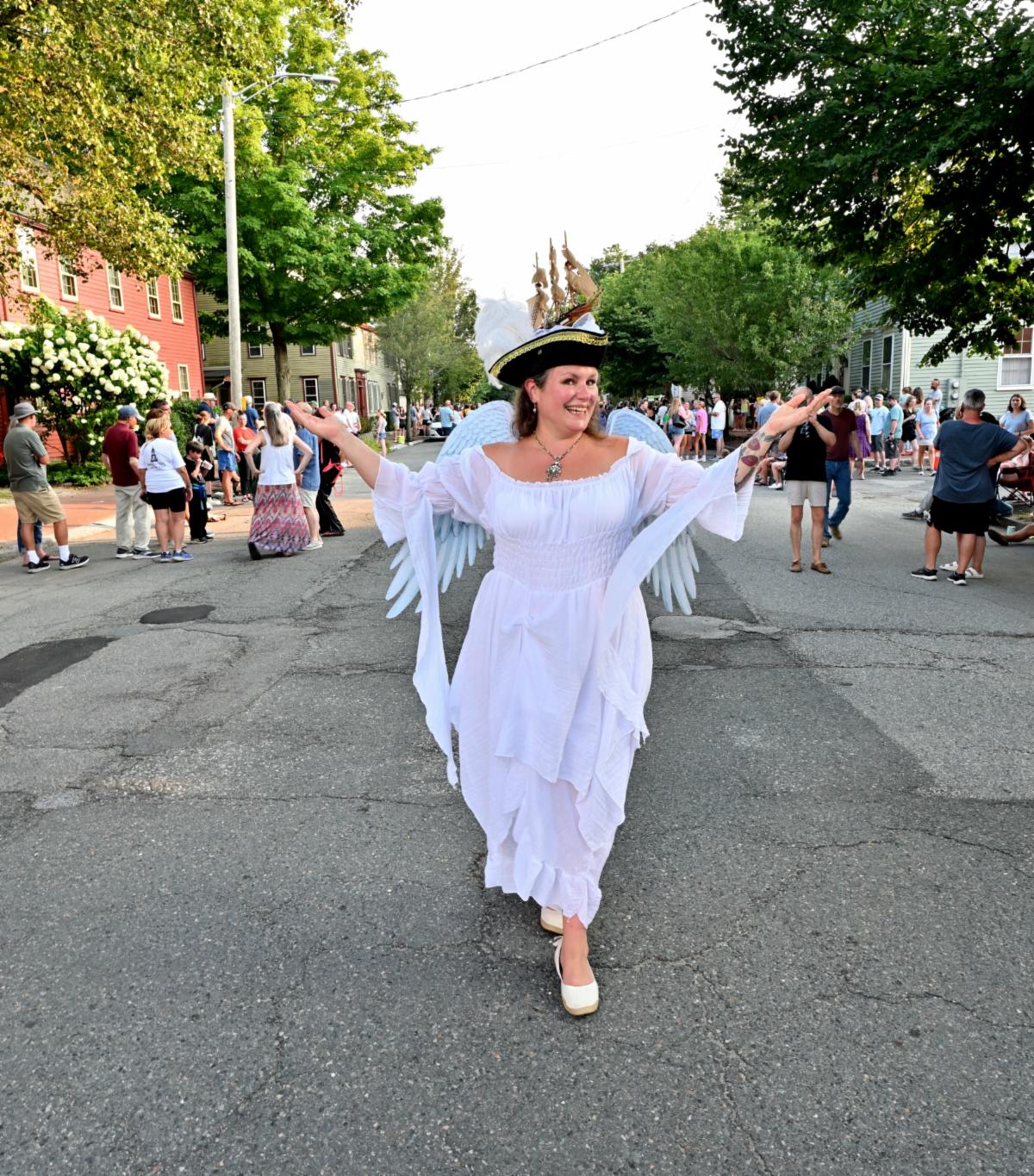
After the race, a photographer asked me to step into the street for a picture, and the smile on my face says it all. I am so proud of all of us. So much effort and thought went into this project, all in service of this wonderful museum.
Joy and friendship and love and wearing wings and a ship on my head are not in my job description, friends. Thank goodness for Other Duties as Required.
| |
Something Is Always Cooking... | |
|
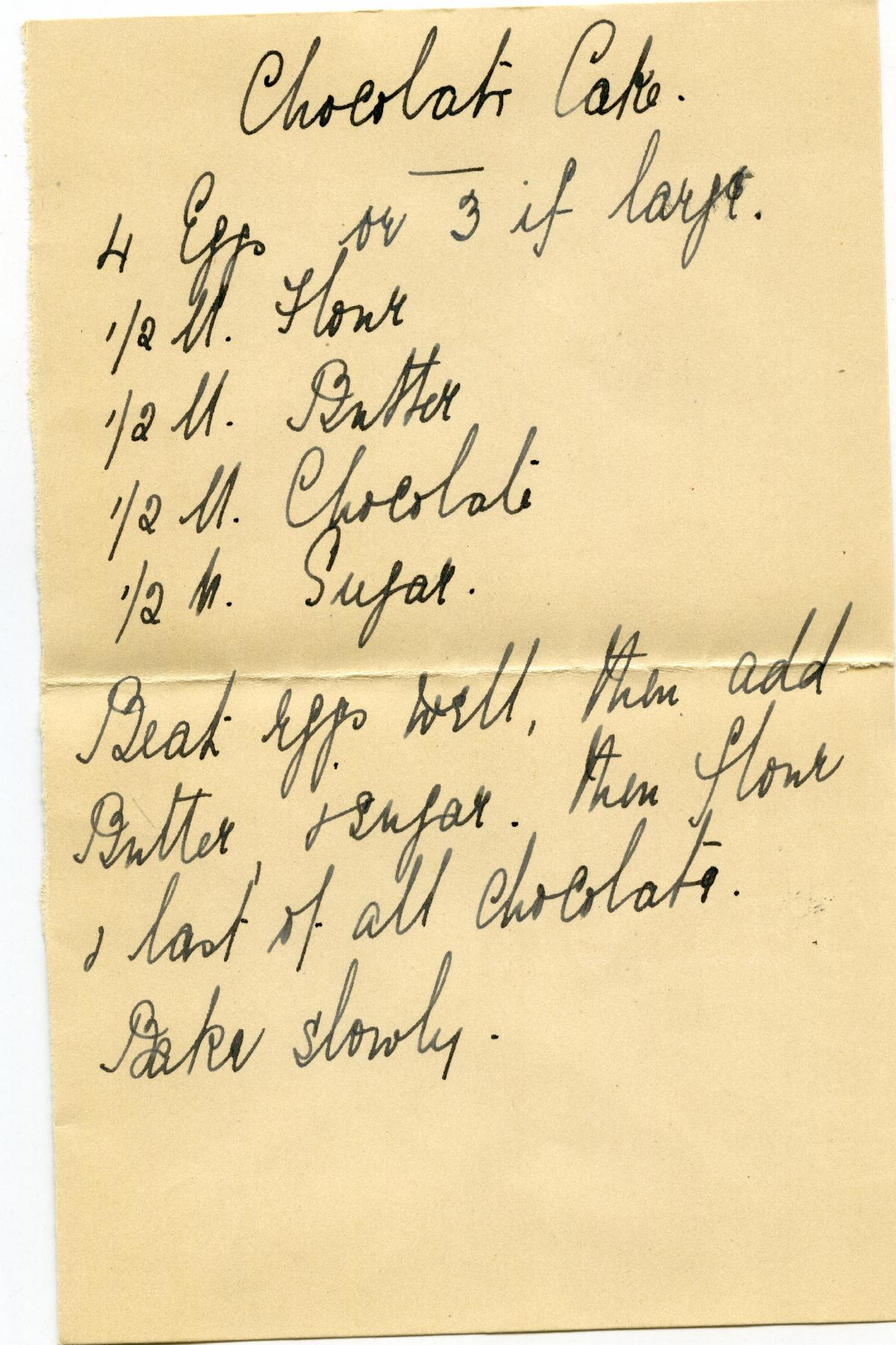
While reading the Graves letters we came across the recipe above from a 1914 letter from Constance T. to Mary Caldwell Graves. The recipe below is a more modern adaption of a classic pound cake.
Chocolate Pound Cake
INGREDIENTS
4 large eggs, room temperature
1/4 cup milk, room temperature
2 sticks (8 ounces/227 grams) unsalted butter, room temperature
1 shot of espresso or roughly 1.5 fluid ounces of coffee, room temperature
1 1/2 teaspoons vanilla extract
1 ⅔ cups all-purpose flour
1 1/4 cups sugar
1 teaspoon baking powder
1/2 teaspoon salt
¾ cup cocoa powder
INSTRUCTIONS
- Preheat the oven to 350°. Grease a loaf pan.
- In a medium bowl whisk together the eggs, milk, and vanilla.
- In an electric mixer or larger bowl mix combine the flour, sugar, baking powder, salt, and cocoa powder.
- Add the butter on low speed to the dry ingredients.
- Add the egg mixture to the dry ingredients a small pour at a time. Thoroughly stir in before adding more. Add in the espresso or coffee and stir thoroughly to combine.
- Pour batter into the prepared pan.
- Bake at 350° for 15 minutes. Reduce heat to 325° and bake for an additional 50 to 55 minutes. Best served with vanilla ice cream or whipped cream on the side!
ENJOY!
| |
|
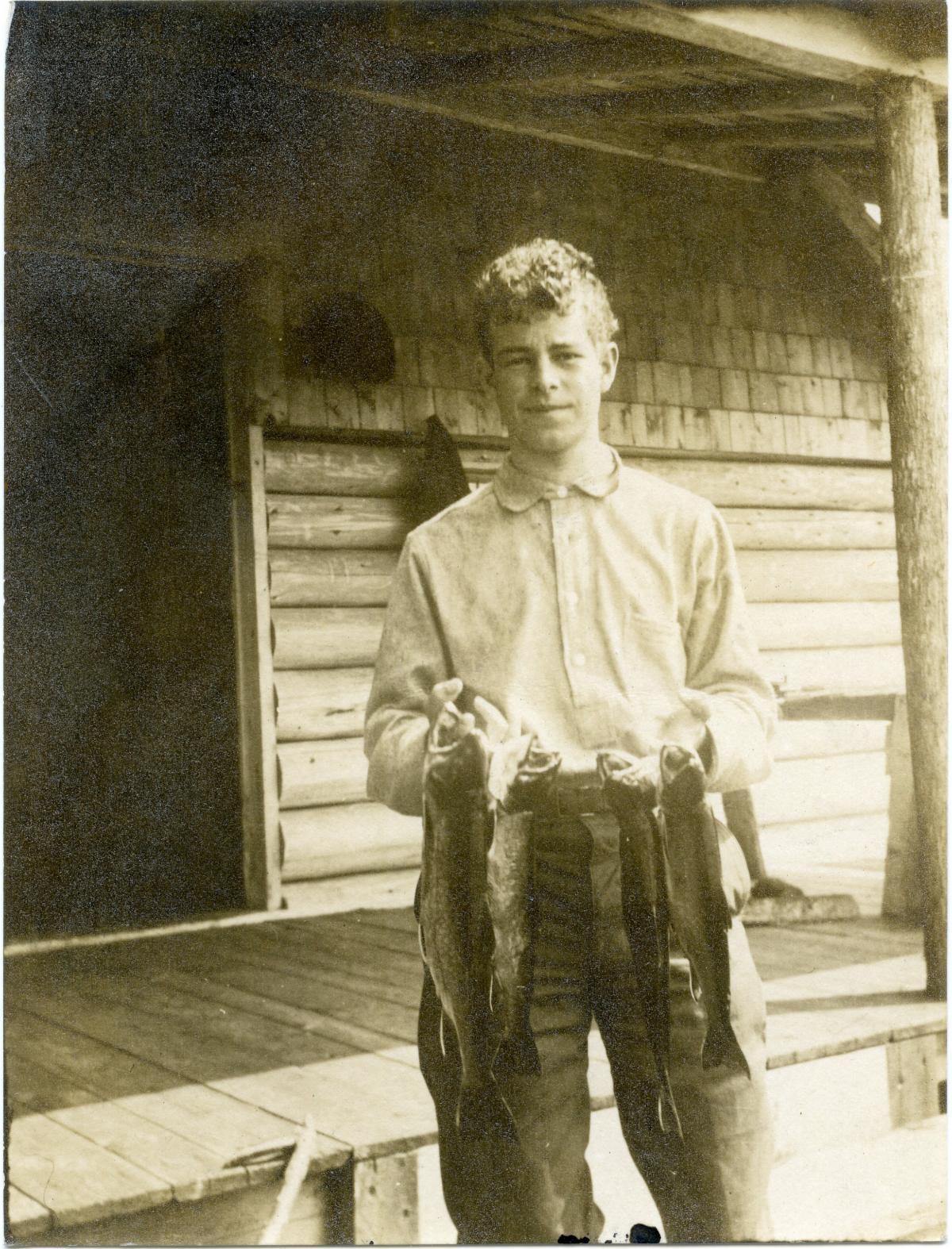
Photograph Minton "Minty" Machado Warren that he sent to Ruth in 1921 of his presumably (teenage) self from years ago.
Click the image to do the puzzle
| | |
Museum e-Newsletter made possible through the
generosity of our sponsors:
| |
| | | |