e-Newsletter | January 17, 2025 | |
|
Pitt, Patriots, and Painters: The Legacy of William Pitt the Elder in Newburyport
by Bethany Groff Dorau
| |
|
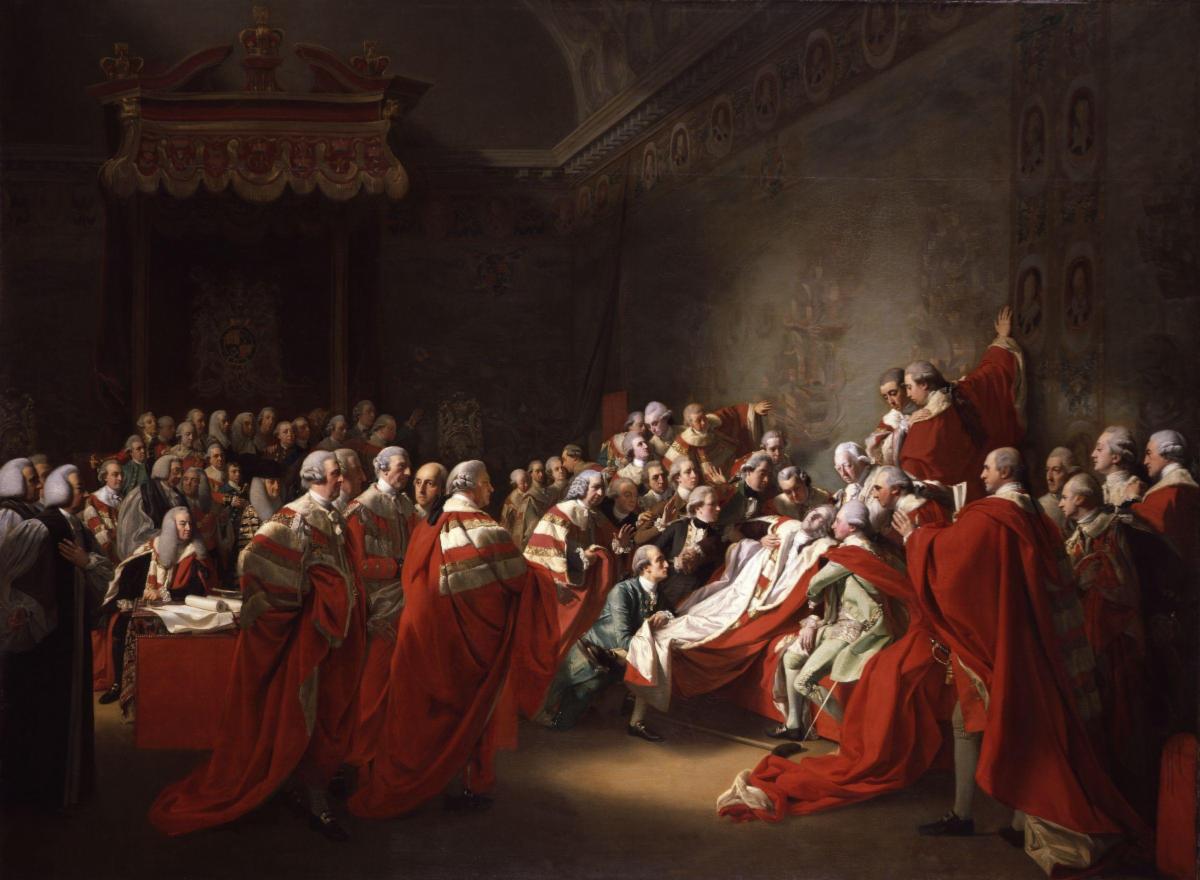
The Death of the Earl of Chatham (William Pitt the Elder) by John Singleton Copley
This is the scene that made a liar out of me. In it, 69-year-old William Pitt, 1st Earl of Chatham and former Prime Minister of Great Britain, is slumped over a bench in the House of Lords, pallid and swathed in the flannels worn by the very ill. He had turned up, half-carried into the House of Lords by his son, future Prime Minister William Pitt the Younger, on that day, May 11, 1778, to argue as passionately as his failed health would allow, AGAINST the liberty of the American colonies.
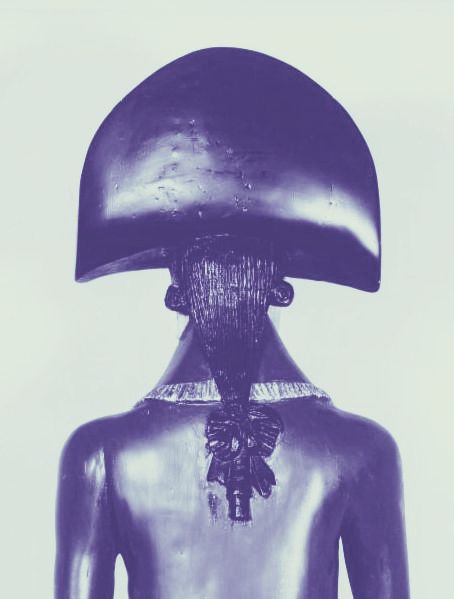
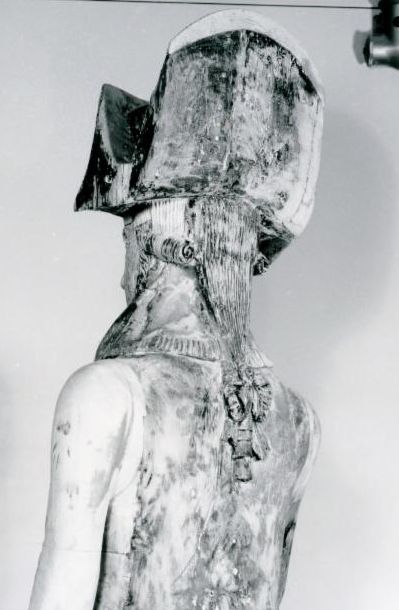
William Pitt the Younger, the 17-year-old prodigy who escorted his dying father that day, would become Britain's youngest minister of all time, ascending to the office of Prime Minister in December, 1783, just months after the end of the American Revolution. At the time that Lord Timothy Dexter was organizing his "museum" of wooden sculpture around his house in 1801, William Pitt the Younger had already been in office longer than his father, and was arguably better known. And so, when the statue identified as William Pitt (it had also likely had several other identities) was given to the museum, I rather rashly assumed it to be William Pitt the Younger.
Read the title story following event announcements.
| |
|
Researching Your Historic House – What the Pros Know!
Thursday, February 20 at 7 p.m.
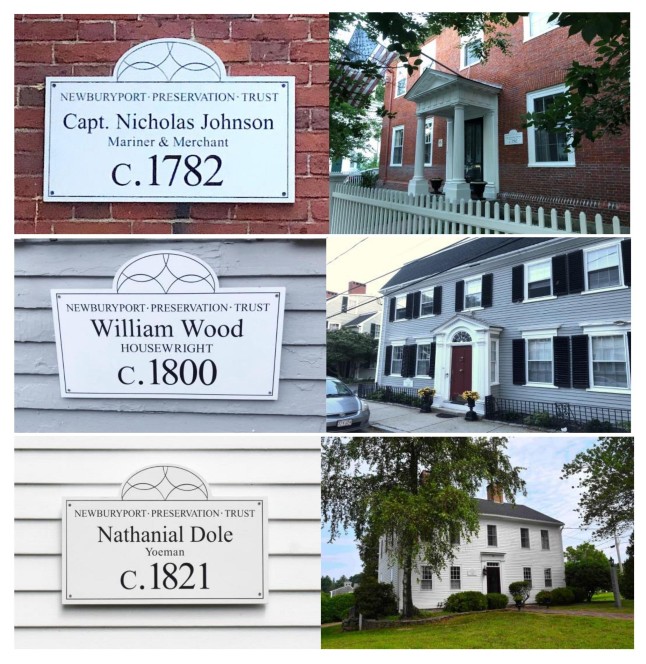
Have you come to a dead end in your online house history research? There's more to discover in the wonderful warrens of local archives and museums. This program, a partnership between the Museum of Old Newbury and the Newburyport Preservation Trust, will provide a primer on what other resources are available to deepen your research. Museum of Old Newbury director Bethany Groff Dorau will share resources available at the Museum of Old Newbury, while researchers Barb and Ellie Bailey will share some of their tips and tricks of the trade as they research houses for the Newburyport Preservation Trust: Historic House Plaque Program. We’ll also hear from a Newburyport homeowner who uncovered some fascinating research about their old home.
Free for Museum of Old Newbury and Newburyport Preservation Trust Members, $10 for all others.
| |
|
Pitt, Patriots, and Painters: The Legacy of William Pitt the Elder in Newburyport
by Bethany Groff Dorau
| |
William Pitt, whose statue is seen here during restoration, c. 1960, was a staunch defender of the rights of the American colonists, but was accused of turning his back on them once the Revolution began. Image courtesy of the Smithsonian National Museum of American History. | |
|
John Singleton Copley's famous painting, The Death of the Earl of Chatham (William Pitt the Elder) made a liar out of me. In it, 69-year-old William Pitt, 1st Earl of Chatham and former Prime Minister of Great Britain, is slumped over a bench in the House of Lords, pallid and swathed in the flannels worn by the very ill. He had turned up, half-carried into the House of Lords by his son, future Prime Minister William Pitt the Younger, on that day, May 11, 1778, to argue as passionately as his failed health would allow, AGAINST the liberty of the American colonies.
William Pitt the Younger, the 17-year-old prodigy who escorted his dying father that day, would become Britain's youngest minister of all time, ascending to the office of Prime Minister in December, 1783, just months after the end of the American Revolution. At the time that Lord Timothy Dexter was organizing his "museum" of wooden sculpture around his house in 1801, William Pitt the Younger had already been in office longer than his father, and was arguably better known. And so, when the statue identified as William Pitt (it had also likely had several other identities) was given to the museum, I rather rashly assumed it to be William Pitt the Younger.
As it turns out, however, our national relationship with the elder Pitt is much more complicated than I could have ever imagined. It was another painting, and the artist behind it, that offered yet another connection between Newburyport, the Stamp Act, and William Pitt.
| |
|
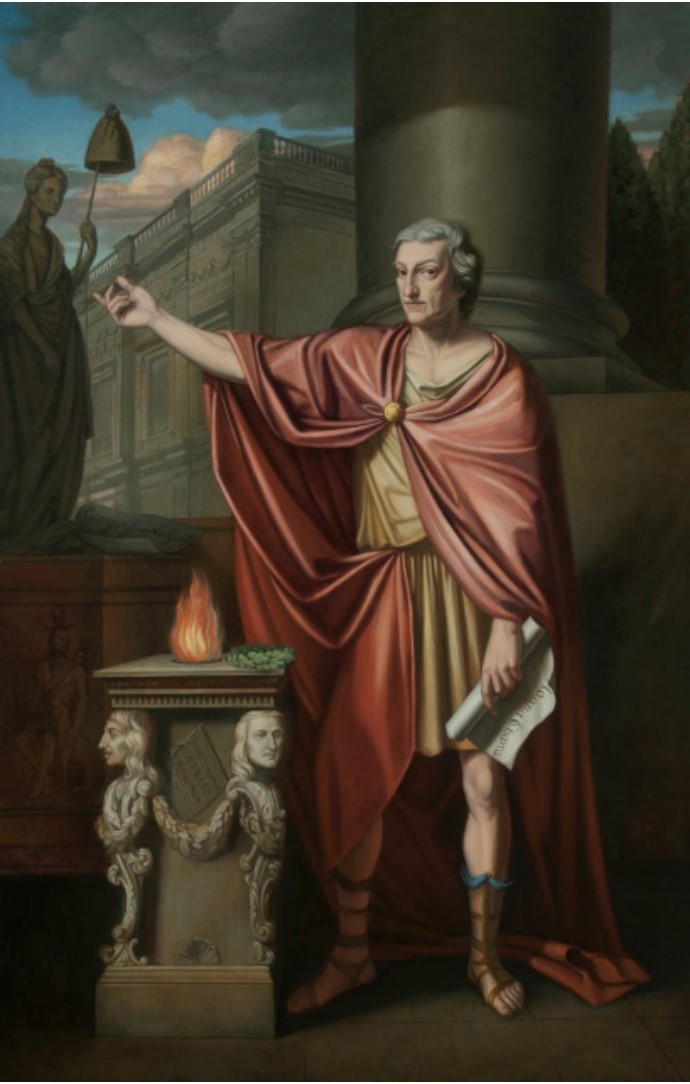
William Pitt, by Charles Willson Peale.
In 1768, young Maryland artist Charles Willson Peale received his first full-size commission from Edmund Jennings, a fellow Marylander living in London. Peale was to paint a portrait of William Pitt, first Earl of Chatham, Prime Minister of Great Britain. The painting was to be a gift to the patriot leaders in Westmoreland County, Virginia, in honor of Pitt's opposition to the Stamp Act in Parliament in 1766.
Peale's portrait of Pitt is chock-a-block with potent symbols of smoldering Revolutionary ideals, then still nearly a decade away from full conflagration. Pitt is shown in Classical garb, clutching the Magna Carta, symbol of the liberties enjoyed by Englishmen, while a statue representing Britannia stands on the discarded resolutions of the Stamp Act Congress, colonial leaders who met in New York in 1765 to coordinate opposition to the Stamp Act. America, represented by an armed Indigenous man, stands ready to defend itself.
Charles Willson Peale was a natural choice to paint a patriot portrait. He was an ardent supporter of the Sons of Liberty in Maryland. At some point, however, he found his way to....you guessed it...Newburyport. In his 1937 monograph, American Miniatures 1730-1850, Harry B. Wehle says, "In 1765, when Peale was twenty-four, his services, in some mysterious way, were required in far-off Newburyport, where he painted five portraits." Other scholars find the reason for Peale's sojourn in Newburyport less mysterious.
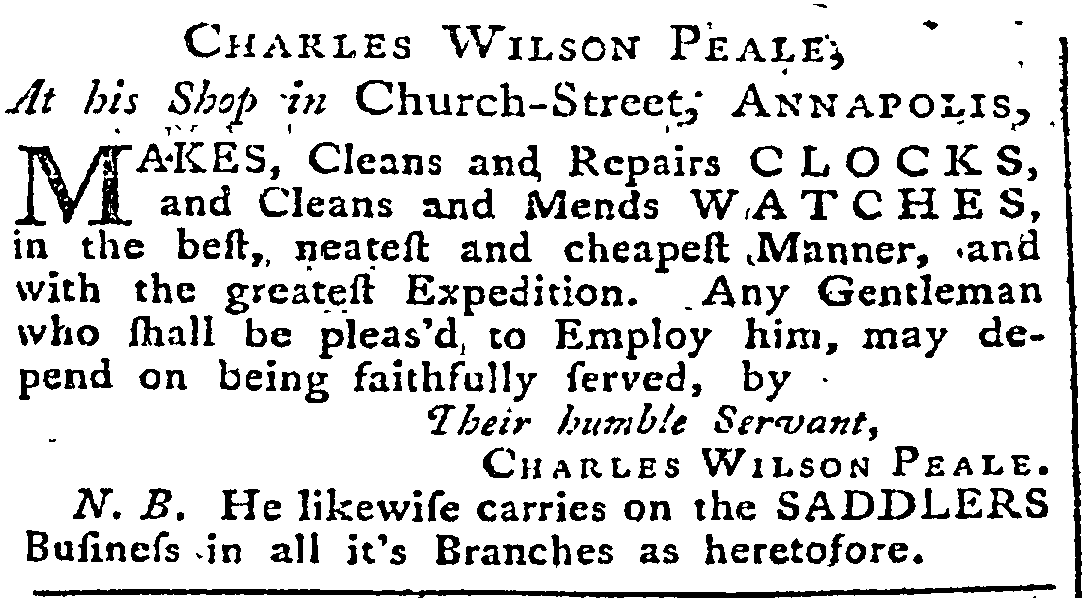
Peale, born in 1741, was a man of modest means, and had tried his hand at a variety of trades to support his young family. He repaired watches, made saddles, upholstered furniture, and was just beginning to show some talent as an artist when he became involved in the fight against loyalist factions in Maryland in the election of 1764. He seems to have found himself on the wrong side of some of his loyalist creditors, and high-tailed it to New England to avoid being imprisoned for debt.
| |
This advertisement for Peale's clock and watch repair and saddle-making business is from the Annapolis Gazette, January 14, 1762.
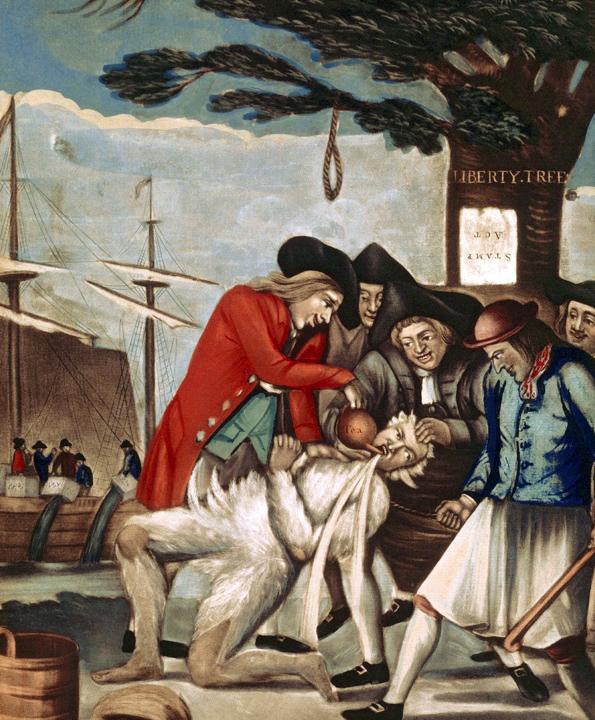
Newburyport was in full froth over the outrageous imposition of the Stamp Act, a tax levied on printed material across the colonies in 1765 to help pay for military expenditures during and after the French and Indian War. Riots broke out across the colonies. In Newburyport, gangs roamed the street looking for anyone foolish enough to defend the Act, and beating them senseless if they did not respond correctly to the question, "stamp or no stamp".
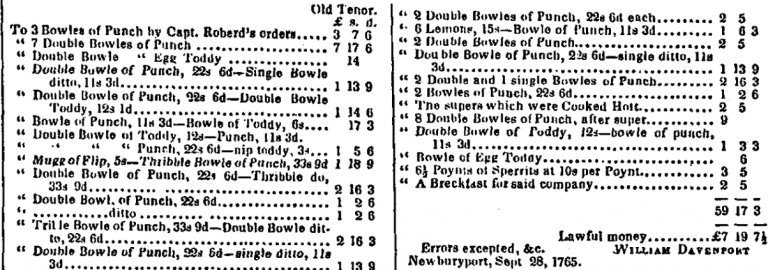
Newburyporters did their best thinking at the Wolfe Tavern, it would seem, and on Thursday, September 26, a meeting was called to organize local resistance to the Stamp Act. The meeting went on all night, and the assembled party put down an amazing amount of alcohol and then stayed for breakfast. The bar bill kept by owner William Davenport's grandson tells the story.
| |
Newburyport's violent reaction to the Stamp Act deserves a full story, but it intersects with Charles Willson Peale in an interesting way. After dipping out of Maryland to avoid his creditors, Peale made his way to Newburyport, where the young artist and ardent Son of Liberty found a sympathetic audience. Peale scored commissions for portrait miniatures, but also, according to his unpublished autobiography, was hired to make "emblematic Ensigns" for the Newburyport Stamp Act protestors. Charles Willson Peale, painter of Pitt, was the graphic designer of the Sons of Liberty in Newburyport. Sometimes the serendipity of the past in this community boggles my mind. | |
The Bostonians Paying the Excise-man, or Tarring and Feathering, 1774. Library of Congress.
Meanwhile, in London on January 14, 1766 (this week, 259 years ago) William Pitt the Elder, despite suffering an acute attack of gout, rose from his sickbed and made his way to the House of Commons. Pitt, who had been de facto Prime Minister during the French and Indian War, had resigned in 1761, and was not present when the Stamp Act was passed. He was outraged on behalf of the colonies, and told a friend that "If I can crawl or be carried, I will deliver my mind and heart upon the state of America." His famous speech begins, "Gentlemen, Sir, I have been charged with giving birth to sedition in America.". He went on to argue that the Stamp Act was a violation of the rights of the colonists as British citizens, and it was within their rights to rebel against taxation without representation. Pitt believed that the colonists were loyal citizens, and that Parliament had legislative authority over the colonies, but reiterated that British citizens could only be taxed by assemblies in which they were represented. Pitt called for the repeal of the Stamp Act and warned that military action against the colonies would only work to destroy the British Empire and encourage further rebellion.
Pitt's speech was widely distributed through the colonies, and as the word spread of his impassioned defense of colonists' rights, he was rewarded in the best way they knew - they named their taverns, baby boys, and ships after him.
| |
|
The William Pitt Tavern in Portsmouth, New Hampshire was renamed in 1777 as William Pitt was less controversial in a patriot town than its former namesake, the Earl of Halifax.
Pitt may have predicted that military enforcement in the colonies would result in rebellion, but he was in no way a supporter of the Revolution and independence. His literal dying breath was spent arguing for war to preserve the British Empire. The same William Pitt who, a decade before had been accused of fomenting rebellion urged war against the French and the traitorous American revolutionaries.
"In God's name, if it is absolutely necessary to declare either for peace or war, and the former can not be preserved with honor, why is not the latter commenced without delay?"
Why, then, would Lord Timothy Dexter choose William Pitt the Elder to represent his ideals? Who knows why Dexter did what he did, but William Pitt's longstanding reputation as a friend of the colonies is certainly relevant here. Pitt has other characteristics that made him a good choice for moral statuary - he was known as the "Great Commoner" because of his refusal to accept a peerage title until 1766, and was seen as a defender of the rights and interests of Englishmen across the empire.
Perhaps more relevant to our story is the somewhat miraculous pass he was given by popular opinion after his condemnation of the Revolution. At a time when English leaders were burned in effigy and Wolfe Tavern signs were used as target practice, somehow Pitt's credit in the colonies was never completely depleted.
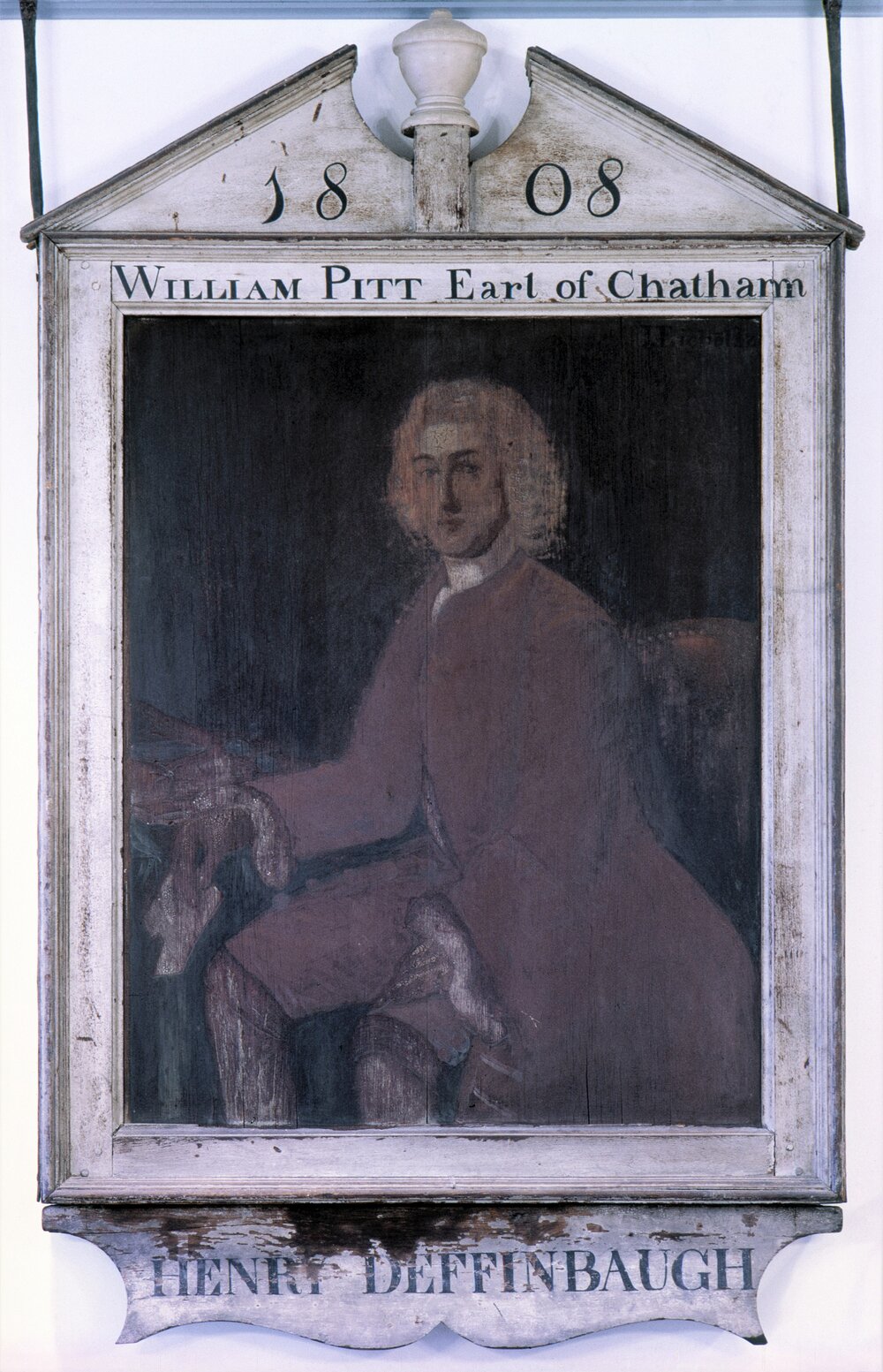
After all, as the 1808 William Pitt Earl of Chatham sign from the Demuth Museum in Lancaster, Pennsylvania demonstrates, seven years after Dexter made his Newburyport "museum", colonists were still naming their most precious public buildings after William Pitt the Elder.
| |
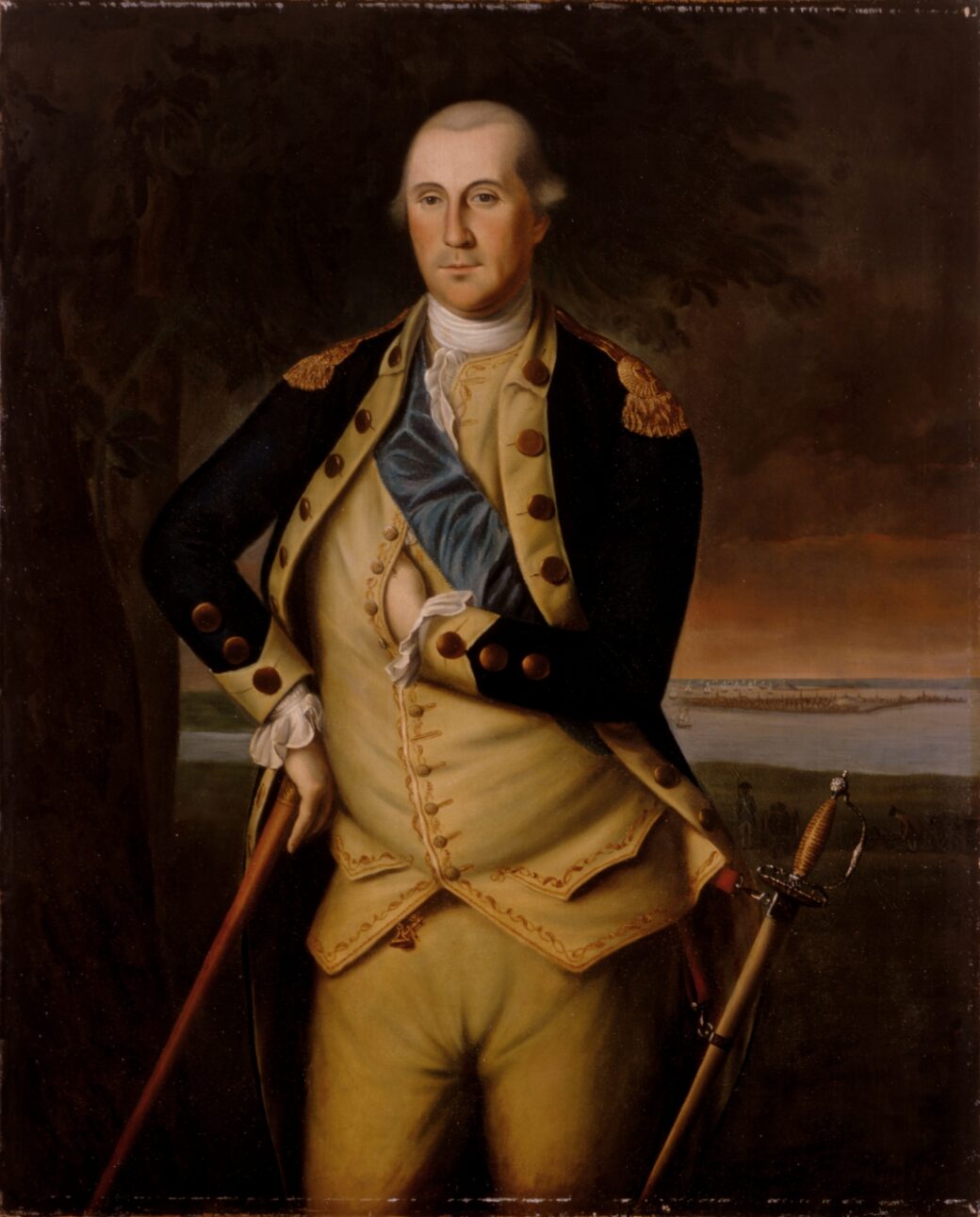
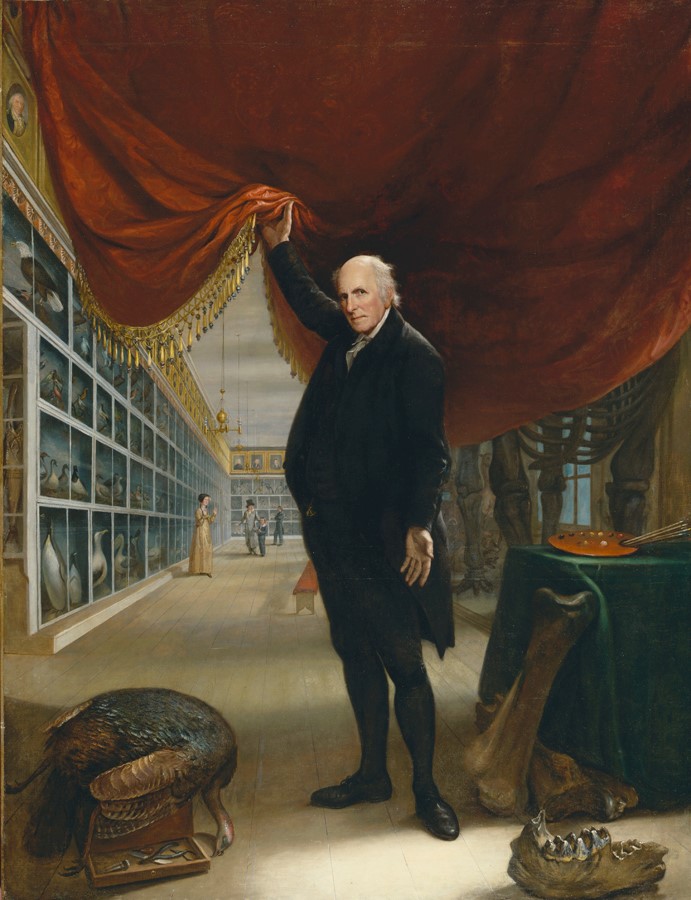
As for our friend Charles Willson Peale? He lived a rich and fascinating life during and after the American Revolution, where he fought on the front lines and painted George Washington numerous times. This is probably where you have encountered him in the past, but he was also, according to the New York Times, the "celebrated patriarch of America’s first artistic dynasty and founder of the nation’s first public museum". Peale's museum rivals Dexter's for strangeness and personality, one more thing the two men shared, in addition to their creation of art based on William Pitt the Elder. | George Washington Portrait ca. 1776, Charles Willson Peale, White House Collection | |
|
It's not too late!
Donate to the 2024 Annual Fund Today!
William Pitt would donate. Just saying.
| |
Something Is Always Cooking... | |
|
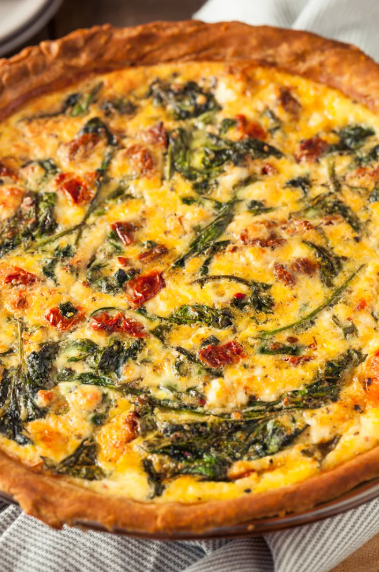
Red Pepper, Spinach & Artichoke Quiche
We did a Christmas Day brunch this year, and quiches, made earlier in the day, were the best way to free us up for other hosting duties. I made three very different quiches. One featured pesto, fresh mozzarella, and spinach, while another was a "taco" style, with roasted onions, peppers, and corn, and veggie chorizo. My favorite is this one, a mix of roasted peppers, marinated artichokes, and spinach. It is just as good as it looks, and made from eggs from our own happy hens.
Ingredients
2 tablespoons extra-virgin olive oil
1 medium-size yellow onion, chopped
2 large garlic cloves, peeled and minced
Salt to taste
2 roasted red peppers, cut in thin 1-inch strips
4 marinated artichokes, chopped
1 teaspoon chopped fresh thyme leaves
1/2 teaspoon herbes de Provence
1generous bunch spinach, stemmed, coarsely chopped
Freshly ground pepper to taste
5 eggs
1(9-inch) pie crust, lightly baked and cooled
Freshly ground pepper
3/4 cup milk (unsweetened almond or soy milk work well here too)
1/2 cup Gruyère, grated
1/4 cup Parmesan, grated
Directions
- Preheat oven to 350 degrees.
- Heat oil over medium heat in a large, heavy skillet and add onion. Cook, stirring, until tender, about 5 minutes, and add a generous pinch of salt, the garlic, and thyme. Cook, stirring often, for 10 minutes, then add red peppers, spinach, and artichokes.
- Turn up heat to medium-high and stir until spinach is wilted. Remove from heat and transfer to a bowl. If you are making filling a day ahead, refrigerate uncovered.
- Beat together eggs. Set pie pan on a baking sheet for easy handling. Using a pastry brush, lightly brush bottom of the crust with some of the beaten egg and place in oven for 5 minutes.
- Add salt (I use about 1/2 tsp. kosher salt and a sprinkle of season salt), pepper, and milk to the remaining eggs and whisk together.
- Spread pepper and spinach mixture in an even layer in the crust. Stir together cheeses and sprinkle in an even layer on top. Very slowly pour in the egg custard over the filling. If your pie pan has low edges, you may not need all of it to fill the shell, and you want to avoid the custard spilling over. Place quiche, on baking sheet, in the oven and bake for 30 to 35 minutes, until set and just beginning to color on the top.
- Remove from oven and allow to sit for at least 10 minutes before serving. Serve warm in winter, or room temp at other times.
Enjoy!
| |
|
Click the image to do the puzzle
In this 1822 self-portrait entitled The Artist in His Museum, Charles Willson Peale raises the curtain on his museum on the second floor of Philadelphia's Independence Hall. Courtesy Pennsylvania Academy of the Fine Arts
| | |
Museum e-Newsletter made possible through the
generosity of our sponsors:
| |
| | | |