e-Newsletter | July 7, 2023 | |
|
The Mystery and Misadventure of Newburyport Artist Ethel Reed (1874-1912)
by Sierra Gitlin, Museum of Old Newbury
During the span of just two years, 1895 to 1897, Newburyport-born artist Ethel Reed appeared as if out of nowhere, rocketed to international acclaim, and then disappeared. Once one of Boston's most prolific illustrators in the burgeoning poster art genre, a form that would go on to shape the worlds of advertising, publishing, and commercial art in general, Ms. Reed is virtually unknown today, despite the influence of her work, the enduring fame of her contemporaries, and the Whartonian drama of her personal life. Her story remains shrouded in mystery - her only biography, written by William S. Peterson in 2013, is just 95 pages long, and lacks as many details as it provides.
Ethel was born in Newburyport on March 13, 1874, the shy and quiet only child of photographer Edgar Eugene Reed, (related by marriage to the more successful and well-known photographer Selwyn Reed) and Mary Elizabeth Mahoney, an Irish immigrant. Her father struggled to support the family, likely working only seasonally making photographs of tourists at Salisbury Beach. Ethel spent her early years on Kent Street in the shadow of The Ocean Steam Mills, where her family rented rooms in a modest boarding house owned by Edgar’s cousin. Her parents seem to have been estranged, and had separated by the 1880s. A cerebral, solitary child, later interviews made no mention of her parents whatsoever, and painted a deliberately pretty picture of her upbringing in “gentle Newburyport.”
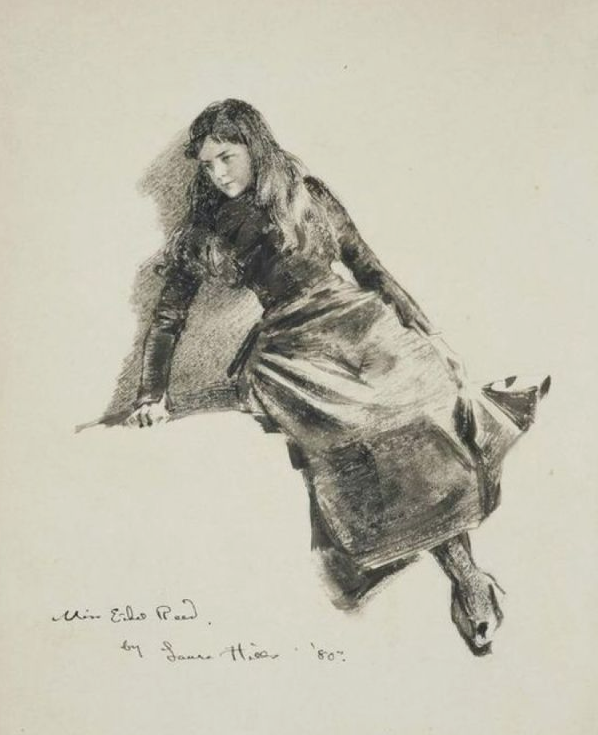
The first hint that Ethel might be destined for more than her working-class beginning suggested, aside from her daydreams of playing violin professionally or one day becoming an actress, was her connection with Newburyport’s own Laura Coombs Hills. In 1880, 31-year-old Miss Hills sketched a pensive Reed, who appears older than just six years old. That sketch is now in the collection of the Museum of Fine Arts, though it is not currently on display.
| |
|
Laura Coombs Hills sketch of six-year-old Ethel Reed (1880)
How this portrait came to be is unclear, but in any case, a few years later when Reed was 12, she took some drawing lessons from Miss Hills. By Reed’s own admission in an interview years later, however, her “inattention and rebelliousness caused [her instructor] much vexation.”
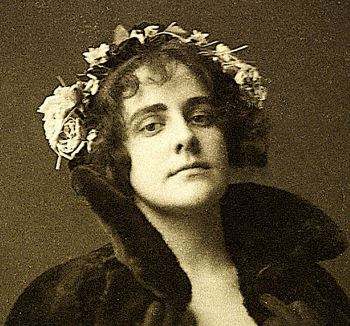
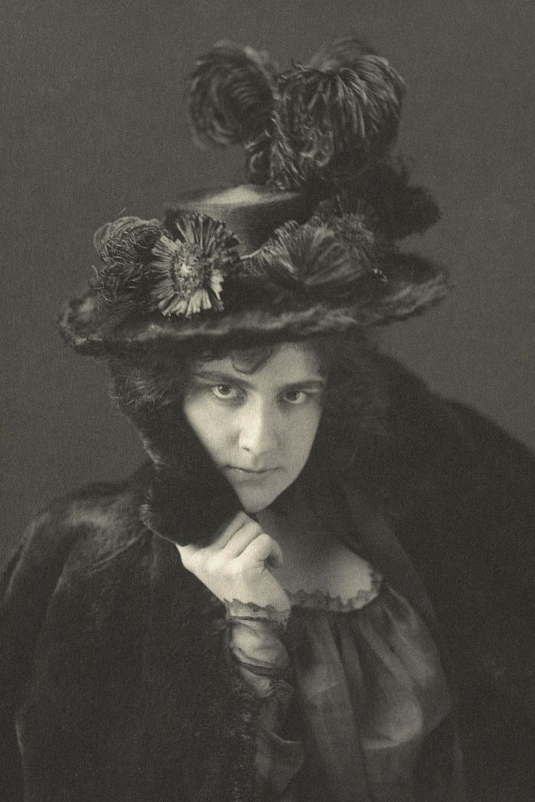
In 1892, Edgar Reed died of tuberculosis, leaving 16-year-old-Ethel and her mother nearly destitute. They had already relocated to Boston, where Ethel studied briefly at the Cowles Art School, where she apprenticed in miniatures, the same format for which Laura Coombs Hills became famous. Over the next few years Ethel’s seemingly innate avant garde sensibilities were stoked by the blossoming Bohemian subculture of Boston. She smoked, drank, had lovers, began using opium, and realized her childhood dreams of the stage by appearing in several plays by the Boston Art Students’ Association. She was lauded in the Boston and New York papers for her striking beauty and talent as an actress and dancer. She worked again with Laura Coombs Hills in 1892 in the “Pageant of Life” festival Hills had designed and produced, and collaborated with photographer/ spiritualist/ eccentric artist Fred Holland Day, whose photos of Reed captured her striking beauty, glamor, and dramatic ability to embody different personas. The photographer Frances Benjamin Johnston also made several iconic portraits of her.
| |
|
Ethel Reed portrait by Frances Benjamin Johnston (1896)
She seemed as enthralled with her beauty as others were, and used her own image as the model for most of the subjects she would draw in the illustration career that was about to begin in earnest.
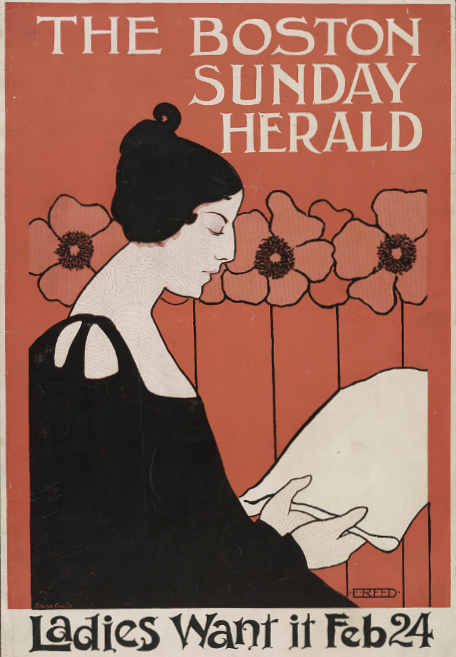
Though she aimed to train as a serious artist during her time in Boston, she valued spontaneity and the creative impulse over self-discipline and commitment to study. At the age of 21, a friend who worked for the Boston Herald noticed Ethel doodling. He suggested she submit her drawing, featuring a woman who looked remarkably like her, to the Sunday Herald - a special weekly edition of the Boston Herald aimed at women, containing recipes, sewing patterns, and cut-out paper dolls for their daughters. Reed’s design featured a seated woman in profile reading, flanked by a row of poppies and the words "Ladies Want It" in lilting, serifed print below.
| |
|
Reed’s first poster for the Boston Sunday Herald (1895)
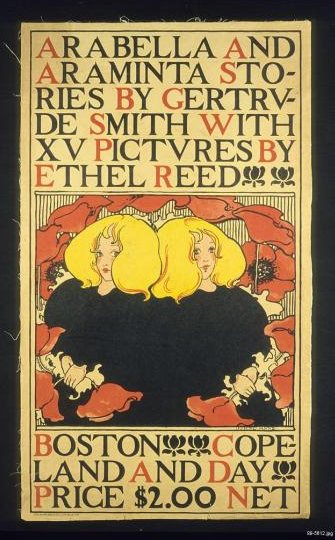
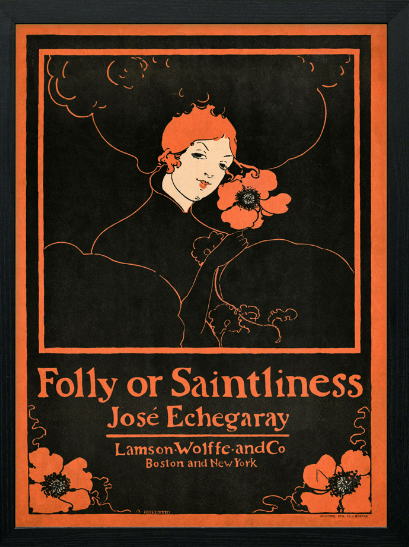
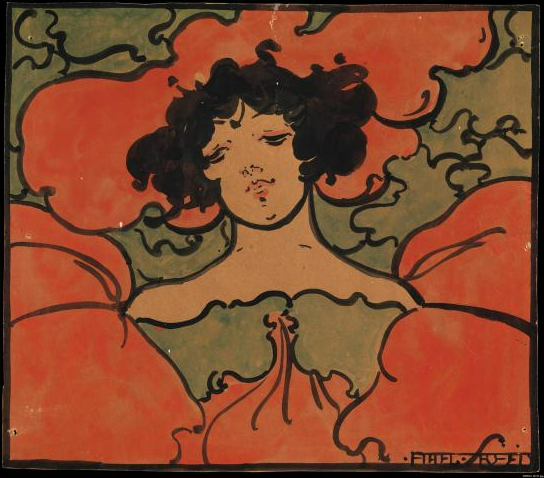
Perhaps a thinly veiled allusion to the opium that would enthrall her for the rest of her life, a dark private joke typical of the young woman who would manage to be both a darling and a disruptor of polite society, the Sunday Herald accepted it. Soon she was being lauded in the press as the preeminent female graphic designer in the country. An object we now consider commonplace - the illustrated book jacket - was in its infancy, and Reed designed advertising posters which would also be used as book covers for Boston-based publishers Lamson Wolfe and Co. and Copeland and Day. She designed more than 25 posters in 1895 and ‘96, as well as illustrations for numerous books and periodicals. Her subjects were predominately beautiful, chaste women and cherubic children. She favored black and white line work and flowers, most often poppies and lilies, firmly rooted in the Art Nouveau style that would come to define the decade. But her body of work was mostly the result of raw talent and happenstance. She did not labor over her drawings and lacked the technical expertise of her American contemporaries like Maxfield Parrish, Will H. Bradley, Edward Penfield, or the European artist with whom she would become most affiliated, Aubrey Beardsley.
| |
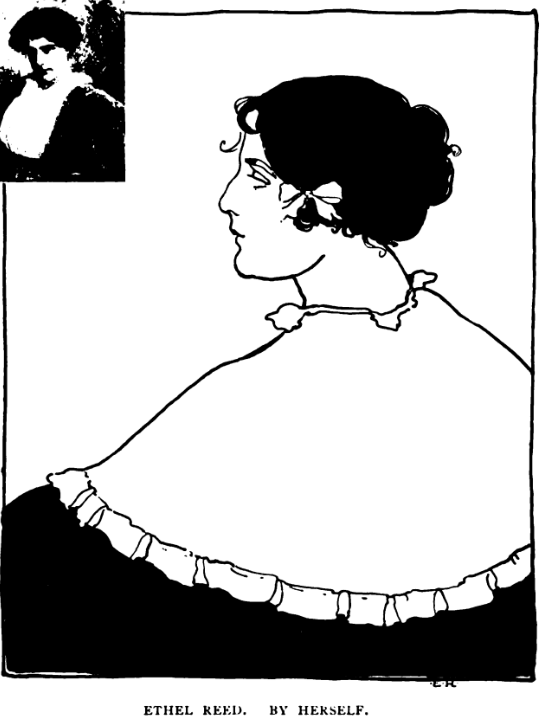
In early 1896 Ethel became engaged to fellow Boston artist Philip Leslie Hale. He had read an interview with her in the literary journal The Bookman, and that interview, combined with the self-portrait that ran alongside it, won his heart before the two even met. | |
|
Self portrait that won Philip Hale’s heart (1896)
The April 13, 1896 Daily news ran this announcement on the front page, reprinted from the Springfield Republican: "The clever and very successful Boston poster artist Miss Ethel Reed is a beautiful and charming young women. She has force of character, is remarkably well poised, and is possessed of a perfect tact. The many friends and admirers of her work hope that she will not drop it on her marriage." Hale’s conservative, Boston Brahmin family did not approve of the match however. The very next day, tucked at the bottom of The Daily News’ page 4, "It is stated on good authority that the marriage engagement between Philip Hale and Miss Ethel Reed has been broken." The couple had planned to honeymoon in Paris, but in May of 1896, Reed set sail for Europe with her mother instead.
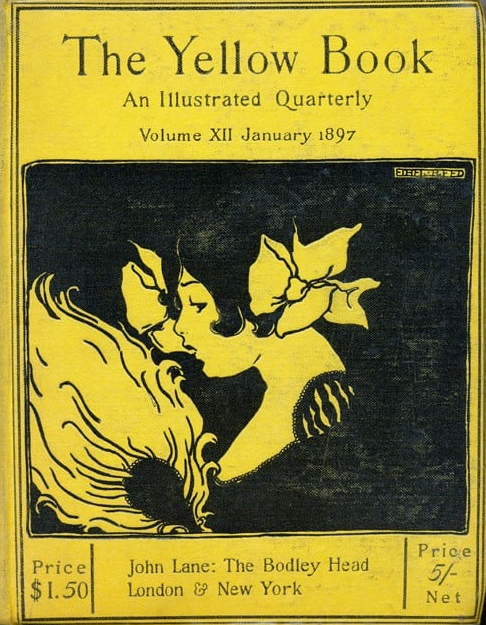
Miss Reed made her way around Europe and the UK, soothing her heartache with the novelty of foreign cities, as well as alcohol and opium. She spent time in Ireland, France, and Germany, eventually settling in the Chelsea area of London, where she was welcomed into the thriving artistic and literary community there. Her work took a darker, more erotic turn (by Victorian standards, anyway); her previously demure subjects now showed a bit more skin, and her poppies gave way to snakes. She followed in the footsteps of her main stylistic influence, Aubrey Beardsley, and in 1897, contributed heavily to the last two issues of London’s notorious Yellow Book periodical.
| |
|
1897 Yellow Book cover art by Ethel Reed
The Yellow Book was a provocative literary and art magazine of the Aesthetic/Decadent movement, so named to connote the lascivious content of illicit French novels bound with their tell-tale bright yellow covers. Beardsley, (who was living outside London at that point, his health in decline from the tuberculosis that would kill him the following year at just 25 years old) had been ousted from the publication after the press mistakenly reported that Oscar Wilde was holding a copy under his arm when he was arrested for “indecency with men.” In fact, he was holding the yellow-covered Aphrodite by Pierre Louÿs, but the association with Beardsley in the public’s mind was cemented. Miss Reed’s illustration for the cover page of the penultimate issue was clearly an affectionate tribute to Beardsley’s distinctive style.
| 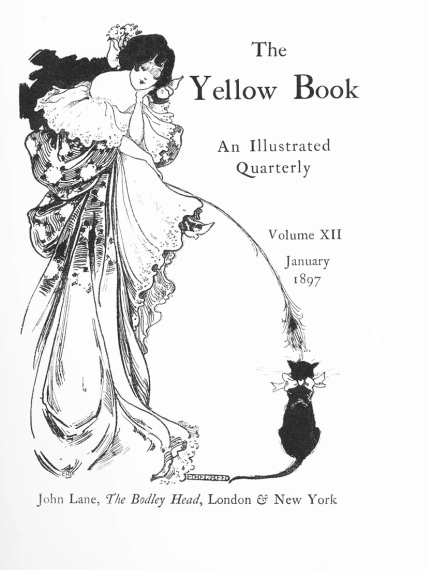 | |
Beardsley-esque Yellow Book Cover page by Ethel Reed (1897)
From here, instead of building on her fame and becoming a canonized artist like Beardsley, Ethel’s prospects inexplicably dwindled. Letters to a former lover in Boston, architect Ralph Cram, tell of her ailing health, depression, anxiety, ruthless insomnia, opium dependency, difficulty recreating the success she’d enjoyed in America, and her mounting financial worries. She rejected his offer of help however, telling him in one letter, “I owe no man anything—neither fidelity nor explanations, I am my own property.” Fierce independence aside, it is difficult to ascertain just how she managed to support herself and her mother in the comfort in which they seemed to travel, especially as her commissions became less and less frequent in the waning years of the 1890s. Eventually, and tragically, she could not.
Details of her remaining years are scant, but she had two turbulent and predictably unsuccessful affairs with married men. One was the writer and Yellow Book literary editor Richard Le Gallienne with whom she had her son Antony, and the other, a crooked solicitor and friend of the painter James McNeill Whistler named Alexander Hannay, who fathered her daughter Alexandra. By 1903 she had married a former soldier, Arthur Warwick, likely more for stability than passion. That union was short-lived as well, dissolving before the honeymoon was over, though he would support her and her children until 1909 when he cut her off, having met someone new. Ethel found herself once again, as she had been during the impoverished childhood she had tried so hard to escape, destitute. By 1910 she seems to have been losing her eyesight, was unable to provide for herself or her children, and on March 1, 1912, just two weeks short of her 38th birthday, Ethel Reed died. Her death certificate gave the cause as “Coma following an overdose of sulphonal taken to procure sleep whilst suffering from chronic alcoholism/Misadventure.”
| |
|
Drawing Newburyport History: Ethel Reed and the Gilded Age.
Saturday July 8, Newburyport Art Association, 65 Water Street, 3-5pm, free.
Join the Museum of Old Newbury, Theater in the Open, and the Newburyport Art Association to celebrate the most famous Newburyport artist you’ve never heard of! The cast of Theater in the Open’s Lady Windermere’s Fan will be posing for Newburyport Artist Association artists, while Sierra Gitlin of the Museum of Old Newbury presents a brief history of the work and life of this enigmatic Newburyport native. Whether you want to draw, learn about Ethel, or just say hi, drop by the beautiful Newburyport Art Association anytime from 3-5pm on Saturday, July 8th.
| |
|
From Port to Port - a Portsmouth Summer Sojourn
Thursday, August 17, 9am - 3:30 pm. SOLD OUT
| Join the Museum of Old Newbury for a day-long exploration of the artistic, familial, and maritime links between Newburyport and Portsmouth. Stops will include the Cushing House, a rare, behind-the-scenes visit to the Portsmouth Naval Shipyard cemetery and museum, and private tours of the Portsmouth Atheneum, and the 1763 Moffatt-Ladd House & Garden. $50 per person, Museum of Old Newbury members only. Limit two tickets per member. | |  | |
History and Cultures of the Great Marsh
Monday, October 23, 2023, 8:30 am - 4:30 pm
The Governor's Academy
Join us for the History & Cultures of the Great Marsh Conference on Mon Oct 23 2023 at The Governor's Academy. This is an in-person event with limited capacity - get your tickets soon! Museum of Old Newbury members and members of Essex County Greenbelt: $30, General Admission, $45. Add-on field trips an additional $10-15.
At this day-long conference, you'll have the opportunity to learn about the rich heritage and diverse cultures of Essex County's Great Marsh. Our expert speakers will cover topics ranging from the indigenous peoples who lived in the area, the impact of European settlement on the development of the Great Marsh, the art that this beautiful place inspired, and the challenges facing the region's most captivating natural landscape today.
Topics and speakers include:
Christoph Strobel, Ph.D., "The Great Marsh, Newbury, and the Indigenous Worlds of the Merrimack River Valley System and Beyond."
Gordon Harris, historian, "Contention in the Commons: The Open Field Land System in 17th Century Newbury"
Tricia Peone, Ph.D., "Slavery and Memory in the Great Marsh"
Monica Reuss, American fine art specialist, "Splendour in the Grass: Art Inspired by the Great Marsh"
Panel: "Agriculture, Fishing, Hunting, & Conservation in the Great Marsh"
- Rich Clyborne, Executive Director of The Gundalow Company
- Russell Hopping, Ecology Program Director, Trustees of Reservations
- Geoffrey Walker, sportsman & wildlife activist, Great Marsh Partnership
Closing remarks: Peter Phippen, Merrimack Valley Planning Commission, Great Marsh Partnership
Optional field trips include:
- Bird watching with Laura Vehring in the Parker River marsh surrounding The Governor’s Academy
- Guided tour of Plum Island’s cranberry bogs
- Guided tour of the Spencer-Peirce-Little Farm & its salt marsh hay production, past & present.
| |
|
Woman on the MOON
...a blog by Bethany Groff Dorau, Executive Director
| |
|
Newburyport's Albert Pike Toppled, Part Two
To read more about Albert Pike’s early life in Newburyport, click here.
It’s almost too easy. Albert Pike, former Newburyport school teacher, enslaver, racist, secessionist, is not a complicated research subject. My feelings about him are equally uncomplicated. At every turn, when he had a chance to express his support of slavery, spew racist hatred, or feed his baser appetites, he did so publicly, and with gusto. The frightening thing about Albert Pike, to me, is how many people excused away the ugliness that came from his own mouth, and his pen.
| |
|
In 1891, as Pike lay dying in Washington, D.C., the Newburyport Daily News called him “a venerable author and statesman”. Later contributors to the Daily News would describe him as a kindly enslaver (check that with the people who ran away from bondage in his Arkansas home), and a lukewarm secessionist who only joined the Confederacy to protect his property.
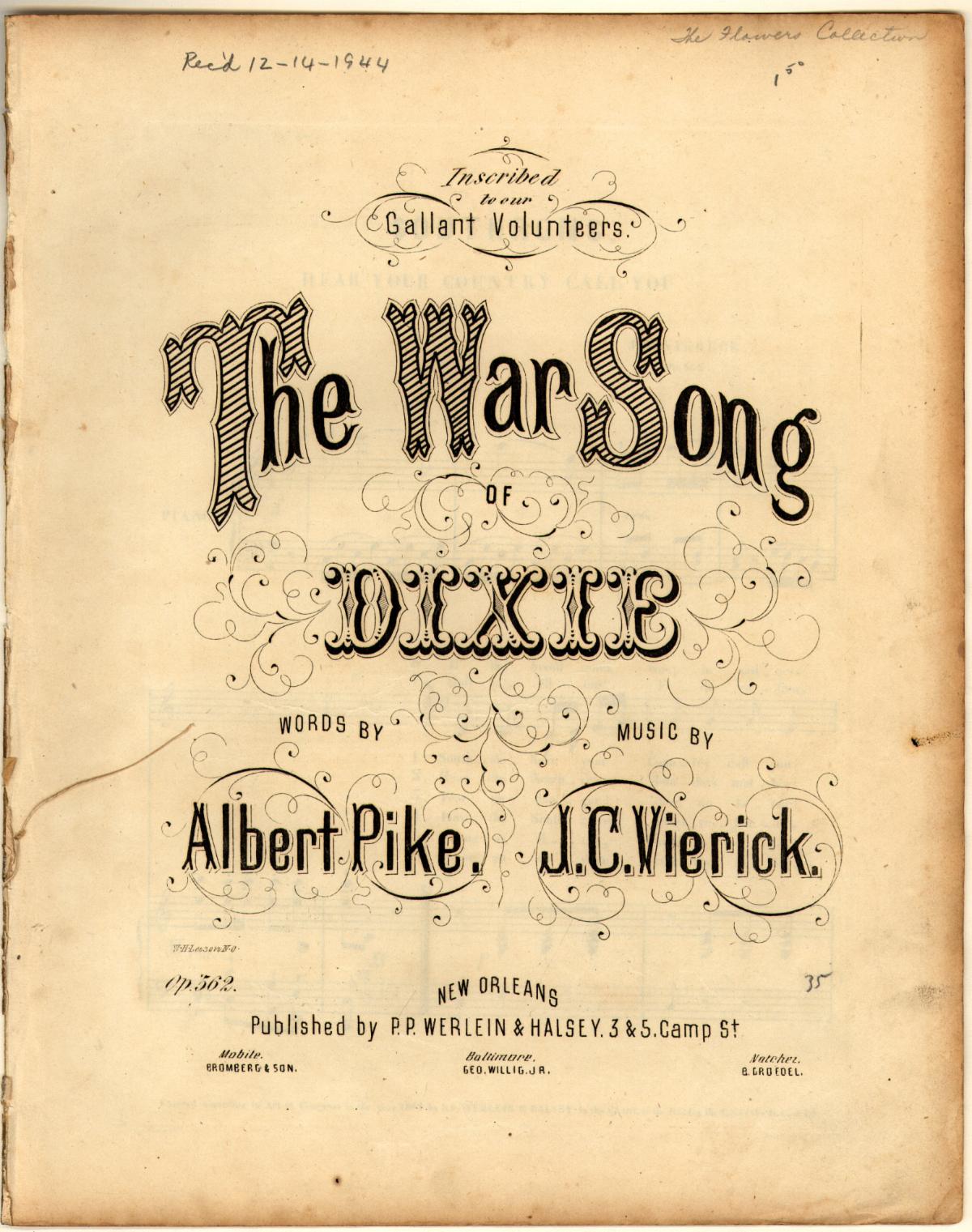
“HEY”, I find myself yelling at my computer screen. “This guy LITERALLY WROTE THE CONFEDERATE WAR SONG.” That’s right. Albert Pike wrote the lyrics to Dixie. Specifically, he wrote these stirring lines:
Southrons, hear your country call you!
Up, lest worse than death befall you!
To arms! To arms! To arms, in Dixie!
Apparently, the preservation of the Union and the eventual end of slavery was…worse than death. Not very ambiguous.
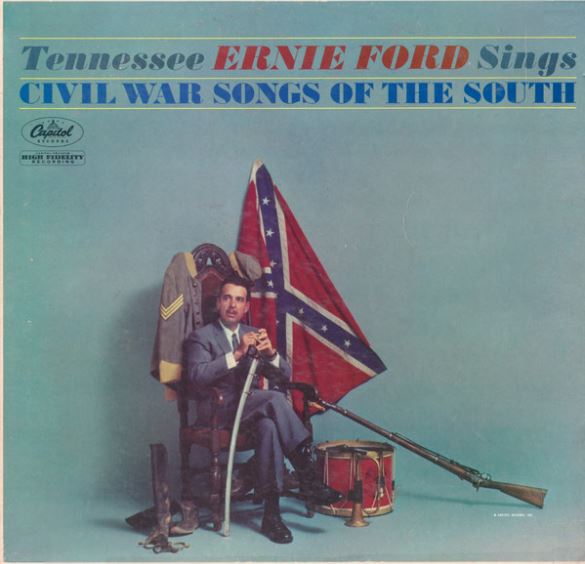
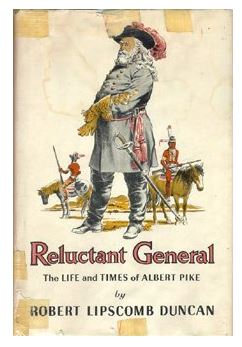
And, lest you think this version of the popular minstrel song fell into obscurity after the war, it was Albert Pike’s lyrics that became a hit once again 100 years later when Tennessee Ernie Ford recorded Dixie for Capitol Records in 1961. Oh, and also in 1961, Albert Pike was reimagined as the “Reluctant General” for a children’s book.
| |
|
Let’s just say, Albert Pike could have written the best-selling pamphlet, “Why I Love Slavery and the Confederacy and the KKK”, and thousands of people would still say, essentially, “there’s no way to know what he was REALLY like.” But I digress. Back to the narrative.
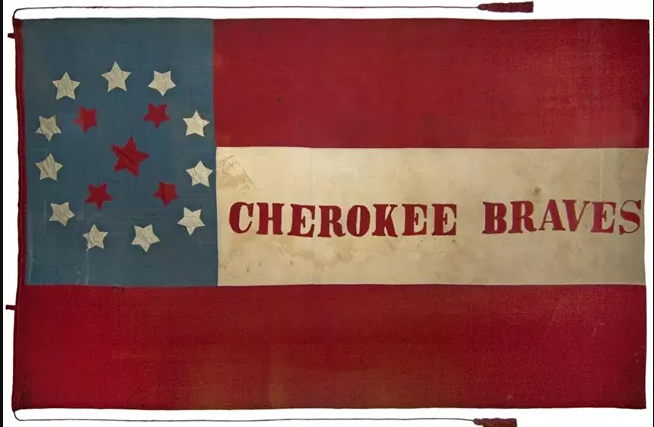
On November 22, 1861, former Byfield resident and Newburyport schoolteacher Albert Pike joined the Confederate Army as a brigadier general. He had already been working hard for the Confederate government, however, as his previous experience with Native American legal issues had resulted in his role as Confederate Commissioner to the Cherokee, Chickasaw, Choctaw, Creek, and Seminole, who had been promised their own free state at the successful end of the war. They had also been promised that they would only be called on to fight in the defense of Indian Territory. And so, after much negotiation – the Cherokee in particular were understandably skeptical about the arrangement – Pike was placed in charge of training three regiments of cavalry. He led two of these regiments into the disastrous Battle of Pea Ridge on March 7, 1862 near Fayetteville, Arkansas, a violation of the defense-only agreement in their treaty, which, to his credit, he protested. Once on the battlefield, well, I’ll let an eyewitness take it from here.
“On the morning of the 7th of March I was on the battlefield of Pea Ridge. While my command was engaging the enemy near Leetown, I saw in the rebel army a large number of Indians, estimated by me at one thousand. After the battle I attended in person to the burial of the dead of my command. Of twenty-five men killed on the field of my regiment, eight were scalped, and the bodies of others were horribly mutilated, being fired into with musket balls and pierced through the body and neck with long knives. These atrocities I believe to have been committed by Indians belonging to the rebel army. "
- Cyrus Bussey, Colonel, 3rd Iowa Cavalry
| |
|
This flag, the only known example of a Confederate American Indian regimental flag, is owned by the National Park Service and is associated with one of the regiments at Pea Ridge.
How involved Albert Pike was with the atrocities committed at Pea Ridge is a matter of considerable debate. Suffice it to say, it made Pike one of the most hated men in the North and a pariah in the Confederacy as well. Later, Pike denied that he had any role in the behavior of the troops under his command, claiming that he was “angry and disgusted” with the whole affair. His hometown newspaper tells a different story entirely. In May, two months after Pea Ridge, and after widespread reporting on the atrocities, the front page of the Newburyport Daily Herald noted that Pike praised his troops for “gallantry”. It does rather upend his case for plausible deniability.
| |
|
The Boston Evening Transcript wrote a scathing article about the episode, concluding that “renegades are always loathsome creatures, and it is not to be presumed that a more venomous reptile than Albert Pike ever crawled upon the face of the earth…there is no pit of infamy too deep for him to fill”.
While Pike was being excoriated in the Northern press, his relationship with his fellow Confederates deteriorated as well. Pike was ordered by Gen. Thomas C. Hindman to turn over funds. Pike refused and issued angry missives against his commanding officers before hiding out in the hills of Arkansas. He was charged with stealing money and material and arrested for insubordination and treason. He was released from a Texas prison in 1863, having resigned from his command. Col. Douglas Cooper remarked to President Jefferson Davis that Pike was "either insane or untrue to the South."
Pike rode out the war in Arkansas, eventually becoming an associate justice of the Arkansas Supreme Court as the Confederacy disintegrated. Pike, considered a traitor in the South and a butcher (and also a traitor) in the North, saw his property confiscated and fled first to New York and then to Canada where he petitioned, and received, a pardon from Andrew Johnson in 1866. Upon his return to Arkansas, however, he was charged with treason, though the charges didn’t stick. He fled again, this time to Memphis, Tennessee, and then to Washington, D.C. His wife, Mary Ann, remained in Little Rock, and Pike began a very public affair with the ambitious 19-year-old sculptor Vinnie Ream, forty years his junior.
| |
|
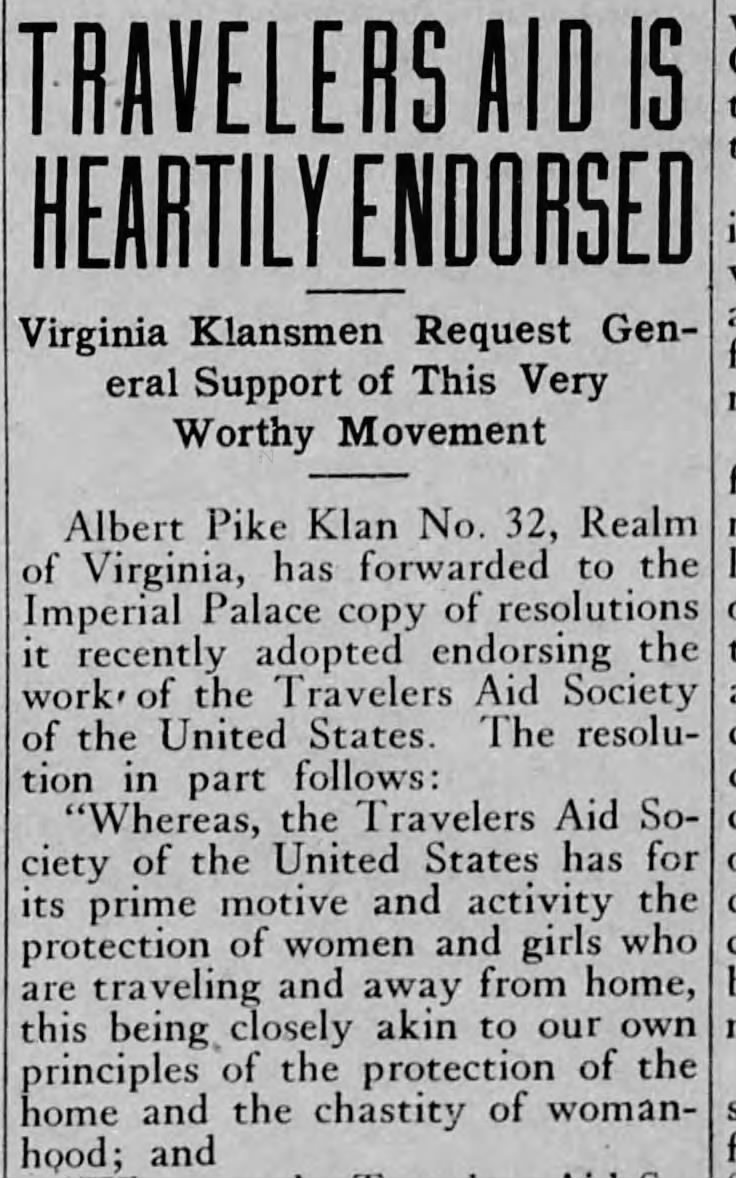
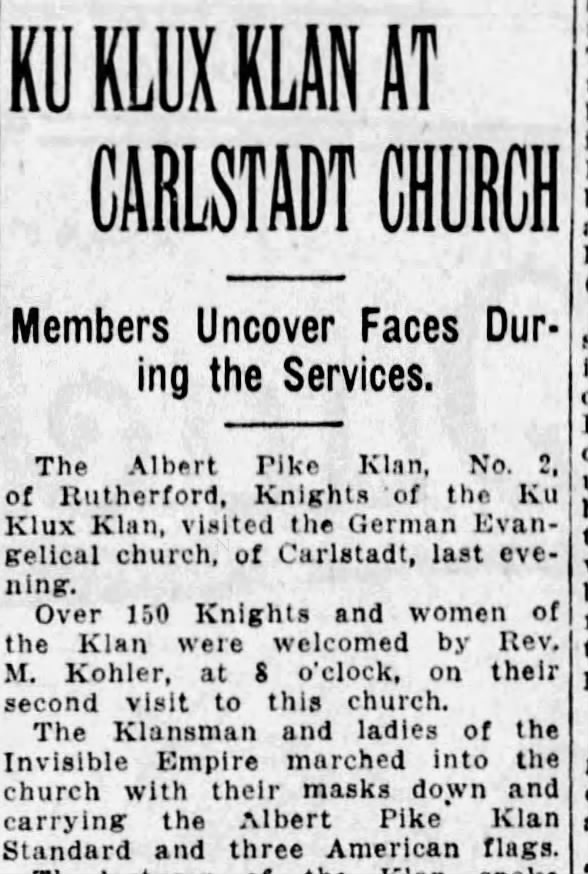
Albert Pike Klan chapters sprang up in Illinois, Kansas City, Oklahoma, Virginia, and New Jersey in the early 20th century.
But let’s go back to Tennessee. There is ample evidence that Albert Pike was instrumental in forming the Ku Klux Klan, established in 1865 in Tennessee and organized in 1867 under the leadership of former Confederate General Nathan Bedford Forrest. Though early Klan membership remains largely secret, Pike published editorials essentially arguing for an expansion of the Klan. "If it were in our power, if it could be effected, we would unite every white man in the South, who is opposed to negro suffrage, into one great Order of Southern Brotherhood, with an organization complete, active, vigorous, in which a few should execute the concentrated will of all, and whose very existence should be concealed from all but its members.” Early, laudatory Klan histories published in the early 20th century praised Pike’s role as a high-ranking founding officer, appointed by Forrest himself as the Klan’s “chief judicial officer”, and a “grand dragon”. A cursory newspaper search turns up Albert Pike Klan chapters across the country by the 1920’s.
| |
|
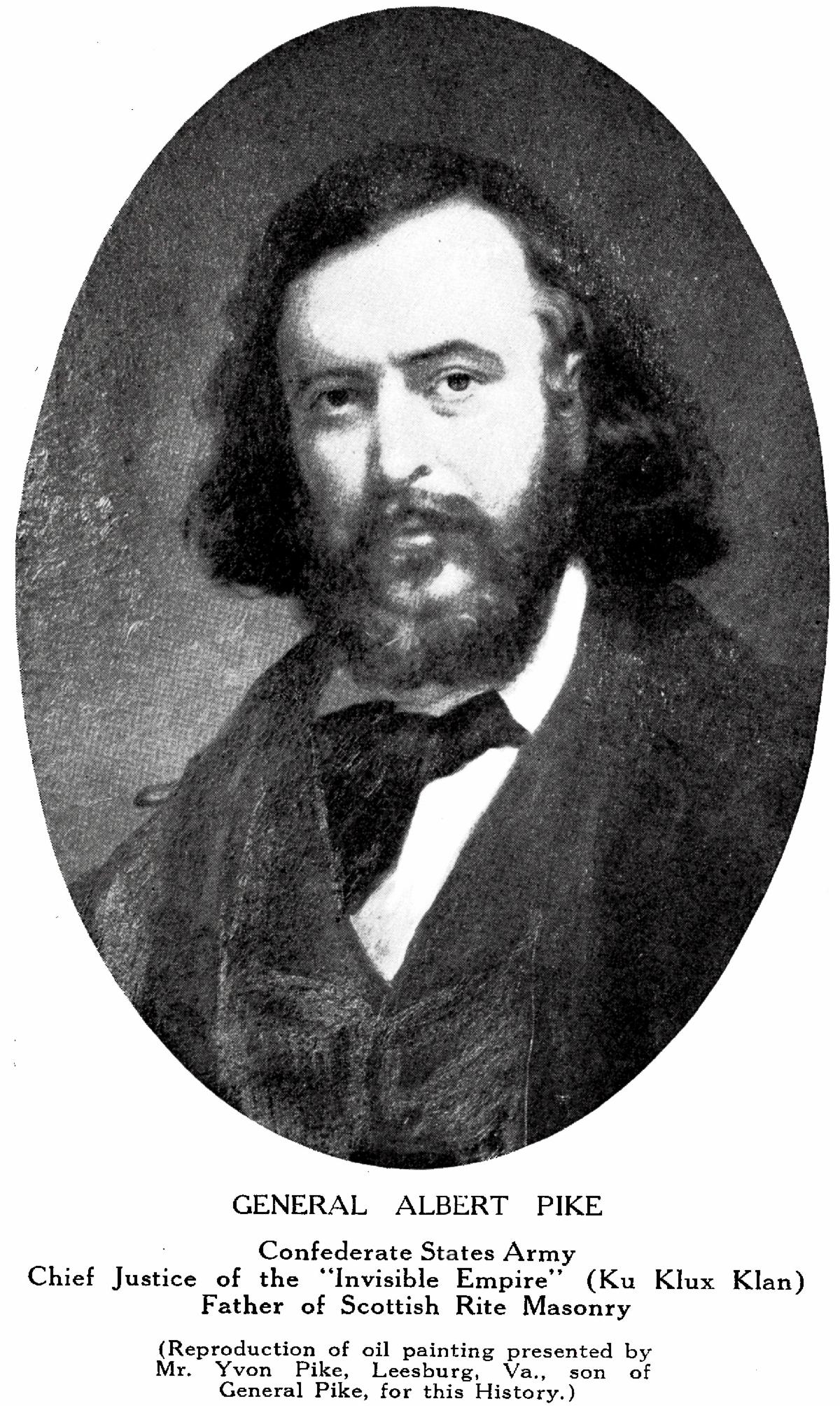
In a 1905 history of the Ku Klux Klan, Susan Lawrence Davis, daughter of a founding member, reprints a portrait of Pike that she uses with permission of Pike’s son. It seems unlikely that such permission would have been granted unless the family fully embraced his Klan leadership.
Much has been written about Albert Pike’s Masonic leadership, enough, in fact, that I will give it short shrift here. Pike had been involved in Freemasonry since the 1840’s, becoming Sovereign Grand Commander of the Scottish Rite's Southern Jurisdiction in 1859. He spent much of his later life working on the rituals of the Scottish Rite, publishing Morals and Dogma of the Ancient and Accepted Scottish Rite of Freemasonry in 1871.
Albert Pike died of esophageal cancer on April 2, 1891, at the Scottish Rite Temple in Washington DC. His remains were interred there in 1944, long after the ugly, bloody work of Albert Pike had been sanitized, excused, and explained away by generations of apologists. Still, today, his name is everywhere. North of Langley, Arkansas, the Albert Pike recreation area boasts “picnic tables, toilets, drinking water, and parking”.
| |
|
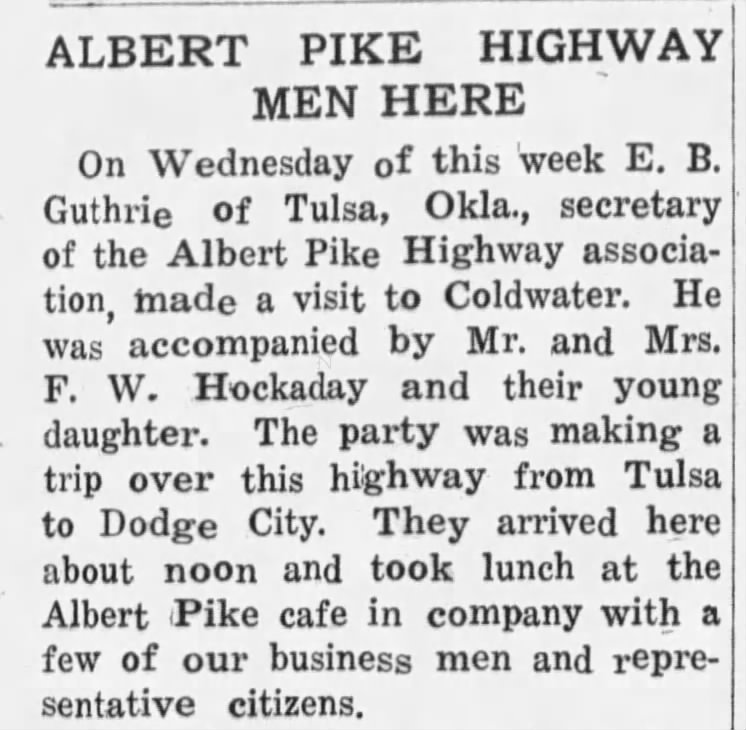
A 1922 traveler on the Albert Pike Highway could stop at the Albert Pike Café. The highway wound through the Ozarks from Hot Springs, Arkansas to Colorado Springs, Co.
Readers of the first installment of this series (we love your emails!) found Albert Pike Road, Albert Pike Apartments, and, perhaps unsurprisingly, the Albert Pike Memorial Temple, listed on the National Register of Historic Places.
At the close of Albert Pike’s memorial service, its details printed in the Evening Star, Washington D.C. edition, the following words were read:
“Who will be man’s accuser?”
“His conscience.”
“Who his defender?”
“No one.”
“Who will give testimony against him?”
“No one.”
We beg to differ.
Join us for Part III of Albert Pike Toppled, where we explore the curious transformation of Albert Pike from Confederate traitor to peace-loving hero and revered son of Newburyport (and Byfield).
| |
Something Is Always Cooking... | |
|
Summer Corn and Avocado Salad
MOON Summer Intern Lilly Baumfeld provides this recipe - she usually does all the chopping! The family enjoys local produce from the Heron Pond Farm CSA and Cider Hill Farm. Enjoy!
3 tablespoons balsamic vinegar
3 tablespoons extra-virgin olive oil
1 teaspoon garlic salt
4 cups fresh corn kernels, about 8 ears
2 cups diced, peeled cucumber
2 cups diced, ripe tomatoes (or halved cherry tomatoes)
2 cups chopped, ripe avocados
1/2 cup chopped fresh basil
Steam ears of corn for six minutes. Cut corn off cobs and dice other vegetables; combine in large bowl. Mix first three ingredients together in a small bowl. Pour dressing over the vegetables. Toss well. Add chopped fresh basil toss. Can be served at room temperature or chilled. About 8-10 servings.
| |
|
Click the image to do the puzzle
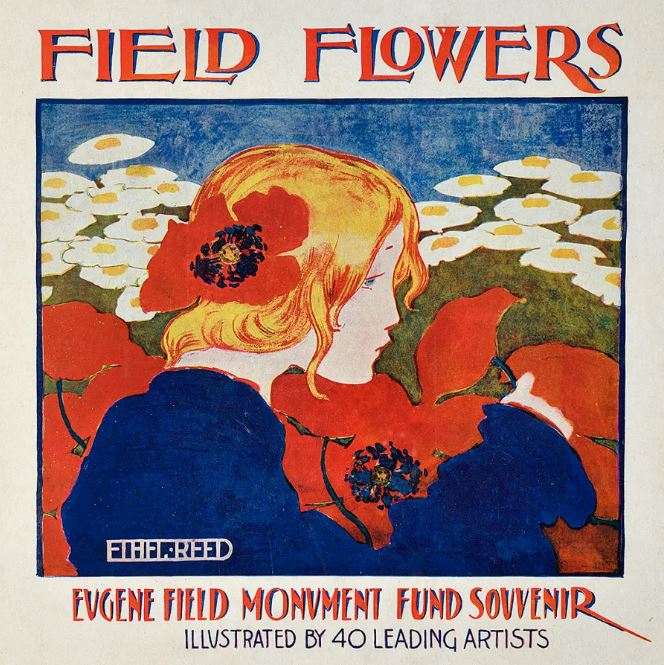
Eugene Field was a popular children's writer who died in 1895. Ethel Reed illustrated the cover of this souvenir during the decades of fundraising for a tribute to the author. A monument to Field was finally built in 1922 in Lincoln Park, Chicago.
| | |
Museum e-Newsletter made possible through the
generosity of our sponsors:
| |
| | | |