e-Newsletter | March 14, 2025 | | |
In Memoriam - Kevin MacDonald
The Museum of Old Newbury would like to take a moment to express our gratitude for the many kindnesses shown to us throughout the years by Custom House Maritime Museum Curator Kevin MacDonald, who passed away suddenly on March 9. Newburyport has lost an incredible resource, and we have lost a treasured friend. Fair winds and following seas to you, dear Kevin.
Friends will find more information here.
| | We know it is frustrating when events sell out quickly, so we are staggering registration dates to give everyone a chance. Please click the image or link below to check out all of our upcoming events! | | Funded, in part, by the Massachusetts Office of Travel and Tourism | |
| | |
Thursday, April 24
6:30 p.m.
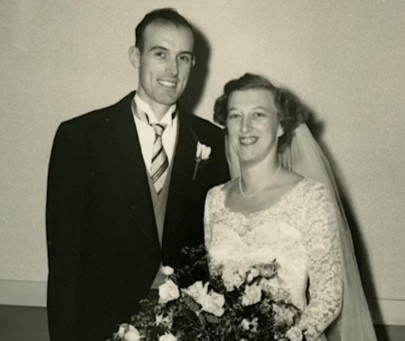
Fashion Night Out! Follow the Thread...a Tale of Six Dresses
Join Fashion Historian Lois Valeo and Executive Director Bethany Groff Dorau at the Museum of Old Newbury for "Follow the Thread...a Tale of Six Dresses" where we showcase six fabulous dresses in person!
Tickets here
| | | |
| | |
Sunday, April 27
1:00 p.m.
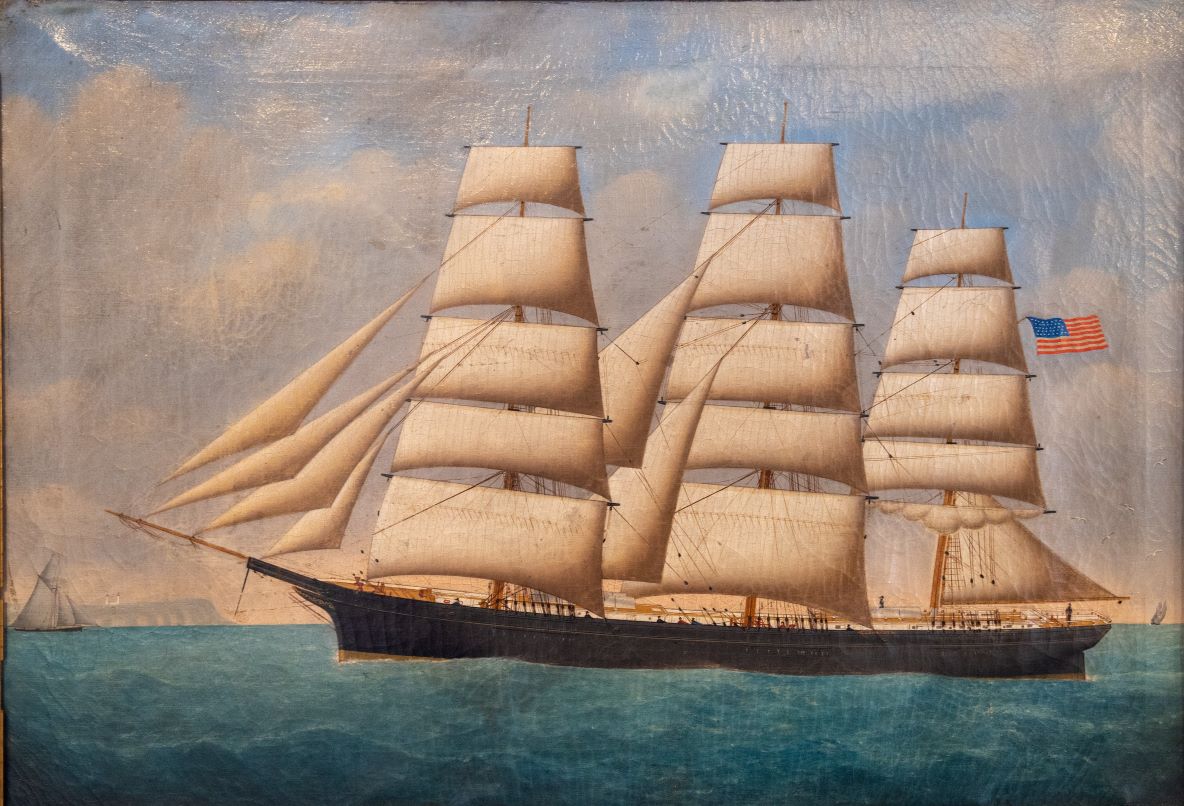
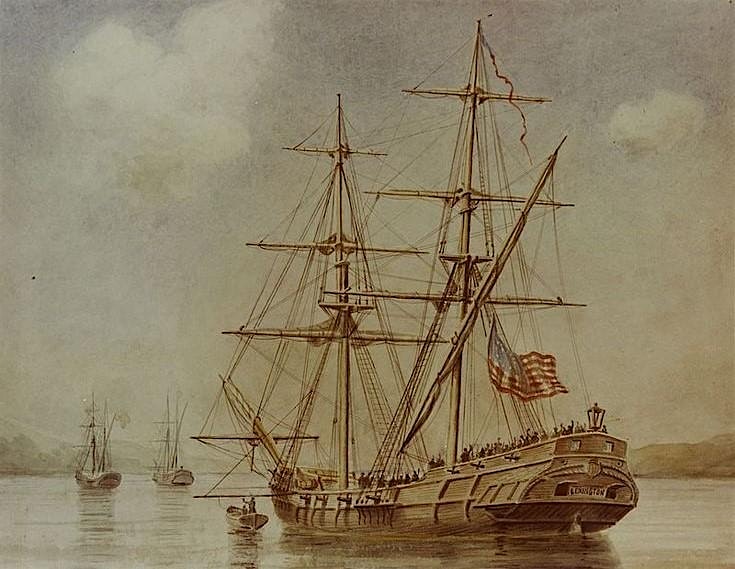
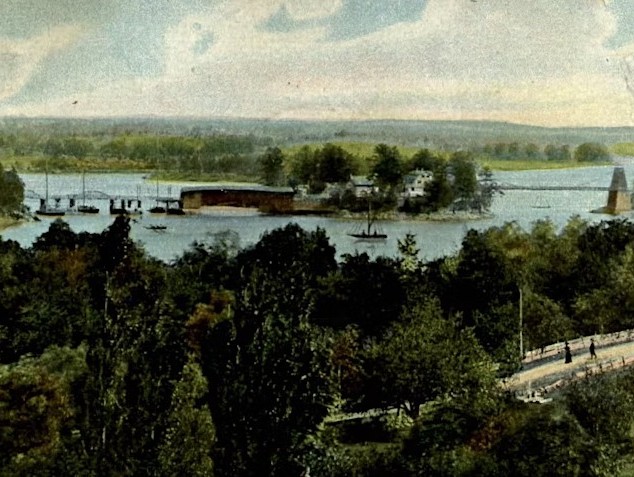
Bridges & Boats, Trains & Planes:
Local Innovations
in Transportation
Come join us for a fascinating event showcasing the history of advancements in transportation within our local community. Tickets here
| | | | |
Save the Date for these Upcoming 250th Events! Click here for more information.
Newburyport's Road to Revolution Part II: Newburyport Braces for Attack by Sea
Thursday, March 20, 2025, 7:00 PM
St. Paul's Episcopal Church - Tickets here
Burying Ground Tour 1: Old Hill and Newburyport's Road to Revolution
Friday, April 18, 2025, 6:30 PM
Old Hill Burying Ground - Tickets available March 20
Newburyport’s Road to Revolution Part IV:
Black Newburyporters
Thursday, May 8, 7:00 p.m.
Newburyport City Hall Auditorium - Tickets here
Burying Ground Tour 2: First Parish and Newburyport's Road to Revolution
Saturday, May 10, 10:00 a.m.
First Parish Burying Ground - Tickets available April 9
Newburyport’s Road to Revolution Part V:
Powder & Shot
Thursday, May 22, 7:00 p.m.
Museum of Old Newbury - Tickets available March 28
Walking Tour: Road to Revolution in downtown Newburyport
Saturday, June 14, 10:00 a.m.
at Museum of Old Newbury - Tickets available May 10
Newburyport’s Road to Revolution Part VI:
Bunker Hill - Heroes & Cowards
Thursday, June 18, 7:00 p.m.
at Firehouse Center for the Arts - Tickets available April 24
Burying Ground Tour 3: Sawyer Hill and Newburyport's Road to Revolution
Sunday, June 29, 6:30 p.m.
at Sawyer Hill Burying Ground - Tickets available May 11
| | |
Partner Spotlight
Theater in the Open Presents: Romeo & Juliet
Tuesday, March 25th, 7:00 p.m.
| | Encounter Shakespeare's most famous love story, Romeo & Juliet, performed at Ipswich Ale Brewery! | | |
Captain Morgan of the Slaver Orion in the Newburyport Jail Part III
by Bethany Groff Dorau
| | HMS Pluto captures the Orion in this April, 1860 image from The Illustrated London News. | | |
Author's note: This is the story of Thomas Morgan, captain of the Orion, who was convicted in 1860 in Boston of knowingly participating in the illegal trade in enslaved men, women, and children, off the coast of Africa. He was sent to serve his time at the Newburyport Jail. This has been a difficult case to research, as the witness statements are filled with suffering and cruelty. Also, because the case involved smuggling and piracy, identities were hidden and facts obscured. It is also a somewhat tangential tale, as Thomas Morgan's connection to our community seems to be only his years in our jail. In the end, however, it is a story of just how tied we in New England were to the institution of slavery on the eve of the Civil War. Thomas Morgan was sailing a ship built in Newcastle, Maine, financed by Boston and New York investors. Morgan was a sympathetic figure to Newburyport's leading citizens, and even, astonishingly, to Abraham Lincoln, in the end. This story is complicated and often frustrating, but compelling, nonetheless. Read Part I here. Read Part II here.
This is the story, as far as I can figure it, of Thomas Morgan, captain of the Orion, convicted of knowingly participating in the illegal trade in enslaved men, women, and children, off the coast of Africa and sent to serve his time at the Newburyport Jail.
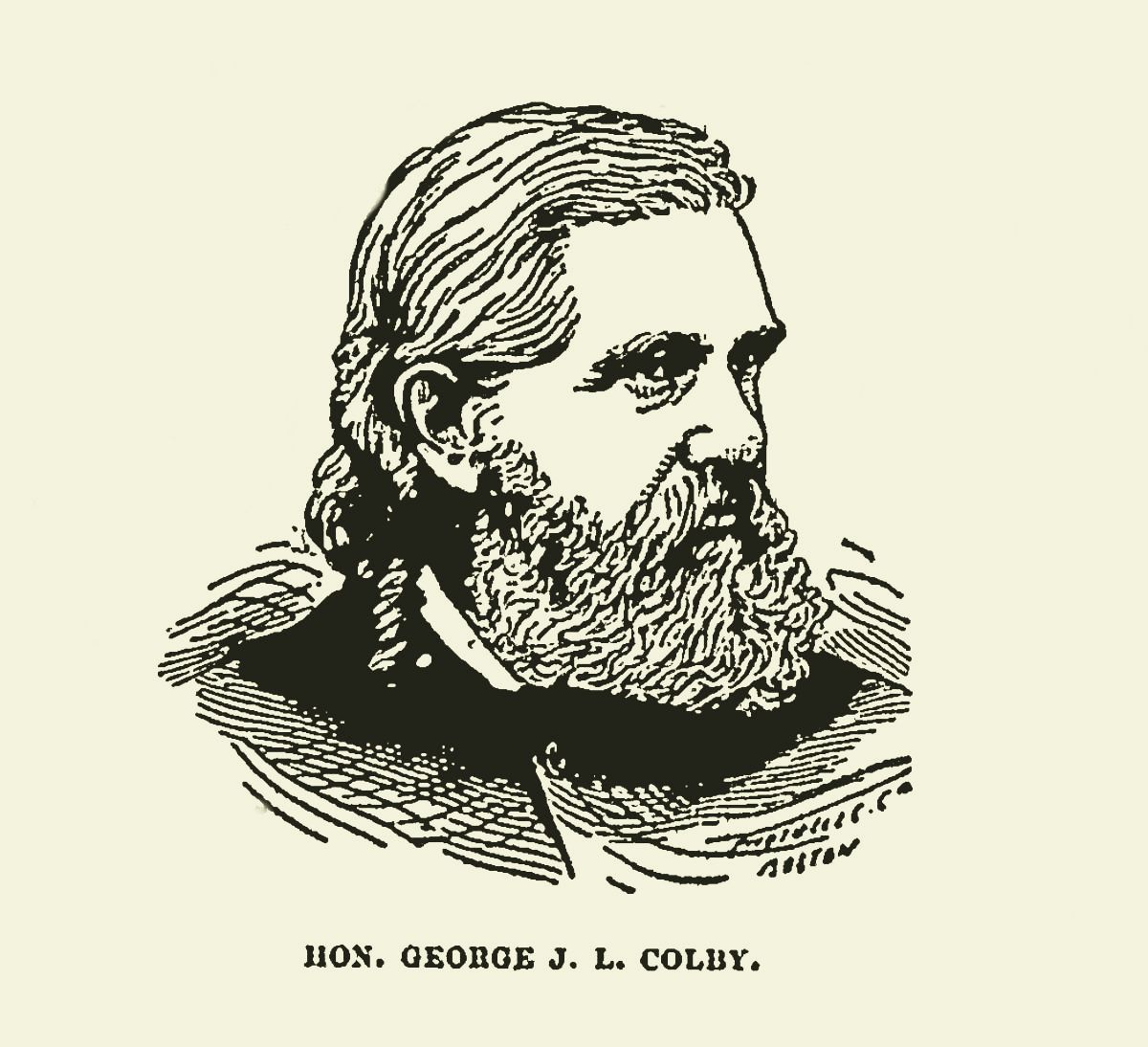
But it began, for me, with George James Lunt Colby, editor of the Newburyport Herald, who sauntered over to the jail on Christmas Eve, 1862, and wrote a long, chatty editorial about the experience.
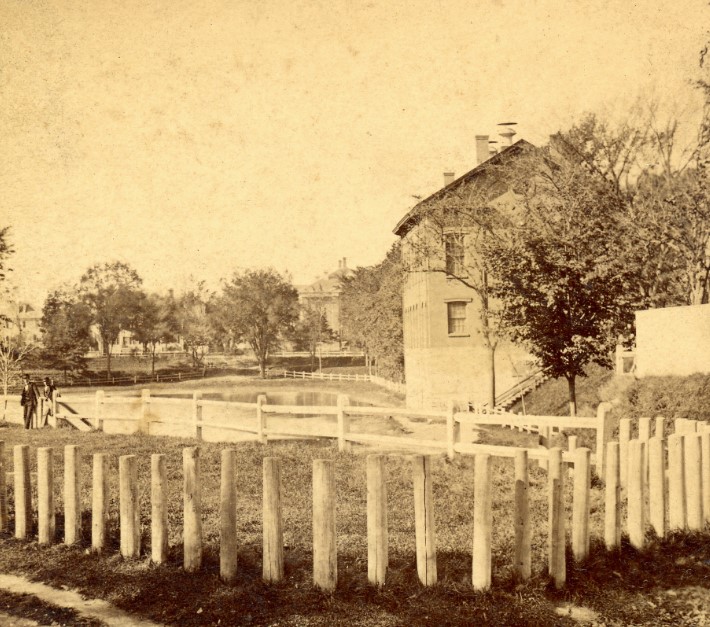
| | Thomas Morgan clearly captured Colby's attention, with his "sharp flashing eye", cheerful demeanor and sense of style. "Captain Morgan is as perfect specimen of a sailor - of a sea boy, as we have met for a long time," he gushed. "The chief luxury he enjoys is smoking, which he does with grace and elegance, and his principal amusement is watching the parties on the (Bartlet Mall) pond through his spyglass." | Captain Morgan amused himself by watching skating parties on Frog Pond, seen here as it looked when Morgan was imprisoned in the Newburyport Jail from 1860 to 1863. Image from the collection of the Museum of Old Newbury | |
Colby was taken with Morgan's stories of "civilized and barbarous countries", and noted that he had sailed from a very young age to assist missionaries in Patagonia. "He seems a jovial sailor fresh from the sea." So far so good, depending on how you feel about missionaries, I suppose.
"We will only state two directions in which he acted," says Colby. "One was to carry the Christian religion to the heathen, the other to bring the heathen to the Christian religion." And in that stunning sentence and all those that followed, Colby explained away Morgan's conviction for slave-trading. According to Colby, Morgan's "last voyages were to the coast of Africa to transfer some of the inhabitants, just north of the Congo river, from their native darkness to the light of western civilization." He did not mention, though it was reported in newspaper nationwide, that at least 191 enslaved men, women, and children died as a direct result of Morgan's actions.
| |
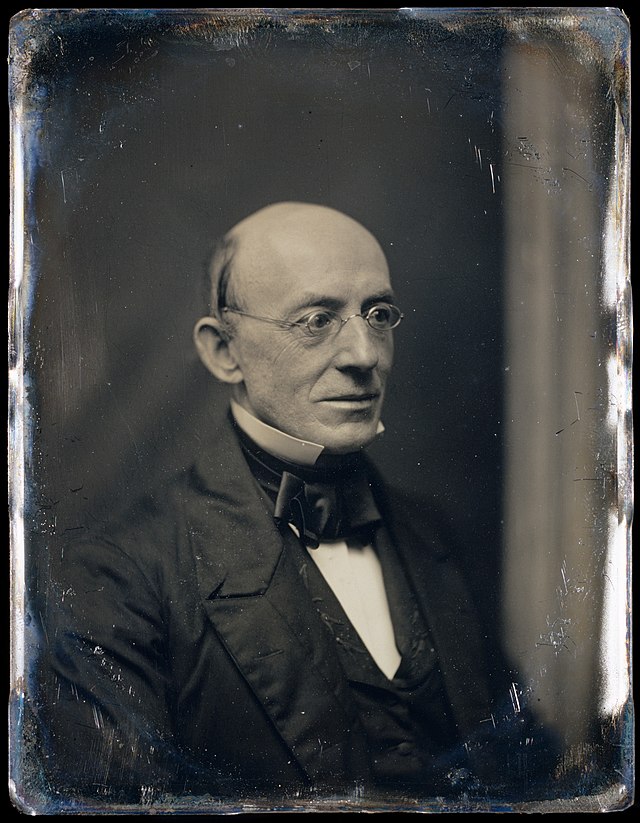
William Lloyd Garrison, c. 1850. Collection of the Metropolitan Museum of Art.
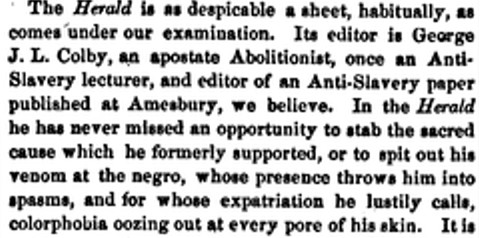
Perhaps no surprise, then, that William Lloyd Garrison, fervent abolitionist and past editor of the Newburyport Herald himself, was no fan of George J.L. Colby. Earlier that year, in the pages of the Liberator, Garrison described Colby as "an apostate abolitionist", who never missed a chance to "stab the sacred cause which he formerly supported, or spit out his venom at the negro, whose presence throws him into spasms...colorphobia oozing out of every pore in his skin.".
| |
The Liberator, April 4, 1862, page 1.
Indeed, George J.L. Colby, who, by the way, was also a Methodist preacher, former mayoral candidate, Naval Officer for the city of Newburyport, and temperance man, was far more displeased with the boys locked up for petty larceny and fighting than the enslaver. "Terrible for a Christian community that juvenile depravity must command the prison," he said of them.
In fact, so taken was George J.L. Colby with Captain Thomas Morgan that the next day, which happened to be Christmas Day, George J.L. Colby sat down to pen a letter to President Abraham Lincoln.
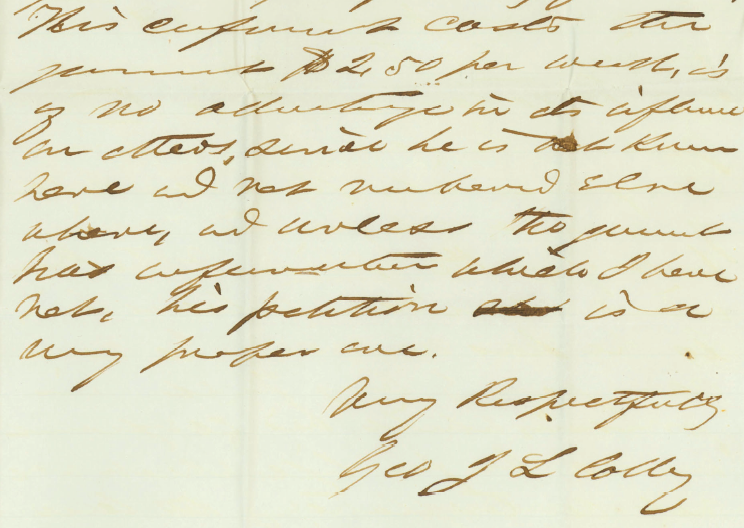
| |
Excerpt from December 25, 1862 letter in support of the pardon petition of Thomas Morgan. Courtesy of the Lincoln Presidential Library.
It took a team of incredible researchers helped to decipher the letter. In essence, Colby's arguments in favor of clemency are threefold. First, Morgan had served his sentence of two years, which is the maximum the law allowed, and was now being held for being unable to pay his fine. Second, he is a decent fellow, and willing to join the United States Navy if he is released, and in closing, it is costing the taxpayers money ($2.50 per day to be exact) to keep him in prison. And so, says Colby, "his petition is a very proper one".
| |
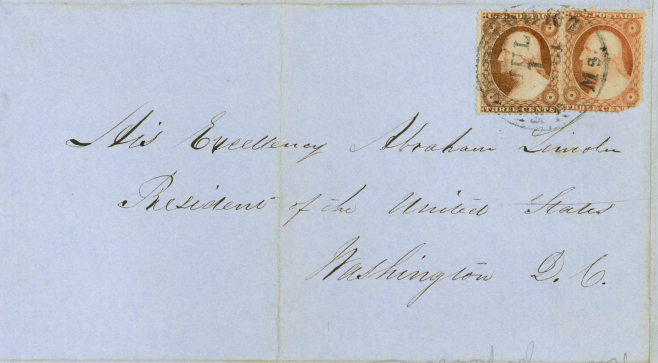
Envelope of Morgan's first pardon letter, sent on July 1, 1861. Courtesy of the Lincoln Presidential Library and Museum.
By the time George J.L. Colby's petition was sent off to the White House, Thomas Morgan had been writing to Abraham Lincoln for over a year. His first letter asking for pardon was sent off to the White House on July 1, 1861, just months after Morgan was sent to the Newburyport Jail. The letter begins with expressions of outrage about how long his case dragged on before going to trial, how he was badly treated and kept in "double irons", while being transported from the base of the Africa Squadron to Boston for trial, and how he was sentenced to the "extreme penalty of the law" - two years and a two thousand dollar fine, which he considers an "unusually severe punishment".
The tone then shifts from outrage to melancholy as Morgan describes his heath failing because "since a youth (he) had been accustomed to an active life", and now suffered from a "long and tedious imprisonment". He claims to be the sole support of his "aged mother", "entirely destitute of means" and unable to pay the fine, which was, of course, the reason for it. The imposition of a fine lengthened the maximum sentence of two years considerably, and was therefore employed in cases where two years was not considered sufficient punishment by the judge.
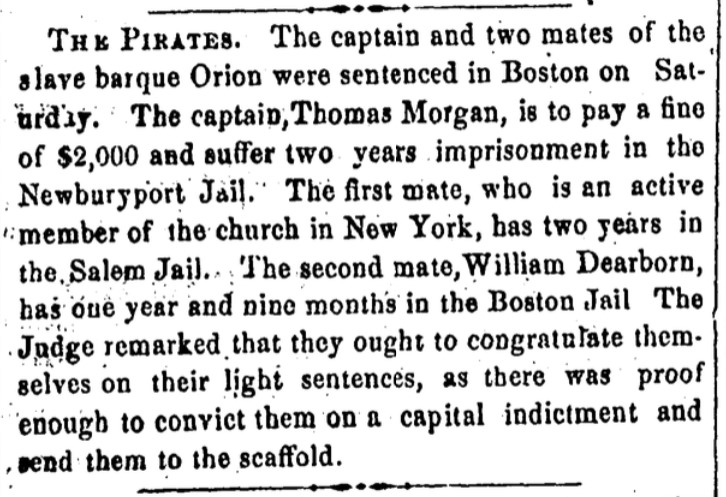
| |
This October 7, 1860 article in the Newburyport Herald notes that the judge in the case of "The Pirates" believed there was enough proof for the officers of the Orion to hang.
Thomas Morgan closed his first petition letter with a request for a pardon and the erasure of the fine, and promises to serve the President "in any capacity or position in which he may be considered qualified or found useful". Morgan points out that he has "twenty-four years of actual experience at sea" to offer the President. He closes with some spectacular groveling.
"Earnestly praying for Your Excellency's honor and welfare, that with the assistance of Divine Providence, you may speedily effectively overcome and triumphantly defeat your enemies, and add new luster to our honored and ever-glorious Flag. Your Excellency's most obedient and humble servant, Thomas Morgan."
| | |
Exactly five months later, on December 1, 1861, Morgan fired off another letter. "Again, I humbly approach Your Excellency with a petition for Pardon," he writes, managing to unironically note that "Liberty is very dear." He pours on the flattery once again.
"May the Great Giver of all Good reward your Excellency, guard you from foreign foes and domestic traitors, strengthen your arm to chastise them, and crush this foul and unnatural rebellion, endowing you with health, happiness, honor, and all other blessings, granting your Excellency long life to enjoy them, is the earnest prayer of your humble petitioner."
| |
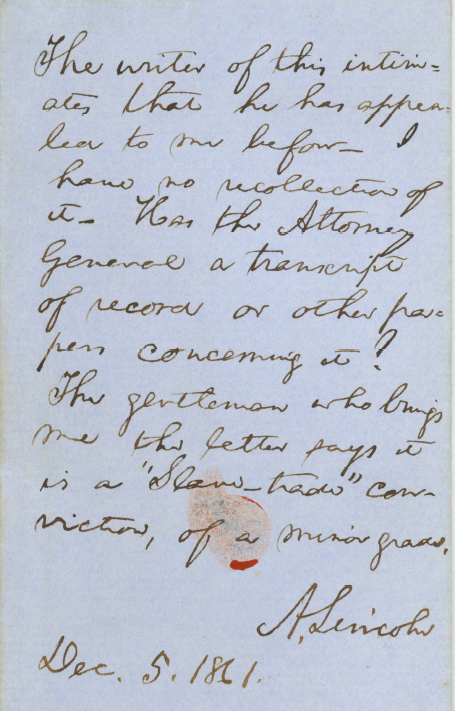
Scrawled on the back of the envelope is this hurried, and somewhat mystifying note from Abraham Lincoln, saying that he has no memory of hearing from Morgan before, and that "the gentleman who brings me the letter says it is a "slave-trade" case of a minor grade". Lincoln asks if there is more information about the case.
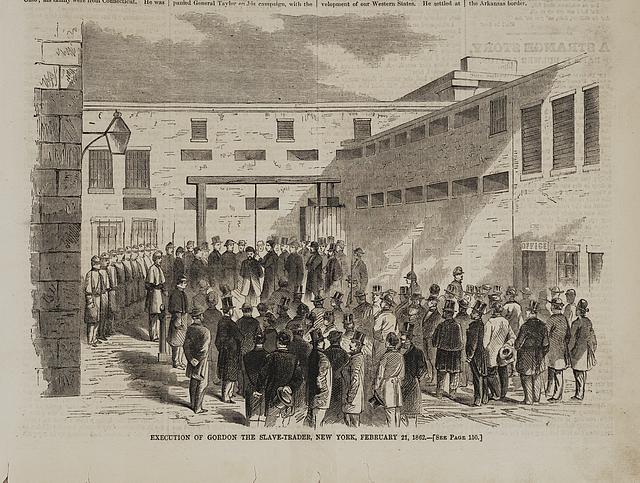
Though this note seems to indicate some willingness to consider a pardon, Abraham Lincoln was not known to consider relief for enslavers. He was quoted by Congressman John B. Alley as having said that though he was "kindly enough in nature, and can be moved to pity and to pardon the perpetrator of almost the worst crime that the mind of man can conceive or the arm of man can execute,” he would ensure that a slave-trader would “rot in jail before he will ever get relief from me.” Indeed, just two months after he penned the note on the back of Morgan's petition, in February, 1862, Lincoln famously refused to spare Nathaniel Gordon, who was hanged in New York, the only person in United States history to be executed for engaging in the slave trade.
| |
The Execution of Gordon the Slave-Trader, from Harper's Weekly, March 7, 1862.
Though he may have heard that Morgan's was a "minor case", a rather shocking assertion, given the nine hundred enslaved Africans found on board his ship, Lincoln did not act on his petition in 1861. Over the course of the following thirteen months, Morgan, his lawyers, Newburyport jailkeeper John Akerman, George J.L. Colby, and several others sent letters in support of his release. The clock ran out on Morgan's two-year sentence, and Morgan's New York law firm of Beebe, Dean and Donohue suggested to Lincoln that Morgan was now effectively, and illegally, imprisoned for debt.
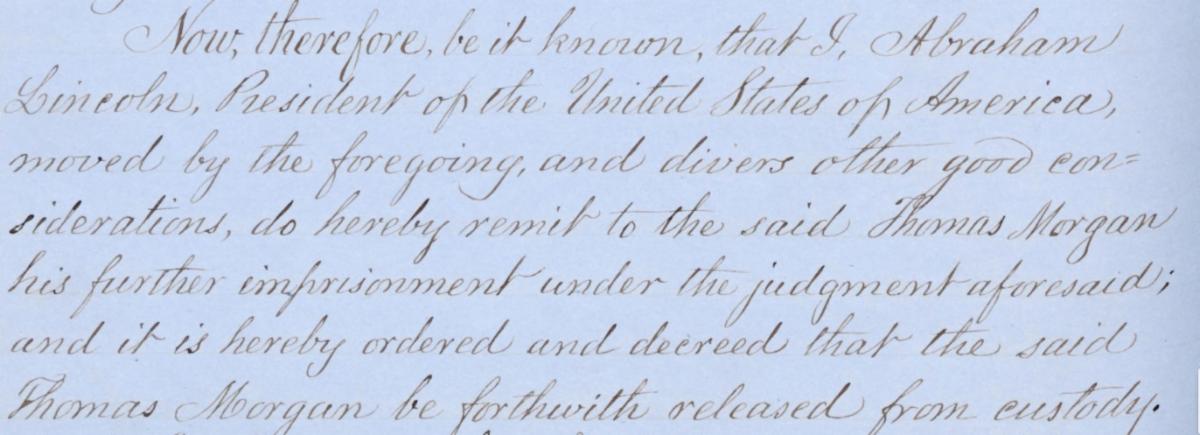
On March 11, 1863, despite the opinion of the pardon clerk that Morgan should not be considered for clemency, Abraham Lincoln signed the papers for Morgan's release. The public explanation was that "his term of confinement has ended", and that "he cannot reasonably pay the fine while further restrained of his liberty".
| | |
Thomas Morgan was released from Newburyport Jail and disappeared, or so we thought. Despite the best efforts of the talented research team at the Museum of Old Newbury, with assists from the Abraham Lincoln Presidential Library and Museum and independent historians, we found little to illuminate how Thomas Morgan spent the remainder of his days.
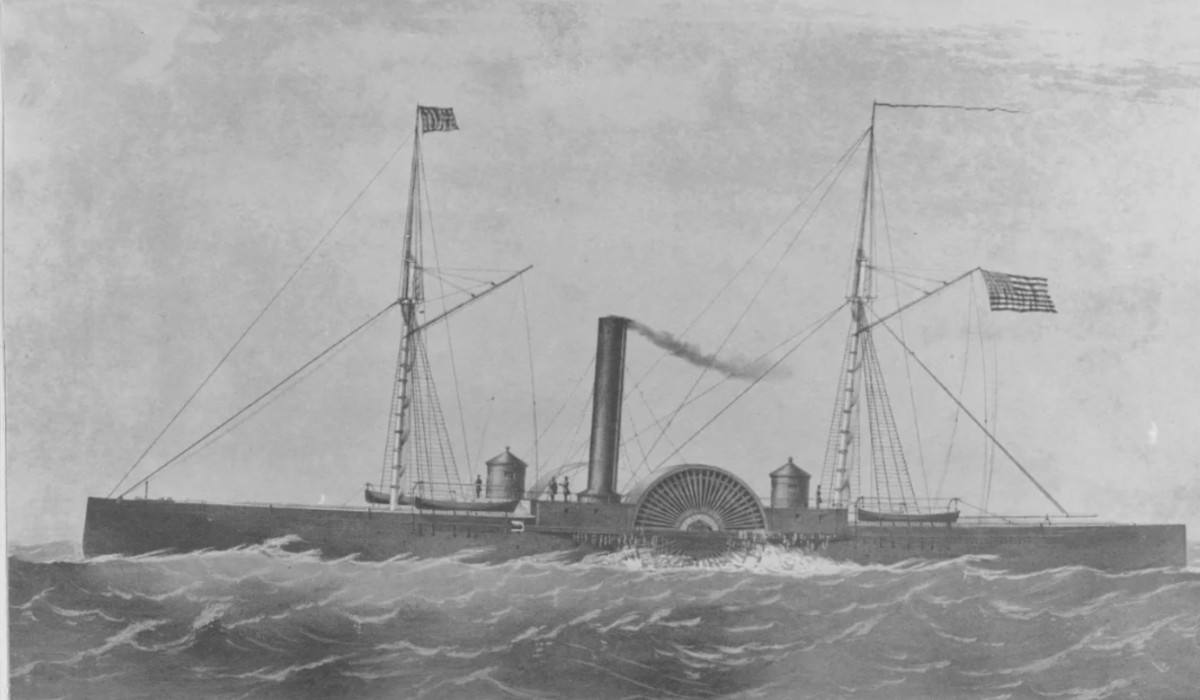
There is new evidence, however, that Thomas Morgan made good on his promise to serve the Union by going to sea. A letter from September 26, 1864 from "Thomas Morgan, Acting Ensign" indicates that he had previously served on the USS Horace Beals before being hospitalized in Pensacola. Two weeks later, he reported for duty aboard the USS Eutaw. On May 11, 1865, Thomas Morgan confirmed in writing that he had left the Eutaw and his address would thenceforth be the Brooklyn Navy Yard. All three of these letters, uncovered by Kristen Fehlhaber, match signatures on the petition letters Morgan sent to Abraham Lincoln.
The trail goes cold with Morgan back where he started, in New York City.
| |
USS Eutaw, Lithograph published by Endicott & Co., New York, circa 1865
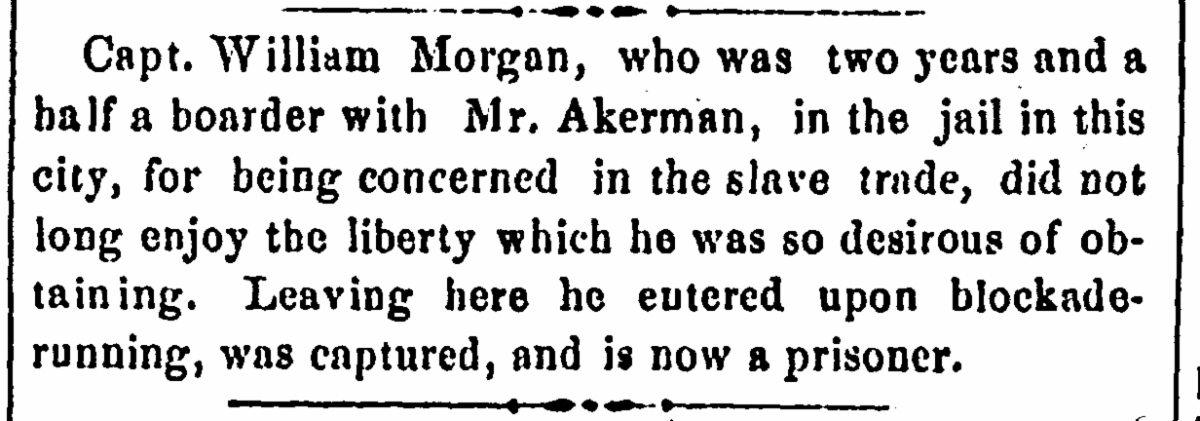
As for George J.L. Colby, his Newburyport Herald only mentioned Thomas Morgan one more time after his Christmas Eve article in 1862. On November 10, 1863, the paper noted that he had "entered upon blockade running" and did not "long enjoy the liberty which he was so desirous of obtaining". If Morgan did embark on a brief stint of blockade running, he would have done so in the service of the Confederacy, and would have been taken prisoner by the U.S. Navy. The USS Horace Beals and Eutaw, where Morgan is known to have served, were both engaged in enforcing blockades. Is it possible that Morgan joined the Confederacy when he was released, was captured, and talked his way into the U.S. Navy? It is unlikely, but so is everything else about this case.
| | Something Is Always Cooking... | | |
Chicken Piccata
Here's a favorite springtime recipe from the Museum of Old Newbury's "Cushing House Cooks" cookbook.
-Sharon Neville
Serves 2
Ingredients
2 boneless, skinless chicken breasts, cut in half and pounded
Kosher salt and freshly ground black pepper
All-purpose flour
2 tablespoons vegetable oil
1/4 cup dry white wine
1/2 cup low-sodium chicken broth
2 tablespoons fresh lemon juice
1 tablespoon drained capers
2 tablespoons unsalted butter
2 cloves of minced garlic
Fresh lemon slices and/or zest
Chopped fresh parsley
Directions
- Season cutlets with salt and pepper, dredge in flour.
- Coat a sauté pan with nonstick spray, add oil and heat over medium-high.
- Sauté cutlets 2-3 minutes on one side. Flip cutlets over and sauté the other side, covered, 1-2 minutes. Transfer cutlets to a platter; pour off fat from the pan.
- Deglaze pan with wine and add minced garlic. Cook until garlic is slightly brown and liquid is nearly evaporated, about 2 minutes.
- Add broth, lemon juice and capers.
- Return cutlets to pan and cook on each side for 1 minute. Transfer cutlets to a warm plate.
- Finish sauce with butter and lemons.
- Once butter melts, pour sauce over cutlets.
- Garnish with chopped fresh parsley and lemon zest (if you prefer). Serve immediately.
Bon appétit!
| | |
Click the image to do the puzzle
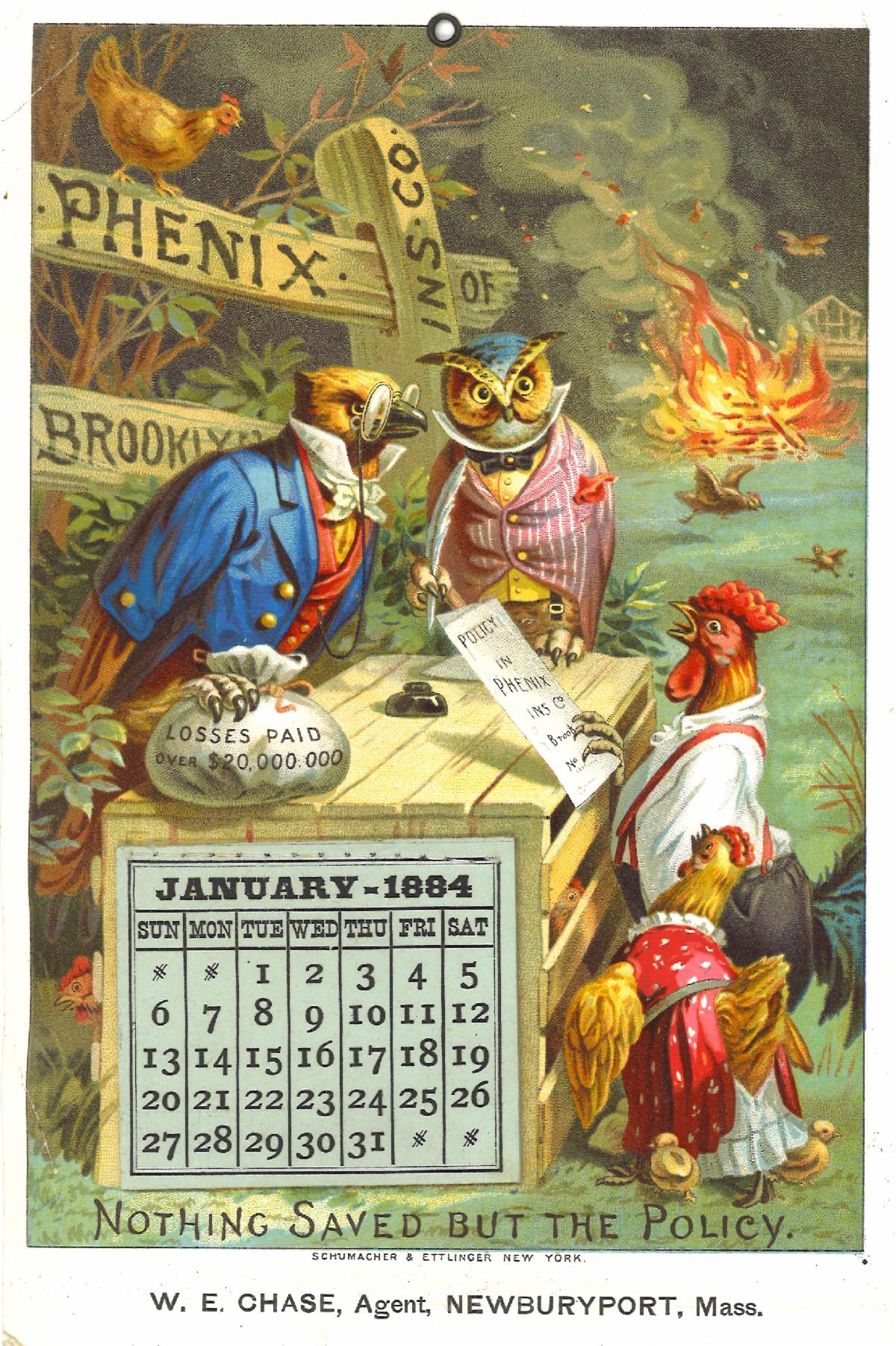
This fun 1884 Promotional calendar card advertises William E. Chase Insurance, Real Estate and Auctioneer, located at 39 State Street.
| | |
Museum e-Newsletter made possible through the
generosity of our sponsors:
| | | | | |