e-Newsletter | March 28, 2025 | | |
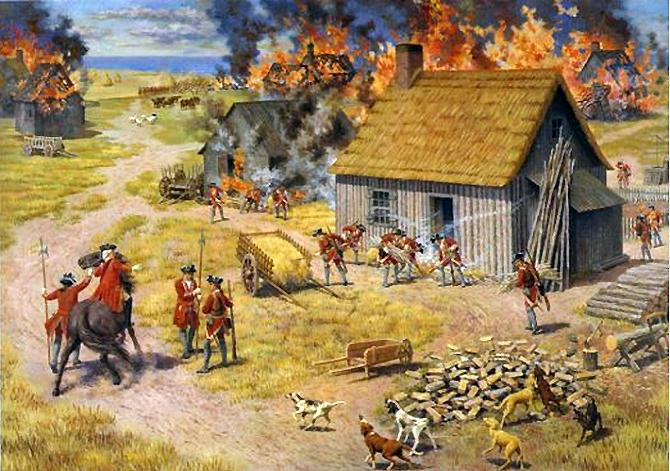
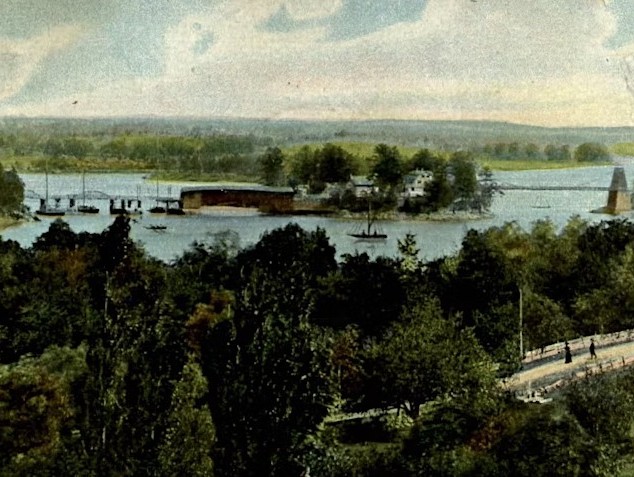
Portrayal of the Burning of Acadia, by Claude Picard
March 21, 1766: The Case of the Neutral Frenchman
by Bethany Groff Dorau
In January, I received an email from a gentleman in Illinois. He had several framed documents related to Newbury(port) history, and he wanted to know if we were interested in purchasing them.
If you know me at all, you know I am interested in everything pertaining even tangentially to this town. You may also know I am a notorious tightwad. And so we did a little dance, this gentleman and I. "I am not mercenary", he said, and when we were through, he had given me one of the documents and the museum had purchased the other two at a very fair price.
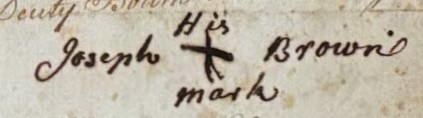
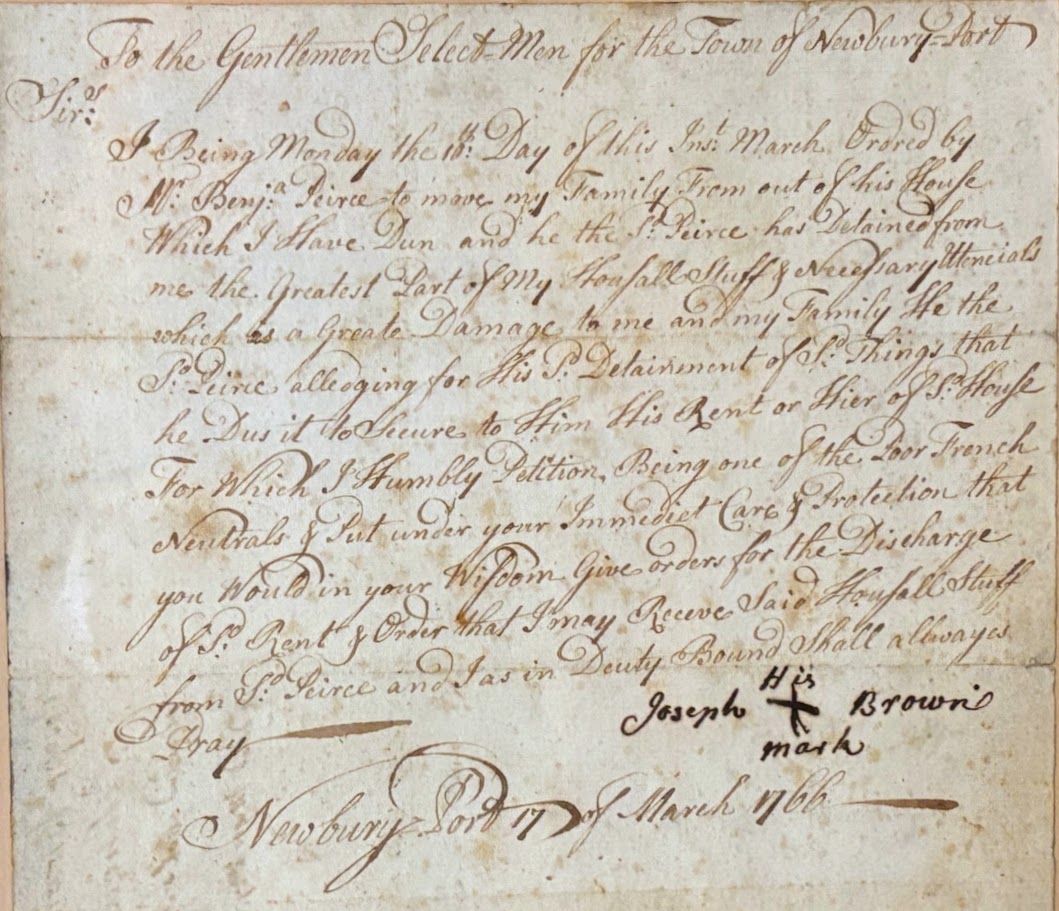
The document that I found most intriguing is a petition to the selectmen "for the town of Newbury-Port", dated March 17, 1766. It was a plea for the return of goods from a "neutral French" man named Joseph Brown.
And then, as I was deep in the records researching the years leading up to the American Revolution, I met Joseph Brown once again...
Read the full story after event announcements below...
| | We know it is frustrating when events sell out quickly, so we are staggering registration dates to give everyone a chance. Please click the image or link below to check out all of our upcoming events! | | Funded, in part, by the Massachusetts Office of Travel and Tourism | |
| | |
Thursday, April 24
6:30 p.m.
Fashion Night Out! Follow the Thread...a Tale of Six Dresses
Join Fashion Historian Lois Valeo and Executive Director Bethany Groff Dorau at the Museum of Old Newbury for "Follow the Thread...a Tale of Six Dresses" where we showcase six fabulous dresses in person!
Tickets here
| | | |
| | |
Sunday, April 27
1:00 p.m.
Bridges & Boats, Trains & Planes:
Local Innovations
in Transportation
Come join us for a fascinating event showcasing the history of advancements in transportation within our local community. Tickets here
| | | | |
Save the Date for these Upcoming 250th Events! Click here for more information.
Newburyport's Road to Revolution Part III: The First Tea Party
Sunday, March 30, 2025, 3:00 PM
St. Paul's Episcopal Church - Tickets here
Burying Ground Tour 1: Old Hill and Newburyport's Road to Revolution
Friday, April 18, 2025, 6:30 PM
Old Hill Burying Ground - Tickets here - Tickets here
Newburyport’s Road to Revolution Part IV:
Black Newburyporters
Thursday, May 8, 7:00 p.m.
Newburyport City Hall Auditorium - Tickets here
Burying Ground Tour 2: First Parish and Newburyport's Road to Revolution
Saturday, May 10, 10:00 a.m.
First Parish Burying Ground - Tickets available April 9
Newburyport’s Road to Revolution Part V:
Powder & Shot
Thursday, May 22, 7:00 p.m.
Museum of Old Newbury - Tickets here
Walking Tour: Road to Revolution in downtown Newburyport
Saturday, June 14, 10:00 a.m.
at Museum of Old Newbury - Tickets available May 10
Newburyport’s Road to Revolution Part VI:
Bunker Hill - Heroes & Cowards
Thursday, June 18, 7:00 p.m.
at Firehouse Center for the Arts - Tickets available April 24
Burying Ground Tour 3: Sawyer Hill and Newburyport's Road to Revolution
Sunday, June 29, 6:30 p.m.
at Sawyer Hill Burying Ground - Tickets available May 11
| | |
Get your tickets for this once-in-a-lifetime event!
Come party with us at the Old Gaol, sip on cocktails, and enjoy a night to remember! This event is a fundraiser to support our archives.
| | |
March 21, 1766: The Case of the Neutral Frenchman
by Bethany Groff Dorau
| | |
Portrayal of the Burning of Acadia, by Claude Picard
March 21, 1766: The Case of the Neutral Frenchman
In January, I received an email from a gentleman in Illinois. He had several framed documents related to Newbury(port) history, and he wanted to know if we were interested in purchasing them.
If you know me at all, you know I am interested in everything pertaining even tangentially to this town. You may also know I am a notorious tightwad. And so we did a little dance, this gentleman and I. "I am not mercenary", he said, and when we were through, he had given me one of the documents and the museum had purchased the other two at a very fair price.
The document that I found most intriguing is a petition to the selectmen "for the town of Newbury-Port", dated March 17, 1766.
| | |
The document is a plea to the selectmen of Newburyport for help in recovering the possessions of Joseph Brown held by Benjamin Peirce, who has apparently just kicked the petitioner and his family out of his home but kept his stuff. A dispute of this nature would not have been unusual but for these three words: Poor French Neutral.
"To the Gentleman Select Men for the town of Newburyport
Sirs: I being Monday the 10th day of this Inst. March ordered by Mr. Benjamin Peirce to move my family from out of his house which I have done and he the said Peirce has detained from me the greatest part of my housall (household) stuff and necessary utensils, which is a great damage to me and my family. He the said Peirce alleging for his detainment of said things that he does it to secure to him his rent or hire of his house for which I humbly petition being one of the poor French neutrals and put under your immediate care and protection that you would in your wisdom give orders for the discharge of said rent and order that I may receive said household stuff from said Peirce and I as in duty bound shall always pray -
Newbury Port 17th of March 1766"
Now what, I asked myself, is a poor French neutral, and what was he doing in our town? The answer opened the door to Newburyport's role in an event that is still remembered as one of the most traumatic in the history of North America.
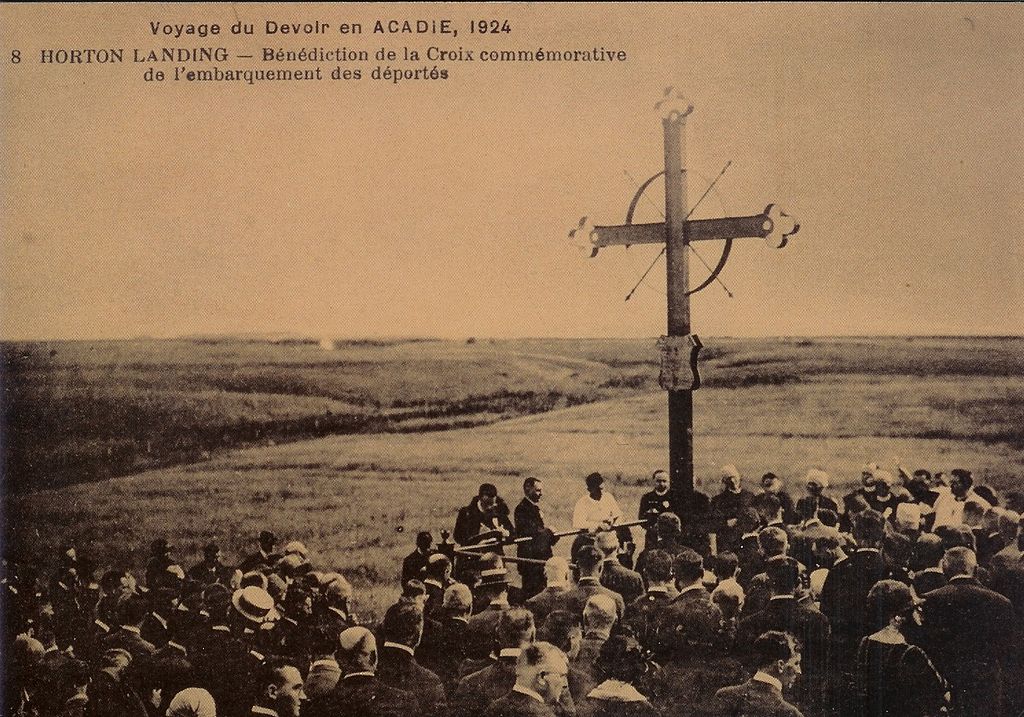
| The 1924 Deportation Cross at Horton Landing, Nova Scotia, marks the location where Acadian settlers, known as French neutrals, were forced into exile in 1755. | |
I am dating myself when I say that my knowledge of the Acadians began (and, until recently, basically ended) with the Longfellow poem Evangeline, a tragic tale of love and loss featuring a couple separated by the forced removal of the Acadians from their land.
Where is the thatch-roofed village, the home of Acadian farmers,—
Men whose lives glided on like rivers that water the woodlands,
Darkened by shadows of earth, but reflecting an image of heaven?
Waste are those pleasant farms, and the farmers forever departed!
I also remember that, growing up in Canada, the Acadians were mythical, and spoken of in hushed tones. I remember a vague sense that this was part of an ancient anger between British and French Canada, and I knew that this story plays out in the Canadian Maritimes.
Recently, I have been delving further into the history of Newburyport's role in the conflicts between England and France as they played out in North America, generally known as the French and Indian War (1754-1763). Newbury soldiers fought in Canada during this conflict, and the Museum of Old Newbury has numerous artifacts from this time. Tavernkeeper William Davenport came home from service under General Wolfe, killed outside Quebec City in 1759, and named the legendary Wolfe Tavern after him. There is a pretty straight line drawn between the expenses incurred by the English government during this conflict and the taxes (without representation) that sparked the American Revolution decades later. The Acadians are part of this conflict, and their presence in Newburyport must have been painful for everyone involved.
| |
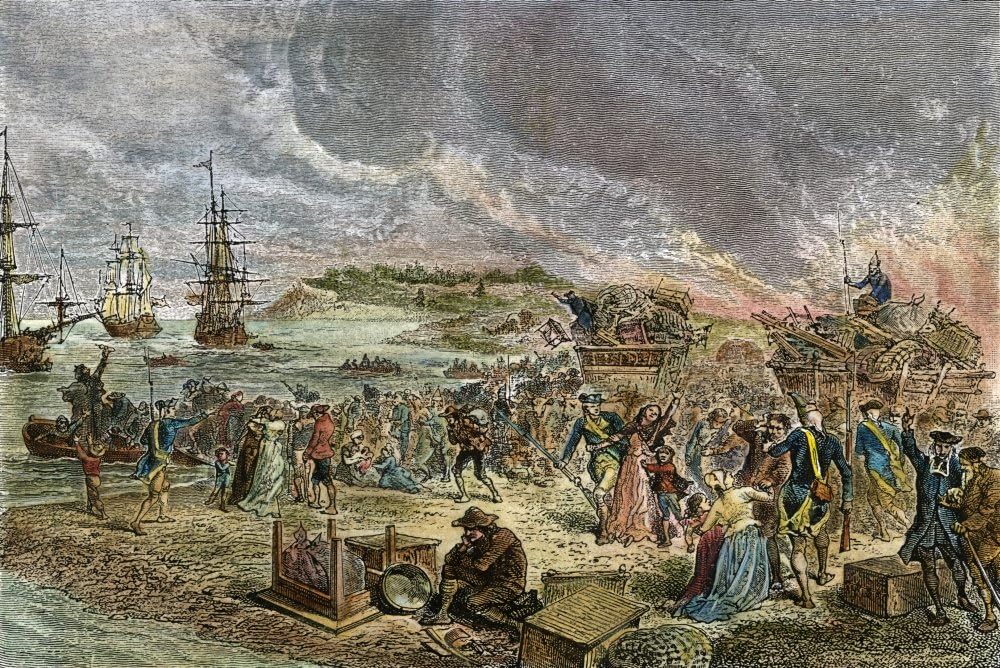
The Embarkation of the Acadians by Émile Antoine Bayard, 1881
The Acadians were the descendants of French settlers who established communities around the Bay of Fundy in present-day Nova Scotia beginning in 1604. They drained and farmed the rich land, formed lasting ties with their indigenous Mi' kmaq neighbors, and lived largely independent of the French government. When their land was ceded to England in 1713, they claimed neutrality (hence the neutral French moniker), and life went on much as before.
As the 18th century progressed, however, France and England were once again in conflict over territory all around the Acadian settlements. A major fortification was built by the French in Louisbourg, a British naval base in Halifax, and rival forts Beauséjour and Lawrence.
When Fort Beauséjour was captured by British forces in June 1755, British governor Charles Lawrence noted that some 270 Acadians were in the French fort. Lawrence demanded an immediate and unqualified oath of allegiance to England, and when the Acadians refused, he ordered their deportation. The decree read in part, "your Land & Tennements, Cattle of all Kinds and Livestocks of all Sorts are forfeited to the Crown with all other your effects Saving your money and Household Goods, and you yourselves to be removed from this Province."
Acadians were forced from their homes and churches, often at bayonet point. Their homes were burned and their farmland flooded. In the end, between 1755 and 1763, over ten thousand Acadians were packed into transport ships without adequate food and water. Nearly one third of them died of disease, starvation, and drowning in the process. The Acadians were shipped to British colonies (later to Europe), including some two thousand to Massachusetts, arriving first in November 1755. Starved, sick, and often unable to speak the language, the Acadians were separated and sent out to various communities to spread out the burden of their care. Meanwhile, settlers, many from New England, took over the rich Acadian farmland.
There is no definitive record of when Joseph Brown, whose name was actually Joseph Brun, arrived in Massachusetts, but it is most likley that he and his family arrived on one of the six ships known to have transported Acadians to Massachusetts between October 1755 and May 1756. Contemporary sources list Joseph BROYN?(BRUN) - 48, Fanny his wife - 46, Molly - 16, Margte. - 13, Joseph - 6, Charles - 4, and four other exiles in Newbury. "these 10 being all well".
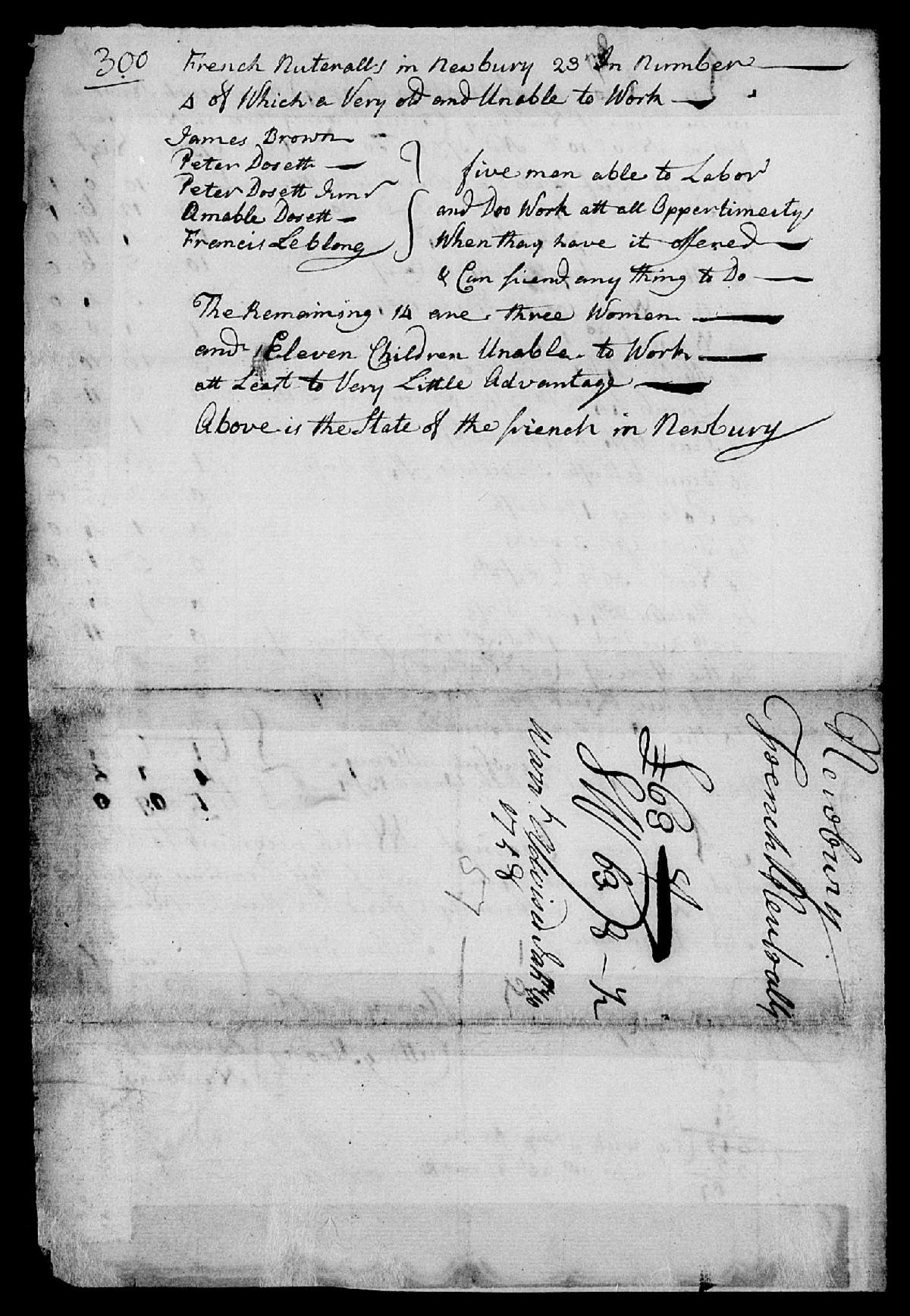
According to the Massachusetts State Archives records, Joseph Brun and his family were assigned to Newbury as of April 4, 1761, though he may also be the "James Brown" (there is no evidence of anyone of that name in any other record), listed as one of 23 "French Neutrals" in Newbury in January 1758 who was "able to labor and do work at all opportunity when they have it offered and can find anything to do." The remaining 18 were either "very old and unable to work", or "unable to work at least to very little advantage".
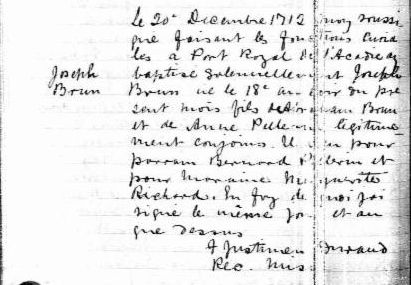
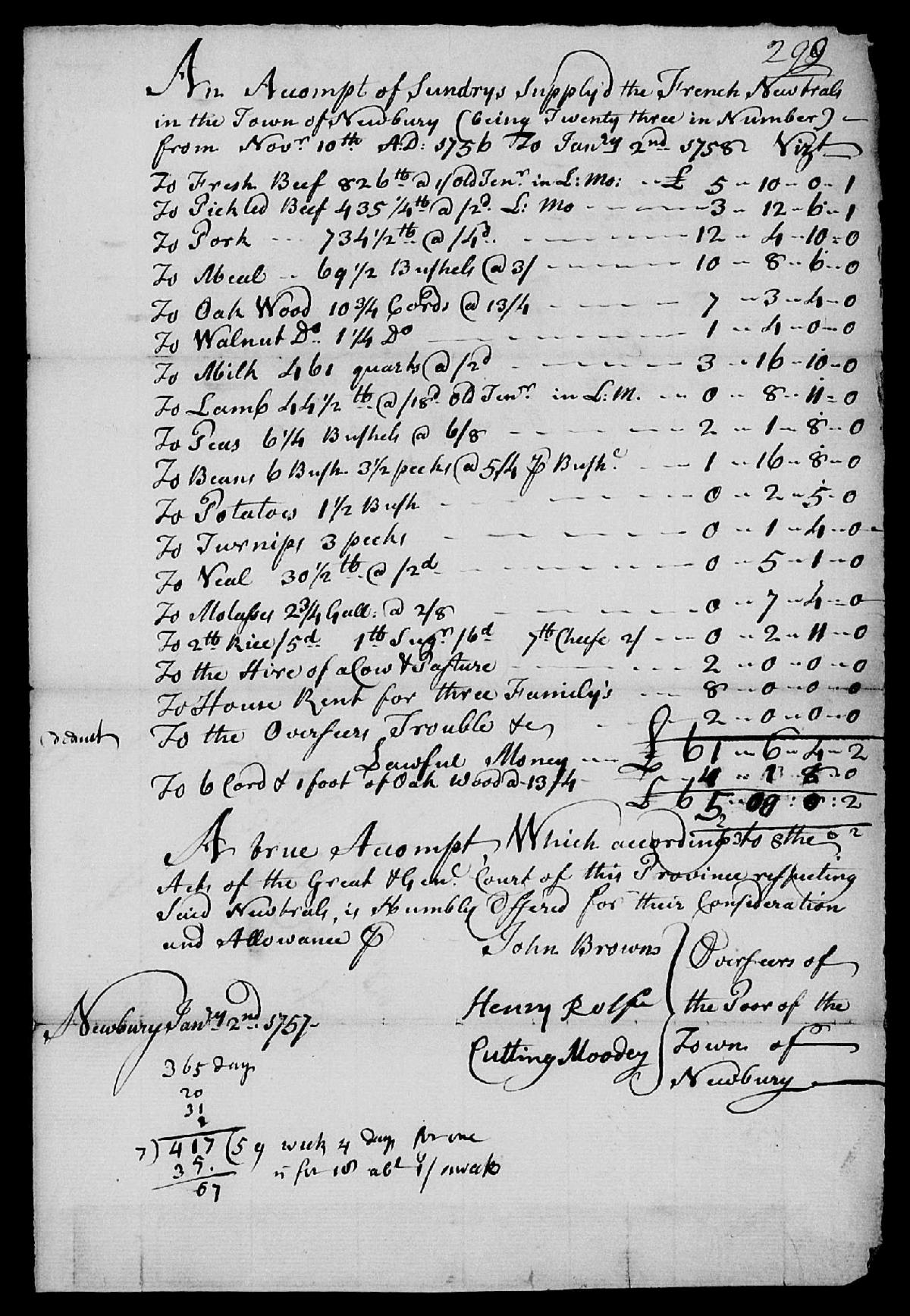
| There is scant information about Joseph Brun and his family. A bit of a wander through the (very well kept) records of the church in Port Royal, Acadia reveals that Joseph Brun was born on the 20th of December, 1712 to Abraham Brun and Anne Pellerin Brun. | Joseph Brun married widow Françoise Comeau, shortened to "Fanny" in the Newburyport record, in 1752 in Port Royal. She had two daughters, Molly and Marguerite. She was 39 years old and he was 40 when they married, and the couple soon had two sons, Joseph Jr. and Charles, born in 1753 and 1754. | The earliest record I was able to find that confirmed the presence of 23 Acadians in Newburyport is the above bill for food and firewood from between November 1756 and January 1757. It is telling that the bill is submitted by the Overseers of the Poor of the Town of Newbury. The Acadians, being whole families and often destitute, were undeniably a burden on the town to which they were assigned, and requests for reimbursement from the colony were sometimes ignored or delayed. The Acadians, who were Catholic, were unable to practice their religion and restricted to the community to which they were assigned. Their children could be taken away and apprenticed, and they were often treated with derision and scorn at best, attacked and beaten at worst. As virtual prisoners of war, the Acadians had little incentive to assimilate. For a full decade, their focus seems to have been on how to get back to their homes. | |
With the signing of the Treaty of Paris in 1763, which effectively ended French rule (though not French influence or culture) in Canada, the Acadians in Massachusetts began to petition for permission and help to return home, or at least to leave the country. Over one thousand Acadians formally requested permission to go to Quebec, whose British governor had indicated that he would accept them, though he would not help pay for their transport. Some also wished to go to France or a French colony. Though Joseph Brun's name does not appear on these earliest petitions, Charles and Paul Brun, who may have been his relatives, are listed with their families.
For three years after the end of the war, the Acadians asked for assistance to leave Massachusetts. Though Massachusetts Governor Bernard was somewhat sympathetic, he did not wish to send these (nominally) British subjects to France or a French colony, and forbade ships from transporting them. But after supporting the Acadians for years, the colony was unwilling to pay for their transport to British Canada either. The Acadians were trapped, forced to make their way back to Canada in small groups and with whatever money they could scrape together, unless the town decided to render assistance.
| | |
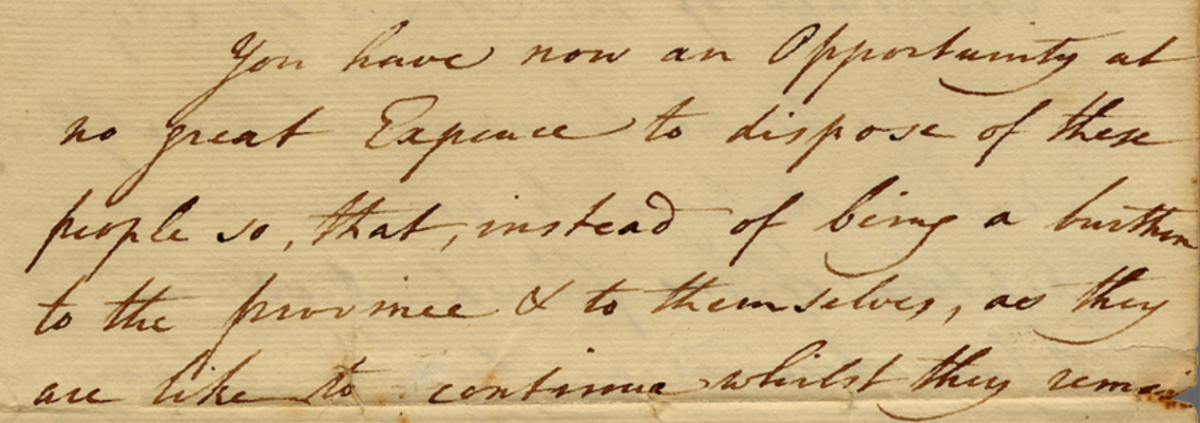
Letter from Governor Bernard to the Massachusetts Legislature, February 13, 1766.
The Brun family's eviction from Benjamin Peirce's rented house came just after Governor Bernard sent the Massachusetts House of Representatives a letter suggesting that they should grant the petitions of the Acadians to return to Quebec. "You have now an opportunity at no great expense to dispose of these people..." he said, arguing that instead of being a drain on the colony, they could contribute to the wealth of the British empire, newly established in Quebec.
Perhaps the town decided not to pay for Brun's support anymore, anticipating their departure. Perhaps Brun himself did not pay rent as he tried to arrange passage. In any case, in October, 1766, the selectmen voted that "the selectmen consider the case of Joseph Brown a Neutral French Man and draw upon the Treasurer for what they think proper for him."
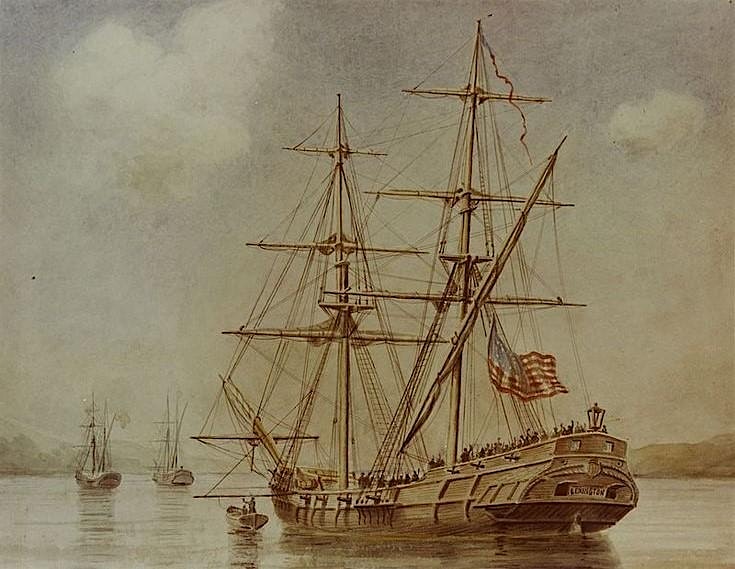
It was over a year later, around June 15, 1767, that Joseph Brun, his wife, step-daughters and sons left Newburyport for Quebec on the schooner Tryal, Captain John Lawson. They arrived a month later, on July 16.
Having fought so hard, and for so long, to return home, it seems doubly unfair that Joseph Brun lived for only one more year, dying on July 12, 1768 in Quebec.
This document's trip from Newburyport to Illinois and back to Newburyport, and the long and complex history it revealed is a testament to the power of archival collections. The Brun family deserves further research, and we would welcome any information you have about the Acadians in Newburyport. But for now, we are grateful for this window into a complicated time in North American history.
| | Something Is Always Cooking... | | |
Carrot Almond Soup
Here's a favorite comforting staff recipe to use up lots of carrots when you pick up that giant bag at the market and don't quite get through them fast enough. This soup is creamy yet dairy free and totally worth the effort!
-Shelley Swofford
Serves 4
Ingredients
2 tbsp. olive oil
1 large onion, finely chopped
1 leek, thinly sliced
1.5 lbs carrots, thinly sliced
6 1/2 cups water
2 oz. soft white breadcrumbs (can use GF bread crumbs)
1 3/4 cups ground almonds
1 tbsp. fresh lemon juice, or more to taste
salt and freshly ground black pepper
Chopped fresh chives to garnish
Directions
- Heat oil in a large saucepan or pot over medium heat, add onion and leek. Cover pan and cook for 3 or 4 minutes stirring occasionally till softened and translucent (do not brown).
- Add carrots, water and some salt and pepper. Bring veggies to a boil, then reduce heat and simmer, partially covered, till vegetables are tender (about 45-50 minutes).
- Put almonds, breadcrumbs and about a 1/2 cup of the carrot cooking water into a blender or food processor and puree into a smooth paste.
- Transfer the soup vegetables and cooking liquid to the blender or food processor (working in batches) and puree till smooth. (If using a blender or food processor, allow the vegetables to cool a little first before pureeing them). Alternately, this is a great job for an immersion blender if you have one as you can blend right in the pot.
- Return soup to pot and simmer on low till reheated through. Add lemon juice, salt and pepper to taste.
- Ladle into bowls and garnish with chopped fresh chives. Serve immediately.
Bon appétit!
| | |
Click the image to do the puzzle
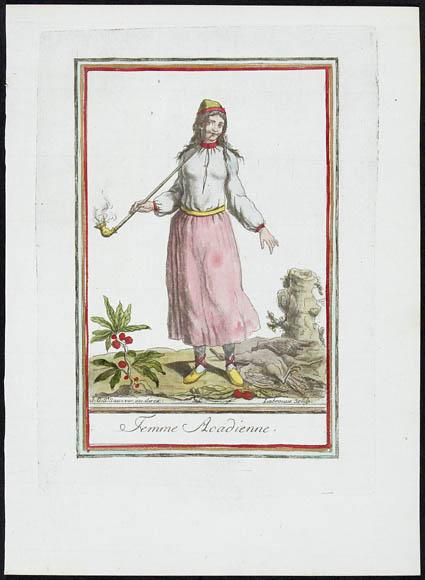
This c. 1796 engraving of a woman in traditional Acadian dress is in the collection of the National Archives of Canada.
| | |
Museum e-Newsletter made possible through the
generosity of our sponsors:
| | | | | |