e-Newsletter | November 7, 2025 | | |
"Upon the tenterhooks of death..."
A Portrait, a Letter, and a Daring Escape Revealed!
by Bethany Groff Dorau
| | Several weeks ago, while looking for something completely different, I came across a box that had been unearthed during the move to the Perkins Art and Research Center. It was unlabeled, with an ambiguous note taped to the top. "Catalogued by M. Atkinson", it said. Well, friends, at one time or another, everything in the museum was catalogued by the venerable Mae Atkinson, so the box could have been filled with literally anything - or nothing. Sometimes the most tantalizingly labelled boxes in the recesses of the museum are tragically empty. I opened the lid, expectations low. And there, encased in gold, were plaits of human hair, a young man's face, and a tale that Joseph Gerrish, born in 1775, travelled through time to share with us... | | Read about Joseph Gerrish's remarkable escape after our event announcements... | |
| |
October to May, 2026
11:00 a.m. to 4:00 p.m.
Seasonal Saturday Tours!
Take a tour through this 1808 Federal mansion, containing art and artifacts from the past four centuries. Hear the story of Old Newbury and the growth of Newburyport.
New starting the fall of 2025, the Museum will be open most Saturdays (*weather permitting, some dates excluded).
Tickets here
| | | |
| |
Saturday, December 6, 2025
10:00 a.m. to 4:00 p.m.
Holidays at the Cushing House
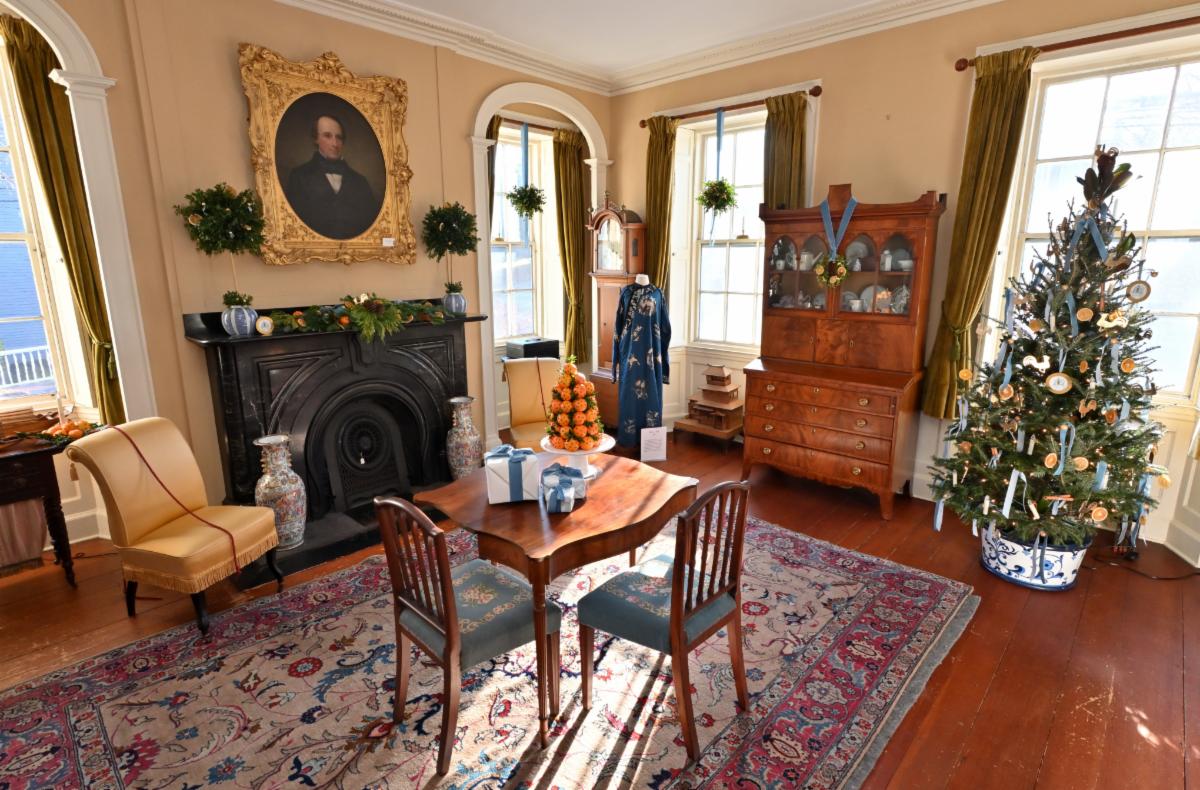
An annual tradition! Come enjoy the 1808 Cushing House decorated for the season by local garden clubs and volunteers.
Tickets Here
| | | |
| |
Sunday, December 7, 2025
10:00 a.m. to 4:00 p.m.
Holidays at the Cushing House
An annual tradition! Come enjoy the 1808 Cushing House decorated for the season by local garden clubs and volunteers.
Tickets Here
| | | |
| |
Sunday, December 21, 2025
6:30 p.m.
Solstice in the Cemetery: Night Walk Through Oak Hill
Join noted author and historian Ghlee Woodworth, a 12th generation Newburyport native, and Museum of Old Newbury executive director Bethany Groff Dorau for a nighttime stroll through the historic 1842 Oak Hill Cemetery. We will say hello to several Ebenezers, though none of them Scrooges, and toast the longest night with hot cider, cider donuts, and good cheer.
Tickets Here
| | | | |
"Upon the tenterhooks of death..."
A Portrait, a Letter, and a Daring Escape Revealed!
by Bethany Groff Dorau
| | |
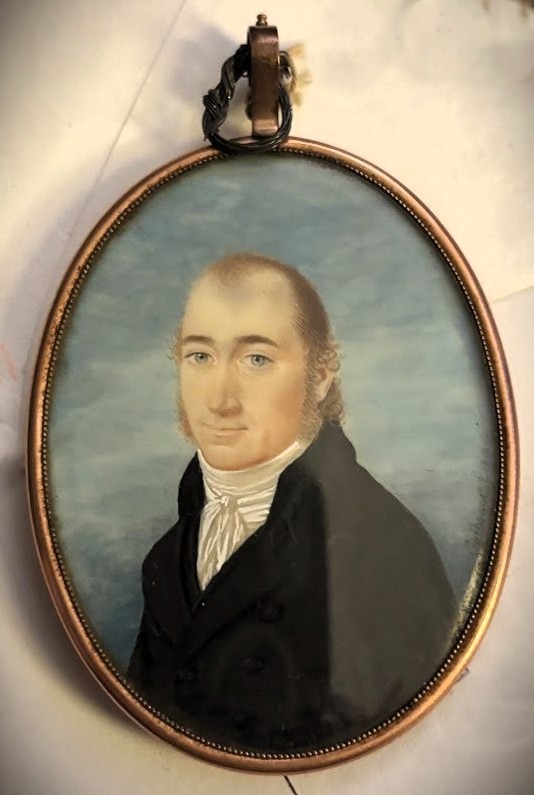
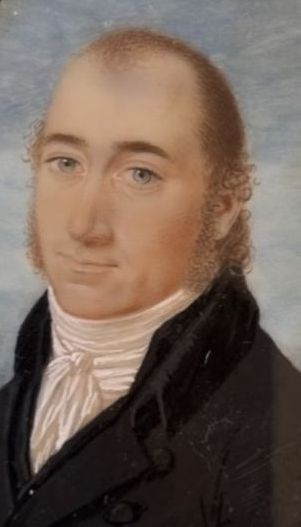
Detail from the 1804 portrait miniature of Joseph Gerrish (1775-1839), front and back.
Several weeks ago, while looking for something completely different, I came across a box (unlabeled) with an ambiguous note taped to the top. "Catalogued by M. Atkinson", it said. Well, friends, at one time or another, everything in the museum was catalogued by the venerable Mae Atkinson, so the box could have been filled with literally anything - or nothing. Sometimes the most tantalizing boxes in the recesses of the museum are tragically empty. I opened the lid, expectations low. And there, encased in gold, were plaits of human hair, a young man's face. Actually, there were many faces, most of them young, some with hair carefully woven and encased behind their portrait. What I had found was a whole delicious box of portrait miniatures, each with a story to tell. I picked one up, then another, and under the portrait of a blue-eyed young man with soft features and curly, thinning hair, was a typed, yellowed label. Joseph Gerrish, 1804, it read. I know better than to assume that a label belongs with that object, just because it shares space with it. But, heaven be praised, the portrait had a tag with a number, and this man was, so far as we could ascertain, Capt. Joseph Gerrish, born in 1775 in the Joppa neighborhood of Newburyport (then still in Newbury).
| | |
The record of Joseph Gerrish's death in 1839 notes that he was the son of Stephen and Ruth Gerrish and died at age 64.
I had a familiar ticklish feeling at the back of my neck when I found his death record. I know this man, I thought. I know Joseph Gerrish. Well, never put too much stock in a neck tickle. The Joseph Gerrish I was thinking of was an eccentric attorney in Newburyport who was born in 1819, is my 5th cousin, and owned my favorite musket (Long Tom), and an impressive collection of canes. The miniature portrait was marked "1804". Not him. We didn't have far to go, however. Eccentric lawyer Joseph Gerrish had an uncle also named Joseph Gerrish, my 3rd cousin, and born in 1775.
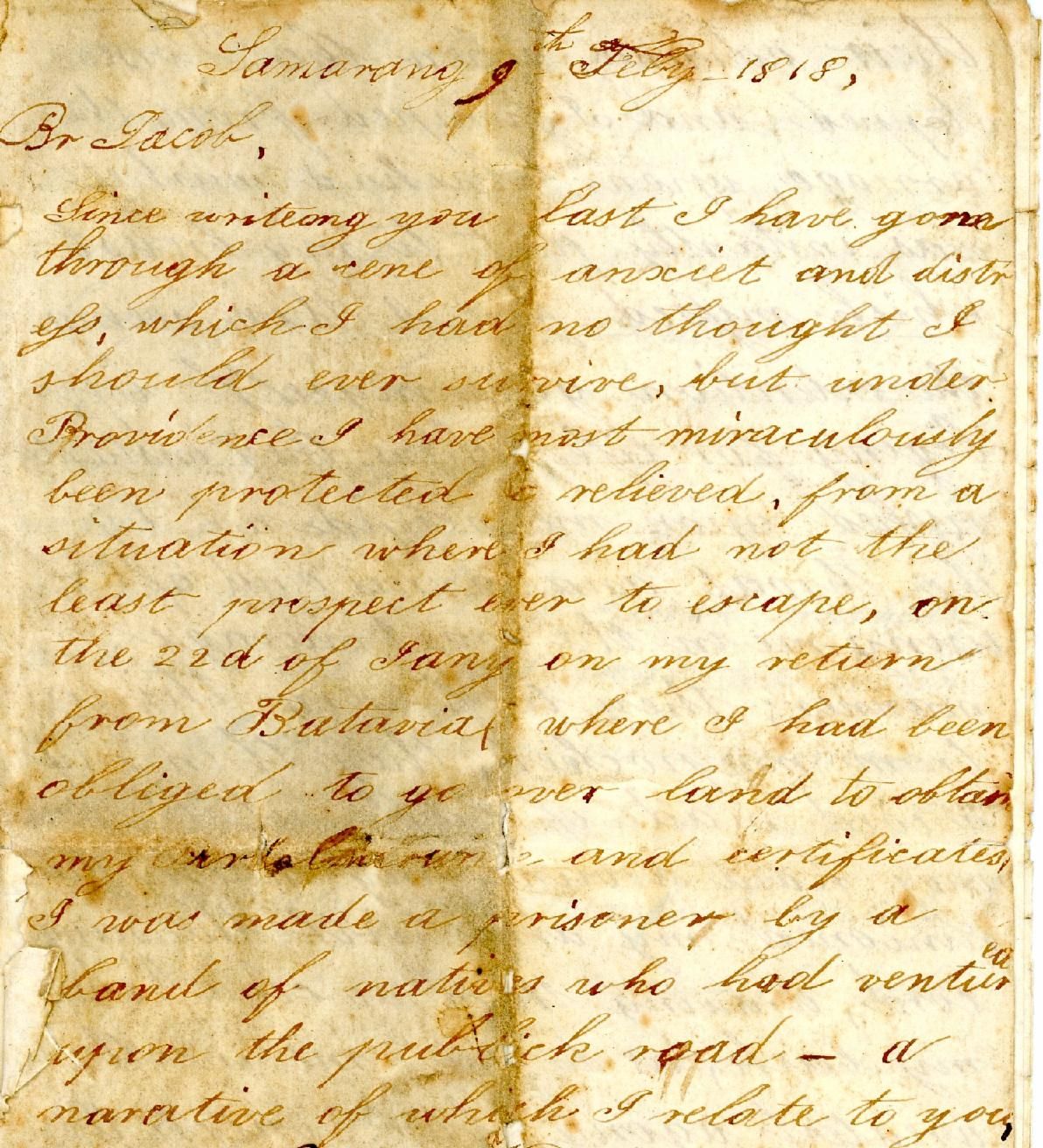
Then I had that feeling again. Several years ago, former assistant director Kristen Fehlhaber came upon a cache of files full of research that had been done for papers presented at the museum over the last century. Our wonderful interns scanned these files, and I had a distant memory of one file containing a letter or a transcription of a letter about a man who had managed to escape from a group of cannibals in what is now Indonesia. I looked up the scan and there was the letter. There was a scan of the original, which had travelled around the world in 1818 and was rather the worse for wear, and a very helpful and very old, but typed transcription. It was from Joseph Gerrish, and, the clincher, he was writing to his brother, Jacob, father of the eccentric attorney. We had our man.
| | |
Most remarkable of all, we had the letter sent from Semarang, the capital city of the Java province and a major Dutch trading port. I called down to Ashley, working hard at Perkins, and she dug up and rescanned the letter. I'll let Joseph Gerrish take it from here.
Samarang, 9th Feby 1818
Bro Jacob
Since writing you last I have gone through a scene of anxiety and distress, which I had no thought I should ever survive, but under Providence I have most miraculously been protected and relieved from a situation where I had not the least prospect ever to escape. On the 22nd of Jany on my return from Batavia where I had been obliged to go overland to obtain my port clearances and certificates I was made a prisoner by a band of natives who had ventured upon the public road—a narrative of which I relate to you.
At one o’clock of day I discovered a band of about 100 men armed with pikes, knives and muskets, immediately on which the driver left his seat and escaped leaving the horses running towards the savages and before I could gain the reins I was within 100 paces of their advance when the horses stopped and I jumped from the carriage, upon which a musket was instantly put to my breast which missed fire. I then seeing the situation gave myself up begging for life when they instantly rushed upon me, seized me by the throat and arms and after using me in the most savage manner they took everything from my pockets. They then put a cord made of bark which was very hard around my neck, then pinioned my arms with the same cord drawing them so close behind me as to put me in the greatest agony, after which they tied my wrists so as to completely stop all circulation. They then began to march me in the heat of the day after pulling the cord which led to my neck. After walking about two miles in that painful situation they made a halt when they made a most horrid yell, at which there instantly appeared from the edge of the woods a detached party bringing two naked bodies, one of which they brought before me pierced in the most shocking manner, the other appeared to show some symptoms of life.
They there turned into the woods on the opposite side with the dead body and with me and a part of the Patrol. The other part kept on with the other body and carriage and horses. We had not gone far into the woods when they slightly buried the corpse naked as it was, and continued on with me. My anxiety was so great and the agony I was in so extreme that sweat ran off at the bottom of my pantaloons.
After going several miles in that situation they came to a small village by a river over which they past on a log, except those who led me who made me wade through. I asked for water to drink which was inhumanly denied me. We then came to an extensive paddy ground when instead of going on the dikes they made me wade through the mud about a foot deep. After crossing this extensive plain we came to a second river over which they made me wade through as before when they came to the village where they belonged. I was then seated on the wet ground in the stocks until the chief came. I was then taken and placed on a bench and 15 of his men called who folded their hands, kneeled, and kissed his feet, after which they were brought before me and their knives examined by the chief. In which place I supposed I was to be executed, but hearing the chief say Hollander, I immediately said American from which he appeared to look earnestly at me and I as earnestly at him, repeating the word American. When after a few minutes he ordered the knives to be returned and then ordered me to be taken off from the bench and put into a shed, it raining very fast.
After I was seated he endeavoured to ascertain where I was from, where going, and to what country I belonged, all of which I gave him to understand. I then endeavoured to show him my hands and neck, how they were swelled and in what misery I was in; when he ordered me again to be searched, and finding nothing he ordered the cords to be taken off, having been in that painful condition 7 hours.
Click here to see the original letter and read the rest of this tale!
Click on the READ ME file for the current transcription.
| | Something Is Always Cooking... | | |
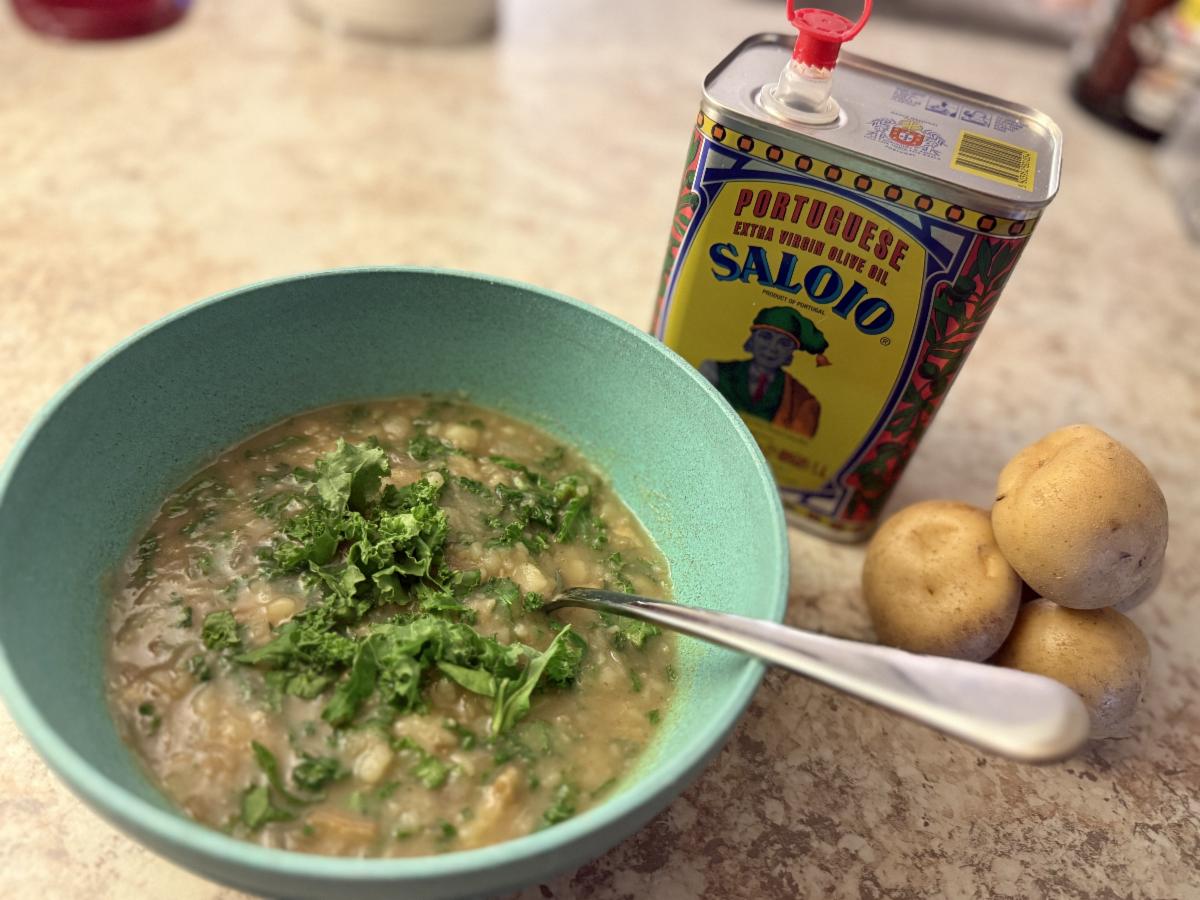
Weekday Caldo Verde
(Portuguese potato and kale soup)
I am not of the Brazilian, Cape Verdean, or Portuguese diaspora descended from whalers, but my goodness do I love my friends and neighbors who are. The coast of Massachusetts has hotspots and communities where markets, churrascarias, and by-the-pound lunch counters make some of my favorite foods. I've found that many Portuguese recipes are special because of method rather than for extravagant ingredients, of which the famously one-pot Caldo Verde (CALdoe VAREgee, in Carioca pronunciation) is a fine example. I learned how to make this creamless-yet-creamy soup from my partner of many years, who was born in Rio de Janeiro to American parents in the Peace Corps. I've adapted it into a vegetarian version here.
-Anne Bryant
Ingredients
(serves 4)
1/3 cup (approx.) olive oil
1 large onion, chopped
garlic (plenty, I use 4 cloves or more) chopped
kosher salt
4-6 yellow potatoes (about 3-4 cups), 2 cm cubes
1 big bunch of kale or collards, I prefer kale, chiffonade
water or vegetable stock to cover
Directions
Just below medium heat in a decently sized pot, sauté the onion and garlic in a generous amount of olive oil with a pinch of salt until translucent. You're just looking to sweat these, not to brown them.
Add the cubed potatoes and stir over the same heat for a little while, then just cover with water or broth. Bring to a boil, then reduce to a simmer.
When the potatoes are soft, the soup is done.
Drizzle with a little more olive oil and take a potato masher to it right there in the pot. No need to puree, you'll get a creamy result from just the masher.
Salt to taste.
I prepare a bowl, then add a good fistful of the thin, ribbony kale to it while hot, which immediately wilts but does not overcook the greens.
I do this with leftovers as well—heat the soup, then add a fistful of greens.
The soup might get thick in the fridge, so just add a little water when reheating.
Enjoy!
| | |
Click the image to do the puzzle
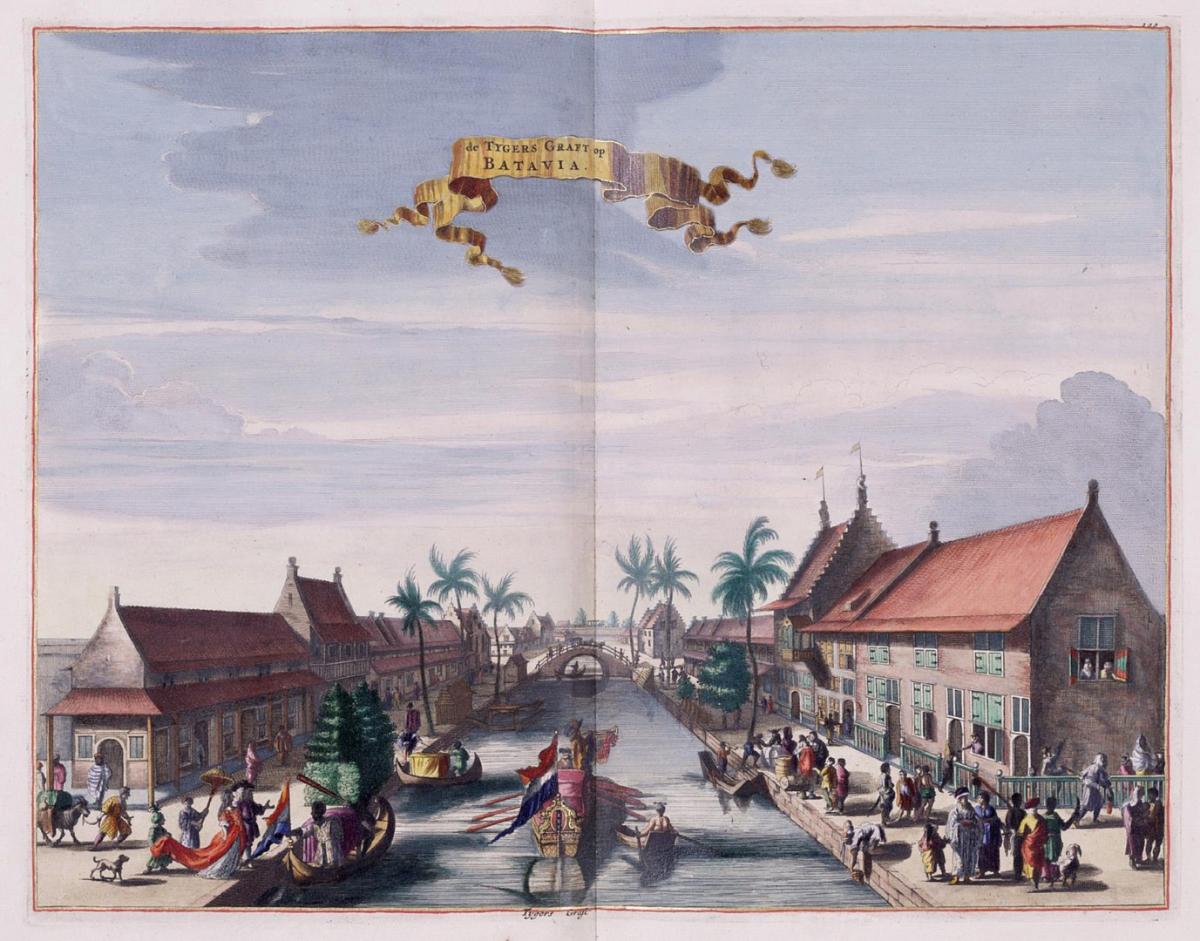
This view of the Tijgersgracht Canal in Batavia (modern day Jakarta), near where Joseph Gerrish was taken, was created in the mid 17th century when Batavia was the capital of the Dutch East Indies. The canal was lined with the houses and buildings of the city's most prominent families.
Print by Weduwe van Jacob van Meurs.
| | |
Museum e-Newsletter made possible through the
generosity of our sponsors:
| | | | | |