e-Newsletter | November 21, 2024 | |
|
“Their deaths are but stepping stones” - Lt. George. T. Garrison of the Massachusetts 55th
by Kristen Fehlhaber
| |
|
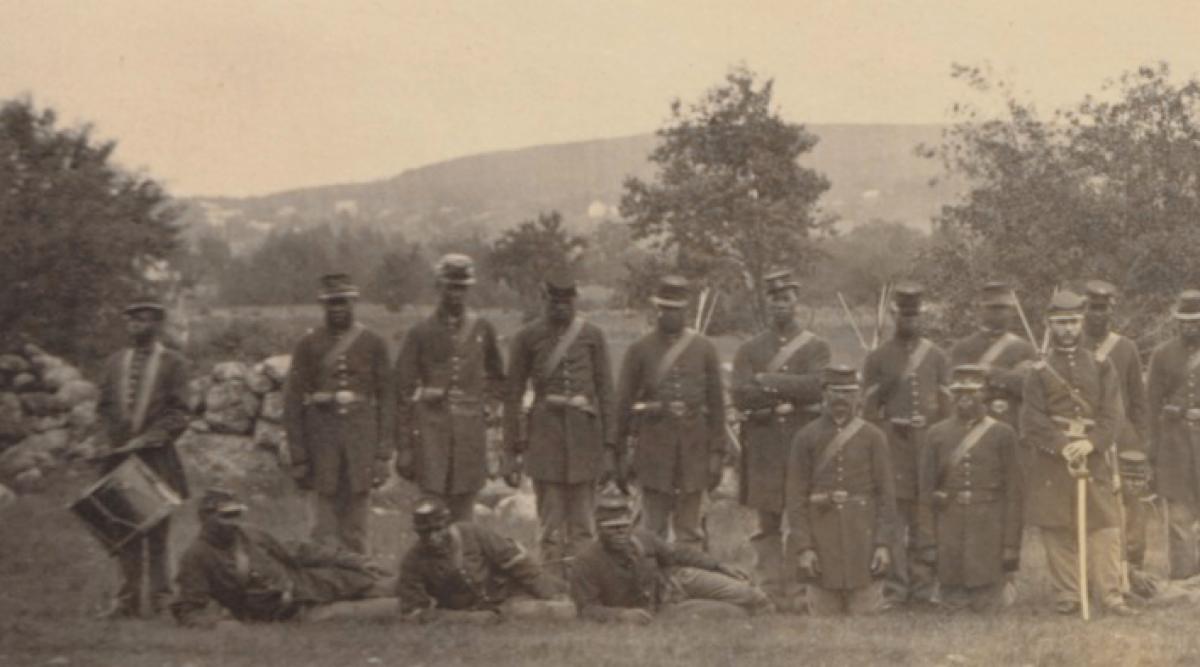
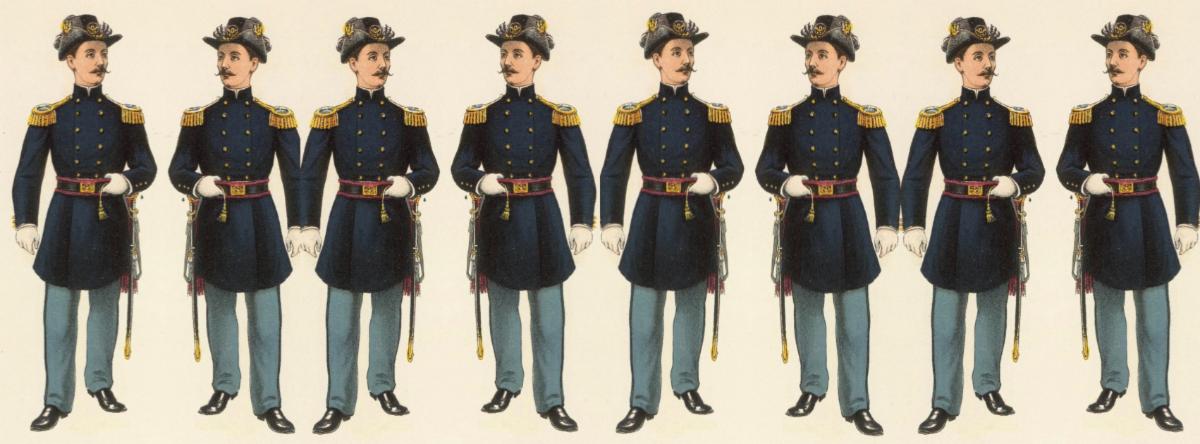
Soldiers and officers of the MA 55th Volunteers. George T. Garrison appears
to be the standing with a sword on the right. Image courtesy National Museum of
African American History and Culture.
Communication today is so fast that it might be hard for some to imagine how slowly news used to travel. Lt. George T. Garrison, age 29, was about 20 miles from Charleston, South Carolina, serving in the Massachusetts 55th Infantry Regiment during the American Civil War. He wrote the following in his diary in the spring of 1865:
“April 13th – The end of this most accursed rebellion now seems near. By the “Liberator,” of April 7th, which I received this evening, I see by a brief paragraph from Father that he has been invited by the Secretary of War to visit Charleston on a free pass, to be present at the celebration of the capture of Fort Sumter on the 14th – tomorrow. Father says that he has accepted the invitation…Today, I suppose, Father is in Charleston. I shall be glad enough to see him and only wish I was there.”
Imagine being at war and learning from the newspaper that your father was nearby? George’s father was the famous abolitionist William Lloyd Garrison, publisher of “The Liberator” newspaper. George knew the power of newspapers, having worked at his father’s paper and others, and had written home a few months before, “If I am killed or wounded at any time, you will hear of it by the newspapers.”
Read the title story following event announcements.
| |
Holidays at the Cushing House - 2024
Saturday & Sunday, December 7 & 8, 2024 10:00 a.m. - 4:00 p.m.
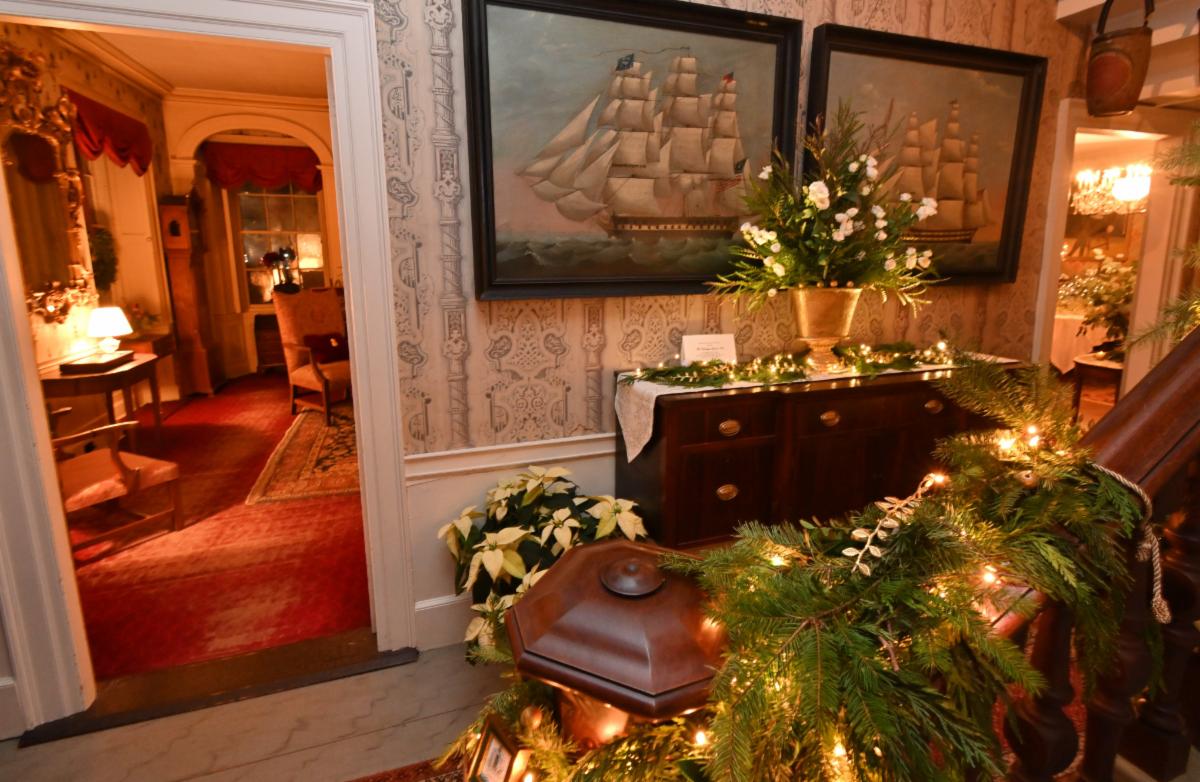
Visit the 1808 Cushing House and enjoy exquisite decorations, festive music and the company of friends and neighbors for two days of walk-through tours.
| |
|
5th Annual William Lloyd Garrison Lecture at Old South Church, Newburyport
Sunday, December 8, 2024 3:00 p.m.
Professor Kellie Carter Jackson presents, "We Refuse: A Forceful History of Black Resistance".
| |
Museum of Old Newbury Members Holiday Party December 8!
Sunday, December 8, 2024 4:00 p.m. - 7:00 p.m.
Come to the hottest party in town, the legendary Museum of Old Newbury Members' Holiday Party!
Check your membership status (call us and we'll gladly check for you), and come back to sign up. Space is limited, so sign up now.
| |
|
Night Added! Solstice in the Cemetery: Night Walk Through Oak Hill
Friday Dec 20, 2024 6:30 p.m.- 8:00 p.m.
| |
|
“Their deaths are but stepping stones” - Lt. George. T. Garrison of the Massachusetts 55th
by Kristen Fehlhaber
| |
|
Soldiers and officers of the MA 55th Volunteers. George T. Garrison appears
to be the standing with a sword on the right. Image courtesy National Museum of
African American History and Culture.
Communication today is so fast that it might be hard for some to imagine how slowly news used to travel. Lt. George T. Garrison, age 29, was about 20 miles from Charleston, South Carolina, serving in the Massachusetts 55th Infantry Regiment during the American Civil War. He wrote the following in his diary in the spring of 1865:
“April 13th – The end of this most accursed rebellion now seems near. By the “Liberator,” of April 7th, which I received this evening, I see by a brief paragraph from Father that he has been invited by the Secretary of War to visit Charleston on a free pass, to be present at the celebration of the capture of Fort Sumter on the 14th – tomorrow. Father says that he has accepted the invitation…Today, I suppose, Father is in Charleston. I shall be glad enough to see him and only wish I was there.”[i]
Imagine being at war and learning from the newspaper that your father was nearby? George’s father was the famous abolitionist William Lloyd Garrison, publisher of “The Liberator” newspaper. George knew the power of newspapers, having worked at his father’s paper and others, and had written home a few months before, “If I am killed or wounded at any time, you will hear of it by the newspapers.” [ii]
At this moment, George was returning from a 10-day march inland. A month previous, his unit settled on James Island in Charleston harbor, enjoying some quiet time after months on the march. In a rare moment of humor in his diary, George wrote on March 12th,
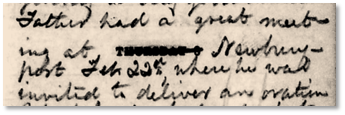
“Sunday. I gave myself a wash all over with soap ends and hot water, the first I have had since Jan. 17th. Fifty-three days without a wash all over. Don’t tell of it.” In the same entry, Newburyport is mentioned. A letter informed him that “Father had a great meeting at Newburyport Feb. 22nd where he was invited to give an oration.”
[i] All quotes and images from the diary courtesy Massachusetts Historical Society, Garrison Family Papers, Microfilm, P-817, reel 1, Diary of George Thompson Garrison, 1854-1865.
[ii]Massachusetts Historical Society, George Thompson Garrison papers, 1836-1948, Correspondence with William Lloyd Garrison, 1854-1877 , Box 9 Folder 7-15, Letter from George T. Garrison to William Lloyd Garrison, Dec. 3, 1864.
| |
|
William Lloyd Garrison had a famously difficult relationship with the city of his birth (see Oct. 15, 2021 newsletter), so his return to Newburyport was no small matter. He spoke at “The Grand Emancipation Jubilee,” an event celebrating the recent passage of the Thirteenth Amendment, ending slavery. His life’s work of immediate emancipation to end slavery had finally come to pass.
Difficult relationships were not uncommon in Garrison’s life. He had a famous falling out with Frederick Douglass about how to advance the fight against slavery. For a time, he struggled with his son’s decision to accept an officer’s commission and fight in the war. George chose the Massachusetts 55th Infantry Regiment, a sister regiment of the renowned Massachusetts 54th, made up of Black soldiers with white officers (until the very end of the war, when a few Black soldiers were promoted). Frederick Douglass campaigned hard for the right of Black soldiers to fight; the fact that George chose to serve with this regiment must have aroused some feelings in his father.
Diaries written by soldiers in war can come in many different flavors – factual, full of confidences, political, or even humorous. Lt. George Garrison’s is mostly matter-of-fact reporting on how his day was spent with occasional personal observations about events around him.
Second in command of the 55th was Colonel Charles Barnard Fox. He was also born in Newburyport, the son of First Religious Society minister Thomas Bayley Fox. On March 15th, George writes at unusual length about a meeting of officers, held by Col. Fox. In it, they decided to ask permission to send a search party to reclaim the bodies of officers lost in the recent Battle of Honey Hill, voted to pay for a coffin and send money to a destitute widow.
Then, “After getting through with business before us, we were invited to remain by Col. Fox to listen to some music by Murray of the Band & another man. It was very good. A dance was proposed and started by Capt. Grant, and “Lanciers” [a quadrille] and a cotillion were danced. After this the Virginia Reel was danced. Being invited by Col. Hartwell to be his partner in it, I accepted and danced with him. After getting through with this, we all sang “Old Lang Syne, my Dear” and started for our tents. It was the largest gathering of our officers that we have had for a long time. Considering what we were called together for, the ending of it was certainly very queer, and hardly appropriate to the occasion. Life is but little thought of in a Regiment and the remembrance of those who have passed away is not long remembered. Their deaths are but the stepping stones for somebody’s promotion.”
| |
|
Union captains dancing a quadrille?
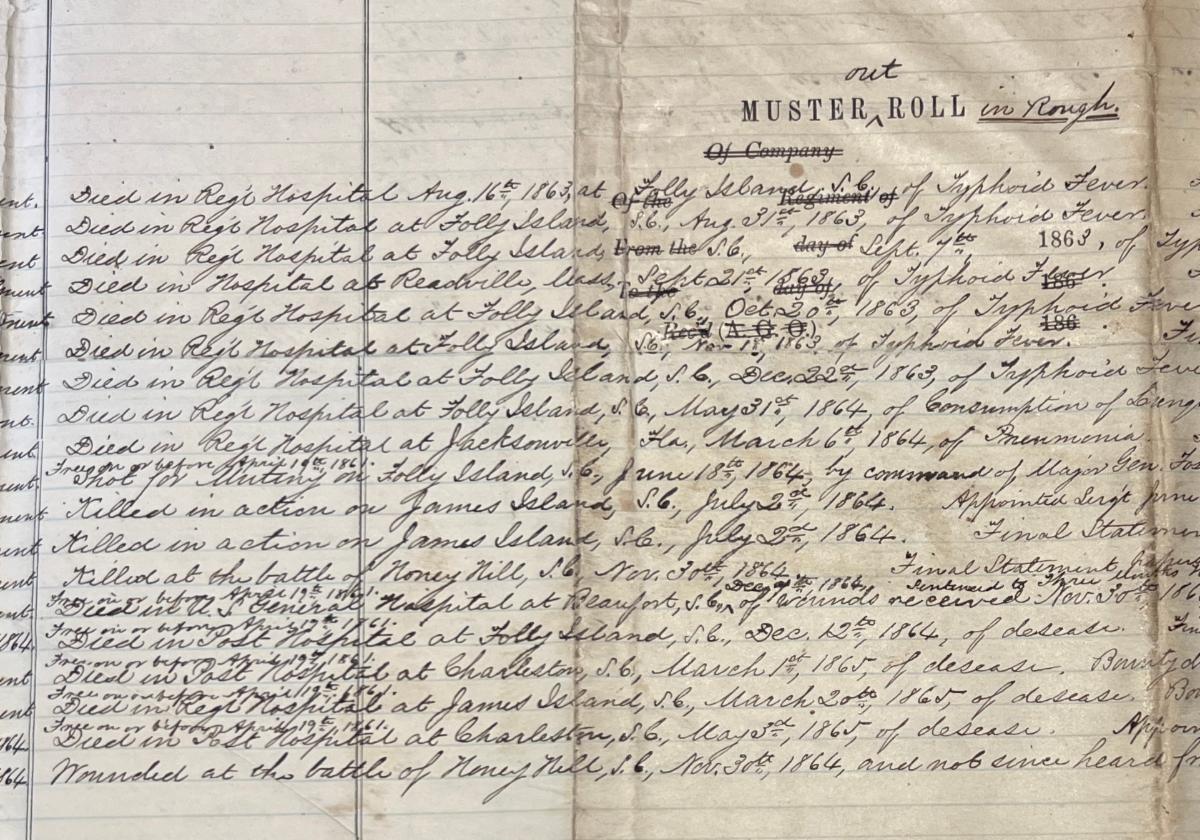
Mentions of sickness and death are present throughout George’s diary. Over the course of the war, the 55th lost 67 men in battle and 130 to disease. On March 20th, George was moved to write about the passing a soldier from his company.
“This morning at 1o’clock old man Thomas P. Wilson died in the Regimental Hospital. He has been sick quite a number of days. His death however took me entirely by surprise. His is one of the recruits that joined the Co. in November. It was a shame enlisting such an old man as he was. He was buried this evening by Sgt. Laws with a detachment from this Co. I was too busy to be able to attend the funeral.” Garrison couldn’t know that Private Wilson’s death would be the last loss in Company “I” during the war. Garrison sounds weary and remains sensitive to deaths in a way that he doesn’t observe in his fellow officers. (A note about Wilson: Thomas C. (not P.) Wilson, a seaman, was born on the West Coast of Africa. He enlisted in Dorchester, MA, on August 1, 1864 at age 40. His enlistment papers state multiple times that he had “sworn to his age,” making it sound as if he looked much older. First assigned to the MA 54th, he was transferred to the 55th. He was paid $100 upon signing and owed $200.)
| |
|
Detail from a giant company muster roll (two-sided, measuring 3’ x 4’), containing all the officers and soldiers of Company “I.” Image courtesy of Massachusetts Historical Society.
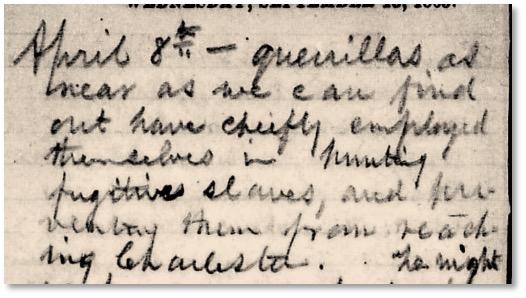
The whole regiment was ordered on a new expedition inland on April 3. On April 8, George wrote in his diary,
“We have learned from some of the slaves that a party of them had had a severe fight with the guerrillas infesting this neighborhood, and that quite a number were killed upon both sides. The slaves were trying to make their way to Charleston but they were all, however, killed or overpowered… The guerillas, as near as we can find out have chiefly employed themselves in hunting fugitive slaves...” .
| |
|
On April 11, the formerly enslaved followed the Union troops and “numbered fully twelve hundred, and their train was over a mile long. Some of them had oxen and some broken down and worn-out horses…. Stove pipe hats, jugs full of molasses, wooden buckets, picture frames, and all sorts of unimaginable things they have brought off with them. All these things they carry on their heads with the greatest ease and safety, and it is very hard to make them throw anything away.”
On April 13, George learned of his father’s presence in Charleston for the Fort Sumter celebration and on the 14th, “when about eight miles from the city we heard the booming of the cannon from all the fortifications and the navy about Charleston, which announced to us the raising of the United States flag over Sumter again by Major Anderson [the same man who lowered it four years before]. It sounded good to my ears and as we rested I listened long and attentively to it.” The same day, “News reached us this morning of the surrender of Gen. Lee with his whole army to Gen. Grant on the 9th.”
Even though they are in the same place, there seems to be miscommunication between father and son. George is told to expect his father in the morning and waits all day on the 15th, making sure his regiment is ready for the visit. His father arrives as night fell with a large entourage. The son wrote, “I was very glad to see him and he was to see me. Had no opportunity to have any conversation with him as his time was wholly taken up with looking and talking with the contrabands [the formerly enslaved].” They make a plan to meet later that night, but when George arrives at the hotel, his father is out. The next morning, “Left camp early this morning, and walked into town to see Father. Found him at the Charleston Hotel in the ladies parlor, and after waiting nearly an hour had an opportunity for a few minutes to talk with him.”
His diary makes it clear that he’s very sensitive to where his father’s attention is directed. As the child of a world-famous crusader, George likely struggled to live up to his father’s expectations; entering the Army against his wishes couldn’t have helped.
George got news that he’d been given a thirty-day furlough, spent a night with his father at the hotel, and writes happily about eating breakfast beside his father while being introduced to dignitaries. He is met with “a hearty greeting” by George Thompson, abolitionist from England and George’s namesake. “He seemed delighted and pleased to see me.” On the 17th, they boarded a ship to travel home and on the 18th, were told that Lincoln had been “stabbed” and “had been given up as past hope of recovery.” Later that day, while still at sea, they saw flags at half-mast, informing them that the President was dead.
Around this time at home in Roxbury, Garrison’s wife received this letter from her husband:
“As for our dear George, I have not yet seen him but expect to in the course of a few hours. He returned with his company last evening, from the interior, with 1200 slaves, now freemen. I understand he is in good health and long to embrace him, for your sake and mine.”
George would return to South Carolina after his furlough and was with the 55th when the unit was mustered out in Boston on August 29, 1865.
Kristen Fehlhaber is a genealogist, researcher, writer, and the former Assistant Director of the Museum of Old Newbury. She can be reached at kfehlhaber@gmail.com
3Charles Fox was with the 13th Mass. Infantry when he was wounded at Antietam. A civil engineer by training, he later designed a monument for the 2nd Mass. Infantry, the first permanent regimental monument on the Gettysburg battlefield. His brother Thomas B. Fox died from wounds at Gettysburg.
4Massachusetts Historical Society, George Thompson Garrison papers, 1836-1948, Regimental muster roll, 1863-1865 » Box OS Folder 4
5 "Letter from William Lloyd Garrison, Charleston, S.C, to Helen Eliza Garrison, April 15, 1865." https://ark.digitalcommonwealth.org/ark:/50959/cv43rs00g
| |
|
A Note of Thanks...
from Bethany Groff Dorau
| |
|
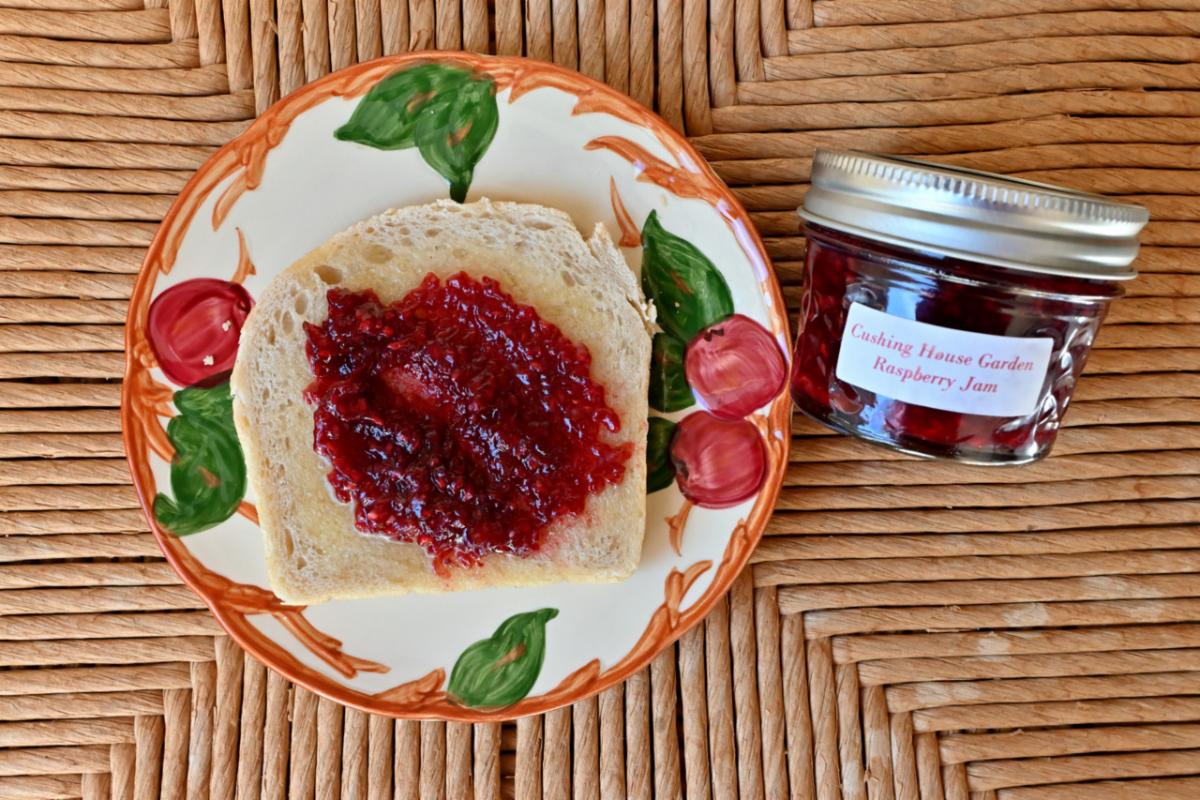
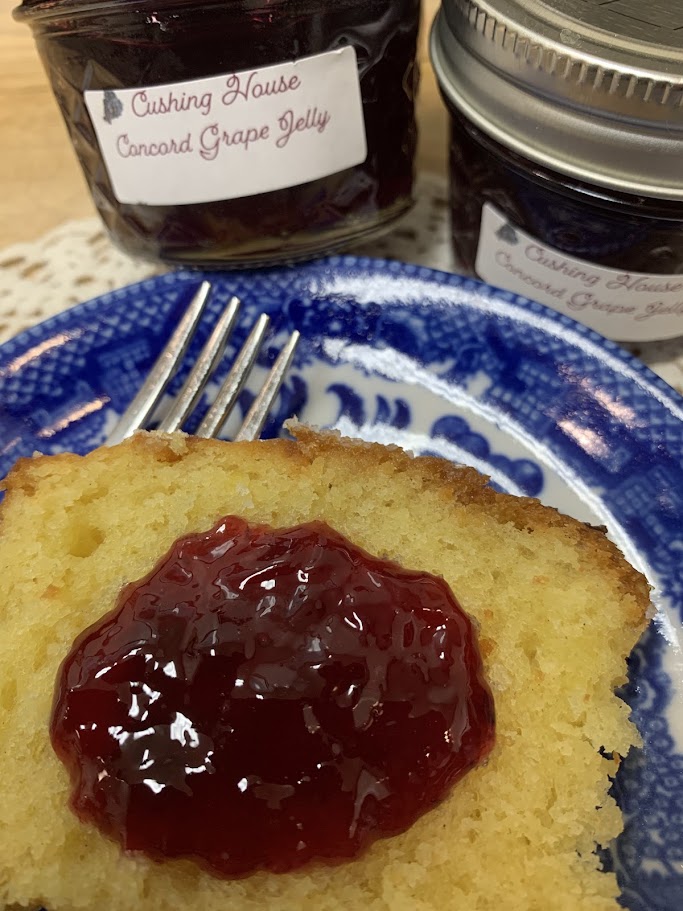
This image is another gift from board member and photographer Bob Watts. The image below is courtesy of operations manager Shelley Swofford.
Well, dear readers, this is the last newsletter before the Thanksgiving holiday, and I am taking stock of how fortunate I am. I have been the director of the Museum of Old Newbury for over three years now, and am still in awe of this place and the treasures and stories it holds. I am delighted at every turn.
In addition to the actual gifts - the family heirlooms, cherished collections, and memories that arrive daily, I am also the fortunate recipient of acts of kindness from people here. From board members who show up to help with anything we need, to neighbors who share their baked goods, to volunteers and colleagues who bring button collections, coffee, shortbread, postcards, keepsakes from trips abroad, hugs, emergency Diet Cokes...anything I need before I know I need it. This newsletter story is another gift - a much-needed assist from my friend and former office-mate Kristen.
Rather than count all my many blessings here with you today, I would like to share one (actually two) small gifts that are delighting me today.
For most of its long life, the Cushing House garden was not only decorative - it helped to feed the family. Board member and long-time volunteer Nancy Thurlow has worn many hats over the years here at the museum, but many of us know her best for her hard work in the garden, along with Margie Gillis and others. Under her careful management, the back garden is once again bearing fruit (and vegetables, for that matter).
This year, there were enough raspberries and grapes growing right here in our urban oasis that Nancy made both jam and jelly, to the delight of all who were lucky enough to be given a jar of the precious stuff. For me, the grape jelly was a trip back to my late childhood, savoring toast with my great-aunt Emily's jelly, made from the grapes that still grow in the pasture below the Poore house.
This time around, I spooned in onto lemon bread for breakfast and enjoyed a classic pb & j for lunch. Anyone who has made grape jelly knows that it takes time, and isn't time the greatest gift of all? So thank you, Nancy, and thanks to all of you who give your time to make this place so sweet.
Happy Thanksgiving to you all.
Now, because I can't help myself, here's a button if you want to make a gift of your own. :-)
| |
Something Is Always Cooking ... | |
|
Old Fashioned Molasses Gingerbread Cake
This cake is a favorite and easy to make last minute. No need for a kitchen mixer - the sugar and butter can be creamed by hand. Very fun to make with children and the aroma is hard to resist.
-Kristen
Ingredients:
2 cups all-purpose flour
2 teaspoons baking powder
1 teaspoon cinnamon
1 teaspoon powdered ginger, or 2t. stronger ginger flavor
½ teaspoon allspice
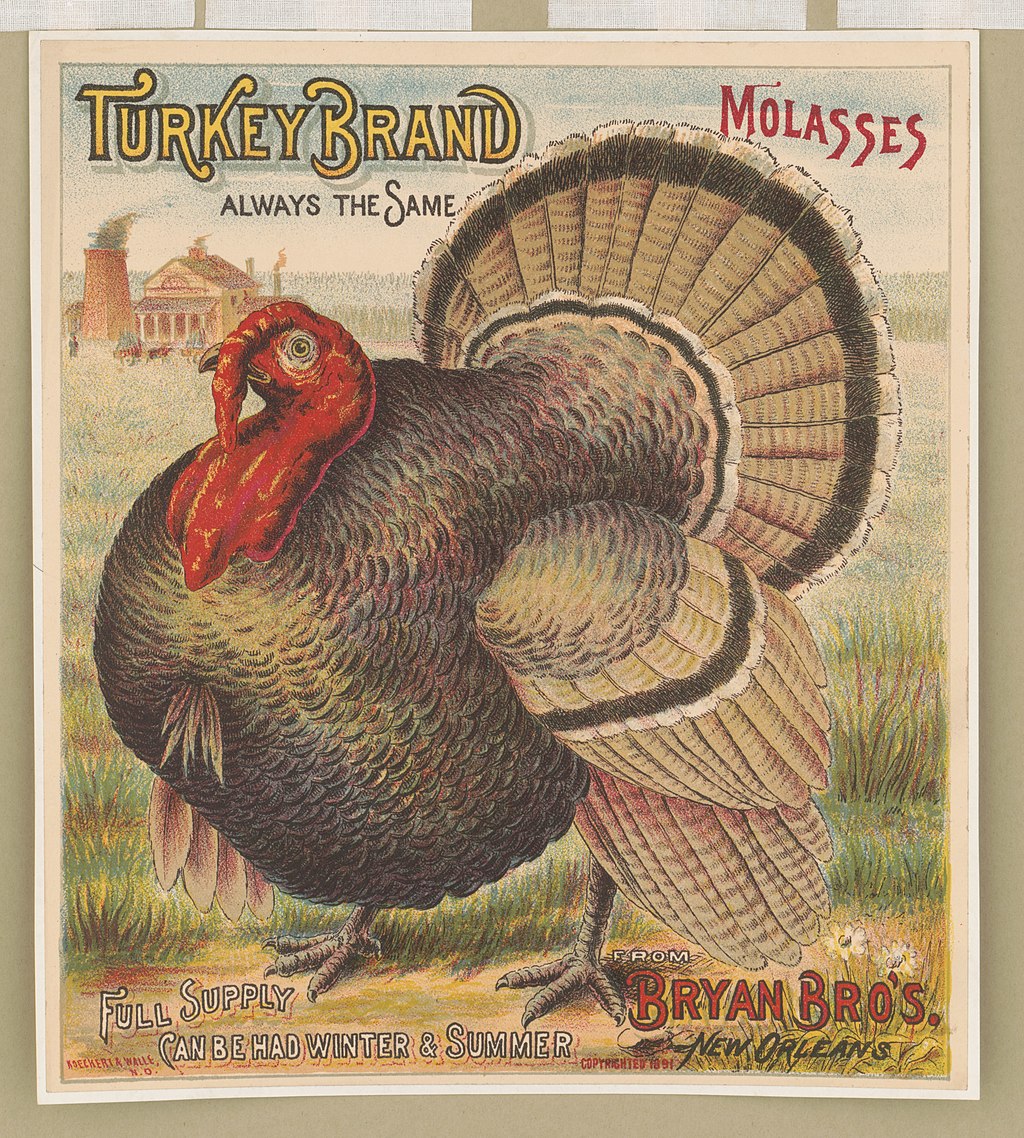
1 cup molasses (not blackstrap)
1 cup boiling water
½ cup packed brown sugar
8 tablespoons (1 stick) salted butter, cut into small chunks, softened (add 1/4 t. salt if using unsalted butter)
2 large or extra-large eggs, at room temperature
Instructions:
- Place a rack in the upper third of the oven and preheat the oven to around 365°F (set the dial halfway between 350°and 375°F). Generously grease an 8-inch square cake pan.
- Combine the flour, baking powder, and powdered spices in a medium bowl and mix well; set aside. Pour the molasses into a 2-cup measuring cup, add the boiling water, and stir to dissolve thoroughly. Set aside.
- Place the brown sugar and butter chunks in a large bowl and cream together with a wooden spoon, or a mixer. Briefly beat the eggs in another bowl, then stir them into the butter-sugar mixture. Add about ½ cup of the flour mixture and stir or beat in on low speed, then add about the same amount of warm molasses-water and stir. Continue to add the flour and liquid alternately, stirring or beating briefly each time. After the final addition, beat briefly (the batter will be quite liquid), then pour into the prepared pan.
- Bake for 25 minutes, then lower the heat to 350°F and bake until done, for 15 to 20 minutes longer, until a skewer inserted into the center comes out clean.
- Let cool in the pan for 20 minutes or more before serving. Serve from the pan with whipped cream.
| |
|
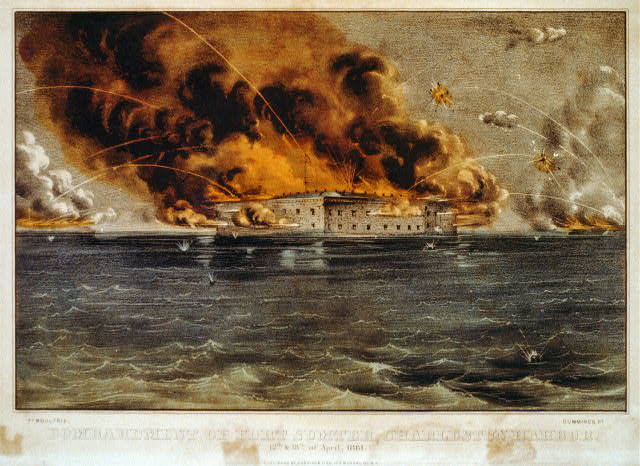
Fort Sumter, in the harbor of Charleston, South Carolina, continued to fly the U.S. flag, even as Confederate forces surrounded it. After negotiations failed, the first shot was fired on April 12, 1861, in a bombardment that resulted in the fort's surrender. Four years later, the U.S. flag was raised there again; according to his son’s diary, William Lloyd Garrison helped raise the flag.
Bombardment of Fort Sumter, Charleston Harbor: 12th & 13th of April, 1861, Currier and Ives. Collection of the Library of Congress.
Click the image to do the puzzle
| | |
Museum e-Newsletter made possible through the
generosity of our sponsors:
| |
| | | |