|
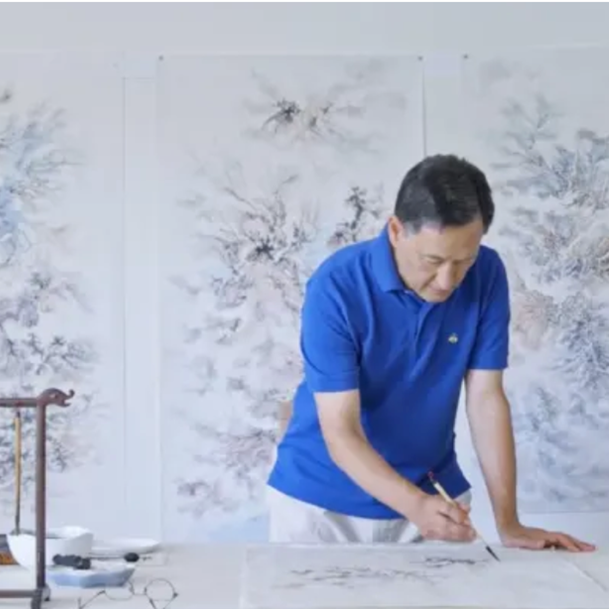
 The Department of History of Art, with support from the Institute for Chinese Studies, will present a painting demonstration by Arnold Chang, independent artist, on Thursday, February 9 from 9:35 a.m. to 10:55 a.m. online. Mr. Chang will present "A Demonstration of Chinese Painting Techniques, Discussion of Materials, and Q&A."
Abstract: A Chinese art curator, researcher, scholar, and teacher of Chinese painting and connoisseurship, Arnold Chang (b. 1954, New York City) applies the materials, tools and techniques that were widely used in China since the tenth century, and is dedicated to exploring the beauty of balance in water, ink, brushwork, and linear rhythm. While Chang’s painting technique adheres closely to tradition, his analysis of Chinese landscape painting is informed by the present. In 2010, in response to curator Hao Shen’s invitation to create a painting in dialogue with a work in the Boston Museum of Fine Art’s collection, Chang chose Jackson Pollack’s No. 10 (1949). Chang’s creation was exhibited alongside the Pollack, both lying flat in a case like a Chinese handscroll. Both works read well when viewed from any direction, and provided audiences with a visual pairing of Eastern and Western abstract art.
In his writing, Chang proposes that both the techniques of Chinese literati painting and western abstract expressionism possess a similar principle—fractal expression, Chinese painted landscapes’ tendency to be composed of forms within like forms. Hence, Chang analyzes orthodox Chinese painting from the lens of Western abstract expressionism. He explores the ever-changing viewpoint and angle of vision in Chinese landscape painting and argues that there is no fixed viewpoint, creating, instead, a non-directional image in space. In the realm of abstract expressionism, Chang still practices traditional Chinese literati painting’s principle of handling the brushwork in a balanced and fused manner while breaking away from the limitations of traditional compositional structure.
|



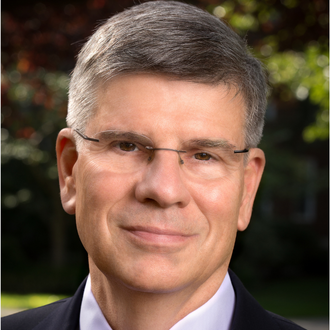
 The Institute for Chinese Studies will present a lecture by William C. Kirby, Harvard University, on Friday, March 3 from 4:00 p.m. to 5:30 p.m. at 150 Pomerene Hall. Prof. Kirby will present "Empires of Ideas: Creating the Modern University from Germany to America to China."


