|
 The Institute for Chinese Studies will present an online workshop featuring Jing Zhu, Xi'an Jiatong Liverpool University, and Megan Bryson, University of Tennessee, on Wednesday, February 9 from 6:30 pm. to 8:00 p.m. online (registration required). Profs. Zhu and Bryson will present "Gender and Regional Representation of Southwest China." Dorothy Noyes, The Ohio State University, will serve as moderator. Coordinated by Wenyuan Shao, Shanghai University.
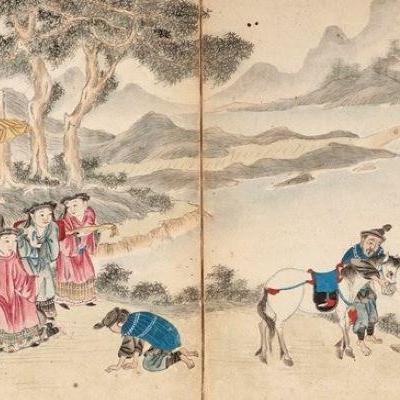
Abstract: "Representation of the Southwest Frontier: Visuality, Gender, and non-Han Bodies": This paper explores new ways to study the representation of Southwest China and it suggests visuality, gender and body are useful categories to understand Chinese imperial regimes in the frontier. Bringing the role of visuality to the fore, this paper explores imperial documentation of the Southwest borderlands beyond text, and highlights different sources of information. It draws on materials from different historical periods: Miao album, a genre of ethnographic illustrations depicting non-Han peoples and environment in late imperial China, and ethnographic photography and paintings during the second Sino-Japanese war period. Images pertaining the Southwest frontier were largely produced in both periods. Probing how the bodies and daily lives of non-Han peoples in the southwest were “translated’ in visual images, it emphasizes the significant role of gender norms in Han Chinese culture in the visual representation of non-Han bodies. By examining the intersections of visuality, gender and body, it seeks new ways to explore how imperial Power relationship of ethnicity is conveyed, popularized, and circulated in Chinese history.
Abstract: "Reading Obliquely: Gender and Ethnicity in the Historical Record": Scholars studying gender and ethnicity in contemporary China may adopt ethnographic methods to talk to people whose voices do not appear directly in historical sources. Though ethnography presents its own challenges, this presentation focuses instead on the challenges of reading gender and ethnicity from premodern sources. Using the example of the goddess Baijie in Yunnan’s history from the 12th to 20th centuries, I will discuss the issues involved in projecting discourses of ethnicity and gender into the past; the extent to which gendered and ethnic identification are legible in premodern sources; and interdisciplinary approaches that can draw out the voices of women and others who did not directly produce historical sources. “Reading obliquely” refers to the method of identifying these voices, or at least the discourses and material world they would have encountered and inhabited.
|