ECNV Newsletter:July
ECNV Boletín Informativo:Julio
| |
|
In this edition:
En esta edición:
[Image: Two little girls holding sparkling hand fireworks. Photo by Jacob Lund Photography from The Noun Project (https://thenounproject.com).]
[Imagen: Dos niñas pequeñas sosteniendo fuegos artificiales brillantes en la mano. Foto de Jacob Lund Photography de The Noun Project (https://thenounproject.com).]
| |
Nuestro boletín de noticias está disponible en Español, a continuación. Desplácese hacia abajo. | |
Americans with Disabilities Act (ADA) Anniversary | |
|
This is the fourth part of a series of articles celebrating ECNV’s 40th Anniversary. This article continues to focus on the people and events surrounding ECNV’s founding in April 1982.
By Doris Ray, Director of Advocacy
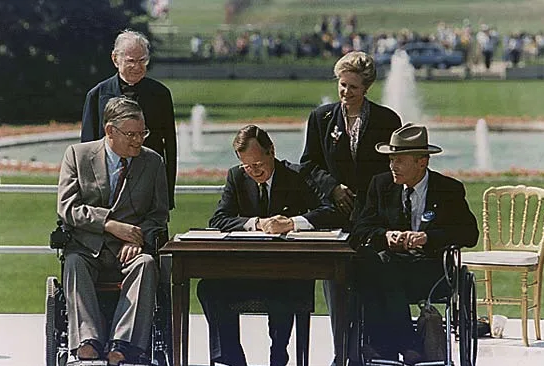
It dawned like no other day – Wednesday, July 26, 1990! Filled with joyful anticipation, I stood on the South Lawn of the White House, along with 2,000 others from all over the United States, waiting to witness President George H.W. Bush signed the Americans with Disabilities Act of 1990 into law.
Flooded with a myriad of thoughts and emotions, I was overcome with the sense I hadn’t come alone to this moment. My mother, my uncle, and my grandmother, all of whom were born blind, like me, were here with me in spirit! From an early age, the stories of the prejudice and discrimination they faced awakened my outrage and anger about the way society treated people with disabilities.
My own experience included exclusion from my neighborhood school and busing across town to segregated classes with other students with disabilities. At a state college after high school, I was offered an isolated, segregated dorm room reportedly because I’d be using readers and want to be alone. At the same college, another blind student, who had earned a 4.0 GPA, was refused student teaching needed to graduate and teach high school English because she could not see the chalkboard. She fought it and won, graduating summa cum laude.
Upon graduation from university, I sought my first job but encountered a gauntlet of barriers, including application forms that forced one to disclose one’s disability and interview appointments that were withdrawn upon arrival. Back then there was no recourse under the law.
I recalled my friends and colleagues being unable to enter government buildings, restaurants, grocery stores, pharmacies, movie theaters, and too many other places because they weren’t accessible. I bristled thinking of the downtown eatery that turned away one of my friends, saying that his cerebral palsy would offend other customers. I remembered my anger growing as I waited 3 hours with a visiting friend at Tysons Corner for a bus with a working lift while drivers either passed us by or claimed the lift was broken. I shivered thinking of waiting with a colleague during a snowstorm for nearly two hours for a lift bus she scheduled that never arrived.
I reflected on how we finally decided we’d had enough and organized as a cross-disability rights movement to advocate for our rights. It started in 1968 with returning Vietnam veterans and civilians with disabilities working to get a law requiring that all newly built or leased federal buildings and facilities be accessible.
Read More Here
| |
[Image: Historical moment, President George H.W. Bush signs ADA Act into Law on July 26, 1990]. | |
ECNV's I Am Self-Advocacy Program - Fall Session 2022 | |
|
This November will mark one year since ECNV launched the pilot for its I Am Self-Advocacy Program. Looking forward, we aim to offer program sessions quarterly throughout the year. We will continue to discuss fundamental topics integral to self-advocacy, while incorporating what we found the alumni students may want to learn more about.
The I Am Self-Advocacy Program is a Pre-Employment Transition Service (Pre-ETS) focused on helping students with disabilities, ages 16-22, learn about and hone their skills in self-advocacy. Participants discuss a range of topics such as self-awareness, disability awareness, self-determination, disability rights and responsibilities, how to be assertive, and how to engage allies and be an ally to others.
Students who complete the program leave with a greater understanding of how to advocate for themselves. One student commented, “I learned that it's okay to ask for help. Even if you don't think you need it. And that you need to speak up for yourself. Otherwise, people won't know what you need or want.” This program assists students in not only exploring their abilities, but also discovering their power to create change and use their voice.
Our Fall Session will begin September 26th and end December 2nd, with a week-long break for the Thanksgiving holiday. During the program, participants will meet virtually with a peer mentor once/week to discuss program topics and as well as on either Tuesdays or Wednesdays (4:15pm – 6:15pm) in a virtual group setting with their peers to learn from one another and build upon what they’ve discussed during the week in their individual sessions.
We are now accepting referrals for the Fall Session. Students interested in participating should talk to their special education teacher or Employment and Transition Representative (ETR) at their school for assistance. Alternatively, reach out to your local DARS office to get started. The referral deadline is September 16th. All referrals must come from DARS.
For more information about the program, please contact the Program Coordinator, Hannah Roberts at hannahr@ecnv.org or call ECNV's office number at 703-525-3268.
| [Image: Three circles overlapping each other with words Self Advocate in the center and words Motivated, Committed, and Passionate on each circle.] | |
I Am Self-Advocacy Program: Summer Session 2022 Recap | |
|
Soon, we will be concluding the Summer Session for our I Am Self-Advocacy Program. The I Am Self-Advocacy Program is a Pre-Employment Transition Service (Pre-ETS) focused on helping youth and young adults with disabilities, ages 16-22, learn about and hone their skills in self-advocacy. Participants discuss topics integral to self-advocacy such as self-awareness, disability awareness, self-determination, disability rights and responsibilities, how to be assertive, and how to engage allies and be an ally to others.
During the Summer Session, we condensed the usual 8-week program into 4 weeks of intense discussion and activity in the month of July. During this session, students met virtually and one-on-one with a peer mentor twice a week, virtually in a group setting twice a week, and virtually or in-person on Fridays for a leadership group.
On these Leadership Fridays, students from both cohorts had the opportunity to meet other students, listen to speakers, participate in extended and robust conversations on the topics of the week, and learn more about self-advocacy through peer discussions and activities. One of our speakers, Salifu Kamara, is an Independent Living Specialist at ECNV. As a survivor of war and poverty from Sierra Leone, Kamara was able to discuss with the students about their ability to create their own futures.
Angela Ramirez, an aspiring human rights advocate, spoke with the students about the start of her advocacy journey in high school where she spoke up for herself at her IEP meeting and for others by leading the charge to put in the first gender neutral bathroom at her school. Her passion for advocacy extended through college where she attended a human rights advocacy seminar and learned about advocacy on a larger scale, advocating on behalf of political prisoners in Bahrain and a political prisoner in the UAE.
During one of the last Fridays, Nancy Mercer from Inclusion Consultants, worked with the students to help them learn more about what constitutes a quality relationship, how to build healthy relationships, how to identify their personal rules, and how to communicate these effectively to others.
These speakers helped to solidify what the students learned in their individual sessions with their peer mentor and their group sessions with their peers as they further discussed the importance of self-determination, being assertive, and how to engage allies and be an ally to others. Through the program, one student came to the realization that “even if you have a disability, you can still be successful in life.” How strongly that rings true.
| |
Freedom to Travel the Metro | |
By Andrew Shaw, MS, CTRS, Program and Training Coordinator
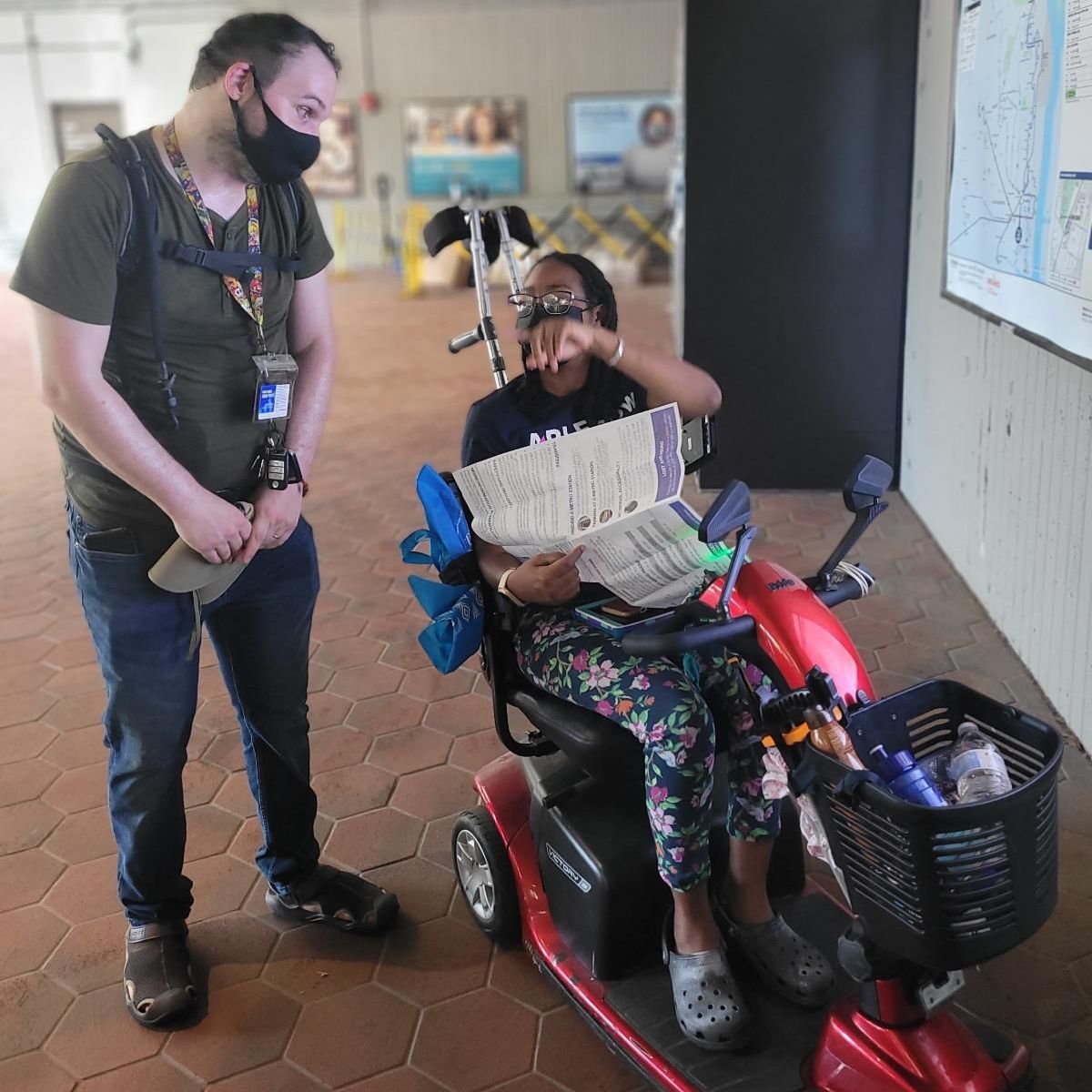
Are you tired of being tied to Metro Access where you have to make appointments and wait for your ride? Did you know that with a little orientation and training, you can make decisions about where you want to go and when you want to go by checking the schedule for the next bus or metro? ECNV’s Travel Training program for people with disabilities has taken off!
We are pleased to partner with the Washington Area Metropolitan Transit Authority (WMATA) to offer this service. ECNV’s Travel Training program offers individualized travel training on goals of your choosing to learn to use the Metro Rail, Metro Bus and local bus systems (i.e. Fairfax Connector or Alexandria Dash).
In Travel Training you will learn how to plan trips, take transit to where you want to go, and be safe while doing so. We also cover best practices. We know our area is cautiously opening up for business again and we encourage anyone interested to ask about travel training.
To sign up for ECNV’s Travel Training program, all you need to do is contact us at ECNV and express interest. To be eligible for Travel Training, you must have Disability Reduced Fare, Metro Access, or Senior Smart Trip (for anyone older than 65+). If you don’t already have one of these cards, we will help you apply for them as well. During this process, if you aren’t already an ECNV consumer, we will work with you to establish independent living goals including travel goals. Finally, with a little behind the scenes work (such as scouting out the area), we can begin the in person training.
In these summer months we are experiencing hotter than normal temperatures, so we do encourage everyone going out to please bring water, wear sunscreen, and bring what you need to be safe out there. We hope to see you out there.
| [Image: Travel Trainer Andrew Shaw with two people with disabilities, one male and the other female]. | |
Welcome to the ECNV Family! | |
We're excited to introduce new ECNV Board Member Susan Picerno. | |
|
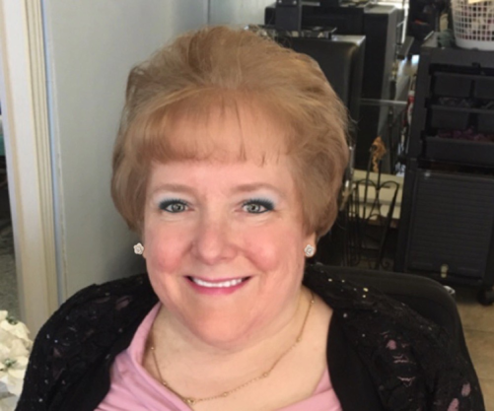
Susan Picerno believes that opportunities for people with disabilities are greatest when "all boats rise on the tide together." She dedicates her life to the equity and inclusion of people with disabilities, including those from intersectional groups. A graduate of the top graduate school for social work in the United States, Ms. Picerno has particular interest and expertise in asset development for the members of the disability community and in disability employment policy. She is a Commissioner twice over for the City of Alexandria: first as a vice-chair of the Alexandria Commission on Persons with Disabilities, and secondly, on the Alexandria Commission for Employment, Alexandria's workforce board. She currently works as a work incentives coordinator in southern Maryland and was previously staffed as an assistant secretary in a disability policy agency in the federal government. She sincerely hopes that young people with disabilities and those who are newly disabled realize what an asset they have in ECNV, the voice of the local disability community.
| [Image: Susan Picerno, a Caucasian woman with short sandy blonde hair wearing a black sweater over a pink blouse and jewelry.] | |
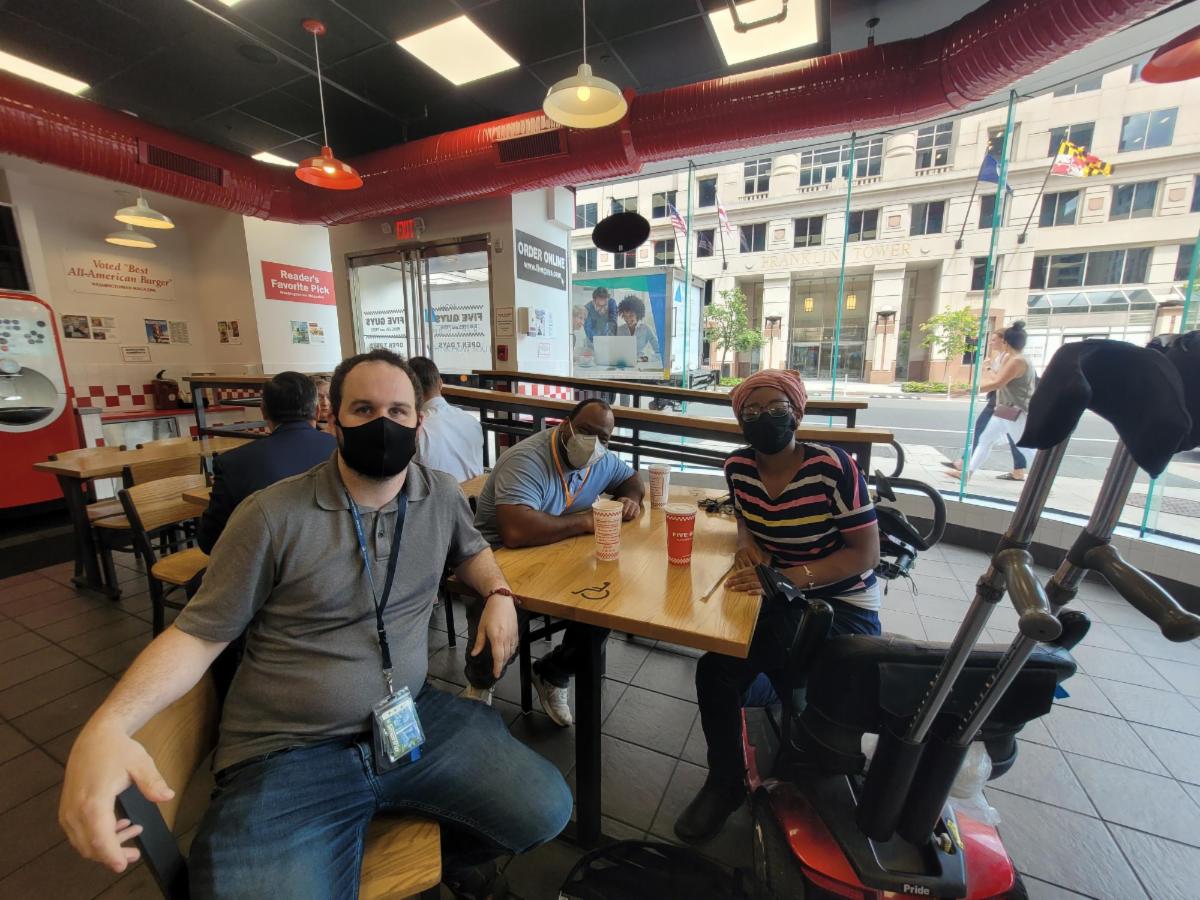
ENCV outreach team and Trusted Disability Champions were around town in promoting our programs and vaccination popups for people with disabilities. | |
Celebrating 32 Years of the Americans with Disabilities Act | |
|
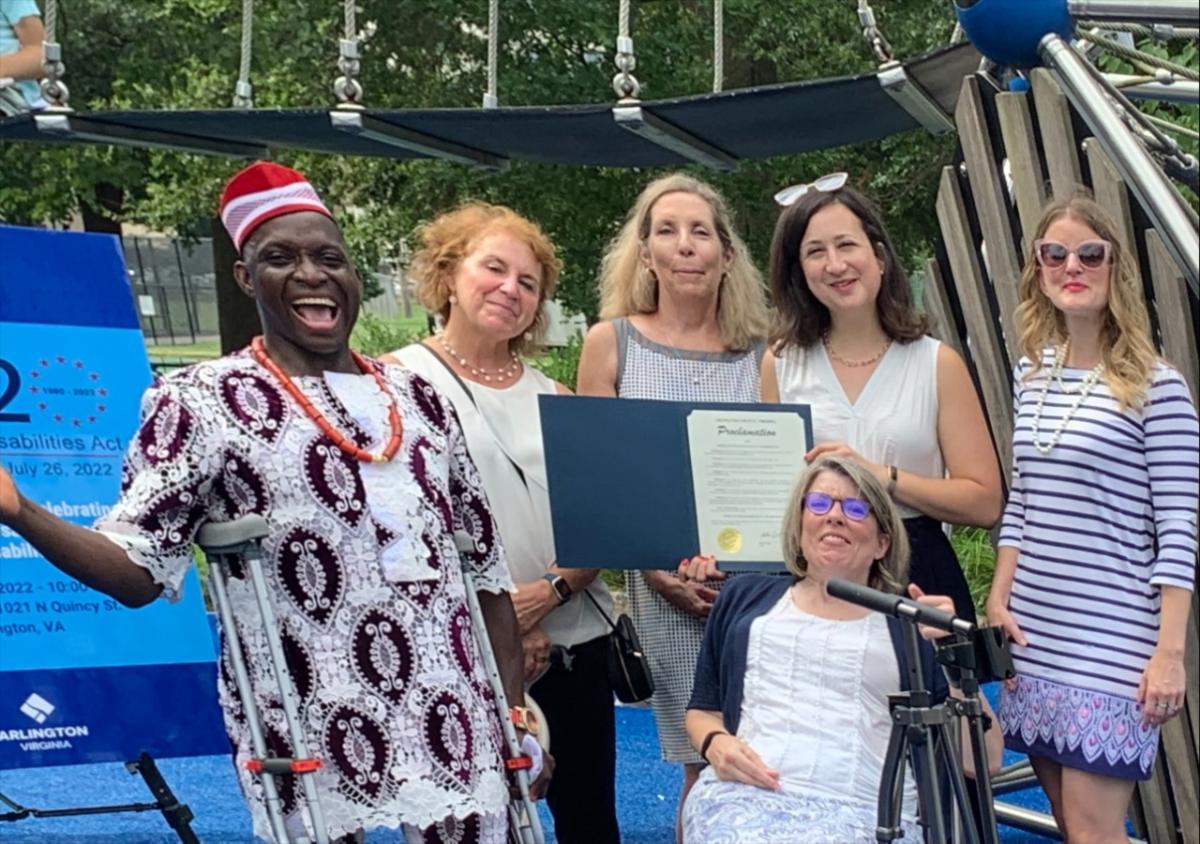
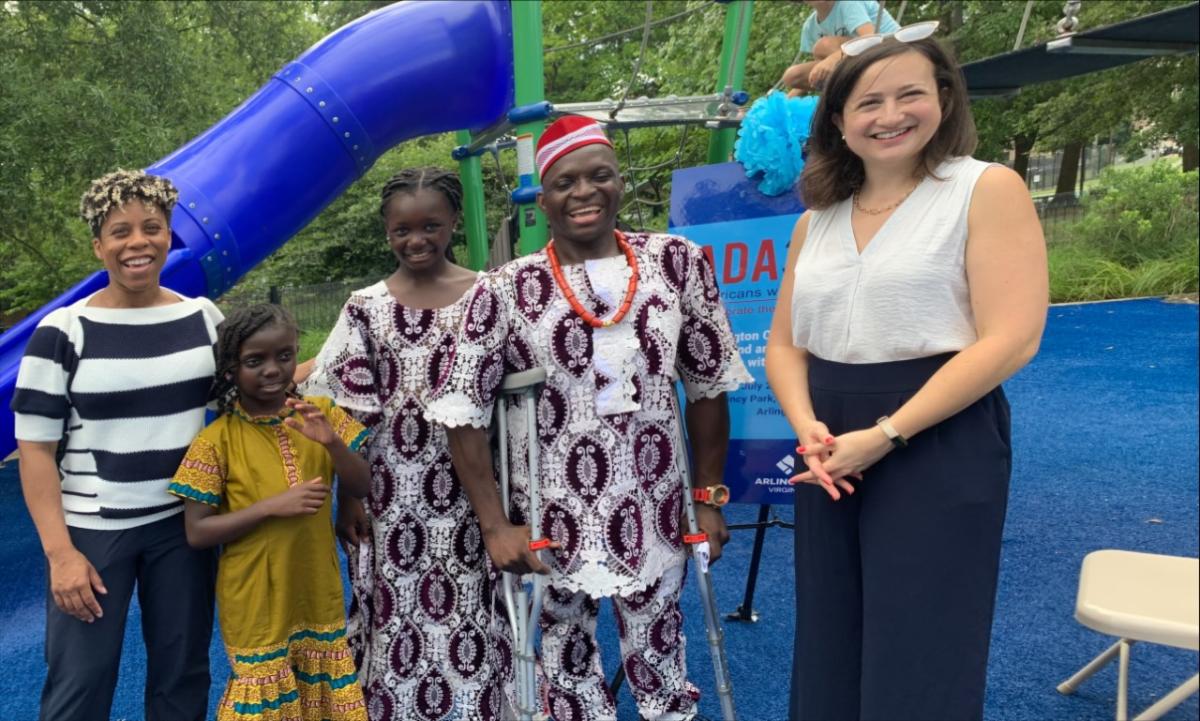
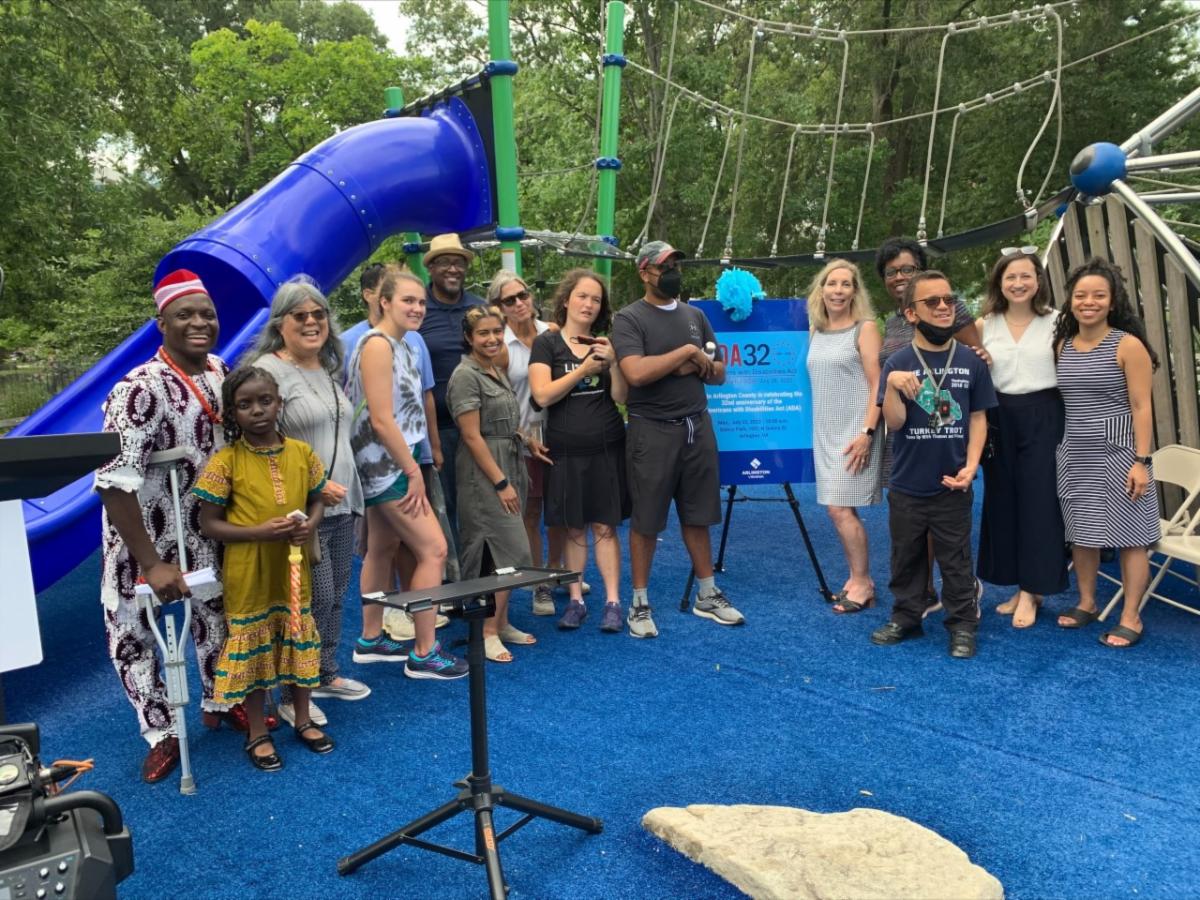
Arlington County officials and key stakeholders from several organizations providing services and resources to people with disabilities celebrated the 32nd anniversary of the Americans with Disabilities Act (ADA) at a new Quincy Park playground built to accommodate all types of abilities. This event and resources for people with disabilities to Live, Work and Play are featured in a special edition newsletter from Arlington County.
| |
[Image (Left to right): Salifu Kamara, ECNV Independent Living Specialist, Susan Kalish, LEAD: Arlington Disability Employee Resource Group, Wendy Crawford, Chair of the Arlington County Community Services Board, Elizabeth Priauxl, Chair, Arlington County Disability Advisory Commission, Katie Cristol, Chair, Arlington County Board, and Lucy Beadnell, Director of Advocacy, Arc of Northern Virginia.] | |
[Image (Left to right): Dominique Dunford-Lack, ECNV Executive Director, Salifu Kamara with daughters, Joana and Yolanda and County Board Chair Katie Cristol.] | |
[Image (Left to right): Some of the celebrants at the ADA 32nd Anniversary Celebration included friends from Our Stomping Ground, Arlington County Board Member, Christian Dorsey, La Voyce Reid, Bureau Director, Developmental Disability Services, and Adele McClure, Executive Director of the Virginia Black Caucus..] | |
See us at Arlington County Fair! | |
|
ECNV will be at the Arlington County Fair – that boasts to be one of the largest FREE events on the East Coast. We will be located inside with the other indoor exhibitors at the following dates and times:
Friday, August 19th 4:00pm – 10:00pm
Saturday, August 20th from 10:00am – 9:00pm
Sunday, August 21st from 11:00am – 7:00pm
We will be there to share information about services ECNV provides such as Medicaid Waiver services, Travel Training, Independent Life Skills training, as well as advocacy. Our corner booth will have free merch giveaways, and candy. You can learn how we can help you or someone you know, of any age with a physical, mental, or learning disability.
Come stop by and say hi!
| [Image: Arlington County Fair spelled out in colorful letters with a big Ferris wheel in the background against a dark blue sky]. | |
988 Mental Health Crisis Line is Live in the Region, and Nationwide! | |
|
The 988 crisis line is now up and running in Northern Virginia and in every community nationwide. Every person can dial “988” to reach trained crisis counselors who can help in a mental health, substance use or suicide crisis. What's easier in crisis - 10 digits or 3?
Anyone can contact "988" during a mental health crisis and be connected with a trained crisis counselor who can listen, provide support, deescalate the situation, and connect you to additional resources that might help. The Lifeline can respond to any type of mental health crisis or emotional distress. It's free, confidential, and open to a person in crisis OR someone calling on behalf of another.
Read here to find out more about the 988 line and other crisis resources in the Northern Virginia area.
| [Image: A Hispanic girl wearing a light blue sweater texting 988 on her phone. 988 24/7 Crisis and Support campaign information]. | |
Long COVID and Disability Protections | |
|
Post-COVID Syndrome or Long COVID occurs when someone still has COVID-19 symptoms or long covid symptoms, long after the typical recovery period from COVID-19. Most people recover within a few weeks of getting COVID; Long COVID occurs when those symptoms don’t go away and don’t seem to be getting better.
Long COVID symptoms can include the typical COVID-19 Symptoms like Fatigue, fever, difficulty breathing, shortness of breath, and a cough. Other Post-COVID Syndrome symptoms include; joint/muscle pain, brain (neurological) symptoms (trouble concentrating or thinking, headaches, dizziness, loss of smell or taste, anxiety, or depression), heart symptoms (chest pain), stomach pain, blood clots, rashes, or changes in your menstrual cycle.
Long COVID is very common; about 1 in 5 people 18-64, and 1 in 4 people 65 and older has a medical condition that COVID-19 could cause. There is a higher risk for Post-COVID Syndrome if you had a more severe case of COVID-19, but it can also happen to people who had a mild case or no symptoms at all; check the CDC website, for more information.
Some people are at increased risk of getting sick from COVID-19 because of where they live or work, or because they can’t get health care. Health inequities may put some people from racial or ethnic minority groups and some people with disabilities at greater risk for developing post-COVID conditions. Scientists are researching some of those factors that may place these communities at higher risk of both getting infected or developing post-COVID conditions. The best way to prevent Post-COVID Syndrome is to get the COVID-19 vaccine and booster shots.
In light of the rise of long COVID as a persistent and significant health issue, the Office for Civil Rights of the Department of Health and Human Services and the Civil Rights Division of the Department of Justice issued Guidance on “Long COVID” as a Disability Under the ADA, Section 504, and Section 1557. Each of these federal laws protects people with disabilities from discrimination. This guidance also provides resources for additional information and best practices.
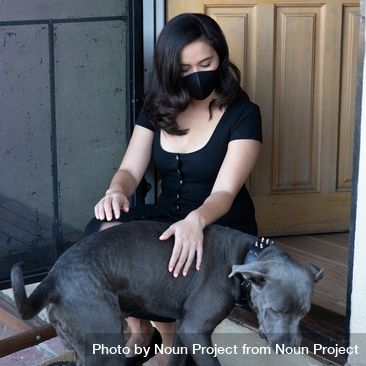
| [Image: Woman sitting at doorstep with mask on petting her dog. Photo by The Noun Project (https://thenounproject.com).] | |
Air Traveler Bill of Rights | |
|
This month, the U.S. Department of Transportation issued an Airline Passengers with Disabilities Bill of Rights. What rights do you have as an airline passenger with disabilities?
- The Right to be Treated with Dignity and Respect
- The Right to Receive Information About Services and Aircraft Capabilities and Limitations
- The Right to Receive Information in an Accessible Format
- The Right to Accessible Airport Facilities
- The Right to Assistance at Airports
- The Right to Assistance on the Aircraft
- The Right to Travel with an Assistive Device or Service Animal
- The Right to Receive Seating Accommodations
- The Right to Accessible Aircraft Features
- The Right to Resolution of a Disability-Related Issue
This document will be updated. So, check the Bill of Rights before you travel to see if they have added ways to make traveling easier for you.
The Bill of Rights applies to Individuals with a disability who have a physical or mental impairment that permanently or temporarily impacts a major life activity such as walking, hearing, or breathing.
The Bill of Rights applies to all flights in the United States and all flights into or out of the United States. If airlines contract out some of their positions, those people are still held to the same standards, and the airlines are held responsible for the action or inaction of any contractors they have hired.
| [Image: Airplane at gate viewed through large window with panes at airport. Photo by Rosley Majid from The NounProject (https://thenounproject.com).] | |
|
The social groups are run by ECNV Staff. These fun gatherings are a great time for connecting, sharing and often take place over a good meal. Perhaps you'll make a new friend, and with lots of pandemic mandates being lifted, it's a perfect time to come back out. For more information, contact Ruchika Lalwani.
August 5 – TGIF Social Group at Silver Diner at 3200 Wilson Blvd, Arlington ,VA 22201 from 5:00 – 7:00 pm
August 19 – The ENDependents Social Group (virtual) from 4:00 – 6:00 pm
[Image: Group of people toasting drinks at table with whole fish plates, side dishes, vertical composition. Photo by Anna Ivanova from The Noun Project at https://www.thenounproject.com.]
| |
Don't forget to support ECNV by shopping at AmazonSmile!
AmazonSmile is a simple and automatic way for you to support your favorite charitable organization every time you shop, at no cost to you. When you shop at AmazonSmile, you’ll find the exact same low prices, vast selection and convenient shopping experience as Amazon.com, with the added bonus that Amazon will donate a portion of the purchase price to ECNV.
[Image: Words Amazon in black with a half arrow smile and the words smile in orange. Under it the words "You shop. amazon gives."]
| |
Nuestro boletín de noticias está disponible en Español, a continuación. Desplácese hacia abajo. | |
Aniversario de la Ley de Estadounidenses con Discapacidades (ADA) | |
|
Esta es la cuarta parte de una serie de artículos que celebran el 40 aniversario de ECNV. Este artículo continúa centrándose en las personas y los eventos que rodearon la fundación de ECNV en abril de 1982.
Por Doris Ray, Directora de Abogacía
¡Amaneció como ningún otro día: el miércoles 26 de julio de 1990! Lleno de alegre anticipación, me paré en el jardín sur de la Casa Blanca, junto con otras 2,000 personas de todo Estados Unidos, esperando presenciar cómo el presidente George H.W. Bush firmó, haciendo la Ley De Americanos con Deseabilidades de 1990.
Inundado con una miríada de pensamientos y emociones, me invadió la sensación de que no había llegado solo a este momento. ¡Mi madre, mi tío y mi abuela, todos los cuales nacieron ciegos, como yo, estaban aquí conmigo en espíritu! Desde una edad temprana, las historias de los prejuicios y la discriminación que enfrentaron despertaron mi indignación y enojo por la forma en que la sociedad trataba a las personas con discapacidades.
Mi propia experiencia incluyó la exclusión de la escuela de mi vecindario y el transporte en autobús de la ciudad a clases segregadas con otros estudiantes con discapacidades. En una universidad estatal después de la escuela secundaria, me ofrecieron un dormitorio aislado y segregado, según los informes, porque estaría usando lectores y querría estar sola. En la misma universidad, a otra estudiante ciega, que había obtenido un GPA de 4.0, se le negó la enseñanza estudiantil necesaria para graduarse y enseñar inglés en la escuela secundaria porque no podía ver la pizarra. Ella luchó y ganó, graduándose summa cum laude.
Al graduarme de la universidad, busqué mi primer trabajo, pero me encontré con un guantelete de barreras, incluidos los formularios de solicitud que obligaban a revelar su discapacidad y las citas de entrevista que se retiraban al llegar a ellas. En aquel entonces no había ningún recurso bajo la ley.
Leer más aquí.
[Imagen: Momento histórico, el presidente George H.W. Bush firma la Ley ADA el 26 de julio de 1990].
| |
Programa I Am Self-Advocacy de ECNV - Sesión de otoño 2022 | |
|
Este mes de noviembre se cumplirá un año desde que ECNV lanzó el piloto de su Programa de I Am Self-Advocacy. Mirando hace al futuro, nuestro objetivo es ofrecer sesiones de programa trimestrales durante todo el año. Continuaremos discutiendo temas fundamentales como parte integral de la autodefensa, al tiempo que incorporamos lo que encontramos que los estudiantes de exalumnos pueden querer aprender más.
El Programa de I Am Self-Advocacy es un Servicio de Transición Pre-Empleo (Pre-ETS) enfocado en ayudar a los estudiantes con discapacidades, de 16 a 22 años, a conocer y perfeccionar sus habilidades en abogacía personal. Los participantes discuten una variedad de temas como la autoconciencia, la conciencia de la discapacidad, la autodeterminación, los derechos y responsabilidades de las personas con discapacidad, cómo ser asertivo y cómo involucrar a los aliados y ser un aliado de los demás.
Los estudiantes que completan el programa se van con una mayor comprensión de cómo abogar por sí mismos. Un estudiante comentó: "Aprendí que está bien pedir ayuda. Incluso si crees que no lo necesitas. Y que necesitas hablar pornosotros mismos. De lo contrario, la gente no sabrá lo que necesitas o quieres". Este programa ayuda a los estudiantes no solo a explorar sus habilidades, sino también a descubrir su poder para crear cambios y usar su voz.
Nuestra sesión de otoño es del 26 de septiembre al 2 de diciembre, con un descanso de una semana para las vacaciones de Acción de Gracias. Los participantes se reunirán virtualmente con un mentor una vez a la semana para discutir temas del programa y también los martes o miércoles (4:15 pm - 6:15 pm) en un entorno de grupo virtual con sus compañeros para aprender unos de otros y aprovechar lo que han discutido durante la semana en sus sesiones individuales.
Ahora estamos aceptando referencias para la Sesión de Otoño. Los estudiantes interesados en participar deben hablar con su maestro de educación especial o Representante de Empleo y Transición (ETR) en su escuela para obtener ayuda. Alternativamente, comuníquese con su oficina local de DARS para comenzar. La fecha límite de referencia es el 16 de septiembre. Todas las referencias deben provenir de DARS.
Para obtener más información sobre el programa, comuníquese con la Coordinadora del Programa, Hannah Roberts, al hannahr@ecnv.org o llame al número de la oficina de ECNV al 703-525-3268.
| |
[Imagen: Tres círculos que se superponen entre sí con palabras Self Advocate en el centro y palabras Motivado, Comprometido y Apasionado en cada círculo.] | |
Programa I Am Self-Advocacy: Resumen de la Sesión de Verano 2022 | |
|
Pronto, concluiremos la Sesión de Verano para nuestro Programa de I Am Sel-Advocacy. El Programa de I Am Self-Advocacy es un Servicio de Transición Pre-Empleo (Pre-ETS) enfocado en ayudar a jóvenes y adultos jóvenes con discapacidades, de 16 a 22 años, a aprender y perfeccionarsus habilidades en autodefensa. Los participantes discuten temas integrales para la autodefensa, como la autoconciencia, la conciencia de la discapacidad, la autodeterminación, los derechos y responsabilidades de las personas con discapacidad, cómo ser asertivo y cómo involucrar a los aliados y ser un aliado de los suyos.
Durante la sesión de verano, condensamos el programa habitual de 8 semanas en 4 semanas de intensa discusión y actividad en el mes de julio. Durante esta sesión, los estudiantes se reunieron virtualmente y uno a uno con un mentor de pares dos veces por semana, virtualmente en un entorno grupal dos veces por semana, y virtualmente o en persona los viernes para un grupo de liderazgo.
En estos Viernes de Liderazgo, los estudiantes de ambas cohortes tuvieron la oportunidad de conocer a otros estudiantes, escuchar a los oradores, participar en conversaciones extensas y sólidas sobre los topics de la semana, y aprender más sobre la autodefensa a través de discusiones y actividades entre pares. Uno de nuestros oradores, Salifu Kamara, es especialista en vida independiente en ECNV. Como sobreviviente de la guerra y la pobreza de Sierra Leona, Kamara pudo discutir con los estudiantes sobre su capacidad para crear su propio futuro.
Angela Ramírez, una aspirante a defensora de los derechos humanos, habló con los estudiantes sobre el inicio de su viaje de defensa en la escuela secundaria, donde habló por sí misma en su reunión del IEP ypor otros al liderar la acusación de poner el primer baño de género neutral en su escuela. Su pasión por la defensa se extendió a través de la universidad, donde asistió a un seminario de defensa de los derechos humanos y aprendió sobre la defensa a mayor escala, abogando por el nacimientode los presos políticos en Bahrein y un preso político en los Emiratos Árabes Unidos.
Durante uno de los últimos viernes, Nancy Mercer de Inclusion Consultants, trabajó con los estudiantes para ayudarlos a aprender más sobre lo que constituye una relación de calidad, cómo construirrelaciones saludables, cómo identificar sus reglas personales y cómo comunicarlas de manera efectiva a los demás.
Estos oradores ayudaron a solidificar lo que los estudiantes aprendieron en sus sesiones individuales con su mentor de pares y sus sesiones grupales con sus compañeros a medida que discutían más a fondo la importancia de la autodeterminación, ser asertivos y cómo involucrar a los aliados y ser un aliado para los demás. A través del programa, un estudiante se dio cuenta de que "incluso si tiene una discapacidad, puedetener éxito en la vida". Qué tan fuerte suena eso cierto.
Consumidores de ECNV fuera de casa.
| |
Libertad para viajar en metro | |
Por Andrew Shaw, MS, CTRS, Coordinador de Programas y Capacitación
¿Estás cansado de estar atado a Metro Access donde tienes que hacer sitas y esperar tu viaje? ¿Sabías que con un poco de orientación y capacitación, puedes tomar decisiones sobre a dónde quieres ir y cuándo quieres ir consultando el horario para el próximo autobús o metro? ¡El programa de capacitación en viajes de ECNV para personas con discapacidad esha despegado!
Nos complace asociarnos con la Autoridad de Tránsito Metropolitano del Área de Washington (WMATA) para ofrecer este servicio. El programa de capacitación en viajes de ECNV ofrece capacitación individualizada en viajes sobre los objetivos de su elección para aprender a usarlos sistemas de Metro Rail, Metro Bus y autobuses locales (es decir, Fairfax Connector o Alexandria Dash).
En Travel Training aprenderá cómo planificar viajes, tomar el transporte público a donde desea ir y estar seguro mientras lo hace. También cubrimos las mejores prácticas. Sabemos que nuestra área se está abriendo cautelosamente para los negocios nuevamente y alentamos a cualquier persona interesada a preguntar sobre la capacitación en viajes.
Para inscribirse en el programa de capacitación en viajes de ECNV, todo lo que necesita hacer es contactarnos en ECNV y expresar su interés. Para ser elegible para Travel Training, debe tener una tarifa reducida por discapacidad, acceso a Metro o viaje inteligente para personas mayores de 65 años (para mayores de 65 años). Si aún no tiene una de estas tarjetas, también lo ayudaremos a solicitarlas. Durante este proceso, si aún no es un consumidor de ECNV, trabajaremos con usted para establecer objetivos de vida independiente, incluidos los objetivos de viaje. Finalmente, con un poco de trabajo detrás de escena (como explorar el área), podemos comenzar el entrenamiento en persona.
En estos meses de verano estamos experimentandotemperaturas más cálidas y normales, por lo que alentamos a todos los que salgan a traer agua, usar protector solar y traer lo que necesitan para estar seguros. Esperamos verte por ahí.
[Image: Travel Trainer Andrew Shaw with two people with disabilities, one male and the other female].
| |
¡Bienvenido a la familia ECNV! | |
|
Estamos muy contentos de presentar nuevos Campeones de Discapacidad de Confianza a la familia ECNV.
[Imagen: Entrenamiento de viajes del Coordinador de Programa y Capacitación Andrew Shaw con Janeek Prince a través de su estación de metro local.]
| |
|
Susan Picerno cree que las oportunidades para las personas con discapacidades son mayores cuando "todos los barcos se elevan juntos en la marea". Dedica su vida a la equidad e inclusión de las personas con discapacidad, incluidas las de grupos interseccionales. Graduada de la mejor escuela de posgrado en trabajo social en los Estados Unidos, la Sra. Picerno tiene un interés particular y experiencia en el desarrollo de activos para los miembros de la comunidad de discapacitadosy en la política de empleo de personas con discapacidad. Es comisionada dos veces para la Ciudad de Alejandría: primero como vicepresidenta de la Comisión de Alejandría sobre Personas con Discapacidades, y en segundo lugar, en la Comisión de Alejandría para el Empleo, la junta de trabajo de Alejandría. Actualmente trabaja como coordinadora de incentivos laborales en el sur de Maryland y anteriormente trabajó como secretaria adjunta en una agencia de políticas de discapacidad en el gobierno federal. Ella espera sinceramente que los jóvenes con discapacidades ylos que están recién discapacitados se den cuenta del activo que tienen en ECNV, la voz de la comunidad local de discapacitados.
[Imagen: Susan Picerno, una mujer caucásica de mediana edad con cabello rubio arena corto que usa un suéter negro sobre una blusa rosa y joyas.]
| |
ECNV Alrededor de La Ciudad | |
El equipo de divulgación de ENCV y Trusted Disability Champions estuvieron en la ciudad promocionando nuestros programas y ventanas emergentes de vacunación para personas con discapacidades. | |
Celebrando los 32 años de la Ley de Estadounidenses con Discapacidades | |
|
Funcionarios del Condado de Arlington y partes interesadas clave de varias organizaciones que brindan servicios y recursos a personas con discapacidades celebraron el 32 aniversario de la Ley de Estadounidenses con Discapacidades (ADA) en un nuevo patio de recreo de Quincy Park construido para acomodar todo tipo de habilidades. Este evento y los recursos para que las personas con discapacidades vivan, trabajen y jueguen se presentan en un boletín de edición especial del condado de Arlington.
| |
[Imagen (de izquierda a derecha): Salifu Kamara, Especialista en Vida Independiente de ECNV, Susan Kalish, LEAD: Arlington Disability Employee Resource Group, Wendy Crawford, Presidenta de laJunta de Servicios Comunitarios del Condado de Arlingto n, Elizabeth Priauxl, Presidenta, Comisión Asesora de Discapacidad del Condado de Arlington, Katie Cristol, Presidenta, Junta del Condado de Arlington, y Lucy Beadnell, Directora de Defensa, Arc of Northern Virginia.] | |
[Imagen (de izquierda a derecha): Dominique Dunford-Lack, Director Ejecutivo de ECNV, Salifu Kamara con sus hijas, Joana y Yolanda, y la Presidenta de la Junta del Condado Katie Cristol.] | |
[Imagen (de izquierda a derecha): Algunos de los celebrantes en la Celebración del32º Aniversario de la ADA incluyeron amigos de Our Stomping Ground,; Christian Dorsey, miembro de la Junta del Condado de Arlington; La Voyce Reid, Directora de la Oficina, Servicios de Discapacidades del Desarrollo; y Adele McClure, Directora Ejecutiva del Virginia Black Caucus.] | |
¡Visítenos en la Feria del Condado de Arlington! | |
|
ECNV estará en la Feria del Condado de Arlington, que se jacta de ser uno de los eventos GRATUITOS más grandes de la costa este. Venga a visitarnos y refrésquese en el interior con los otros expositores de interioren las siguientes fechas y horarios:
- Viernes, 19 de agosto 4:00pm – 10:00pm
- Sábado, 20 de agosto de 10:00am – 9:00pm
- Domingo, 21 de agosto de 11:00am – 7:00pm
Estaremos ahí para compartir información sobre los servicios que proporciona ECNV, como los servicios de exención de Medicaid, capacitación en viajes, capacitación en habilidades para la vida independiente, así como defensa. Nuestro stand de la esquina tendrá regalos de merchandising gratuitos y dulces. Puede aprender cómo podemosayudarlo a usted o a alguien que conoce, de cualquier edad con una discapacidad física, mental o de aprendizaje.
¡Ven y pasa a saludarnos!
[Imagen: Feria del Condado de Arlington deletreada en letras coloridas con una gran noria en el fondo contra un cielo azul oscuro].
| |
¡La línea de crisis de salud mental 988 está disponible en la región y en todo el país! | |
|
¡La línea de crisis de salud mental 988 está disponible en la región y en todo el país!
La línea de crisis 988 ahora está en funcionamiento en el norte de Virginia y en todas las comunidades de todo el país. Cada persona puede marcar "988" para comunicarse con consejeros de crisis capacitados que pueden ayudar en una crisis de salud mental, uso de sustancias o suicidio. ¿Qué es más fácil en una crisis: 10 dígitos o 3?
Cualquier persona puede comunicarse con "988" durante una crisis de salud mental y conectarse con un consejero de crisis capacitado que pueda escuchar, brindar apoyo, desescalar la situación y conectarlo con recursos adicionales que podrían ayudarlo. La línea de vida puede respondera cualquier tipo de crisis de salud mental o angustia emocional. Es gratuito, confidencial y abierto a una persona en crisis O a alguien.
Lea más para obtener más información sobre la línea 988 y otros recursos de crisis en el área del norte de Virginia.
Es una emergencia. ¿Debo llamar al 988 o al 911?
Leer más aquí.
[Imagen: Una niña hispana con un suéter azul claro enviando mensajes de texto al 988 en su teléfono. 988 24/7 Información de la campaña crisis y apoyo].
| |
Covid largo o síndrome post-COVID | |
|
Entonces, ¿qué es el síndrome Post-COVID?
El síndrome post-COVID o COVID largo ocurre cuando alguien todavía tiene síntomas de COVID-19 o síntomas largos de covid, mucho después del período de recuperación típico de COVID-19. La mayoría de las personas se recuperan a las pocas semanas de contraer COVID; El COVID prolongado ocurre cuando esos síntomasno desaparecen y no parecen estar mejorando.
Los síntomas de COVID largos pueden incluir los síntomas típicos de COVID-19 como fatiga, fiebre, dificultad para respirar, dificultad para respirar y tos.
Otros síntomas del síndrome post-COVID incluyen; dolor articular/muscular, síntomas cerebrales (neurológicos) (dificultad para concentrarse o pensar, dolores de cabeza, mareos, pérdida del olfato o del gusto, ansiedad o depresión), síntomas cardíacos (dolor en el pecho), dolor de estómago, coágulos de sangre, erupciones cutáneas o cambios en el ciclo menstrual.
El COVID largo es muy común; aproximadamente 1 de cada 5 personas de 18 a 64 años, y 1 de cada 4 personas de 65 años o más tiene una afección médica que COVID-19 podría causar; según la Clínica Mayo, haga clic aquí para obtener más información. Existe un mayor riesgo de síndrome post-COVID si tuvo un caso más grave de COVID-19, pero también puede sucederles a personas que tuvieron un caso leve o ningún síntoma; consulte el sitio web de los CDC, vinculado aquí para obtener más información.
Es importante recordar que muchos síntomas del síndrome post-COVID también podrían deberse a una condición de salud diferente. Si cree que puede tenersíndrome post-COVID, la mejor manera de averiguarlo sería ir a su proveedor de atención médica.
La mejor manera de prevenir el síndrome post-COVID es recibir la vacuna COVID-19 y las vacunas de refuerzo.
[Imagen: Mujer sentada en la puerta con máscara acariciando a su perro. Foto de The Noun Project (https://thenounproject.com).]
| |
Declaración de Derechos del Viajero Aéreo | |
|
Este mes, el Departamento de Transporte de los Estados Unidos emitió una Declaración de Derechos de Pasajeros de Líneas Aéreas con Discapacidades. ¿Qué derechos tiene como pasajero de una aerolínea con discapacidades?
- El derecho a ser tratado con dignidad y respeto
- El derecho a recibir información sobre servicios y capacidades y limitaciones de la aeronave
- El derecho a recibir información en un formato accesible
- El derecho a instalaciones aeroportuarias accesibles
- El derecho a la asistencia en los aeropuertos
- El derecho a la asistencia en la aeronave
- El derecho a viajar con un dispositivo de asistencia o animal de servicio
- El derecho a recibir alojamiento para sentarse
- El derecho a las características accesibles de las aeronaves
- El derecho a la resolución de un problema relacionado con la discapacidad
Este documento se actualizará. Por lo tanto, consulte la Declaración de Derechos antes de viajar para ver si han agregado formas de facilitarle el viaje.
La Declaración de Derechos se aplica a las personas que tienen un impedimento físico o mental que afecta permanente o temporalmente una actividad importante de la vida, como caminar, escuchar o respirar.
La Declaración de Derechos se aplica a todos los vuelos en los Estados Unidos y a todos los vuelos hacia o desde los Estados Unidos. Si las aerolíneas contratan algunos de sus puestos, esas personas siguen teniendo los mismos estándares, y lasaerolíneas son responsables de la acción o inacción de cualquier contratista que hayan contratado.
[Imagen: Avión en la puerta de embarque visto a través de una gran ventana con paneles en el aeropuerto. Foto de Rosley Majid de The NounProject (https://thenounproject.com).]
| |
|
Los grupos sociales están dirigidos por personal de ECNV. Estas divertidas reuniones son un buen momento para conectarse, compartir y, a menudo, tienen lugar durante una buena comida. Tal vezhagas un nuevo amigo, y con muchos mandatos pandémicos que se están levantando, es un momento perfecto para volver a salir. Para obtener más información, póngase en contacto con Ruchika Lalwani.
5 de agosto – TGIF Social Group en Silver Diner en 3200 Wilson Blvd, Arlington, VA 22201 de 5:00 a 7:00 pm
19 de agosto – The ENDependents Social Group (virtual) de 4:00 a 6:00 pm
[Imagen: Grupo de personas brindando bebidas en la mesa con platos de pescado entero, guarniciones, composición vertical. Foto de Anna Ivanova de The Noun Project en https://www.thenounproject.com.]
| |
¡No olvide apoyar ECNV comprando en AmazonSmile!
AmazonSmile es una forma simple y automática de apoyar a su organización benéfica favorita cada vez que compra, sin costo para usted. Cuando compre en AmazonSmile, encontrará exactamente los mismos precios bajos, una amplia selección y una experiencia de compra conveniente que en Amazon.com, con la ventaja adicional de que Amazon donará una parte del precio de compra a ECNV.
[Imagen: palabras amazon en negro con una sonrisa de media flecha y las palabras sonrisa en naranja. Debajo, las palabras compras. amazon da.]
| | |
|  |
Follow Us on Social Media | | | | | |