Environmental Interpretive Center eNewsletter Nov. 8, 2024 | |
|
In this issue:
- Jolly Good Fellows, Indeed
- New Look and New Books
- Upcoming Programs
- Photo Contest results & video
- Volunteer Power!
- Tales From the Trails
- Greenways: Feast Sustainably
| |
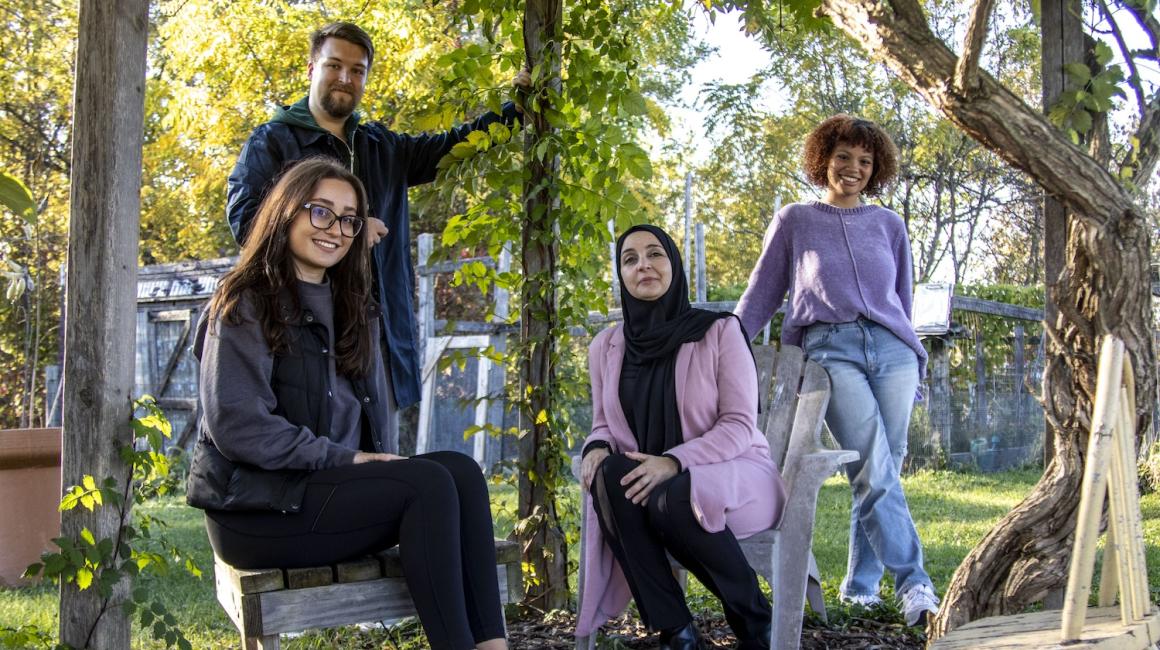
EIC Sustainability Fellows are, from left, Anisa Elezi, Kirill Nartov, Diana Mtairek, and Leah Williams. | |
|
Meet the EIC Fellows!
Four UM-Dearborn students have been selected as Environmental Interpretive Center Collegiate Sustainability Fellows. The program, which is a collaboration between the EIC and the Office of the Provost, selected one student from each UM-Dearborn college to improve sustainability practices on campus, both through individual projects and interdisciplinary collaboration.
Pictured above are the Anisa Elezi from the College of Business, College of Engineering and Computer Science master’s student Kirill Nartov, College of Education, Health and Human Services EdD student Diana Mtairek, and College of Arts, Sciences and Letters senior Leah Williams.
"We looked for students who were very interested in learning, understood that they're going to start with a blank slate and brought a lot of tools to the team," EIC Director Jacob Napieralski said. He noted that applicants demonstrated creativity and originality in the application and interview process. “There were moments when interviewing these students that we said to ourselves, ‘We never thought about that,’" Napieralski observed.
We will keep you apprised of the projects on which these talented students are collaborating with each other and the EIC staff. This article was originally published in The Reporter :Story by Sarah Tuxbury and Shaun Manning; Photos by Annie Barker.
| |
|
New Look!
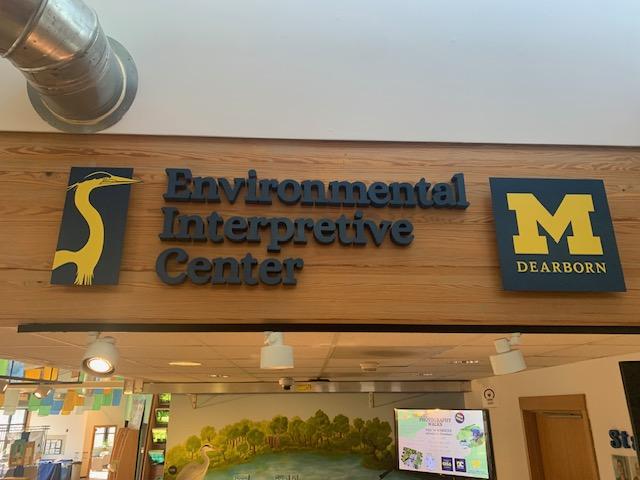
There is no doubt about where you are when you enter our front door now! Above the reception desk is a bold new way to know you've arrived. Bridget Quinn from the College of Engineering and Computer Science designed this new look to welcome visitors in a big way.
| |
|
New Books!
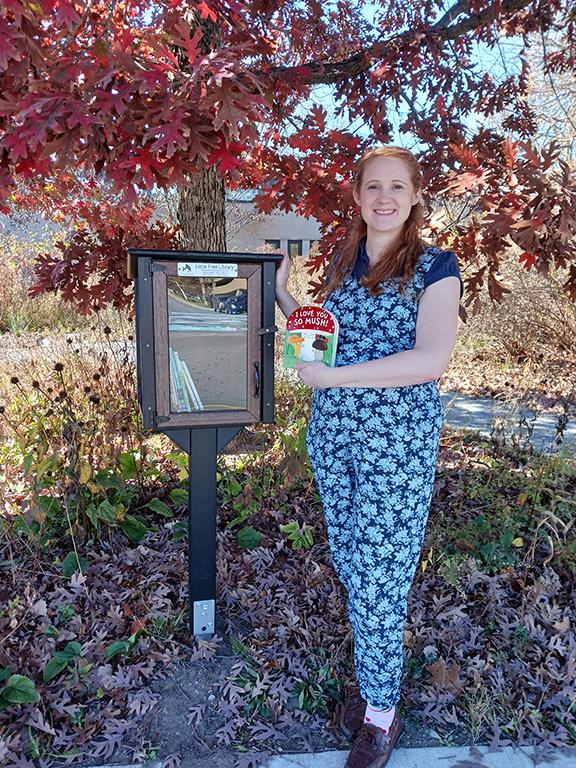
Come check out what's new in front of the EIC rain garden! We are happy to introduce our Little Free Library, where members of the community are welcome to peruse a selection of nature and science related books. Feel free to “take a book, leave a book” or share some of your books with your neighbors.
Enjoy a good read with friends!
| |
An Evening Owl Prowl with the Naturalists
Friday, November 22
7:00-9:00 p.m.
Join EIC Naturalists as we listen and look for owls in the Natural Area. A short presentation in the Center will lead into a quiet night-time walk on the trails. Please register in advance for this program; space is limited to 60 participants! Please dress appropriately for the weather, whatever it may have in store for us this year!
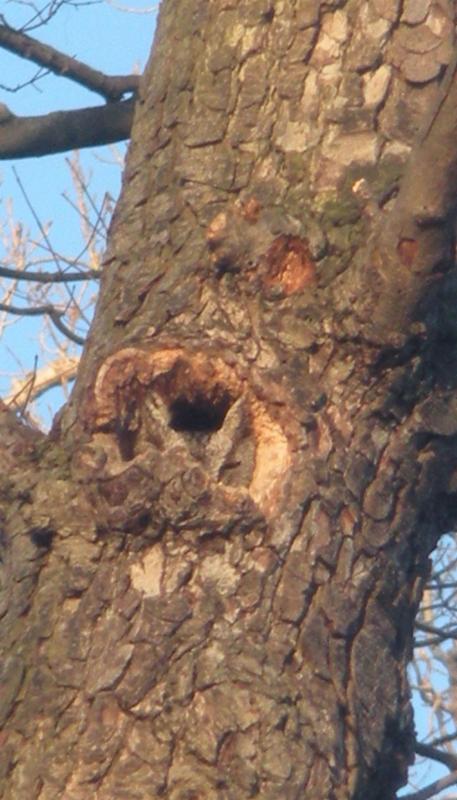
Can you see the screech owl in Joe Turek's photo...?
Nature Walk for Mental Health
Tuesday: Nov. 19, Dec. 3
2:00 -2:45 p.m.
Relax, unwind, and get outside; with brief guided meditations, and 45-minute nature walks. You will be entered into a raffle for each event you attend, where winners will be announced at the final walk and celebration. Please dress appropriately for walking outdoors. This event is free and open to the public. Please register for this program.
Photography Walk
Thursday: Nov. 14
2:30-3:30 p.m.
Take a hike with an EIC Naturalist and Nature Photographer! Bring your own cameras and accessories, we supply the scenery. There will also be opportunities to submit your photos to be displayed in a Photography Showcase in April. Please dress appropriately for walking outdoors. This event is free and open to the public. Please register for this program.
| |
The Return of Art in Nature Walks
Thursday: Nov. 21
2:00-3:00 p.m.
Meet with EIC student naturalist Morgan Corley who will lead these art-inspired walks. Some materials provided, but feel free to bring your own! Please register for this program.
| |
|
|
Stewards Free the Trees!
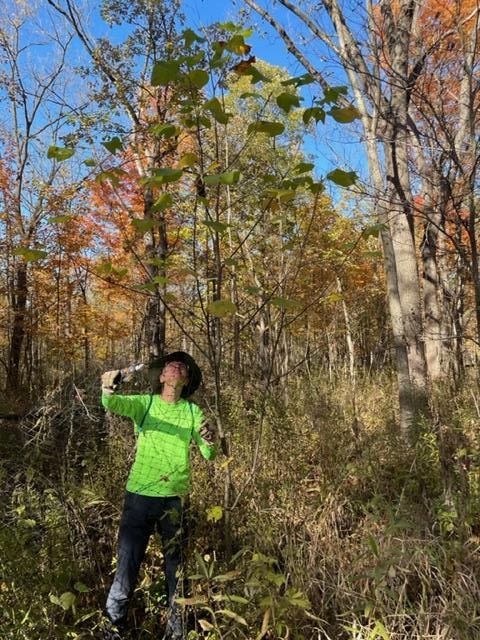
Our habitat management activities in the Environmental Study Area (ESA) include caging seedlings of oaks and other native trees. This is done to protect the seedlings from being browsed by White-tailed Deer, whose sheer numbers in the ESA often prevent the seedlings from ever growing into trees. In time, the little trees become bigger trees that are about 6 feet tall. When finally out of reach of the deer, we remove those protective cages.
This past October, Stewardship Saturday volunteers Lisa Campbell (pictured left), Jade Olsen, and Joe Turek removed cages from several trees, including a Tulip Tree that was a seedling when it was first planted in the ESA in 2015.
We hope that the caged native tree seedlings currently present in the ESA have the same trajectory in the years to come! -Rick Simek
| |
We Get By With a Little Help From Our Friends
We can all use a little help sometimes. At the EIC we are committed to the sustainable stewardship of our natural areas and community spaces, and that’s a big job. We often rely on volunteers to tackle large chores and specialized tasks. Many of our volunteers are long-time friends of the EIC, but new friends are always welcome!
In May 2023, the EIC received an email with an interesting proposal. A new student-led conservation group was being formed by students at Henry Ford Early College. At HFEC, a collaboration between Henry Ford College and Dearborn Public Schools, high school students can earn both college credits and their high school degree over a 5-year program. These ambitious students had come up with a plan to streamline organization of volunteers, largely composed of fellow students, with the goal of revitalizing ecosystems surrounding the Rouge River. nn
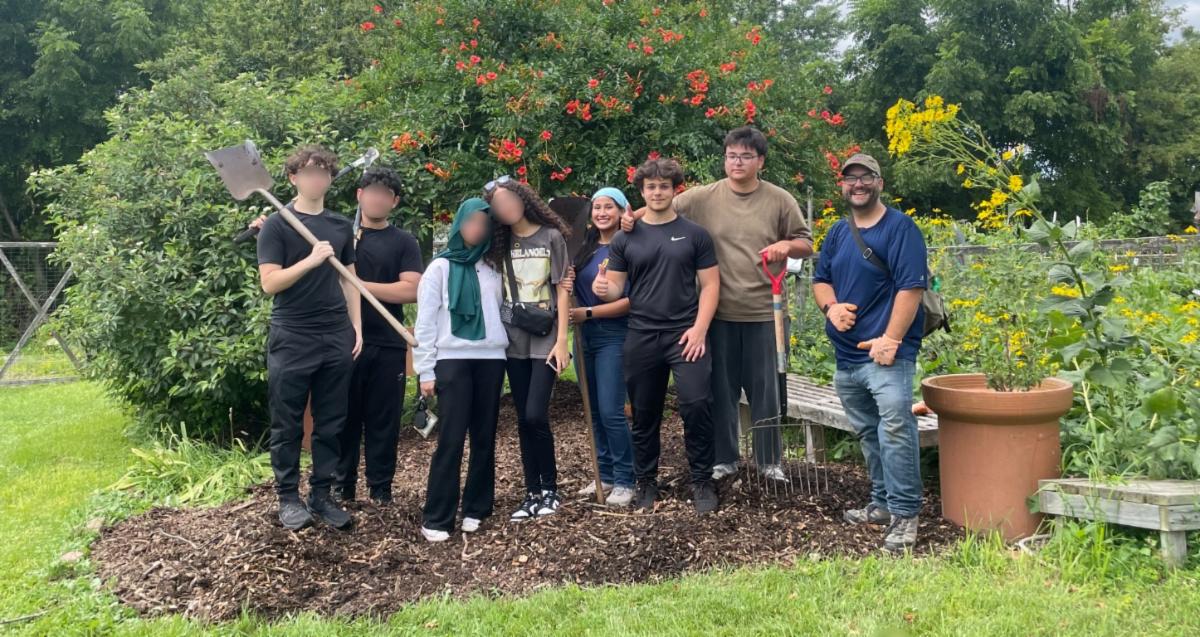
Soon, this seed of an idea became the Ladybug Initiative. Dedicated to environmental stewardship and local conservation efforts, this organization is led by Ali Berry and Yara Reda and was co-founded by Mohamed Alsaidi. Ali and Mohamed often walked the trails in the Environmental Study Area and deeply connected with the sense of peace they felt in times of stress or difficulty. The Ladybug Initiative began with their desire to reconnect Dearborn youth with nature, and the EIC was their first choice as a partner.
Ali describes their inspiration; “We felt that a disservice was being done to not only ourselves (by) subconsciously stripping our relationship with nature, but nature itself through not recognizing and acknowledging its importance in our lives.”
| |
|
With Yara’s help, they have connected with over 90 students from Dearborn high schools who regularly volunteer their time. They have removed invasive plants like garlic mustard, protected young Oak trees with fencing, and planted native grass seeds in the Environmental Study Area. The Ladybugs have also spent countless hours in the Community Organic Garden, helping to maintain community spaces and clearing empty plots to prepare them for future gardeners. (Some Ladybugs with the EIC's Mike Solomon)
| |
|
Ali, a “super senior” high school student, is studying biochemistry at HFEC, and plans to transfer to UM and continue working with Planet Blue to continue environmental work. He and Yara hope to grow the Ladybug volunteers, expanding their reach further into Dearborn and beyond. He is inspired by “how excited our volunteers were to discover a hidden natural gem in metropolitan Detroit. We realized the potential of what we had started, and it solidified our belief that reconnecting with nature can truly inspire collective action and bring about meaningful change in our community.”
Students like Ali, Yara, and Mohamed are truly impressive young people who are ushering in the next generation of environmental stewards and engaged community members.
| |
|
Featured Volunteer
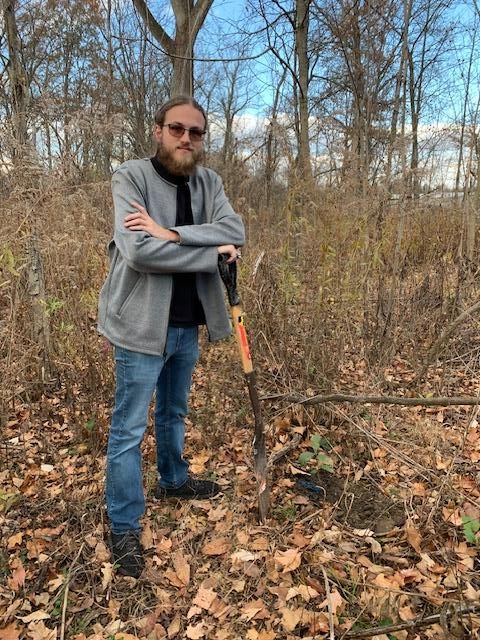
Another new EIC friend is Traven Yarbro, a UM-Dearborn student studying Mathematics and Applied Statistics and a senator in Student Government. This summer, he had the opportunity to volunteer through SG as a part of Wolverine Welcome Day. With other students, Traven helped plant nearly 75 native perennial plants. He enjoyed the experience of working with others to enhance our habitat and reached out to ask what more he could do.
| |
|
|
In the months since, Traven has ensured the new plants’ survival by watering them weekly. He particularly enjoys planting, and is amazed by the difference that can be made by a few small actions. Having moved here from a less urban area, Traven really appreciates the natural spaces surrounding the EIC and has committed to restoring them.
This fall, by planting chokeberry, oak, and hickory trees, Traven has helped increase healthy habitat and resources for a huge variety of species that rely on natural food sources and shelter. Welcome to the team Traven, we’re so happy to have you!
-Dale Browne
| |
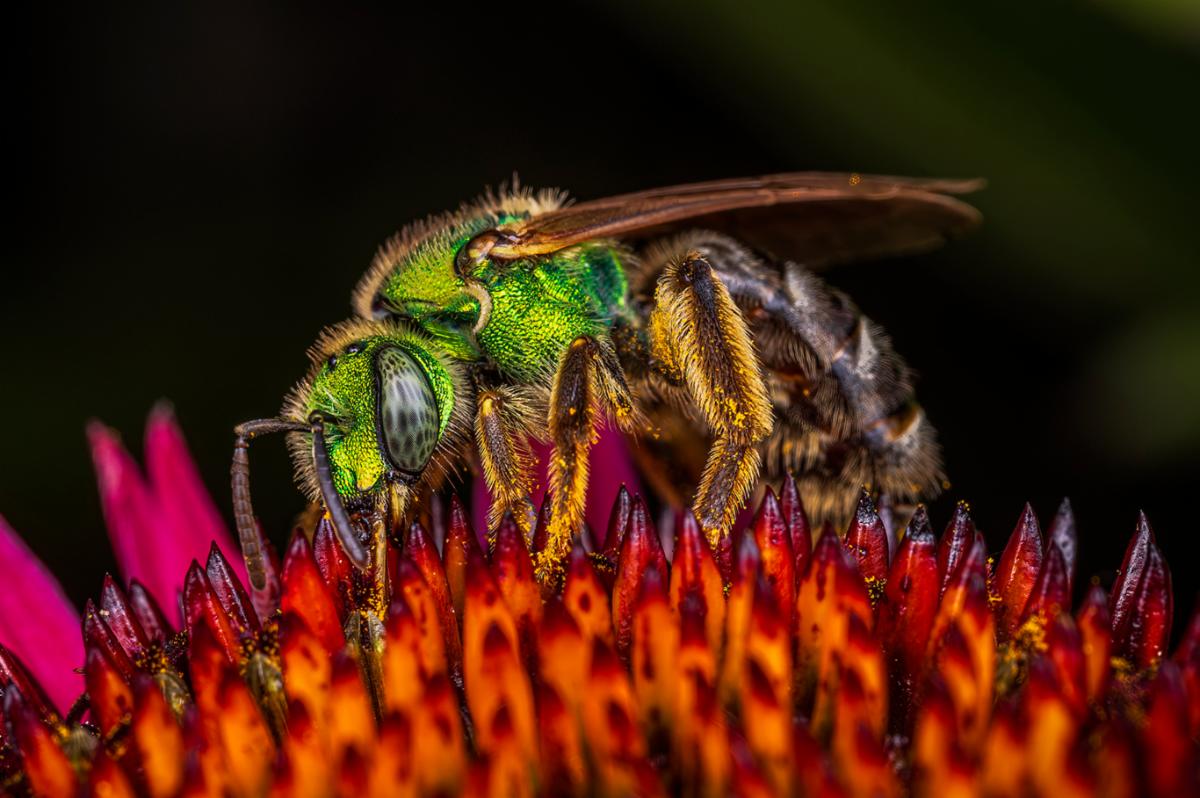
Pollinator Photo Contest
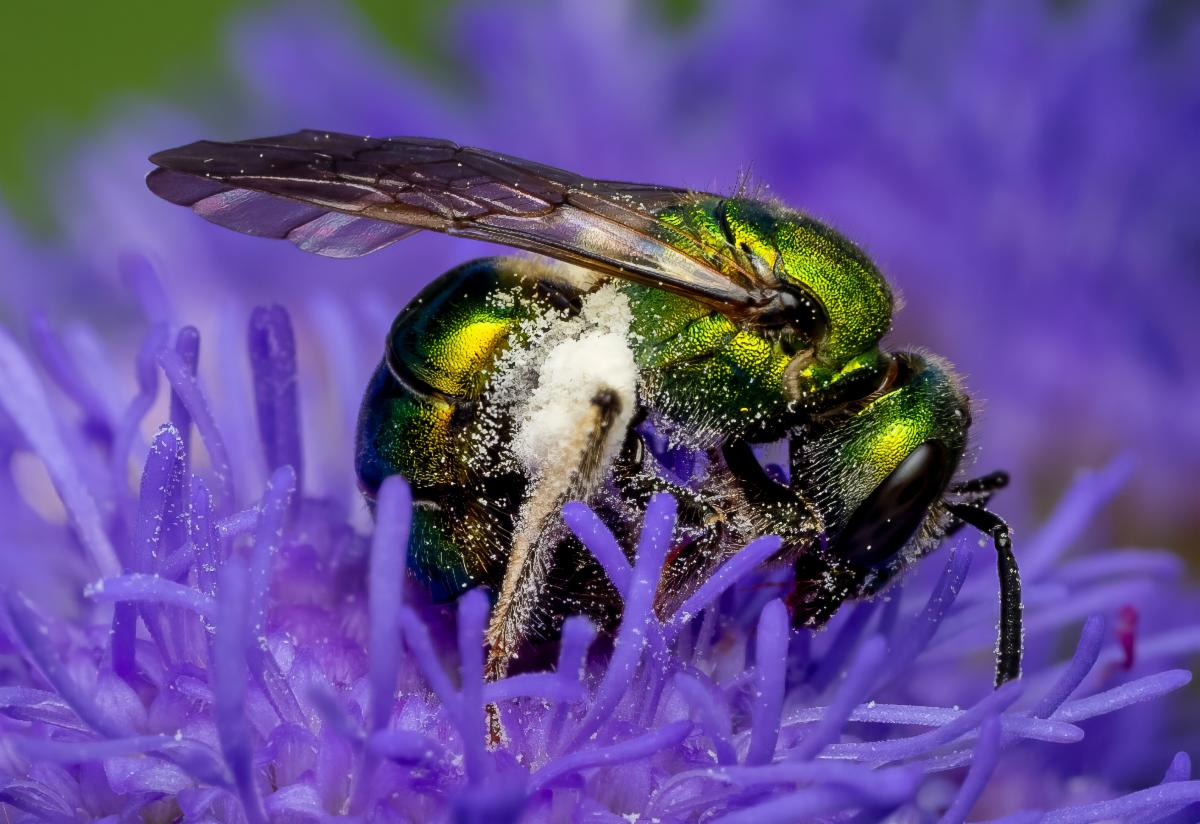
The results are in! The "greens" have it! Thank you to all our contributors, some of whom have featured billing in the video below. Congratulations to this year's prize winners, Evan Deutsch and Joseph Ferraro!
| |
Pollinators Up-Close - Green Sweat Bee by Evan Deutsch (a repeat winner from last year!)
| |
Pollinator Flower Interactions -Agapostemon + Coneflower by Joseph Ferraro | |
Red Leaves and Red Dragons
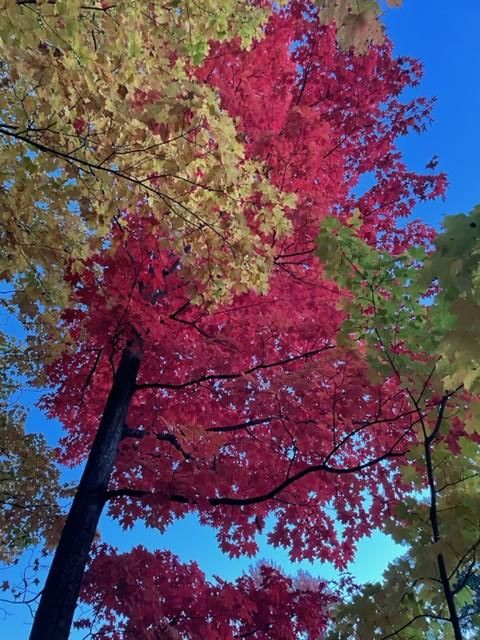
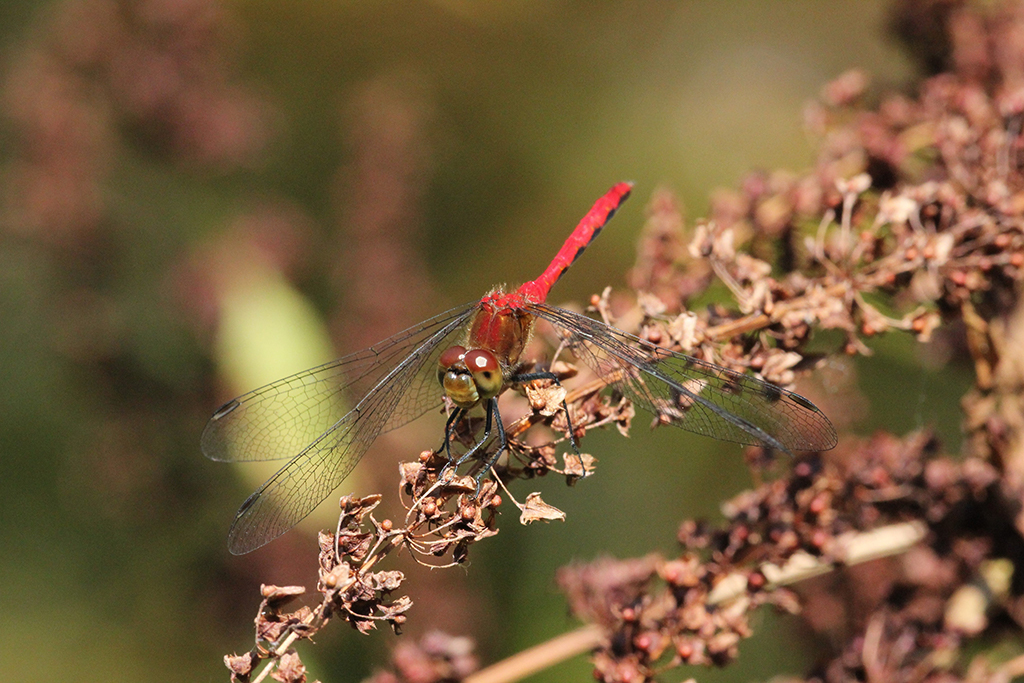
Fall colors in the Environmental Study Area (ESA) this mid-October included the spectacular, attention-getting red foliage of a maple tree along the Lakeside Trail. On warm, sunny days, visitors who paused to admire the tree may have also encountered a brilliant red dragonfly, a species of Meadowhawk of the genus Sympetrum.
Male meadowhawks, which sport the bright red coloration, can be encountered from late summer through fall along the lake edge as they patrol for females, which are a more subdued brownish hue. Mating takes place in mid-air, during which the female will deposit her eggs into the very shallow water or even the moist soil along the lake edge.
| |
|
Male meadowhawks seem to have a penchant for landing on people. Occasionally, visitors to the Environmental Interpretive Center will share with our naturalist staff how a red dragonfly alighted on them while out by the lake.
(Meadowhawk photo by Ken Neitering)
This fall, that included a few groups of schoolchildren who came to the Center for educational programs in the ESA. There were even reported instances of a Meadowhawks landing on multiple program participants as they stood by the lake. It’s the sort of real-world, unexpected encounter with the natural world that can spark a child’s curiosity and sense of wonder.
The bright red leaves have fallen from the trees in the ESA for this year, but for a few more weeks, on warm, sunny days, the male meadowhawks might still be active by the lake. If you walk along the Lakeside Trail and see a bright red dragonfly zipping about nearby, stand still and perhaps it will land on
you, too. Enjoy!
-Rick Simek
| |
|
Celebrate Your Harvest Sustainably!
With this year’s fall harvest in full swing, many of you are likely getting ready to gather with friends and family in order to celebrate the holidays with a bountiful feast. This is not only the best time of year to fill up on delicious homemade meals, but also to learn how to sustainably consume during this season of thankfulness!
While it is tempting to buy large quantities of food to appease your guests, it can be wasteful and harmful to the environment to finish dinner with too many leftovers. Every year, over 300 million pounds of food are wasted on Thanksgiving day in the U.S. Often, this food has been transported from farms far away from the grocery stores; this results in the release of about 1.1 million tons of greenhouse gasses as trucks deliver the food used to cook everyone’s Thanksgiving dinner alone. So, while shopping this year, please be mindful of how much food you will really need to feed your family, and eat up any and all leftovers you may have!
Another way to combat the harmful effects of overconsumption during the holidays is to avoid the grocery store altogether and buy your ingredients at a local farmers market. Products at a farmers market are typically not shipped from a land far, far away, so fewer greenhouse gasses are released to bring food to your table. The produce is also often grown in-season, meaning that the farmers likely did not need to use extensive fertilizers or other unsustainable practices for their harvest.
Finally, locally grown produce is fresher and can be more nutritional than store-bought foods. There are many farmers markets in the metro-Detroit area that remain open through December, so make sure to visit one or more while preparing for your celebrations this year!
Valerie Osowski
Environmental Interpretive Center Cooper Family Intern
| |
Venturing outdoors and encountering nature is good for your health. Our trails are accessible, so please visit our Environmental Study Area. Stay engaged in learning activities and check out our Remote Learning Activities & Resources page for ideas to create a “Neighborhood Nature Journal” and “Family Nature Walk” activities!
We also hope to see you in person at our upcoming programs!
| | |
Please remember...
The EIC Environmental Study Area is open daily from sunrise to sunset. We would like to remind nature-goers that fishing on site is prohibited and to leave bikes and dogs at home because they cause disruption and stress to the EIC wildlife.
| |
| | | |