|
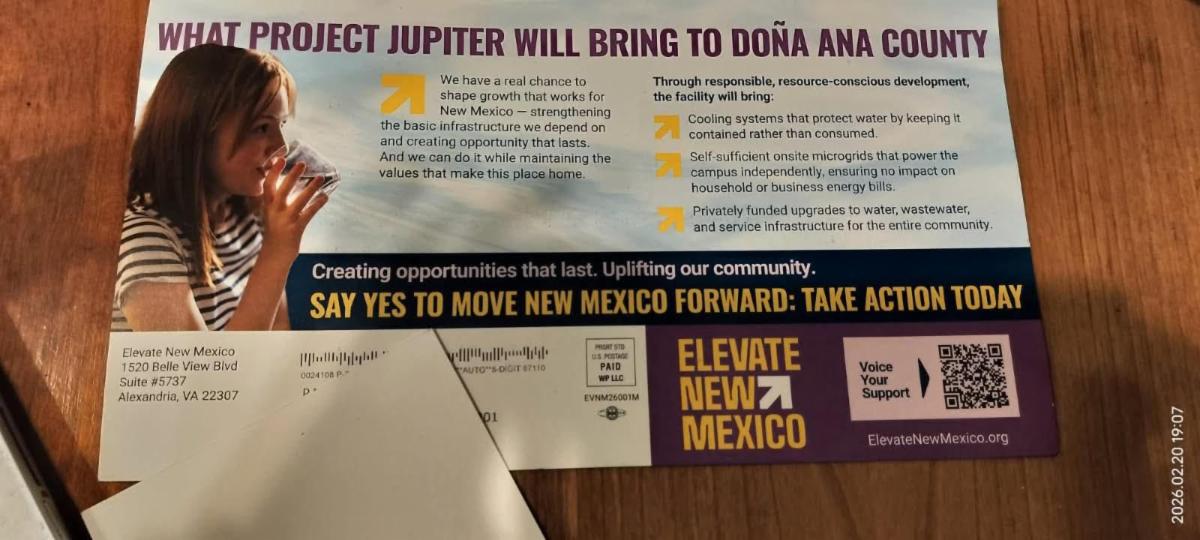
SUBMIT A WRITTEN COMMENT ON PROJECT JUPITER'S AIR QUALITY PERMIT APPLICATIONS
On January 26, 2026, the New Mexico Environment Department (NMED) published its English public notices that Project Jupiter's two air quality permit applications for its microgrid facility are administratively complete and open for public comment. On January 30, 2026, NMED published the Spanish public Notices.
Project Jupiter's air quality permit applications and public materials can be found here: https://www.env.nm.gov/public-notices/ Select Doña Ana County and then view both the "Acoma, LLC East Microgrid" and "Acoma, LLC West Microgrid" tabs.
The public has 30 days to submit written public comments to NMED before the Department releases its written analysis on Project Jupiter's air quality permit applications. According to NMED's public comment portal, the current deadline to submit written comments is February 26, 2026.
To submit your own written public comment, you may do so in 1 of 3 ways and be sure to include the Company and Permit Number for each application. Acoma LLC's West Microgrid (Permit No. 10734) and TEMPO Agency Interest No. 41311. Acoma LLC's East Microgrid (Permit No. 10732) and TEMPO Agency Interest No. 41309
-
Email your written comments to aqb-acoma-microgrids@env.nm.gov
- Mail your written comments to: New Mexico Environment Department, Air Quality Bureau, Permitting Section, 525 Camino de Los Marquez, Suite 1, Santa Fe, NM 87505-1816
- Use NMED's Public Comment Portal, using the links below. Be sure to submit a written comment in both the West Microgrid and East Microgrid application portals.
West Microgrid Application Comment Portal here
East Microgrid Application Comment Portal here here
In one minute, you can easily submit a draft written comment on both applications to NMED, which includes comments such as the following;:
The New Mexico Environment Department must consider the East Microgrid and West Microgrid as one major source, subject to a Title V Clean Air Act permit. As it stands, Project Jupiter is attempting to subvert more stringent air quality protections under state and federal law by splitting its one microgrid facility into two. Artificially dividing the emissions of Project Jupiter’s microgrid facility into two “separate” facilities and applications is deceptive, only serving the purpose of allowing Project Jupiter to avoid the responsibility of stronger air quality protections.
Project Jupiter’s proposed ozone concentrations will permanently solidify Southern New Mexico communities’ air quality status in non-attainment. For years, Sunland Park, Santa Teresa, and La Union have been in non-attainment for federal air quality standards, with community members subject to some of the worst air quality in the entire state. In 2025, the U.S. Environmental Protection Agency reaffirmed, as well as expanded, the areas of non-attainment beyond Sunland Park and Santa Teresa, to include more of Doña Ana County and all of El Paso County, Texas. The amount of toxic and dangerous emissions Project Jupiter’s microgrid facility proposes will only further pollute an already overburdened airshed – significantly harming communities already bearing the adverse health impacts from air pollution.
NMED must deny Project Jupiter’s microgrid air quality permit applications. The Department must “protect and restore the environment and foster a healthy and prosperous New Mexico for present and future generations.” To allow one single industrial development to move forward that will emit more hazardous pollutants than New Mexico’s two largest cities combined is a direct contradiction to NMED’s mission and responsibility, and an extreme endangerment of New Mexicans’ health, safety, and environments. There is no world in which Project Jupiter can move forward, without NMED exploiting New Mexico communities’ health, safety, and lives as well.
NMED must hold a public hearing on both air quality permit applications in Santa Teresa, with a hybrid/virtual option available, so that the community members most impacted by the proposed project, as well as all concerned citizens across the state of New Mexico, have the opportunity to meaningfully participate and inform NMED’s decision. All materials, well in advance of the hearing, must be provided in both English and Spanish, and the hearing must have Spanish interpretation and translation services available so that community members can participate in the language of their choice.
|