Early Learning Center

Family Connections


January 23rd 2026

Spotlights in this Issue:


  • Inclement Weather Policy Reminder
  • Take Winter Wear & Necessary Medications Home Over the Weekend
  • (And returning them next week!)
  • Butterscotch & Childhood Conversations about Death
  • Other Grief Resources
  • ELC Parking Lot
  • Rituals & Drop Off Resources
  • Consumer Product Recalls
  • Important ELC Dates

Inclement Weather Policy Reminder

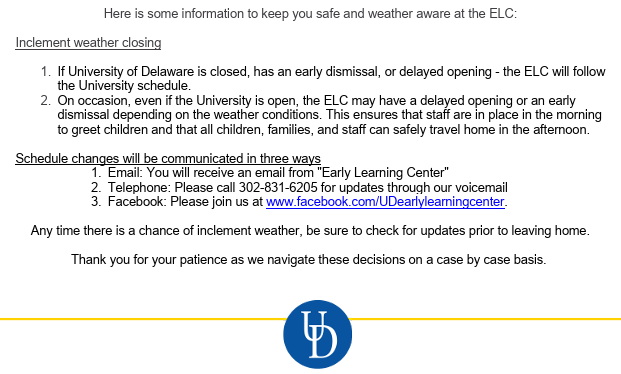
A winter storm is brewing! Lots of speculation is going around about this weekends winter weather - here is a reminder of our inclement weather policy:

Taking Home Winter Gear & Medciations

As we gear up for the storm please take home any winter wear your child might need for a fun weekend out in the snow! As well as any necessary medication here that might be needed over a long snowy weekend!


Please remember to bring these items back at the start of next week so the fun in the snow can continue here!

Butterscotch & Childhood Conversations about Death

Butterscotch is at the top of our minds each morning, as he was part of our family and a big part of your routine and ritual upon your arrival to the ELC. We’ve heard many conversations and know that you are all doing a great job wrestling with a very challenging topic for young children- really, for us all.


Death is not something that we are comfortable with, and we know that you might benefit from some developmentally appropriate resources. Please see the below tips, articles, and book list from our previous tools when we lost our other beloved guineas, Lambchop, Mac and Oreo.


We have several books at the front to read/review and teachers are borrowing them to read to their classes over the next several days. If your child continues to struggle or need closure, please feel free to sign the books out at the front desk during the last week of January. This will give us time to allow teams to use them as well.


We’ve added some resources to the bottom about creating routines and rituals. If you are need further support, please talk with your child’s teacher.


When talking to young children about death:  

  • Be as direct as possible: “___ died”. Do not use phrases like “passed on”, “died in their sleep”, or “is in a better place” as these phrases can cause confusion and/or fear.
  • You can say “when someone/something dies, their body stops working and we won’t be able to see them again”. The child might be satisfied after hearing this statement and you can end the conversation. However, if the child continues the conversation and/or asks questions, speak with them honestly. If they ask about “their/your body not working” assure them that they are “very very healthy” and list all the ways they are healthy (exercise, play, eat healthy foods, rest/sleep, etc.) and the people who work to keep them healthy (parents/caregivers, doctors, teachers, etc.) at home and at school.
  • Let the child lead the conversation. If they end the conversation, do not press them to talk about things further. If they ask questions, answer in an honest and matter-of-fact way.
  • It is very normal for a young child (especially toddlers) not to express any emotions or concerns surrounding a death since they don’t fully grasp the concept or finality of death. Remember, all emotions are ok! It is also very normal for preschoolers to reenact or reference death during their play (solo play and/or peer play)-this is how they process the world around them. Let them continue their play and answer their questions if they have any.
  • It is very common for kids to bring up a prior death (people, pets, insects, etc.) they may have experienced. If a child(ren) shares about someone/something that died in their life, you can say “thank you for sharing/telling me”.

Additional Resources - Grief & Death

Additional Resources:


Children's Books:


The Dead Bird By Margaret Wise Brown. Illus. by Remy Charlip. 1995. HarperCollins.

A favorite children’s author tells the simple story of a group of children who find a dead bird and bury it in the woods. The children visit the bird’s grave and decorate it with flowers daily, until eventually, they forget.


Everett Anderson’s Goodbye By Lucille Clifton. Illus. by Ann Grifalconi. 1983. Henry Holt. Readers journey with Everett Anderson, a young boy, as he experiences the five stages of grief following the death of his father. Rhyming text and charcoal drawings illustrate Everett’s emotions and his mother’s support.


The Fall of Freddie the Leaf: A Story of Life for All Ages By Leo Buscaglia. 1982. Slack. Freddie the leaf learns about life and death as he, his friend Daniel, and their fellow leaves change with the passing seasons and finally fall to the ground in the winter snow.


Jim’s Dog Muffins By Miriam Cohen. Illus. by Ronald Himler. 2008. Star Bright. First-grader Jim has been having a hard time since his dog Muffins died. At school, he becomes angry when his classmates don’t seem to understand how he feels. Can his good friend Paul help him to feel better?


Lifetimes: The Beautiful Way to Explain Death to Children By Bryan Mellonie with Robert Ingpen. 1983. Bantam. Using examples of humans, trees, and sea creatures, this book explains that all living things have a lifetime with a beginning, an ending, and living in between. This simply-worded book is a good resource for explaining the life cycle to young children.


Love Never Stops: A Memory Book for Children By Emilio Parga. 2007. The Solace Tree. Emilio Parga, founder of The Solace Tree, a child and adolescent center for grief and loss, created this memory book to give grieving children an opportunity to express themselves.


Nana Upstairs & Nana Downstairs By Tomie dePaola. 2000. Putnam. First published in 1973 and later expanded and updated, this autobiographical picture book describes dePaola’s relationships with his grandmother and greatgrandmother and how he deals with their deaths. 


The Next Place By Warren Hanson. 1997. Waldman House. In this beautifully illustrated book, Hanson presents a reassuring, universal view of heaven, or “the next place,” while avoiding specific religious messages. The book is best suited for children whose families believe in life after death and who are curious about what happens after someone dies.


The Saddest Time By Norma Simon. Illus. by Jacqueline Rogers. 1992. Albert Whitman and Company. A child experiencing the loss of a loved one is the subject of these three gentle stories. While each presents a different scenario (death by illness, accident, or old age), all of the stories address children’s sad feelings and present different coping strategies.


The Tenth Good Thing About Barney By Judith Viorst. Illus. by Erik Blegvad. 1971. Simon and Schuster. When his cat Barney dies, a boy tries to think of 10 good things to say about his pet at the funeral. But he is only able to think of nine good things, until a conversation with his father helps him to discover the tenth.


When Dinosaurs Die: A Guide to Understanding Death By Laurie Krasny Brown and Marc Brown. 1996. Little, Brown. This book offers a straightforward introduction to death and dying for young children. Bright illustrations accompany honest answers to questions children may have about death, including “Why does someone die?” and “What does dead mean?”


 You Hold Me and I’ll Hold You By Jo Carson. Illus. by Annie Cannon. 1992. Orchard. At her great-aunt’s memorial service, a young girl is overwhelmed by the formal setting and emotions of relatives. But she is able to find comfort in holding and being held by her father.

ELC Parking Lot Meeting

Did you see a parking lot meeting last night at pick up time?


We have been steadily and consistently sharing and talking through our parking lot safety needs over a period of years. Last night’s discussion was created as a result of several conversations with Interim Dean, Rena Hallam (CEHD) and the Directors of the Children’s Campus (including Kelly and Jessica).


We were discussing and studying the traffic flow and ongoing safety concerns. We met with members of UD parking, UD PD, Emergency management, Newark PD and DelDot to try to puzzle out how to adjust our patterns to enforce safety routines. As updates become available, we will share them with you. Our collective goal is to “help people drive a little more honest and a little less reckless”.


Please continue to slow down in the parking lot and keep your children close to your side during drop off and pick up, including on the sidewalk-and in the hallways. Safety is always a top priority for us and even our youngest learners know to walk and stay with an adult.  

Routines and Rituals

Butterscotch was a big part of many families ELC routines. Here are some resources about routines around dropping off and picking up


Resources about Routines and Rituals:

No More Tears: Parenting Tips for Easier Drop-Offs  - Triple P Positive Parenting Programs

Parenting Tips for a Successful Back-to-School Season: Learning Routines – Sesame Workshop

Transition Time: Drop off - Song by Big Bird  

Conscious Discipline for School Drop-off

Helping Children Transition Between Activities - NCPMI Pyramid Model 

Consumer Product Recalls

Please click the button below to access the US Consumer Product Safety Commissions Site with up to date information about recalled items.


New Additions:

  • Joyful Journeys Recalls Baby Loungers Due to Risk of Serious Injury or Death from Entrapment and Fall Hazards; Violates Mandatory Standard for Infant Sleep Products
  • Kori Gey Water Toy Kits Recalled Due to Risk of Serious Injury or Death from Battery Ingestion; Violates Mandatory Standard for Toys; Sold on Amazon by Qaniy
  • Pounding Toys Recalled Due to Risk of Serious Injury or Death from Magnet Ingestion Hazard; Violate Mandatory Standard for Toys; Sold on Amazon by Findriver and Weeksome


More products and information at link below-

Important ELC Dates

  • 2/9-2/13 Spirit Week! More Info to come!
  • 3/25-3/27 ELC CLOSED to Students - Parent Conferences & Professional Development
  • 4/6-4/10 Week of the Young Child - More info to come!
  • 4/9 Art Show!

Kelly Freel kfreel@udel.edu Jessica Peace jpeace@udel.edu


University of Delaware Early Learning Center

 www.elc.udel.edu

Facebook