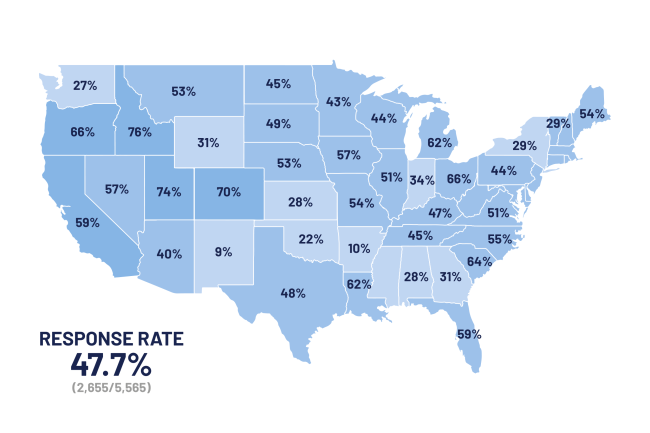
2,600+ EDs Nationwide Have Taken the Pediatric Readiness Assessment – Has Yours? Participate by May 31!
All 24/7 EDs are encouraged to participate in the 2026 National Pediatric Readiness Project (NPRP) Nationwide Assessment by May 31. Nationwide assessments typically occur every five years, making this a critical opportunity to check your ED’s pediatric capabilities, align with the latest best practices, and contribute to national research efforts. High Pediatric Readiness is associated with up to a 76% reduction in mortality risk for ill or injured children. Take assessment here.
What EDs are saying:
- “Thank you for collecting this data.”
- “I see we need to work on our pediatric preparedness policies/education (which is a good thing).”
- “We would be happy to improve our pediatric emergency care for our ED.”
- “Learned something from this assessment today - thanks!”
Join a May 6 webinar for ED clinicians:
The American College of Emergency Physicians (ACEP) is hosting a webinar, “The National Pediatric Readiness Assessment: Why Every ED Should Participate,” on May 6. Learn why the assessment matters, how to translate your results into improvements in care, and about free resources to help your ED. CME available. Register today.
Pediatric Readiness Success Stories:
| | |
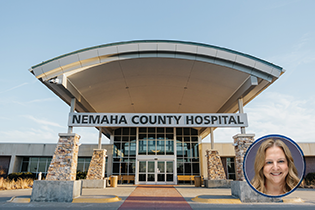
Nemaha County Hospital
A small rural hospital in Nebraska is proving that Pediatric Readiness isn’t about size, it’s about commitment. Discover how their team turned low patient volume into national impact.
Read more.
| |  |
Geisinger Health System
Across a sprawling rural health system, Geisinger is proving that Pediatric Readiness starts with teamwork and a shared mission. See how a system-wide approach is transforming care for children.
Read more.
| | |
Celebrate EMS Week and EMSC Day!
The EMSC Program is a proud sponsor of National EMS Week, May 17–23, a time to recognize the lifesaving work of EMS clinicians and their impact on communities every day. This year’s theme, “Improving Outcomes, Together,” highlights the role EMS professionals play in delivering high-quality care when it matters most. The week is presented by the American College of Emergency Physicians in partnership with the National Associations of Emergency Medical Technicians (NAEMT).
EMS for Children (EMSC) Day – Wednesday, May 20
EMSC Day is dedicated to honoring EMS clinicians' dedication to children and raising awareness about the importance of Pediatric Readiness. It’s also an opportunity to highlight the work of the federal EMSC Program and ensure every EMS system is prepared to deliver optimal care for kids.
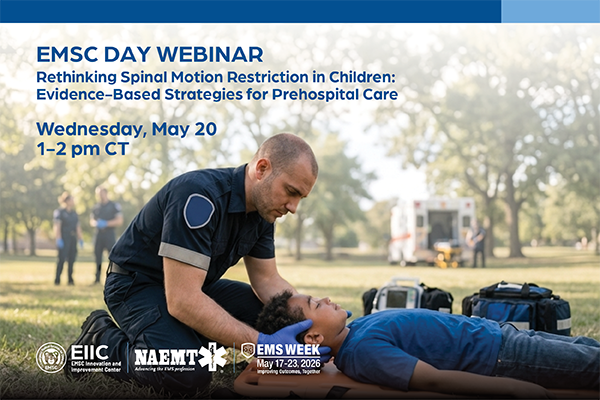
Join the EMSC Day Webinar
Participate in an EMSC Day webinar on managing cervical spine injuries in children, “Rethinking Spinal Motion Restriction in Children: Evidence-Based Strategies for Prehospital Care.” Cohosted by NAEMT, the May 20 webinar will feature Julie Leonard, MD, MPH, and Caleb Ward, MB BChir, MPH. This webinar is free, open to all, and approved for 1 hour of CAPCE continuing education credit. Register today.
Promote and Celebrate with the EMSC Day Promo Toolkit
Access materials designed to help you recognize EMS clinicians, request an EMSC Day proclamation, promote Pediatric Readiness, and amplify your EMSC Day activities. Materials include social media graphics and sample posts, logos, banners, handouts, and more! Access the EMSC Day promotional kit.
Join the National Center for Fatality Review and Prevention Webinar
On May 22, the Friday of EMS Week, the National Center for Fatality Review and Prevention is hosting "From Dispatch to Definitive Care: Using 911 and EMS Data to Improve Pediatric Trauma Outcomes” at 1:30 pm CT. Register here.
Join us in celebrating EMS Week and shining a spotlight on pediatric care!
|
Utah Passes Landmark Pediatric Readiness Bill
Utah's S.B. 127 Pediatric Care Amendments, signed by Governor Spencer Cox on March 23, is among the most significant state-level legislative action for Pediatric Readiness in the country. Sponsored by Senator Jen Plumb, the law moves what the EMSC Program has long championed through voluntary improvement efforts into enforceable state statute.
The law takes effect May 6, 2026, and requires every hospital emergency department in Utah to:
-
Designate a pediatric emergency care coordinator — a clinical emergency staff member responsible for overseeing pediatric policies, training, and all readiness activities
-
Develop evidence-based policies and procedures covering pediatric triage, vital signs, record weight in kilograms, medication dosing, pediatric equipment use, and age-appropriate care protocols
-
Conduct annual staff training, including hands-on simulation and pediatric emergency drills at least every six months
-
Complete the National Pediatric Readiness Project Nationwide Assessment, which typically occurs every five years, and submit results to the state Bureau of EMS
The Bureau of EMS is additionally required to collect and may publish aggregate readiness scores statewide and to establish minimum standards for pediatric ED care through rulemaking. For the EMSC community, SB 127 offers a legislative blueprint worth following. Read the full bill here.
| |
PECARN-Supported Study Settles a Long-Standing Question in Pediatric Sepsis
Which IV fluid is best for children with sepsis? After years of debate, a landmark study conducted in part through the Pediatric Emergency Care Applied Research Network (PECARN) has a clear answer: it doesn't matter. Researchers enrolled more than 9,000 children across 47 emergency departments in five countries and found no meaningful difference in outcomes between children with suspected septic shock treated with 0.9% saline and balanced fluids like lactated Ringer's solution.
For ED clinicians and EMS providers, the message is simple: use whichever of the two fluids is available and focus on recognizing and treating suspected sepsis quickly. Read the full press release here.
| |
Prehospital Pediatric Readiness Project Research Round-Up
The National Prehospital Pediatric Readiness Project (PPRP) aims to help EMS and fire-rescue agencies better prepare for pediatric emergencies — providing tools, resources, and an assessment to identify and close gaps in care. A recent paper in Prehospital Emergency Care offers an overview of the project's history and looks ahead to next steps, including sharing national assessment results and helping agencies act on what they find.
Two additional papers take a closer look at specific parts of the work. One evaluates the PPRP's free online toolkit, which organizes Pediatric Readiness resources across seven domains — finding that use has grown steadily since launch, with over 193,500 page views and quarterly visits nearly doubling over the study period. The other paper describes the development of 24 quality measures covering common pediatric EMS calls, from airway management to seizures to trauma, behind new NEMSIS pediatric dashboards.
View the toolkit, or explore the NEMSIS pediatric dashboards.
|
EMS Agencies: Apply for the FY26 Safe Streets and Roads for All (SS4A) Grants
The U.S. Department of Transportation has released the FY26 Notice of Funding Opportunity (NOFO) for the Safe Streets and Roads for All (SS4A) program, making nearly $1 billion available to support regional, local, and tribal efforts to reduce roadway deaths and serious injuries.
What’s new in FY26?
This year’s NOFO places a strong emphasis on public safety infrastructure, including:
- Post-crash care improvements
- Emergency response coordination
- Prehospital blood transfusion capabilities
Who should apply?
The National Highway Traffic Safety Administration Office of EMS and the National 911 Program encourage 911 centers and EMS agencies to apply, either independently or in partnership with local, regional, health care, planning, or transportation partners.
This is a key opportunity to secure funding that strengthens your community’s emergency response and improves outcomes for pediatric patients after roadway incidents. The application deadline is May 26. Learn more.
| |
State Snapshots
-
Connecticut: In March, members of the CT EMSC State Partnership Program, EMSC, and Pediatric Pandemic Network teams attended the Fourth Annual Connecticut EMS for Children Pediatric Emergency Care Coordinator (PECC) Conference. This educational event brings together ED and EMS PECCs committed to improving pediatric emergency care across Connecticut, with sessions focused on strengthening care in both emergency departments and prehospital settings.
-
New York: State leaders partnered with Orange County hospitals, including Montefiore St. Luke’s Cornwall, Garnet Health, St. Anthony Community Hospital, and Bon Secours Community Hospital, to announce a grant incentive program to move Orange County hospitals toward certified Pediatric Readiness. Funding will help advance pediatric-focused emergency care improvements across the region. Read more.
| | The Health Resources and Services Administration (HRSA), Department of Health and Human Services (HHS) provided financial support for this and other communications projects. The award totaled $2.5M with 18% of this total used to support this and other educational works. The contents are those of the author. They may not reflect the policies of HRSA, HHS, or the U.S. Government. | | | | |