Referendum Questions on the April 4 Ballot:

What Do They Really Mean?

By: Dr. Peter Bakken, Justice and Witness Coordinator

Is this not the fast that I choose: to loose the bonds of injustice, to undo the thongs of the yoke, to let the

oppressed go free, and to break every yoke?...Then your light shall break forth like the dawn, and your

healing shall spring up quickly…. – Isaiah 58:6-8a


The blizzard of campaign advertising and political news that piles up around every election – including the election on April 4 – can bury a fundamental truth: Democracy is how we work with other members of our community to solve problems and pursue common goals. This process ought to be fair and inclusive, with everyone having a voice in the decisions that affect them, and those decisions promoting the well-being of everyone in the community. But too often the way we “do democracy” marginalizes some of our neighbors, demeaning them, disregarding their interests, and making their lives more difficult – especially when they have low incomes or are persons of color.


The statewide advisory referendum questions on the April 4 ballot are a case in point. With so much attention focused on the Wisconsin Supreme Court race, we need to take a closer look at these questions before casting our ballots.


Two questions are about cash bail and pretrial detention. If passed, they would amend the Wisconsin state constitution to allow courts to (1) impose on someone who has been accused of a crime, but not convicted, conditions that are designed to protect the community from “serious harm,” and (2) require cash bail for someone accused of a violent crime based on “the totality of circumstances,” including previous convictions and the need to protect members of the community from “serious harm.” (Currently, the constitution only allows cash bail to assure that the accused will appear in court.)


So what’s the problem? If the first passes, “serious bodily harm” (as the constitution reads now) would become “serious harm as defined by the legislature by law.” A bill (SB75/AB54) has been introduced that would define “serious harm” to include mental anguish, emotional harm, property damage, and economic loss. But voters couldn’t know this from reading the question. There could be legal challenges to the amendments based on the misleading wording.


The second proposed amendment is supposed to protect the community. But accused persons with means could more easily buy their freedom than those who are poor. Both changes would give courts more reasons to detain persons awaiting trial, and would likely lead to more persons being held in overcrowded jails without being convicted of a crime.


Given the extreme racial disparities in Wisconsin’s legal system, the consequences of these amendments – loss of freedom, loss of income, increased likelihood of re-offending -- will fall disproportionately on people of color, as well as on those in poverty.


The third referendum question asks, “Shall able-bodied, childless adults be required to look for work in order to receive taxpayer-funded welfare benefits?” Although this question is only “advisory,” it, like the others, undermines the inclusive community that is essential to real democracy. Simply by being on the ballot, it creates misunderstandings and reinforces stereotypes that stand in the way of making our communities places where everyone can thrive with dignity.


The question itself is misleading in many ways. The term “welfare” seems to be used here to refer to a public benefit program intended to help people in poverty, such as Wisconsin Works (W-2), FoodShare or Medicaid. However, W-2 and FoodShare already have work requirements, and the federal government currently bars work requirements for Medicaid. The question not only fails to tell the voter which programs are meant, but misleads by lumping them all together and implying that there are currently no work requirements for any.


If the referendum is meant to “advise” the legislature on what laws to enact, the question leaves too many questions up in the air for voters to make an informed decision. What is the definition of “able- bodied”? Or of “childless”? What would it mean to “look for work” and what assistance would be provided? What would be the penalties for failure? There are many ways to help more people to find jobs that can lift them out of poverty, but passing this referendum is not one of them.


More insidiously, the term “welfare” evokes negative stereotypes of people – especially Black persons -- in poverty who supposedly are unwilling to work. “Taxpayer-funded” suggests resentment at having to support government antipoverty programs for those who are believed to fit the stereotype. (And it ignores the many publicly-funded benefits for wealthier taxpayers.) Absent is any understanding of the real lives of people in poverty and the challenges they face. Nor is there any sense that we all belong to an interdependent community, and we can only flourish to the extent each of our neighbors can flourish.


The opportunity to vote is a chance to use our voices to express our values as Christians and as citizens. On April 4, let us speak with love for all our neighbors, without exception.


There may be other county or municipal or referendum questions on your ballot, as well as choices for

local public office – be sure to check https://myvote.wi.gov/en-us/Whats-On-My-Ballot


More information:


American Heart Association Looking to Partner with Churches

The American Heart Association in Wisconsin is looking to branch out in local partnerships. Like many health organizations, they're interested in promoting health equity in places like poor urban neighborhoods and under-served rural areas.


They tell us: "The mission of the American Heart Association is to be a relentless force for a world of longer, healthier lives. Fulfilling that mission will require building powerful partnerships and meeting people where they are. Because churches play a critical role in addressing the spiritual needs of their community, the Association wants to collaborate to help address the physical health of congregations as well.


"This brief survey provides an opportunity to express your interest in learning about - and working with - the Association's desire to implement processes that will have a sustained health Impact. Possible efforts include focuses on blood pressure, nutrition, CPR, and tobacco." If you're interested in working with them on a deeper level—and we hope that you are—take the survey and let them know.


What is Awaken Dane?

Awaken Dane is accepting applications for its third cohort, beginning this Fall. This program is for churches in Dane County that are interested in engaging in the work the Spirit is already doing in their neighborhoods alongside other participating congregations in a supported, ecumenical space.


Awaken Dane is a program for the church's pastor or ministry leader and 4-6 congregation members. Together, the team meets monthly from September to May to break bread together and attend to the curriculum. Pastors have one additional monthly meeting together.

At the end of the first year, members will have the opportunity to renew participation for a second year focused on engaging in experiments within the neighborhood.  


Interested in learning more? Please check out our website at AwakenDane.org or contact Program Director Johnna Georgia at Georgia@wichurches.org. 


Events from the WCC

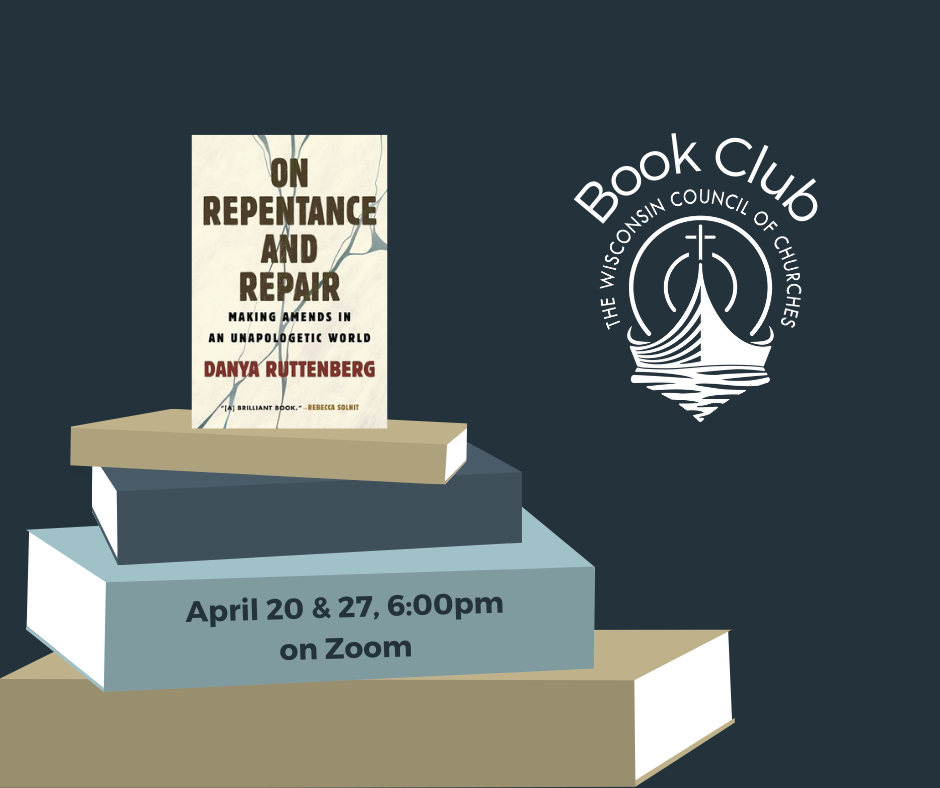
WCC Book Club: On Repentance and Repair

April 20 & 27 | 6:00-7:00pm | Online

Join us to discuss On Repentance and Repair: Making Amends in an Unapologetic World by Rabbi Danya Ruttenberg on Thursdays April 20 and 27, from 6-7pm on Zoom. You are invited to read the book ahead of time and then join both sessions to discuss it with others.


Study guide here

Register Here

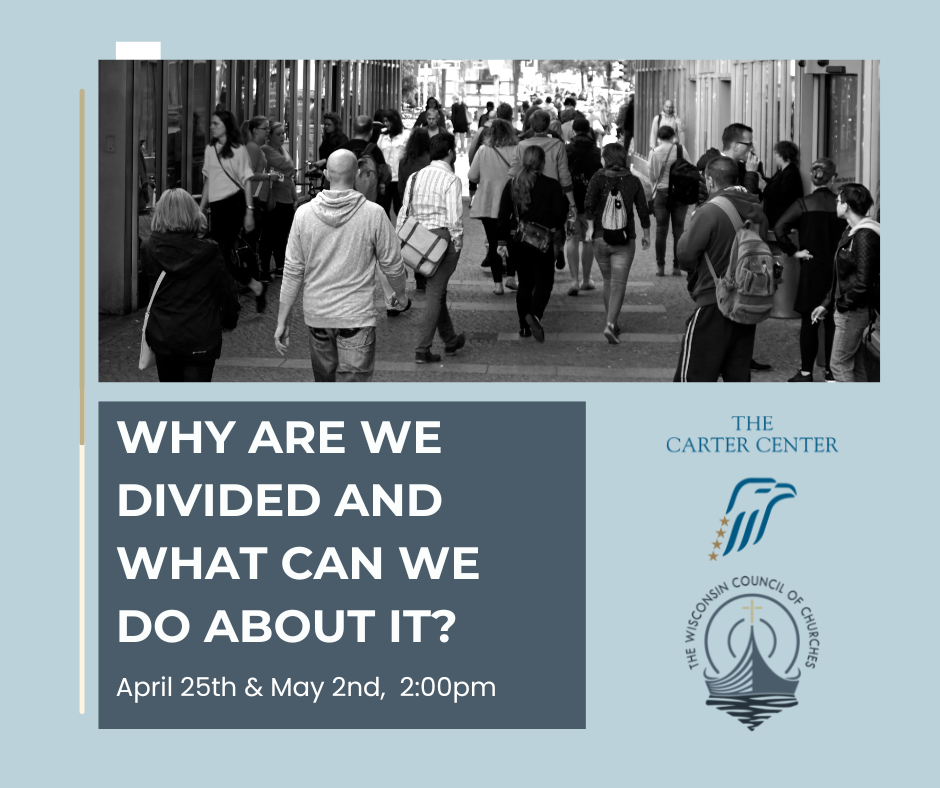
Why Are We So Divided and What Can We Do About it?

April 25 & May 2 | 2:00pm | Online

The Wisconsin Council of Churches is excited to partner with the Carter Center for a conversation about polarization in the United States. In this two-part webinar, Nathan Stock, Associate Director with the Carter Center’s Conflict Resolution Program, will explore drivers of polarization, while also sharing suggestions for addressing partisan differences in our personal relationships and our communities. These one-hour webinars will be recorded if you are unable to make one or both of the live events.

Register Here

We cosponsor a variety of events. You can see a list of upcoming events here.

Interested in cosponsoring an event with the WCC? Email us.

 
News from our Partners

Climate Change Training for Pastors

May 22-May 24 I Madison

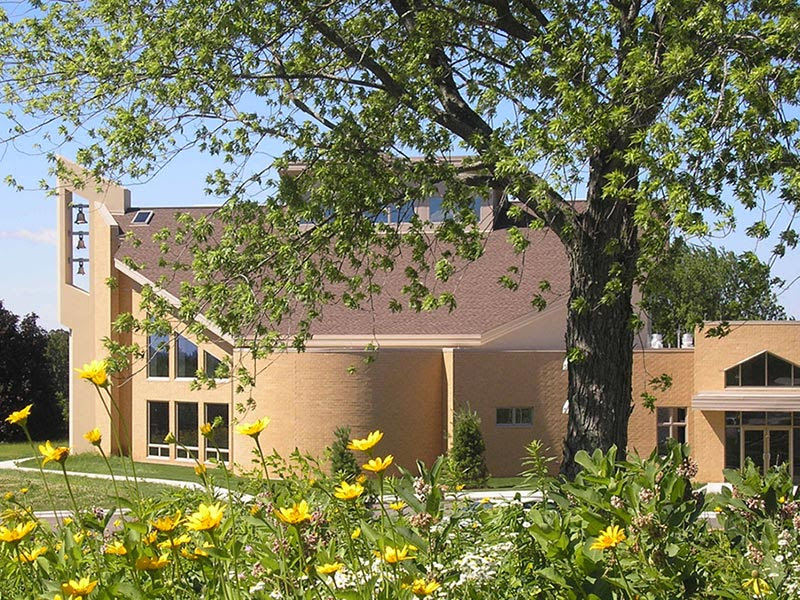
Creation Justice Ministries, the Anabaptist Climate Collaborative, Garrett Evangelical Theological Seminary, and Faith in Place invite your partnership in “Pastoring for Justice & Healing in a Climate Crisis.” Through this workshop at the Holy Wisdom Monastery in Madison, climate impacts and ministry responses will be explored, including biblical, personal, scientific, community and congregational aspects of climate change. The workshop will begin with lunch on Monday, May 22 and continue until lunch on Wednesday, May 24. The application deadline is March 31! 


This event free of charge for those engaged in ministry in the region. In addition, other leaders who come with their pastor or executive are also free. Otherwise the cost is $350.  


The exciting and diverse team of presenters from across the region include:

  • Rev. Dr. Otis Moss III, Senior Pastor of Trinity United Church of Christ in Chicago, Illinois
  • Victoria Loorz, "wild church pastor," "eco-spiritual director," and author of Church of the Wild
  • Dr. Timothy Eberhart, Assistant Professor of Theology and Ecology at Garrett-Evangelical Theological Seminary
  • Rev. Brian Sauder, President and Executive Director of Faith in Place
  • Rev. Scott Onque, Pastor of St. Luke Missionary Baptist Church, a 100-year-old historic church on the south side of Chicago
  • Doug Kaufman, Director of Pastoral Ecology at the Anabaptist Climate Collaborative
  • Avery Davis Lamb and Karyn Bigelow, co-Executive Directors of Creation Justice Ministries


More information, including biographies and a full list of presenters, is available at www.creationjustice.org/wiworkshop or by email contact at ecopastor@anabaptistclimate.org.

Do you have news to share? Send us a short description with a link to more information, and we will add it to our weekly e-news. Email illene@wichurches.org with ENEWS in the subject line.

Continue the Work of Collaboration Across our State

We focus on the YES work of our faith, modeling the alternative to systems that isolate, devalue and exclude. We extend care, joy, and grace, building a network of people committed to holy imagination. If you believe in our work and our witness, please become a financial supporter!

One-time and recurring gifts are essential to building our capacity to encourage the church.

Make a One-Time Gift Today
Become a Friend of the Council
 
Wisconsin Council of Churches | www.wichurches.org
30 W. Mifflin St, Suite 602, Madison, WI 53703
(608) 837-3108 | wcoc@wichurches.org
 
Facebook  Twitter  Instagram  Youtube