Newsletter of the Alliance's EPIC Learning Health System | | Alliance honours Dr. Jennifer Rayner with inaugural Research for Health Equity Award. | | |
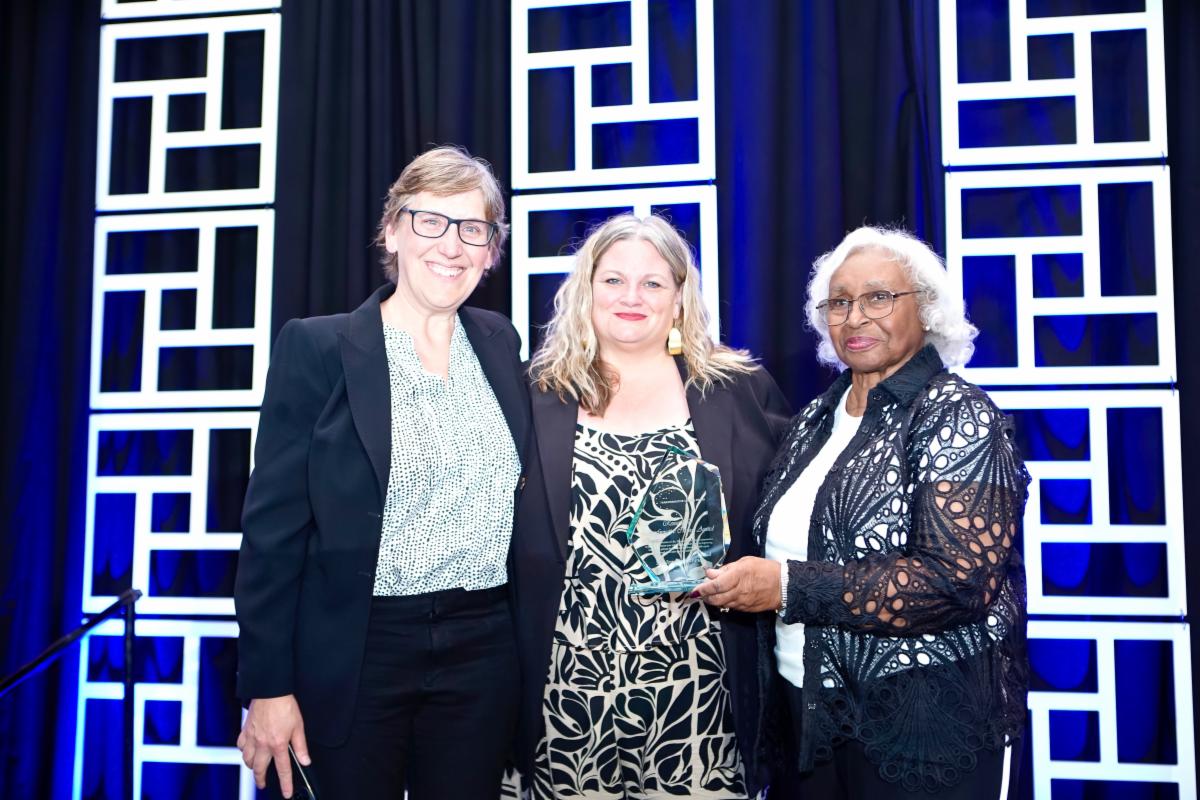
On June 4, 2025, the Alliance for Healthier Communities launched a new Research for Health Equity Award and named Dr. Rayner its inaugural recipient in recognition of her years of service to the Alliance and its members as a leader in researcher, evaluation, and advocacy.
Since officially joining the Alliance in 2016, Dr. Rayner has overseen the development of evaluation frameworks and measurement tools, led and co-led dozens of research projects, and architected the EPIC Learning Health System. Her work has helped to establish the Alliance as a recognized and respected voice for community-based, comprehensive primary health care and health equity.
Going forward, this award will be known as the Jennifer Rayner Research for Health Equity Award. Stay tuned this fall for information on how to nominate someone from your organization.
| |
Singing on Prescription:
SingWell in North Simcoe
| By partnering with an international research project and a local music instructor, Chigamik CHC and their Ontario Health Team partners are exploring an innovative way to support people with COPD in their community. | | Challenging Compounding Disadvantage | Newcomers to Canada partnered with Toronto health researchers, including some from Access Alliance, to study the compounding impacts of newcomer status, chronic illness, and the COVID-19 pandemic. | |
Equity in
Kidney Health:
A Race-Free Calculator
| For decades, the most common tool for estimating kidney function was based on incorrect and racist assumptions about Blackness and Black bodies. A new, race-free calculation has been introduced to close this equity gap. | | Learning Events
& Programs | See the courses, webinars, workshops, and other learning opportunities we've recently added to our calendars. | | Get Involved: Research & Sharing | See how you, your colleagues, and your clients can participate in research that advances health care quality and health equity. | | Access publications, reports, toolkits, and more to support your organization's learning, improvement, and advocacy. | |
Singing on Prescription:
Breathing New Life into Health and Wellbeing
Rebecca Barnstaple, University of Guelph
Arla Good, The SingWell Project
| | |
By partnering with an international research project and a local music instructor, Chigamik CHC and their Ontario Health Team partners are exploring an innovative way to support people with COPD in their community.
North Simcoe is a largely rural area between the shores of Georgian Bay and Lake Simcoe. Chigamik Community Health Centre (the “people’s place”) was established in 2010 to serve Francophone and Indigenous communities there, as well as others experiencing barriers to health care. Chigamik strives to be a welcoming space where everyone feels they belong and where cultural and linguistic needs are recognised as core determinants of health. It is also a core member of the North Simcoe Ontario Health Team (NSOHT).
A priority for the region is lung health, as North Simcoe is home to a disproportionate number of people living with Chronic Obstructive Pulmonary Disease (COPD). One of the NSOHT’s strategic goals is to develop regional, integrated care pathways for specific diagnoses, starting with COPD. While there is one lung health program for the region, community programs have been lacking. Isolation and ceasing social activities are risk factors for people living with this diagnosis.
| | The SingWell Project is an international research initiative investigating the potential for group singing to support people living with communication challenges, such as lung disease. When Chigamik’s then Community Engagement and Programs Manager Rebecca Barnstaple met SingWell co-director Arla Good at a conference in May of 2023 and learned about the goals of this program, a partnership was born. | | |
SingWell’s "Singing on Prescription" program at Chigamik began with a pilot phase to test the feasibility of the pathway and explore the potential benefits of group singing for individuals with breathing disorders. The goal was to establish a foundation for a cost-effective “singing on prescription” approach to improving wellbeing. The program was developed in partnership with Stephen Ruppert, a local music instructor, who also leads the weekly 60-minute sessions. Each session includes gentle physical warmups, breathing exercises, vocal warmups, and repertoire practice, followed by social time with coffee, tea, and cookies.
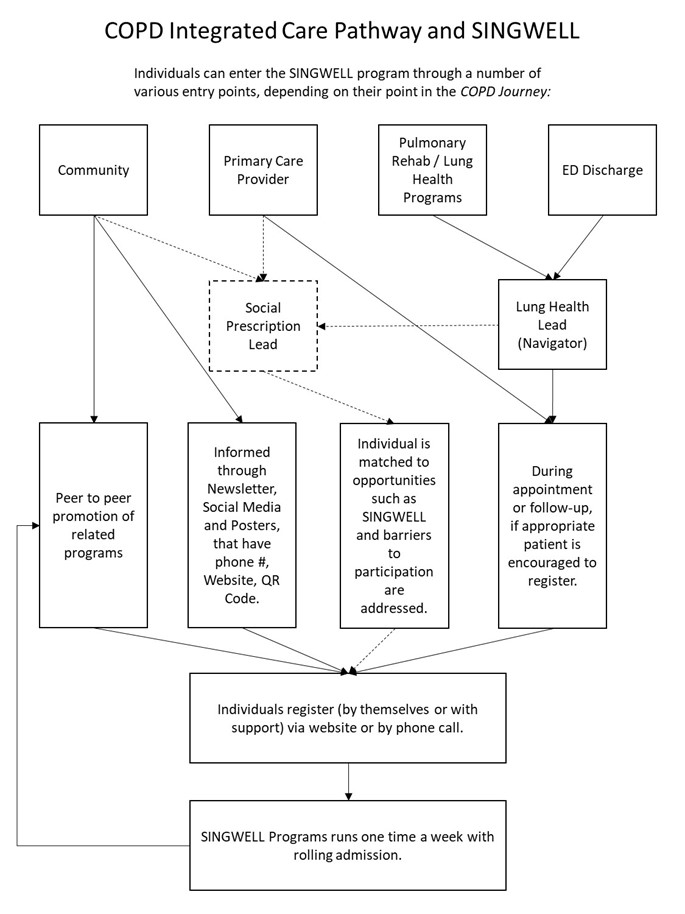
Collaborating with Primary Care team members at Chigamik and other organizations in the NSOHT helped determine a path for medical professionals to “prescribe” participation in the weekly singing group. Individuals can enter the SingWell program in various ways, depending on where they are on their journey with COPD, as shown in the pathway diagram at right (click it to enlarge). The program was designed to be accessible to people of all singing abilities - no prior singing experience or auditions required!
| |
The Care Pathway for SingWell at Chigamik. Click image to enlarge. | | Before and after the 12-week program, psychosocial wellbeing was assessed through a series of questionnaires, including scales for loneliness, social connectedness, quality of life, and severity of respiratory disease. We also tested participants before and after 60 minutes of singing to gauge mood, social bonding, and states of anxiety. Additionally, we measured biosocial indicators including heart rate variability and levels of salivary cortisol and/or oxytocin. | | |
Rebecca Barnstaple is an Assistant Professor at the University of Guelph, where she has a cross-appointment in the Creative Arts, Health & Wellness, and Theatre Studies programs. She was formerly the Community Engagement and Programs Manager at Chigamik Community Health Centre in Midland.
Arla Good is the co-director and chief researcher of the SingWell Project, a SSHRC-funded project of SMART lab, an interdisciplinary research team at Toronto Metropolitan University. SingWell involves over 50 researchers, practitioners, community organizations, and choirs in Canada and around the world.
| |
Challenging Compounding Disadvantage
An Intersectional Lens on COVID-19 and Newcomer Health
Akm Alamgir, Access Alliance
| | The COVID-19 pandemic disproportionately affected newcomers to Canada. Those who were already living with chronic illness experienced even deeper impacts – the result of “compounding disadvantages.” Researchers from several Toronto organizations, including a community health centre, applied an intersectional lens to explore these compounding disadvantages and their effects. The result: A powerful collection of videos, community reports, and publications detailing this groundbreaking study and its findings. | | |
Identifying the Impacts
Led by Dr. Mandana Vahabi, the research team from the University of Toronto, Toronto Metropolitan University, Women’s College Hospital, Access Alliance Multicultural Community Services, and other key partners focused on the compounded impact of COVID-19 on immigrants and refugees living with cancer or mental health and addiction (MH&A). Historically excluded from mainstream studies, these populations face unique intersectional social and clinical challenges that make them especially susceptible to the adverse effects of crises like the COVID-19 pandemic. Drawing on existing data, the team’s findings shed light on the urgent need to address the disparities these communities face during times of crisis.
| | |
Co-Designing Interventions
In September 2023, the team hosted two virtual Think Tank sessions to share their findings. The goal of the Think Tanks was to engage affected communities, service providers, and policymakers in meaningful discussions about strategies to mitigate barriers to social and healthcare services during crises like COVID-19. These sessions brought individuals with lived experience together with healthcare professionals and researchers, creating a platform for them to collaboratively explore solutions. These discussions ultimately aimed to identify actionable strategies to improve access to care and ensure better health outcomes and support in future public health crises.
The key recommendations from each Think Tank are summarized below:
| | Akm Alamgir, PhD, MPhil, MBBS is director of Organizational Knowledge and Learning at Access Alliance Multicultural Health & Community Services, a Community Health Centre serving immigrants, refugees, and their communities in Toronto. He is also an Adjunct Professor in the School of Social Work at York University and an Academic Editor at PLOS One. | |
Advancing Renal Health Equity
A race-free calculator for kidney function
| | For decades, the most common tool for estimating kidney function was a calculation that included a modifier for Black patients, which was based on incorrect and racist assumptions about Blackness and Black bodies. This led to routine miscalculation of kidney function for many Black individuals and may have resulted in missed or delayed diagnoses of kidney disease and, ultimately, higher rates of kidney-related illness among Black people. Now, an updated, race-free calculation has been introduced to help close this equity gap. | | |
How race was used in calculating kidney function
Estimated glomerular filtration rate (eGFR) is an indirect measure of kidney function that has been used since the 1960s to evaluate a person’s risk or severity of kidney disease. It starts with a measurement of the amount of creatinine, a natural waste product, in a person’s bloodstream. A mathematical formula is then used to derive a value for the eGFR based on this as well as the age, sex assigned at birth, height, and weight of the individual.
Beginning in the 1990s, an adjustment for race was added to the formula. This was based on some observations that people identified as Black had higher levels of creatinine, on average, in their blood. It was assumed that this difference was based in biology and would apply to Black people across the board.
Inclusion of race in the eGFR calculations was meant to adjust for this presumed difference. However, the adjustment was rooted in racist assumptions about Blackness and Black bodies. It assumed that Black people have a higher average muscle mass, which has never been proven. It also assumed that race is singular, biologically based, and visually identifiable, and it did not allow for the diversity of Black populations or multiracial identities.
This had harmful impacts. By adjusting for race, the calculation gave misleading information, making many Black people’s kidney function appear better than it really was, by as much as 10%. Early-stage kidney disease is often asymptomatic, so accurate screening is essential for timely diagnosis; overestimating eGFR led to missed opportunities for early diagnosis and care.
| | |
Developing a race-free calculation
Thanks to advances in social and scientific knowledge, combined with public advocacy, health care providers and the health system now have a more sophisticated understanding of race and health. Race is recognized as a social construct, and there is a deeper and broader awareness of the social and structural underpinnings of health inequities associated with race.
In 2020, the National Kidney Foundation (NKF) and the American Society of Nephrology (ASN) in the US reviewed the use of race in calculating eGFR and discovered that this practice was deepening race-based inequities related to kidney health and access to care.
In 2021, the NKF and ASN published an updated, race-free eGFR equation, known as CKD-EPI 2021. After a 2-year review, the CKD-EPI was endorsed by the Canadian Society of Nephrology in 2023. After consulting with numerous partners, including patients and families, Ontario Health (Ontario Renal Network), decided they would discontinue using race in eGFR calculations. In May 2024, Ontario Health (Ontario Renal Network) recommended that hospital and community laboratories implement the CKD-EPI 2021 calculation. The new calculation should be utilized by all care providers, including primary care providers, nephrologists, and other specialties across Ontario.
| | Written with input from Ontario Health (Ontario Renal Network). | |
Learning Events & Programs
| | |
July 15, 1:00 - 2:00 pm | Virtual Networking Event | Free
Join the Canadian Social Prescribing Exchange to connect and learn! Held on the 3rd Tuesdays of March, July and November, this meeting is a space for individuals and organizations in Canada interested in social prescribing to network, collaborate, and discuss current social prescribing developments. Register here. Presented by the Canadian Institute for Social Prescribing (CISP).
| | |
Through Their Lens: Using Photovoice and Cellphilms to Understand the Experiences of Clients of Safer Supply Programs in Toronto
July 24, 12:00 - 1:30 pm | Online | Free
This webinar explores innovative arts-based research methods used to understand the real-world impacts of safer supply programs in Toronto. members of the research team will present findings from two community-engaged projects that employed photovoice and cellphilms to capture participants' lived experiences with safer supply programs at two different Toronto sites. Attendees will learn about the research methodology and how to tailor the process to meet participants' needs. They'll also learn about key findings that demonstrate the positive impacts of safer supply programs. Register here. Presented by the Substance Use Health Network (SUHN) as part of their Resarch Spotlight Webinar series.
| | |
PxP Virtual Conference 2025
September 9 - 13 | Virtual Conference | Free
This world-wide conference will consist of live, core content viewed simultaneously around the world as well as "watch parties" in which content is played back at different times in different regions, allowing attendees to watch and chat with others in their region at a more accessible time. Led by patient partners, this event will provide both patients and researchers with a wealth of capacity-building knowledge, skills, and resources about patient partnership. Learn more and register here. Presented by PxP: For Patients, By Patients.
| | |
North American Refugee Health Conference 2025: Health Means the World to Us
September 11 - 13 | In-Person Conference (Niagara Falls) | $260-935
NAHRC 2025 will include keynote addresses, workshops, and oral abstracts profiling important refugee health issues in Canada and globally. There will also be ample time for for discussion and opportunities for those who work in the health and settlement sectors to network, learn from one another, discuss barriers and possible solutions, learn new skills, and develop guidelines for refugee health. Full program here. Register here. Presented by NARHC Inc.
| |
Recording Community Initiatives in PS Suite
September 17, 12:00 - 1:00 pm | Webinar | Free
This webinar is being presented to support the roll-out of a new, EMR-based tool that will help our members more easily collect and share information about their Community Initiatives in order to facilitate spread, scale, continuous improvement, and advocacy. Learn more here. Register here.
Presented by the Alliance for Healthier Communities. This webinar is open to all Alliance members; however, it is most relevant to those who work in Community Health Centres that use PS Suite.
| | |
Alliance Social Prescribing and Health Promotion Professional Learning Event
September 26 | In-Person Learning Event (Richmond Hill) | $50 - $60
This in-person professional learning event (PLE) is open to social prescribing and health promotion staff working in Alliance member organizations. If your role involves social prescribing, community development, community health or health promotion, this day is for you. Discounted hotel rates available. Learn more and register here. Presented by the Alliance for Healthier Communities.
| | |
Alliance Finance Professional Learning Event
October 9 | In-Person Learning Event (Richmond Hill) | $250 - $275
This in-person professional learning event (PLE) is open to finance professionals, executive leaders, and data management staff in working in Alliance member organizations. If your role involves financial planning, management, reporting, or data management, this day is for you. Discounted hotel rates available. Learn more and register here. Presented by the Alliance for Healthier Communities.
| | |
Trillium 2025 Primary Health Care Research Day
October 17 | Hybrid: Virtual and In Person (Toronto) | $0 (virtual), $95-$125 (in person)
This is an annual, one-day provincial meeting of researchers, policy makers, patients, and clinicians interested in primary health care research. This year's themes focus on access and attachment to primary care, featuring keynote address on attachment by Dr. Jane Philpott and a panel of experts, including Dr. Elizabeth Muggah, speaking on access. Learn more here. Register here. Scholarships are available for a limited number of in-person attendees for whom registration fees would be a barrier to participation. If you would like to share your unpublished research (completed or in progress), submit an abstract here. Presented by INSPIRE-PHC and the Ontario Departments of Family Medicine.
| | |
Type 1 Diabetes Screening in Canada: Building the Evidence, Shaping the Future
October 24, 12:00 - 1:00 pm | Webinar | Free
As primary health care professionals, your insights are essential in helping to shape upcoming research into the acceptability and feasibility of Type 1 Diabetes (T1D) screening for children in Canada, including a pilot T1D screening program. This research will inform future policy directions and begin to map essential steps for nationwide implementation. Join this webinar to learn more and add your thoughts to the conversation. Learn more about the research here and register here. Presented by the Alliance for Healthier Communities and the CanScreenT1D Research Consortium.
| |
November 18, 1:00 - 2:00 pm | Virtual Networking Event | Free
Join the Canadian Social Prescribing Exchange to connect and learn! Held on the 3rd Tuesdays of March, July and November, this meeting is a space for individuals and organizations in Canada interested in social prescribing to network, collaborate, and discuss current social prescribing developments. Register here. Presented by the Canadian Institute for Social Prescribing (CISP).
| |
CPRI Clinical Symposium
November 25 | Online| $40-$80
Join the Child & Parent Resource Institute (CPR) for this biennial symposium focused on key developments in complex child and youth mental health and fostering resiliency through evidence-based psychosocial interventions. Register here.
| | |
Alliance Data and Quality Improvement Professional Learning Event
November 25 | Richmond Hill | $250-$275
Join the Alliance's EPIC Learning Health System team at this full-day, in-person learning event to develop your strength and confidence in quality improvement (QI), explore ways to use your data to inform improvement efforts, and connect with peers from across the province. Register here. This event is for Alliance members only. It will be especially relevant for data management professionals, program managers, quality managers, and anyone else whose role includes data management or QI.
| | Ongoing Training and Collaborative Learning | | Learning Collaborative 4: Increasing access through intake process improvements – Using an equity-based approach | | |
Rapid Action Learning Intensives (RALI)
Alliance for Healthier Communities
Rapid Action Learning Intensives (RALI) are a learning tool developed by the Alliance to spread and scale successful change ideas from our learning collaboratives and implementation pilots. RALI is self-paced and coach-supported learning. Participating teams get access to online modules, a workbook, curated external resources, and the dedicated support of an Alliance Quality Improvement Coach, as well as the option to join scheduled learning sessions, when available. RALI is available in English and French. Currently, we are offering RALI on two topics: Improving your sociodemographic data collection process (RALI-SDD) and implementing the EQ-5D Patient-Reported Outcome Measures Tool (RALI-PROMs). To learn more or sign up, email QI@AllianceON.org.
| | |
Social Prescribing - Online Course
Alliance for Healthier Communities
Our new health equity-focused, online Social Prescribing training modules are designed for healthcare teams interested in implementing or improving their social prescribing process. These self-directed modules include Getting Buy-in from Interdisciplinary Teams, Co-designing a Process Map, Building an Asset Map, Meeting with Clients, and Using the EMR to Track the Client's Journey, among others. Learn everything from key terms and concepts to practical tips on creating helpful resources tailored to your workplace and working with clients. The modules can be taken individually or as a whole course. Also available in French. Register here.
| | |
ECHO at UHN
Echo at UHN is an interactive, interprofessional, collaborative learning program funded by the Ontario Ministry of Health. It's free and open to all health care providers, and CPD credits are available. Participants get access to weekly didactic lectures and anonymized, peer-led case discussions. Learn more and register here.
| | |
FUNDING OPPORTUNITY: IHI Pfizer Collective Action Collaborative
Institute for Healthcare Improvement | Apply by July 11
Up to $10,000 available! Eight community-based organizations and health systems in Canada and the US will be chosen to participate in this 14-month Collective Action Collaborative, which will build capacity for integrating social-related health needs and health care for the most vulnerable patients. Participating teams will receive a $10,000 grant from Pfizer to support their work. Participating teams should include community-based organization staff, health care system staff, a patient/client representative, and preferably someone with data analysis and quality improvement knowledge. Full details and application instructions here.
| | |
Successes from Black-Focused Social Prescribing
Recorded Webinar | Alliance for Healthier Communities
This webinar was presented on June 12 by the Alliance for Healthier Communities in partnership with participating organizations and evaluators in the Black-Focused Social Prescribing (BFSP) project. It provides an overview of the project and the final evaluation report that was published earlier this year.
| | |
Connected Health Neighbourhoods: A Vision for Health System Transformation
Recorded Webinar | Alliance for Healthier Communities
In this webinar, Sarah Hobbs, CEO, and Jennifer Rayner, Director of Research and Policy at the Alliance, shared a vision of a system of locally coordinated and integrated, community-based primary health care based on the Model of Health and Wellbeing - a vision that, if implemented, has the potential to advance health equity and vastly improve the health and wellbeing of people across Ontario. Also available in French.
| | |
Webinar: Ontario AI Scribe Program - Your Guide to Smarter Clinical Documentation
Recorded Webinar | Ontario MD
On June 16, OntarioMD hosted a webinar share details of the new Ontario AI Scribe Program and answer questions from their colleagues. Watch the recording to learn more about AI scribes on the OMD Practice Hub. NOTE: The Alliance, on behalf of the members, are working with OntarioMD and Supply Ontario on the second level procurement. We are looking for AI Scribes that meet Alliance member requirements at a reduced price.
| | Other Learning Opportunities | | |
Indigenous Cultural Safety in Mental Health
Self-Paced | Online | $175 per User - Discounts Available
The Indigenous Primary Health Care Council (IPHCC) recently launched a second cultural safety course as part of their Anishinaabe Mino’Ayaawin – People in Good Health program. The Indigenous Cultural Safety in Mental Health course provides a comprehensive understanding of mental health challenges within Indigenous Communities. It combines historical and present-day contexts with actionable and effective strategies to support culturally safe mental health practices. To participate, email ics@iphcc.ca with your name, organization, and the course name - Indigenous Cultural Safety in Mental Health. Their team will follow up with registration and payment details.
| | |
Primary Care Clinician Educational Series: Your Gateway to Quality Improvement!
Self-paced | Online | Free
Advance your quality improvement learning and earn CME credits with the Department of Family and Community Medicine's free self-paced learning series designed to provide primary care clinicians with the knowledge and skills to lead QI work in their practice. This engaging program covers nine comprehensive e-modules on key topics like the Model for Improvement, patient engagement, equity, patient safety, and more.
Why complete the modules?
-
Interactive Learning: Dive into modules packed with videos, practical resources, and real-world examples.
-
Flexible Approach: Complete the series at your own pace or focus on the modules most relevant to you.
-
Professional Development: Earn up to 6 Mainpro+ credits from the College of Family Physicians of Canada.
Enhance your QI skills and make a lasting impact in your practice! For more information and to register to access the series please visit https://dfcm.utoronto.ca/primary-care-clinician-educational-series. What to know more? Email dfcm.quality@utoronto.ca.
| |
Research & Sharing Opportunities
| | |
Help the Alliance Evaluate Health Promotion for Chronic Disease Management
The Alliance is conducting a project to measure the impact of chronic disease management health promotion programs on client outcomes in CHCs, demonstrate the importance of health promotion as part of our model of care, and support the creation of a standardized approach to evaluation health promotion programming. This project was co-designed with CHC staff and CHC client advisory groups. Participating organizations will share information about their health promotion program and support client recruitment. Participating clients will complete pre-program, post-program, and follow-up surveys and may be invited to participate in a virtual interview. Clients will receive up to $50 depending on their involvement. Email Isabelle.Fortuna@AllianceON.org for more information or to sign up. Sign up by December 15.
| | Surveys, Focus Groups, and Interviews | | |
African-Caribbean-Black Vaginal Health Study
African, Black, and Caribbean (ACB) people living in Toronto or the GTA are invited to participate in community-based research at Women’s Health in Women’s Hands. Participants can choose to contribute to a focus group interview; complete a survey and have a sample collected; or both. Sign up by August 15.
| | |
Health Promotion Program Evaluation Project
Help the Alliance develop a standardized approach to measuring the impact of chronic disease management health promotion programs on client outcomes. Sign up your health promotion program by December 15.
| | Evidence for Comprehensive, Community-Based Primary Health Care | | |
Annotated Bibliography: Evidence for the value and impact of Community Health Centres
There is an abundance of evidence demonstrating the value and impact of Community Health Centres (CHCs), the critical role they play in Ontario’s Health System, and their potential to advance health system integration and sustainability. This bibliography can help you access that evidence to support your decision-making and advocacy. Developed by the Alliance for Healthier Communities.
| | |
Vision for a Health Home
This document elaborates on a vision of primary health care based on the MHWB, bred in our bones. If implemented, it will improve the health and wellbeing of people across Ontario. Developed by the Alliance for Healthier Communities. Also available in French.
| | Insights for Improvement and Highest-Quality Care | | |
Ontario Hepatitis C Elimination Roadmap
The Ontario Hepatitis C Elimination Roadmap is guiding policy and practice action to end hepatitis C as a public health threat by 2030. This is a collaborative, multi-sector initiative led by hepatitis C experts and with contributions from government, clinicians, community and more. It outlines an approach to reduce new infections by 80% as well as diagnosing 90% of people living with hepatitis C and beginning treatment for 80%
| | |
Cancer and Renal Systems Plans Released by Ontario Health
Ontario Health has released the sixth Ontario Cancer Plan and fourth Ontario Renal Plan, both spanning the years 2024 to 2028. These plans build on the solid foundations of previous plans, which have led to progressive advancements in the way cancer and kidney services are managed and delivered across this province. Working together with partners across the health system, Ontario Health is putting these plans into action to ensure there are systems in place dedicated to reducing the burden of cancer and chronic kidney disease, and to providing high-quality cancer and kidney care when and where people in Ontario need it.
| | |
Strategic Planning for Planetary Health and Sustainable Care playbook
This resource from CASCADES identifies practices for incorporating climate change considerations and planetary health into organizational strategic plans to support the transition to sustainable, equitable health systems. Grounded in evidence and illustrated with real-world case studies, this playbook outlines seven actionable organizational practices to embed planetary health and sustainable care into healthcare strategy.
| | |
Social Work in Primary Care Modules
Six e-learning modules about the role of social workers in primary health care teams were recently released in both English and French. Created for social workers in primary care and social work learners considering a future practice in primary care, they are also useful to health professionals and trainees from other disciplines who want to learn more about social workers' role in primary care.
| |
Looking for more?
Consider subscribing to these newsletters to receive regular updates from Alliance system partners:
| |
Got a moment?
Tell us what you think of EPIC News
| |
| Do you consider the content relevant? | | | |
| Do you consider the presentation (writing, layout, visual elements) to be engaging? | | | | |
Thank you!
Your responses will help us make EPIC better.
Please send comments, suggestions, or story ideas to LHS@AllianceON.org.
| | | | |