Newsletter of the Alliance's EPIC Learning Health System | | Towards Sustainable Attachment | | Alliance News: Conference, QI | | New clinical tools for POTS, ME/CFS and FM | |
| Learning Events
& Programs | | Get Involved: Research & Sharing | | |
Sustainable Primary Care Attachment
Insights from community-based research
Interview with Dr. AKM Alamgir, Access Alliance Multicultural Health & Community Services
| | The need to attach millions of people to primary care has been a significant driver of activity in the community primary health care sector and across the health system since 2024. Access Alliance Multicultural Health & Community Services is one of the organizations that has received funding to increase its primary care capacity and is working hard to attach new clients. This prompted their research team to wonder: How do we know whether our attachment efforts are aligned with the needs of clients, providers, and the health system? EPIC News spoke with Dr. AKM Alamgir, a researcher on the Attachment Readiness Initiative, to learn more. | |
Defining Attachment: Why alignment matters
The researchers view the attachment initiative as timely, population health-focused, and primary care-enhancing, and they urge its continuation as a sustainable and scalable practice. They began by studying client and provider perceptions of what it means to be attached. They found people who had attended an uninsured walk-in clinic at a CHC and saw a primary care provider with language supports, who referred them to a specialist in the community. The specialists’ fees are being covered by the CHC. To the client, this means they are attached. But to the provider, this is a single encounter, because there’s no long-term ongoing clinical relationship. Both are logical assumptions, but they are unaligned.
Another type of unalignment occurs when a client is nominally attached but does not feel that the relationship with the provider is meeting their needs. This can happen because of system constraints – for example, a client may not feel seen or heard adequately to their satisfaction when appointments are kept short and limited to a single issue. It can also arise when the provider is in some sense perceived (by the clients) as unready, such as when a client who is racialized, a newcomer, or a member of a 2SLGBTQ+ community does not receive culturally safe or appropriate care, or when an individual living with a complex, chronic illness is prescribed ongoing testing or treatment they can’t afford. In such cases, clients can experience what Dr. Alamgir calls a “decay of readiness” (for attachment) as they lose trust in the system and the provider to whom they are attached, and they distance themselves from the relationship.
| |
Sustaining Attachment with Equity and Accessibility
Dr. Alamgir emphasizes that the work of attaching unattached people to primary care is essential and must continue, and that it must be done in a way that aligns with patient needs, doctor motivation, and system ease. He shared three specific calls to action that can help:
-
Ensure that the work of attachment goes hand-in-hand with implementation research and realist evaluation. Monitor attachment quality and quantity to ensure they are equitable, meaningful, and sustainable; that client and provider readiness are aligned; and that we can identify when course-correction is needed and act accordingly.
-
Build readiness into the system by making health records portable and interoperable. Despite many changes in EMRs over the years, systems across sectors are not always able to share important information. One of the promises made when offering attachment is that the person will have someone to walk with them on their health journey and won’t have to keep telling that story. Without interoperability, that promise is often impossible to keep, leading to trust and decay of readiness.
-
Remove the barriers that are keeping 6000+ internationally trained clinicians from working in Ontario. Bringing more clinicians into the system as a supply component of the issue builds capacity for attachment. Bringing in clinicians of diverse ethnic, cultural, and linguistic backgrounds specifically builds capacity for attachment to tailored, culturally safe care that meets diverse needs.
Attachment to primary care is like one leg of a three-legged stool: It is upheld and sustained by the two others: Equity and access. Each of Dr. Alamgir’s calls to action supports and sustains attachment by ensuring that people are attached to equitable, accessible care. “In conclusion,” he says, “attachment is a system-enabled relationship rather than a singular administrative event. To achieve sustainable continuity of care, we need a readiness-informed approach to attachment that invests in navigation supports, reduces clinician burnout, and standardizes intake processes.”
| |
Dr. AKM Alamgir is a community-based researcher whose work bridges academia, policy, and community action to address health equities among refugees and marginalized populations in Canada. He is Director of Organizational Knowledge & Learning at Access Alliance Multicultural Health and Community Services, an Adjunct Professor at York University, a guest teacher at the University of Toronto, and an Academic Editor of the PLOS One journal. He holds a PhD in evaluation research, a master’s degree in epidemiology, and a bachelor’s degree in medicine.
| |
Alliance News:
Updates on our 2026 Conference, QI Supports, and more
Alliance for Healthier Communities
| |
2026 Conference: Attachment for Everyone
Although winter still has a firm grip in Ontario, June is just a season away, and planning for our annual conference is well underway. This year's theme, Attachment for Everyone: Centring Health Equity in Ontario’s Primary Health Care Expansion has generated excitement among our members and system partners, and we received a record 144 abstract submissions. Our Learning Sessions team is now eagerly reviewing them and diving into the work of creating 32 learning sessions and 14 research posters.
Mark your calendars: Registration opens next week, and early bird rates will be available until April 16. The conference will take place on June 3rd and 4th at the Sheraton Parkway North Toronto in Richmond Hill. Don't miss out; last year's conference sold out well in advance. For more information or to find out about how to be a sponsor or exhibitor, email Conference@AllianceON.org.
IPCT Expansion Supports for Attachment and Access
The Interprofessional Primary Care Team (IPCT) Expansion Toolkit, which we first published in Spring 2025, has been updated and expanded for 2026. We anticipate another round of updates in late spring or early summer. If you have questions about the toolkit, suggestions for improving it, or content to submit, please reach out to us at LHS@AllianceON.org
| | Advancing your Quality Improvement Goals | | |
Our Learning Health System team is committed to helping Alliance members deliver highest-quality, person-centred care. Supports available include:
-
Rapid Action & Learning Intensives (RALIs) for Sociodemographic Data Collection and using the EQ-5D tool to collect Patient-Reported Outcome Measures. RALI is a self-paced online learning tool that includes tailored coaching and implementation support from our Quality Improvement & Performance Leads (QIPLs)as well as access to curated resources and the option to connect with peers working towards similar goals.
- A Social Prescribing Online Course, a series of modules that takes about three hours to complete across up to six months.
- Tailored QI and implementation coaching from our QIPLs and our social prescribing implementation coach.
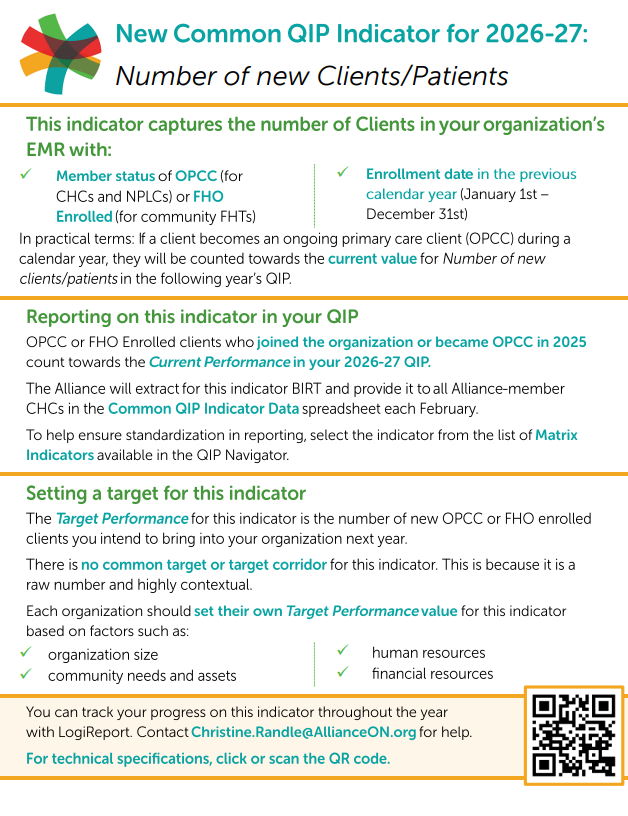
- Updated resources to support your 2026-27 Quality Improvement Plan (QIP). This year, we've introduced a new indicator, Number of New Clients/Patients to our set of Common QIP Indicators (right).
| | | |
Sharing our Stories of Impact
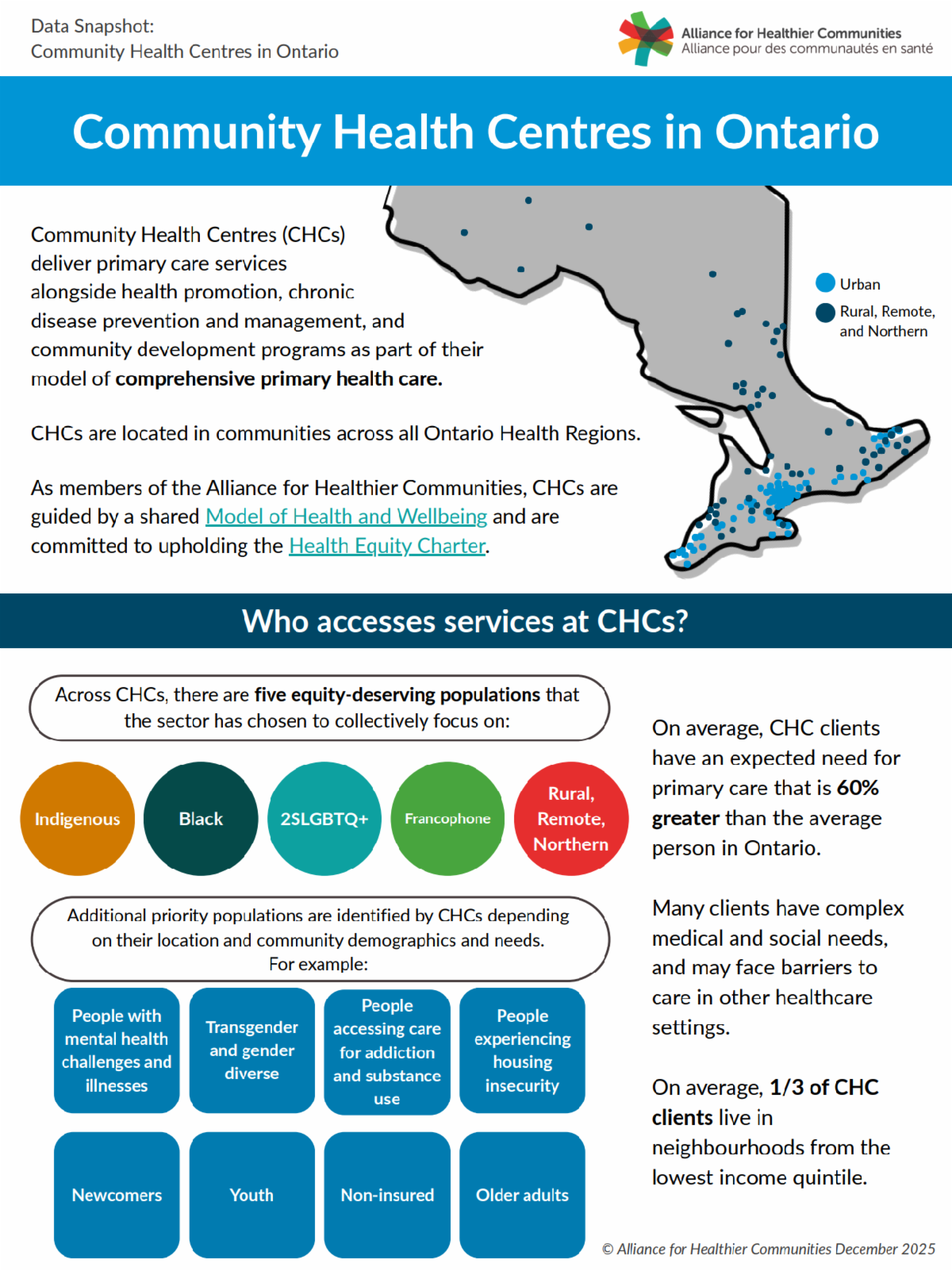
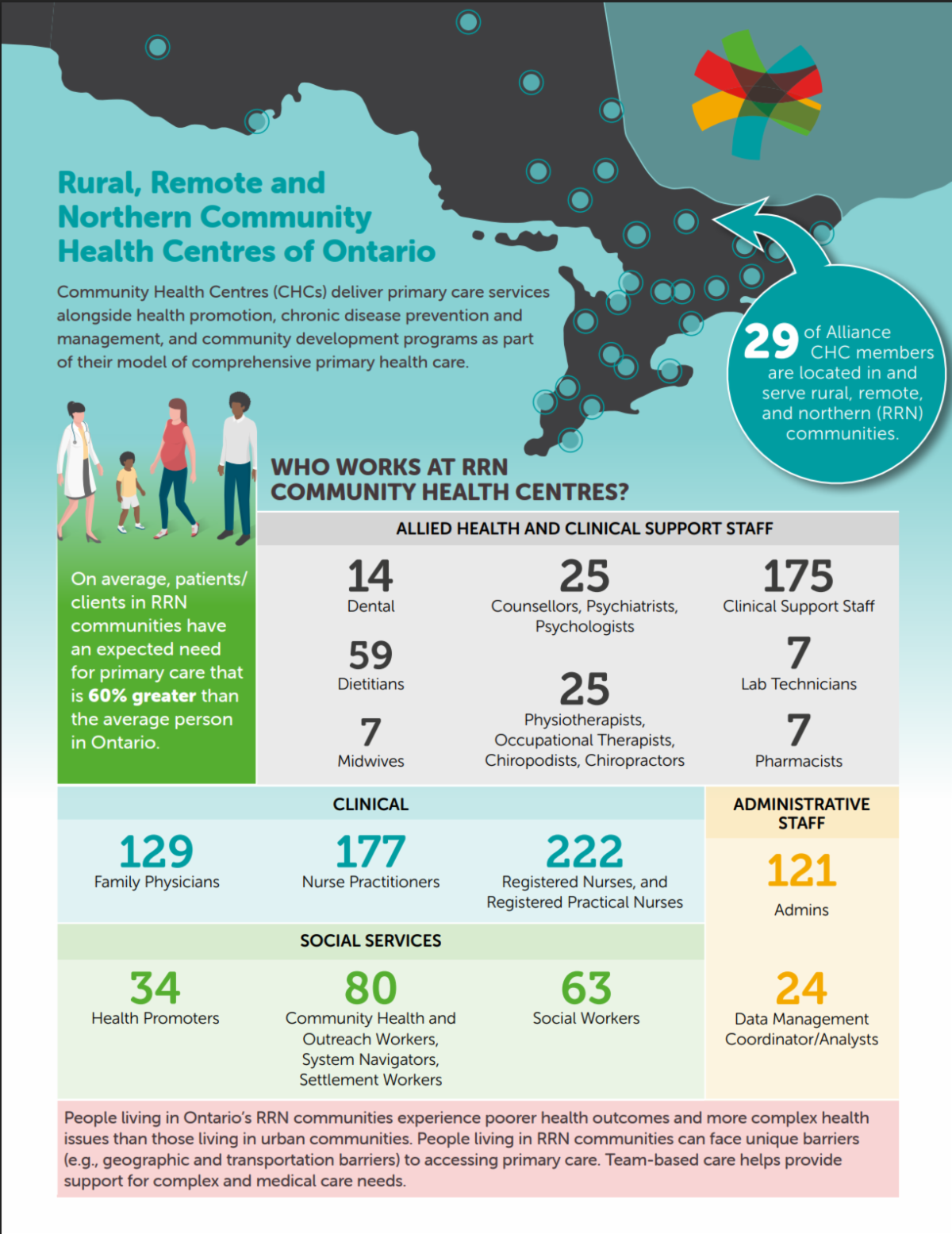
Thanks to our members, who took the time in the midst of all the busy-ness to respond to last year's membership survey, we are creating a series of infographics that describe our sector and illustrate our members' work of advancing health equity. So far, we have published and updated (and visually improved) CHC Data Snapshot (below, left) and a brand-new infographic on Rural, Remote and Northern Community Health Centres of Ontario (below, right). Coming soon: Infographics about how our sector is advancing equity for Black, Francophone, and 2SLGBTQ+ people and communities.
| |
Helping Your Team Identify and Manage POTS, ME/CFS and Fibromyalgia
Evidence-Informed Tools for Primary Health Care
Kathleen Dennis, CareNow Ontario
| | |
Are you seeing clients with persistent but hard-to-explain symptoms — debilitating fatigue, dizziness, unrefreshing sleep, pain, or brain fog — and wondering how best to help when tests don’t provide clear answers?
For many people living with Postural Orthostatic Tachycardia Syndrome (POTS), Myalgic Encephalomyelitis/Chronic Fatigue Syndrome (ME/CFS), and Fibromyalgia (FM), symptoms begin after an infection but persist long after the initial illness resolves. Although no single pathogen has been confirmed as a cause of ME/CFS, up to 80% of people report onset following an acute viral-like illness, including Epstein–Barr virus, influenza, COVID-19, and other viral or bacterial infections.
These infections can trigger long-lasting conditions — including POTS, ME/CFS, and FM — that share features such as debilitating fatigue, cognitive dysfunction, autonomic nervous system instability, sleep disruption, and pain. This post-infectious pattern is not always recognized in clinical practice, contributing to delays in diagnosis and care.
| | Tools from CEP for POTS, ME/CFS, and Fibromyalgia | | a single specialty. As a result, many patients are referred to multiple specialists without receiving clear answers, and a substantial proportion wait five years or more for a diagnosis. | | |
Post-Pandemic: Cases on the Rise
| Since the COVID-19 pandemic, Infection associated chronic conditions have increased substantially, with research suggesting that roughly half of people with Long COVID meet diagnostic criteria for ME/CFS, alongside a marked rise in cases of POTS. Primary health care providers and teams are now seeing growing numbers of clients with these conditions. | |  | |
What is Post-Exertional Malaise (PEM)?
| Post-exertional malaise (PEM) is a hallmark feature of ME/CFS characterized by a worsening of symptoms following physical, cognitive, or emotional exertion that would previously have been tolerated. Symptom exacerbation may be delayed by hours or days and can last for days or longer, often significantly impairing function. | | |
The Role of CHCs, IPHCOs, NPLCs and FHTs in Advancing Care
Community Health Centres and other equity-focused primary care settings are uniquely positioned to lead in this area. Clients living with ME/CFS, POTS, FM, and Long COVID (the latter being another overlapping infection-associated chronic condition) often face intersecting barriers related to gender, disability, income, race, and access to specialty care.
The CEP tools align well with interprofessional team models by supporting comprehensive, team-based management and creating a shared clinical language across interprofessional teams.
Ontario now has practical, evidence-informed resources to support safer, more confident, and more equitable care — in the setting where patients first seek help: in primary care.
| | Keep learning with these additional resources | | |
Free CEP Tools Webinar
Wednesday, May 20
| |
|
Join CareNow and the Alliance for Healthier Communities for a free Lunch & Learn webinar. Get an overview of the CEP tools, hear from providers and clients who have benefitted from them, and come away better equipped to identify and care for people living with POTS, ME/CFS and Fibromyalgia.
Register here
| CareNow wants to hear from you. Complete this short survey to help us understand how best to support you in this work. | | |
|
The lingering shadow of epidemics: post-acute sequelae across history
| |
Christine M. Miller, Janna K. Moen, & Akiko Iwasaki. Trends in Immunology (2026).
Read it here
| |
Unexplained post-acute infection syndromes
| |
Jan Choutka, Viraj Jansari, Mady Hornig & Akiko Iwasaki. Nature Medicine (2022).
Read it here
| | | Kathleen Dennis is a former nurse and a lived-experience advisor with CareNow Ontario, an organization that seeks to improve access to services for people living with Myalgic Encephalomyelitis/Chronic Fatigue Syndrome (ME/CFS), Fibromyalgia (FM) and Environmental Sensitivities/Multiple Chemical Sensitivity (ES/MCS). She contributed to the development of the CEP Toolkit for FM, ME/CFS, and POTS. | |
Learning Events & Programs
| | Attachment for Everyone: Centring Health Equity in Ontario's Primary Health Care Expansion
June 3-4, 2026 | In-Person (Richmond Hill) | $454 and up
Presented by the Alliance for Healthier Communities | |
CPRI Research Symposium 2026
June 16, 9:00 am - 3:30 pm | In Person (London, ON) | $40-120
Presented by the Child & Parent Resource Institute (CPRI)
Leading Quality Improvement: Essentials for Managers
16 Weeks Starting June 9 | Online | $995 (USD)
Presented by the Institute for Healthcare Improvement
| |
Ongoing Training and Collaborative Learning
Echo at UHN
Free, interprofessional, collaborative learning funded by the Ontario Ministry of Health. Join ongoing cohorts on liver, concussion, rheumatology, and chronic pain & opioid stewardship. Register here.
ECHO Planetary Health & Sustainable Care
Next cycle starts on April 7, 2026. This time, the topic is Climate Impacts on Health & Health Equity. Register here.
Rapid Action & Learning Intensive on Sociodemographic Data Collection
Free, open to Alliance members only. Sign up any time for access to four online modules, a workbook to help track your progress, and expert coaching support if and when you need it.
The Canadian Social Prescribing Exchange
All individuals and organizations in Canada who are interested in social prescribing are welcome to participate. Presented by the Canadian Social Prescribing Exchange. Register here.
Bamemin – To Care For: Cultural Safety Training for Health Care Practitioners
Free, online cultural safety training from the Ontario Native Women’s Association, developed to improve healthcare delivery for Indigenous women and their families.
| |
Research & Sharing Opportunities
| | |
Climate & Health Conference 2026
Apply by May 29
This conference will take place in Toronto on October 23. Abstracts are being accepted for oral presentations, panelists, interactive workshops/roundtables, and posters.
| | Research Participants & Partners | | More Tools for Population Health and Highest-Quality Care | |
Sawubona Africentric Circle of Support
Sawubona was created to provide a safe space for families of African descent to come together, share resources and expertise, and support one another through the journey of raising Black children or supporting a sibling with a disability. TAIBU Community Health Centre is one of the partner organizations; funding is provided by the Government of Ontario and the Ontario Caregiver Organization. Check out their community resource listings and their handbook and toolkit, (available in English and French).
Recorded Presentation: Nursing Home Without Walls
Senator Victor Boudreau presented the Nursing Home Without Walls model at the Senate of Canada. This evidence-informed, community-based model can help older adults age where they call home by delivering care, social connection and support directly to them at home.
Teach Resilience
Teach Resilience is a trauma-informed training program for organizations across Ontario and Canada, and it grew out of training developed by and for staff of the Kingston Community Health Centres, with funding from the Community Foundation of Kingston. It is now offered to organizations across Canada as a social enterprise supporting Pathways to Education Kingston at KCHC. Facilitators are certified by the Community Resilience Initiative to help participants build resilient thinking at individual, community, and systemic levels. Learning sessions combine seminal studies and emerging science with practical tools, best practices and personal insight. Presentation formats can be adapted to groups of any size, delivered online or in person, and taught in full-day blocks or multiple shorter sessions.
| |
Other Newsletters
Looking for more? Consider subscribing to these newsletters to receive regular updates from Alliance system partners:
| |
Got a moment?
Tell us what you think of EPIC News
| |
|
| How interesting did you find the content of this issue? | | | | |
| How engaging did you find the presentation ( layout, writing)? | | | | | |
Thank you!
Your responses will help us make EPIC better.
Please send comments, suggestions, or story ideas to LHS@AllianceON.org.
| |
| | | |