Thursday, February 11, 2021 |
|
DR EPIC Newsletter
For Arizona SNFs: Emergency Preparedness Infection Control
|
|
Infection Preventionists Assemble...
Monthly Call Planned for March 25!
Have you recently been assigned the Infection Control Position within your facility? Are you a seasoned Infection Preventionist that is looking for fresh ideas and strategies? The Disaster Ready Emergency Preparedness Infection Control (EPIC) grant program is dedicated to supporting you in this role and helping you implement infection prevention and control measures that empower you to confidently succeed in your role. Beginning in March on the fourth Thursday of each month at 1 pm, the DR EPIC program will be hosting a monthly one-hour zoom call with our subject matter expert, Dr. Buffy Lloyd-Krejci. The first call with be Thursday, March 25th at 1 pm. This is the time to have all of your infection prevention and control questions answered and to collaborate with your Arizona peers. In the meantime, if you are interested in participating in the monthly calls, please send your contact info (including title, facility, email address and phone number) to Kay Huff at khuff@azhca.org. We will send you the link to join in prior to the call.
|
|
DR EPIC Tip Topics:
Exploring the Top Ten Deficiencies in SNF Infection Control Surveys
The DR EPIC program has been offering “Tip Topics” on the top ten deficiencies cited in infection control surveys. You can find the resources provided to date on the DR EPIC website athttp://epic.disasterreadyaz.org/. Here are a few for your review:
-
Housekeeping and Laundry: Some citations involve not following the facility policies and appropriately wearing PPE for transmission-based precautions while cleaning and lack of training for the housekeeping staff and laundry staff not following the proper procedures for handling the linen from the COVID-19 unit. To learn more about corrective actions and best practices to consider, check out this Tip Topic.
|
|
-
Hand Hygiene: Other citations relate to empty hand sanitizer dispensers, CNAs not washing hands between resident contact and licensed nursing staff not washing their hands when leaving a resident room that is on droplet transmission-based precautions. To learn more about corrective actions and best practices to consider, check out this Tip Topic.
|
|
-
PPE: Other citations center around PPE access, staff not correctly earing the PPE per the facilities policies and residents not wearing face coverings outside of their rooms. To learn more about corrective actions and best practices to consider, check out this Tip Topic.
|
|
HPP Funds Available for AzCHER Members
The Arizona Coalition for Health Care Emergency Response (AzCHER) has funding available for AzCHER members. Funds can be used to obtain supplies, services and equipment needed to adequately prepare for and respond to emergencies affecting the health care delivery system. A portion of the coalition's HPP funding has been set aside to provide sub-awards of up to $5,000. For more information go to https://azcher.org/coalition-funds.
|
|
Focus on K-923:
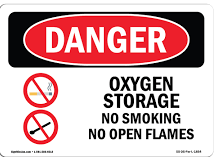
Oxygen Storage Signage
A common deficiency that skilled nursing facilities receive is K-923 pertaining to oxygen storage requirements. Specifically, facilities are sometimes cited for having improper signage in place on their oxygen storage room. Here's an excerpt from NFPA 99 regarding this requirement:
A precautionary sign readable from 5 feet is on each door or gate of a cylinder storage room, where the sign includes the wording as a minimum "CAUTION: OXIDIZING GAS(ES) STORED WITHIN NO SMOKING"
While smoking is obviously not allowed in a health care facility, the Health Care Facilities Code (NFPA 99, 2012 edition) still requires this language "as a minimum." It is important that the signage on your facility's oxygen storage room(s) meets this requirement to help ensure safety and compliance. Click here for a complete listing of the Life Safety tags applicable to a skilled nursing facility. Contact Stan Szpytek, AHCA Life Safety/ Disaster Planning Consultant with any questions at 708.707.6363 or email at stan@azhca.org.
|
|
E Tag Compliance and Familiarity with the Post-Acute Care Capacity Tracker (PACCT) |
At the end of May 2020, in order to assist with hospital surge related to COVID-19, ADHS mandated post-acute facilities to utilize the PACCT form to enter census, bed space and ability/willingness to accept COVID-19 patients. By completing PACCT, facilities meet at least two Emergency Preparedness regulatory requirements; E0009 EP Collaboration and E0034 Sharing information on Occupancy/Needs and possibly E0025, Arrangement with other Facilities. If you are a post-acute facility, be sure to find out who is entering this data for your building and make sure completing the PACCT is a priority. For more information contact DR EPIC Consultant, Gil Damiani at gild@azhca.org.
|
Beware of Counterfeit N95 Masks |
Heads up! The Washington State Hospital Association (WSHA) says hundreds of thousands of N95 masks bought by local hospitals and the association are counterfeit. The WSHA says 3M, a manufacturer of the N95 mask, notified them on Friday of possible counterfeit masks in circulation. According to DR EPIC Program Industrial Hygienist Derrick A. Denis of Clark Seif Clark, Inc. “Ne'er-do-wells exist; they always have. Sadly, N95 respirator counterfeits are out there. It is particularly disheartening when these unscrupulous folks prey upon the desperation spurred by a global pandemic. Counterfeit N95s likely do not protect you, your team or your residents as you expect. At best, you simply do not get what you paid for and at worst their use causes injury or death of staff and residents. I hope a thorough investigation is launched, and I hope any perpetrators of these deceitful acts, who found to be guilty, receive prosecution to the fullest extent. Buyers beware!" We do not yet know the identity of the counterfeit mask supplier but will make you aware of the name as soon as possible. Here is a helpful resource in the meantime: https://www.cnn.com/2021/02/05/us/counterfeit-masks-how-to-spot-trnd/index.html.
|
|
OSHA Issues Stronger Workplace Guidance on Coronavirus
-
Conduct a hazard assessment. - This is a focused assessment process to identify hazards in the workplace related to COVID-19 (not the same as the Emergency Preparedness HVA you review annually at your facility.)
- Identify control measures to limit the spread of the virus.
- Adopt policies for employee absences that don’t punish workers as a way to encourage potentially infected workers to remain home.
- Ensure that coronavirus policies and procedures are communicated to both English and non-English speaking workers.
- Implement protections from retaliation for workers who raise coronavirus-related concerns.
Contact Stan Szpytek, AHCA's Disaster Ready / DR EPIC Consultant with any questions at stan@azhca.org or on his mobile number at 708.707.6363
|
|
Life Safety Considerations During a Pandemic
-
Storage Height: As facilities continue to navigate the logistical elements of infection control within their facilities, a simple reminder on Life Safety compliance is in order. Storage in storage rooms and areas of your facility that were not originally intended for storage must be maintained in a compliant condition that includes a minimum of 18 inches of clearance beneath and around fire sprinkler heads. Failure to maintain the required clearance will translate into a Life Safety Code deficiency (K353).
-
Extension Cords: No matter what your practical needs may be pertaining to the use of electrical equipment within your facility to support infection control measures, electrical extension cords cannot be used as a substitute for fixed wiring. In accordance with common interpretations from surveyors, this means that extension cords should not be used in your facility. If extension cords are observed in use in your facility by a surveyor and it is interpreted as a substitute for permanent electrical wiring, it is likely that you will receive a Life Safety Code deficiency (K920).
-
ABHR Storage Requirements: While the demand for alcohol-based hand rub (ABHR) solution otherwise known as hand-sanitizer in your facility is very high, there is an important requirement that needs to be addressed to help ensure safety and compliance with the Life Safety Code (NFPA 101, 2012 edition as enforced in SNFs). Storage in an amount greater than 5 gallons in a single smoke compartment must comply with NFPA 30 storage requirements. This means solutions greater than 5 gallons must be stored in an approved flammable liquids locker. Quantities greater than 5 gallons that are not stored in an approved flammable liquids locker within a single smoke compartment creates a safety hazard and will likely equate to a Life Safety Code deficiency (K325).
For more information, contact AHCA's Disaster Ready / DR EPIC Consultant Stan Szpytek at stan@azhca.org or on his mobile number at 708.707.6363.
|
|
DR EPIC Helpline
Question of the Week
Is it still mandatory to have a resident in isolation for 14 days after they have gone out for an appointment? And coming from the hospital?
ANSWER:
From the hospital:
The Governor’s Executive orders 2020-22 includes that “Nursing Care institutions…All COVID-19 positive and COVID-19 unknown residents admitted and readmitted to the facility should be isolated in their room for 14 days unless it is a COVID-19 positive resident in a COVID-19 positive facility.”
From outpatient appointments and dialysis:
The CDC guidance includes that all patients/residents to outpatient hemodialysis facilities should wear masks.
Liz Kim the Healthcare-Associated Infections Program Manager for ADHS stated that there is no strict guidance regarding residents who need to leave the facility regularly for dialysis or other medical appointments. We do advise that facilities may want to be conservative with these patients and treat them as they would admissions/readmissions since these residents are at higher risk due to their community exposure.
|
|
Check out our DR EPIC Helpline!
To submit questions, email the DR EPIC online Help Center at EPIC@azhca.org. You can also call the DR EPIC phone Helpline at 602-241-4644 and we will assist you.
Don’t forget to utilize our DR EPIC website for valuable infection prevention resources! Go to: EPIC.DisasterReadyaz.org to explore these tools.
|
|
Questions? Contact EPIC@azhca.org |This program is funded by ADHS HPP
The Disaster Ready Emergency Preparedness Infection Control (DR EPIC) program provides education and technical assistance for skilled nursing providers throughout the state. Individual providers will need to exercise their independent discretion in how to apply this information and technical assistance to the unique operation of each facility. For that reason, a facility’s of its professional judgment and due diligence in utilizing the program for infection control and risk management practices is solely within the facility’s control for which it is entirely responsible.
Copyright 2021.
|
|
|
|
|
|
|