Thursday, September 15, 2022 |
|
EPIC Newsletter
Emergency Preparedness Infection Control for Arizona's SNFs
|
|
Valuable Toolkit Available
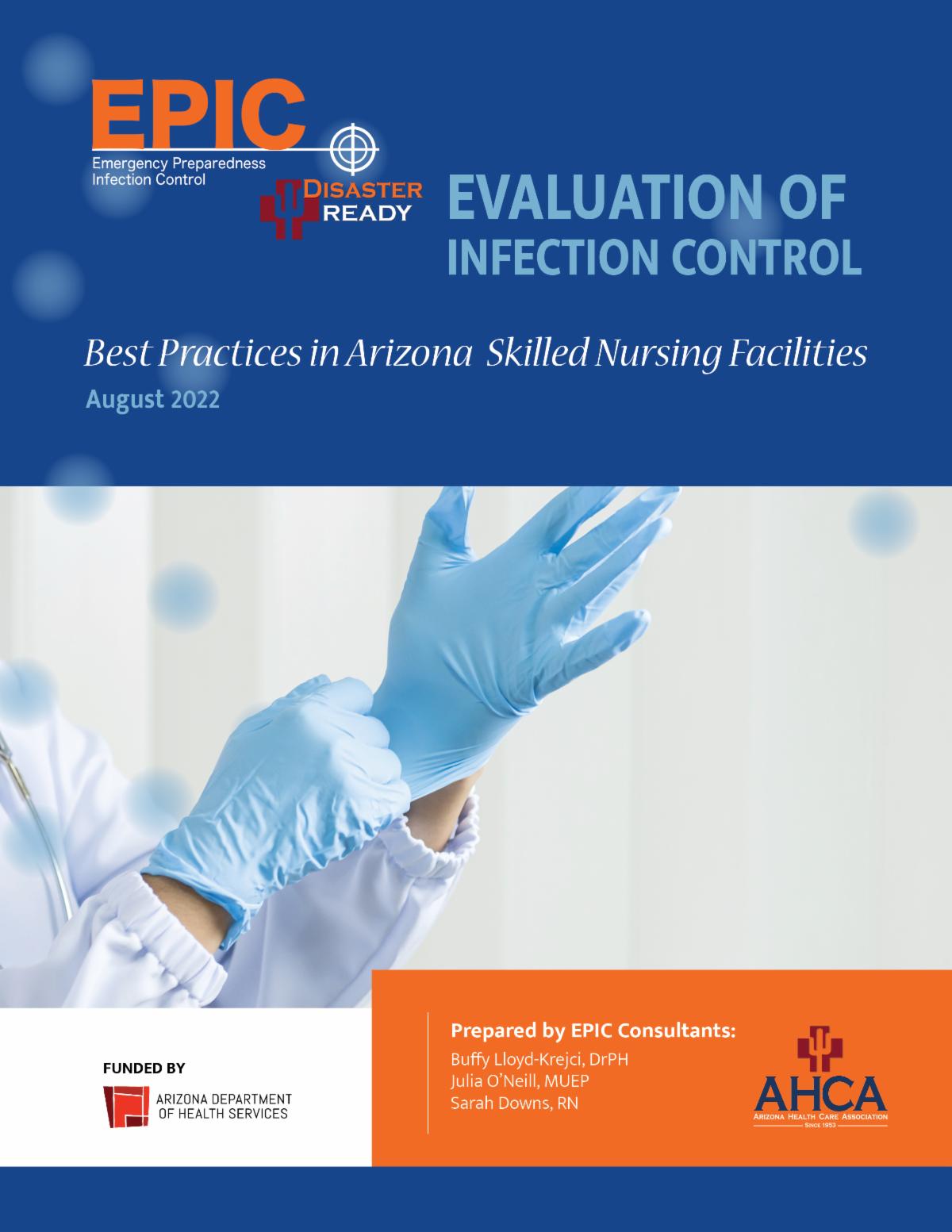
Evaluation of Best Practices in Infection Control
The EPIC grant funded an evaluation of best practices in infection control and we are pleased to make this useful toolkit available to you.
This project was a two-year effort that included methodology examining 20054 IPC and COVID-19 targeted surveys completed by SNFs, along with an intensive analysis of self-reported operational IPC successes and gaps in service delivery. The evaluation was spearheaded by EPIC consultant Dr. Buffy Lloyd-Krejci and her team.
The end result is a toolkit that outlines key recommendations for IPC best practices, with real-world suggestions for implementation along with additional resources. It is our hope that this will be a useful tool for all clinicians and especially for your Infection Preventionists.
|
|
EPIC Grant Offers FREE Onsite IPC Support for SNFs in Arizona
The Emergency Preparedness and Infection Control (EPIC) grant administered by AHCA is offering onsite technical assistance in infection prevention and control. Dr. Buffy Lloyd-Krejci and her team at IPCWell are contracted to provide this support to skilled nursing facilities statewide in our 2022/23 grant.
They may assist with strengthening best practices, auditing IP protocols, reviewing policies, reporting, and addressing IP issues identified in the survey process.
They will provide a one-time onsite visit, FREE of charge, funded by the EPIC grant. If you would like to be on the list to receive this technical assistance, please contact Dr. Buffy at buffy@ipcwell.com.
|
|
Infection Preventionist Call this Month
The EPIC Infection Preventionist call will occur on Thursday, September 22 at 1:00 pm.
Please email Kay Huff with any questions or to receive the zoom link.
|
|
Infection Prevention and Control is the Most Frequently Cited
SNF Deficiency
In Arizona, F880 Infection Prevention and Control is the most frequently cited deficiency on standard surveys and is the second the most frequently cited deficiency on all survey types. According to the CMS website, F880 Infection Prevention & Control is also the most frequently cited deficiency in the nation and the third most frequently cited at the Immediate Jeopardy level in the nation. In Arizona, F880 is most often cited for:
- Failing to don PPE as required for Transmission Based Precautions (TBP).
- Failing to screen staff prior to working.
- Failing to perform hand hygiene when required.
- Failing to wear PPE specifically face masks so that they cover the staff members nose and/or mouth.
- Failing to post signage for TBP outside residents’ rooms.
The top reasons why F880 has been cited may seem familiar, as they have remained basically the same for the past couple of years.
|
|
F880 Infection Control Updates and Revisions
CMS has updated/revised its guidance for F880 Infection control, which will go into effect October 24, 2022. The added guidance requires the facility’s IP to develop policies and procedures that define standard precautions and transmission based precaution and to explain their application during resident care activities. CMS also defined that staff in this guidance includes all facility staff, contracted staff, consultants, volunteers. It also includes others who provide care and services to residents on behalf of the facility, and students in the facility’s nurse aide training programs or from affiliated academic institutions. The definitions for transmission-based precautions. C. difficile, Legionellosis and MDROs have been added.
CMS also added the following sections to this requirement:
- Environmental Cleaning and Disinfection
- Water management
- MDRO Colonization and Infection.
- Blood Glucose Monitors
|
|
Measles and Monkeypox
The number of total positive cases of Monkeypox in Maricopa County has surpassed 270 cases according to Maricopa County Public Health as of September 6, 2022.
Most cases of monkeypox are self-limited and only require supportive care to fully recover. So far during the 2022 outbreak, about 20% of cases have met eligibility for treatment with Tecovirimat.
Tecovirimat (TPOXX) is an antiviral medication approved by the FDA for treatment of smallpox, and is now being used to treat monkeypox infection under an Expanded Access Investigational New Drug (IND) protocol from the CDC.
Monkeypox is often a painful, debilitating illness. Prompt initiation of Tecovirimat can lessen suffering and reduce risk of complications. For more information, including information about supportive care for monkeypox, visit NYC.Gov.
Three confirmed cases of Measles have been identified in Arizona. Healthcare providers should be aware that measles may be circulating in Maricopa County and should consider measles in the differential of unvaccinated individuals who present with fever and a rash.
Measles is highly contagious and dangerous, especially for babies and young children according to the CDC. The rash usually appears about two weeks after a person is exposed. People at high risk for severe illness and complications from measles include infants and children 5 years old and younger, adults 20 years and younger, pregnant women and people with compromised immune systems.
Measles can be prevented with measles-containing vaccine, which is primary administered as the combination measles-mumps-rubella. For more information on measles, visit CDC.gov/measles.
|
|
Influenza Update and Upcoming Study
As we approach this year’s influenza season, please be aware that influenza rates are likely to return to normal or be higher than normal. Influenza rates in the southern hemisphere (their winter) are happening earlier and much more widespread than normal. What happens in the southern hemisphere often predicts what will happen in the northern hemisphere. Besides the vaccine, current guidelines recommend using one of two FDA-approved antiviral medications to prevent spread and to treat residents. However, we don’t know which is more effective and one requires a single dose and the other multiple doses over a period of time.
A team of nationally recognized long term care researchers from Brown University is undertaking a national quality improvement study to compare the effectiveness of two FDA approved antiviral medications in controlling influenza outbreaks in U.S. nursing facilities. Participating facilities will be provided a free supply of one of the two antiviral medications to use, and because these are FDA-approved medications patient consent is not required. If you are interested in having your facility participate in this project, please notify Insight Therapeutics as soon as possible by calling 757-625-6040, or emailing H. Edward Davidson, PharmD, MPH, at NHFluRx@inther.com.
|
|
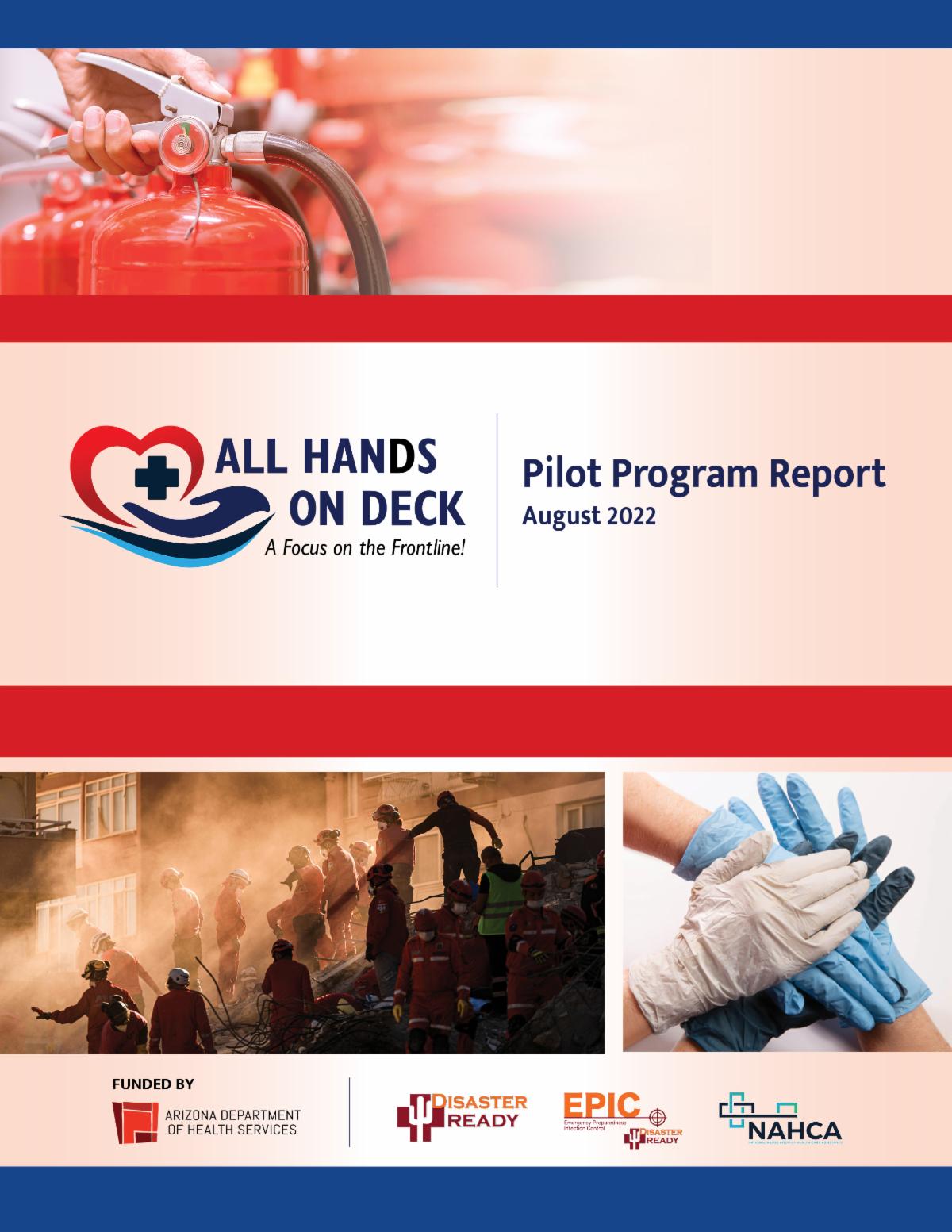
All Hands on Deck Pilot Program Report Available
Emergency preparedness for the frontline is important for every facility. We recognize that Caregivers and CNAs are often in the epicenter of any disaster or emergency scenario. In a collaborative effort to learn more about how to support the readiness of the frontline, AHCA and the National Association of Health Care Assistants (NAHCA) designed an emergency preparedness educational pilot program specific to the frontline known as All Hands on Deck (AHOD).
AHOD was a “pilot”, which allowed us to test the efficacy of the content and delivery of the material to a very specific and new audience- the frontline. The pilot study was funded by the Arizona Department of Health Services through our EPIC and Disaster Ready grants. Disaster Ready consultants Stan Szpytek and Gil Damiani played an important role in creating the curriculum in partnership with NAHCA and provided three educational events to deliver this content to the frontline. The study clearly validates the importance of reaching the frontline in disaster preparedness education.
|
|
Free COVID Tests for Assisted Living
Assisted living communities now have access to free COVID-19 testing for their staff and residents through December 31, 2022. CDC’s Operation Expanded Testing (OpET) program expanded access to free testing nationwide to now include assisted living communities, which previously targeted schools, shelters, and correctional facilities.
- Testing under OpET is available at no-cost to providers and can be used on staff or residents. You can receive up to a four-week supply at a time, and there is no cap on the number of tests that can be used in this program.
How it Works:
OpET coordinates with four regional coordination hubs to provide pooled PCR tests (i.e., laboratory-based Nucleic Acid Amplification Tests [NAAT]), with specimen collection supplies, shipping materials, laboratory testing, and results reporting. The provider must contribute staff to collect specimens.
How to Enroll:
- Identify your facility’s region and coordination hub.
-
Visit your regional coordination hub’s – Arizona and the western part of the US are in Hub 1:
-
Hub 1 – West: Alaska, Arizona, California, Guam, Hawaii, Idaho, Marshall Islands, Nevada, Northern Mariana Islands, Oregon, Palau, and Washington
-
Hub 2 – Midwest: Colorado, Illinois, Indiana, Iowa, Kansas, Michigan, Minnesota, Missouri, Montana, Nebraska, North Dakota, Ohio, South Dakota, Utah, Wisconsin, and Wyoming
-
Hub 3 – Northeast: Connecticut, Delaware, Maine, Maryland, Massachusetts, New Hampshire, New Jersey, New York, Pennsylvania, Puerto Rico, Rhode Island, U.S. Virgin Islands, Vermont, Virginia, Washington D.C., and West Virginia
-
Hub 4 – South: Alabama, Arkansas, Florida, Georgia, Kentucky, Louisiana, Mississippi, New Mexico, North Carolina, Oklahoma, South Carolina, Tennessee, and Texas
3: Enroll your assisted living community.
|
|
Industrial Hygiene Resources and EPIC Team Support
If there is one thing that long term care's collective response to COVID-19 has taught us, it is that the management of a Public Health Emergency requires a "team" approach to control infections.
A critical element of that team approach includes focus on a facility's environment of care and physical plant. The Disaster Ready EPIC website contains a wide range of resources designed to give your facilities management team the ability and tools needed to help create and sustain a safe and compliant environment of care.
Additionally, our EPIC consultants stand ready to assist you with your industrial hygiene, clinical and emergency management questions.
|
Mixed Environmental Hazards
Hazard overlap is a common occurrence and many environmental issues are comingled.
Examples include:
- Mold growing on asbestos-containing drywall = biohazard cleanup with regulated asbestos-containing materials.
- A fire that burned the pharmacy = fire restoration with drug residues.
- Pigeon waste accumulations that caused a roof leak = nuisance bird pathogens and water restoration.
- A power outage and exceptional outdoor temperatures = temporary power needs and heat or cold stress considerations.
- A burst water pipe that caused the flooring to delaminate = water restoration and trip hazard.
- A car that crashes into your biohazard accumulation room = structural concerns and infection control issues.
Each issue has its unique human health and safety considerations, but when combined, the effects can often be synergistic. In most instances you cannot simply divide the overlapping issues to tackle them individually. A common reaction is for a facility to simply pick one hazard and view all response measures through that singular lens. This is an oversight and can cause avoidable serious injuries or deaths. Be prepared, and be flexible because no two incidents are alike. A SNF must carefully consider all the hazards presented by any emergent situation and tailor the response to address them in concert. Feel free to contact EPIC consultant Derrick A. Denis of Clark, Sief, Clark, Inc. with any questions at DerrickDenis@csceng.com. Also, check out related resources on our website.
|
|
Emergency Generator
Fuel Quality Testing
Long term care facilities that are equipped with an emergency generator are required to maintain that equipment in accordance of NFPA #110, Standard for Emergency and Standby Power Systems (2010 edition). Part of the required inspection, testing and maintenance of these systems includes an annual fuel quality test in accordance with section 8.3.8 of the standard. On occasion, facilities sometimes fail the annual fuel quality test due to the presence of foreign material within the fuel and/or fuel tank. A common recommendation by vendors who service this equipment is to replace the fuel which is likely contaminated with bacteria and other micro-organisms of initiate an expensive process know as fuel polishing. Clearly, this is a test that you don't want to fail. One provider in Arizona discovered contamination at one of their facilities and researched a solution that would not require them to replace the fuel. Diesel additives are available that can cure the intrusion of bacteria and other foreign material.
Additionally, these additives will help stabilize the fuel and prevent future contamination. Providers should check with their emergency generator contractor and fuel vendors to inquire about this important matter to avoid a failed fuel quality test. While these additives may not be super inexpensive, they are worth the investment if you can avoid wasting hundreds of gallons of diesel fuel or expensive fuel polishing. Most importantly, a reliable and uncontaminated fuel source is needed to ensure that the emergency generator will start and properly operate during an emergency. Still need more information? Contact Stan Szpytek, AHCA Life Safety / Disaster Ready Consultant at Stan@azhca.org or (708) 707-6363.
|
Emergency Preparedness Planning Important in Wildfire Season
Currently, dozens of wildland fires are active across middle and northern California. The increased temperatures and stress on the power grid are reasons for concern, along with the near drought conditions in both California and Arizona. These are considered “perfect storm” incidents when two or more significant emergencies occur at the same time in the same regional area.
Consider the components of these disaster scenarios and analyze how each one may impact services and continuing care for residents. Evacuation, receiving locations, accepting locations, transportation resources/availability, and current memorandums of understanding (MOU) are essential components. Power outages, generator operation, alternate cooling practices, adequate water supply, plans for staffing shortages must also be considered.
Keep in mind that all of these situations will most likely affect entire regions, not just a single facility. Any one of these emergencies in itself would be an opportunity to review your disaster plan. Staffing shortages added to the equation makes it an absolute necessity. Please review your facility's emergency plan and revise as necessary. Need help? Contact EPIC consultants Gil Damiani at
|
|
Check out our DR EPIC Helpline!
To submit questions, email the DR EPIC online helpline at EPIC@azhca.org. You can also call the DR EPIC phone Helpline at 602-241-4644 and we will assist you. or valuable infection prevention resources! Go to: EPIC.DisasterReadyaz.org to explore these tools.
|
|
Questions? Contact EPIC@azhca.org |This program is funded by ADHS
The Disaster Ready Emergency Preparedness Infection Control (DR EPIC) program provides education and technical assistance for skilled nursing providers throughout the state. Individual providers will need to exercise their independent discretion in how to apply this information and technical assistance to the unique operation of each facility. For that reason, a facility’s of its professional judgment and due diligence in utilizing the program for infection control and risk management practices is solely within the facility’s control for which it is entirely responsible.
Copyright 2022.
|
|
|
|
|
|
|