EPIC Newsletter
Emergency Preparedness Infection Control for Arizona's SNFs
|
|
Obtaining COVID-19 Vaccinations |
|
The Public Health Emergency for COVID-19 will end on May 11, 2023, which means there may be changes with how facilities obtain COVID-19 vaccinations and boosters for their residents and staff. Some of the pharmacies that have been offering vaccination clinics will no longer be providing this service. We encourage facilities to contact their vaccine provider to discuss how and/or if they will be providing COVID-19 vaccines after the end of the PHE.
To prepare for this change facilities may also choose to have their own staff provide the COVID-19 vaccine and/or booster to their residents and staff by enrolling into the Arizona State Immunization Information System (ASIIS). To start the process for enrolling click ASIIS Provider Profile Change form (azdhs.gov) and complete the provider change form. This process can take several days to weeks to complete as all the information provided must be reviewed by ADHS. For questions or help with the enrollment process please contact the ASIIS Help Desk at 602-364-3899.
|
|
Infection Preventionist Call
The EPIC Infection Preventionist call is scheduled for Wednesday, April 26 at 1:00 pm.
Please email Kay Huff with any questions or to receive the Zoom link for the monthly calls.
|
|
|
Grant Funded On-Site Industrial Hygiene Technical Assistance Available to LTC Facilities
The Disaster Ready / EPIC program has received funding from ADHS to provide infection control support to both skilled nursing facilities and assisted living facilities in Arizona. This innovative program will give SNF and ALF providers the opportunity to have EPIC Industrial Hygienists from Clark, Seif Clark INC., visit individual facilities and provide consultative services - AT NO COST - related to water management, indoor air quality, mold, asbestos, airborne infection isolation rooms and respiratory protection programs.
This free service does not include reporting to any regulatory agencies and is designed to give providers the support they need to maintain a safe and healthy environment of care. If you are interested in participating in this program, please email Stan Szpytek, AHCA Life Safety / Disaster Ready consultant at Stan@azhca.org to get these complementary services scheduled.
|
CDC Updates Booster Protocol
The CDC does not recommend more than one updated COVID-19 booster shot at this time for adults who have completed their primary series of vaccinations, according to guidance information updated last week.
The FDA last August authorized omicron-targeting vaccines made by Pfizer-BioNTech and Moderna as preferred COVID booster shots. Last month, the CDC’s independent vaccine advisers decided that current evidence did not support more than one yearly dose of the newer, bivalent vaccines, including for older adults and other groups vulnerable to severe disease. That decision was largely based on a lack of existing data on the efficacy of multiple doses. But the CDC itself did not confirm a stance on the issue at the time.
|
CMS Rescinds
Issues Updated Guidance for Enhanced Enforcement for Infection Control Deficiencies
CMS Center for Clinical Standards and Quality/Quality Safety Oversight Group released QSO Memo QSO-23-10-NH, which updates the enhanced enforcement policy that was implemented early in the pandemic. This update is related to changes that have occurred throughout the pandemic, including an interim final rule that established long term care facility vaccine immunization requirements, CMS noted the need to continue to evaluate guidance.
The biggest change, in enforcement, is that a CMP (Civil Money Penalty) would no longer apply for all infection control citations. Instead, a CMP would only apply if the scope and severity was cited at a G or higher. Furthermore, enhanced enforcement (Directed Plan of Correction and Discretionary Denial of Payment for New Admission), would only be enforced at Level 2 (D, E, & F) when both F880 Infection Prevention & Control and F887 COVID-19 Immunizations were cited. However, CMS did reduce the times to achieve substantial compliance.
Please contact AHCA’s Kay Huff with further questions.
|
|
Candida auris (C. auris) Rising in Facilities
A fungal infection that can be fatal is spreading at “an alarming rate” across U.S. health care facilities and nursing homes, according to a report released last week by CDC. This report looks at the spread of infection of Candida auris, commonly called C. auris, between 2020 and 2021, terming it a “serious global threat.” In general, C. auris is a threat to patients who are very sick, have invasive medical devices, or have long or frequent stays in healthcare facilities.
C. auris is an urgent antimicrobial resistance threat because it is often resistant to multiple antifungal drugs, spreads easily in health care facilities, and can cause severe infections with high death rates. Researchers said C. auris case counts have increased for many reasons, including poor general infection prevention and control practices in health care facilities. C. auris was first reported in the United States in 2016, and its prevalence has increased each year, with a total of 3,270 clinical cases and 7,413 screening cases reported through December 31, 2021. Arizona had 53 clinical cases of c. auris in 2022 but just one in 2021 and one in 2020.
People who have recently spent time in nursing homes and have lines and tubes that go into their body (such as breathing tubes, feeding tubes and central venous catheters), seem to be at highest risk for C. auris infection according to CDC. Colonization and infection in healthy persons is extremely rare.
-
Cleaning and disinfecting the patient care environment (daily and terminal cleaning) and reusable equipment with recommended products, including focus on shared mobile equipment (e.g., glucometers, blood pressure cuffs).
-
Communication about the patient’s C. auris status when the patient is transferred.
|
|
F945 Infection Control Training
Infection Control Training F945 states that a facility must include as part of its infection prevention and control program mandatory training that includes the written standards, policies, and procedures for their program. The facility must develop, implement, and permanently maintain an effective training program for all staff, that is appropriate and effective, and is determined by staff need.
For the purposes of this training requirement, staff includes all facility staff (direct and indirect care functions), contracted staff, and volunteers (training topics as appropriate to role). At a minimum the training must include:
- A surveillance system designed to identify possible communicable diseases or infections before they can spread.
- When and to whom possible incidents of communicable disease or infections should be reported.
- How and when to use standard precautions, including proper hand hygiene and environmental cleaning and disinfection practices.
- How and when to use transmission-based precautions for a resident, including but not limited to, the type and its duration of use depending upon the infectious agent or organism involved.
- Occupational health policies, including the circumstances under which the facility must enforce work restrictions and when to self-report illness or exposures to potentially infectious materials; and
- Proper infection prevention and control practices when performing resident care activities as it pertains to particular staff roles, responsibilities, and situations.
Changes in the facility’s resident population, community infection risk, national standards, staff turnover, the facility’s physical environment, or facility assessment may necessitate ongoing revisions to the facility’s training program for infection prevention and control.
The complete requirement at F945 can be found in Appendix PP. Contact AHCA’s Kay Huff with your questions.
|
|
Understanding the Role of the IP
The Infection Preventionist (IP) role in a long term care facility is one of the most important positions in any nursing home. Why? Not only is this role a requirement by the Centers for Medicare and Medicaid Services (CMS), but it is also key in keeping staff and residents free from preventable infections in their facility. A lot of people assume that this role may only be filled by nurses and can be effective in a part time capacity. That is not always the case. The role of the IP can be fulfilled by not only nurses, but those with degrees in epidemiology, microbiology, medical technology, public health, or other health care science degrees. This job is extensive and critical and arguably requires much more than part time hours. So, what is an Infection Preventionist? The IP is accountable for decreasing the incidence and transmission of infectious diseases between patients, staff, visitors, and the community. In this key position, essential job duties and responsibilities include:
- Developing and implementing written policies and procedures to instruct staff on the importance of IPC practices and when and how to perform them.
- Creating a system for recording incidents identified by the IPC program and the corrective actions taken by the facility within the Quality Assurance Performance Improvement (QAPI) program.
- Implementing a system for infections surveillance to identify and prevent the spread of infections.
- Implementing a system for investigating and reporting incidents of communicable disease to identify, prevent, and control infection outbreaks.
- Conducting an annual review of IPC program policies, procedures, and activities and updating them as necessary based on the facility’s IPC risk assessment.
- Establishing a program to optimize the treatment of infections and reduce adverse events when prescribing antibiotics.
|
|
|
Prepare Now for Wildfire Season and Wildfire Smoke
The greenery that we see in the valleys, on the hills and up in the mountains means that we had a very wet winter. Well, that green won't last much longer as temperatures start to rise and humidity starts to drop. The lush landscape will turn to dead and dry vegetation which equates to a significant risk of wildland fires, even in the desert.
Don't wait for things to dry out and the threat to become real. Now is the time to review your Emergency Operations Plan (EOP) as it relates to wildfires and other procedures including evacuation. Even if you aren't directly impacted by a wildfire, your facility may be impacted by wildfire smoke. Here is a video produced by the DR/EPIC Team on wildfire smoke: https://epic.disasterreadyaz.org/aiovg_videos/wilde-fire-smoke/. Prepare your team now for the upcoming wildfire season and check out the Wildfire Tabletop Exercise planned for the Southern Region in the next article!
|
|
Wildfire TTX Scheduled for Southern Region
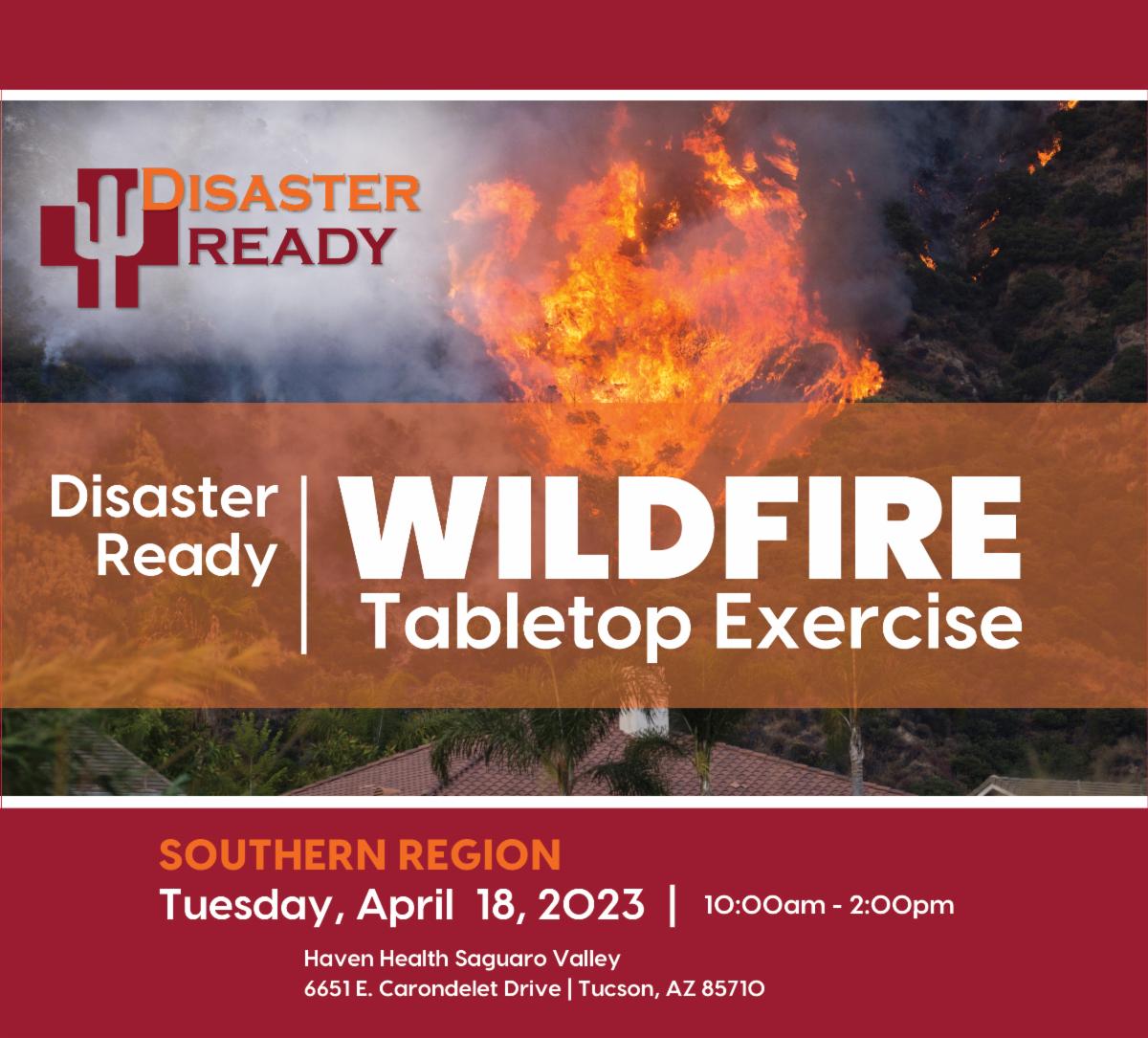
If you are in the southern region of Arizona, you don't want to miss this opportunity to participate in a tabletop exercise (TTX) scheduled for April 18 between 10:00 am and 2:00 pm at Haven Health Saguaro Valley.
The exercise will be facilitated by our Disaster Ready team and will focus on the management of a fast-moving wildfire that threatens the whole community requiring LTC facilities to evacuate.
Since it takes the whole team to manage an emergency, each SNF in the region is encouraged to send as many staff members as possible to this grant-funded program. Lunch will be provided. Registration links will be forthcoming in future Updates.
|
|
Emergency Management Resource Manual Available
As part of the Disaster Ready program, every skilled nursing facility in the state was provided with a copy of the Med Pass Emergency Planning and Resource Manual a few years ago. This comprehensive document was designed to enhance a facility's Emergency Operations Plan (EOP) with helpful information or can be used as a template to create a CMS-compliant EOP.
Due to ownership and leadership changes, some facilities may not have a copy of this valuable resource. If you need a copy of this manual, please contact AHCA’s Krysten Dobson to request a copy.
|
Medical Response and
Surge Exercise
The Arizona Coalition for Healthcare Emergency Response (AzCHER or Coalition) will be executing a functional exercise that meets the Coalition’s Medical Response and Surge Exercise (MRSE) requirements. The exercise will take place on May 18 from 9 am to 12:30 pm. The exercise will provide you with an opportunity to test your surge response and preparedness capabilities.
This is a functional exercise only, not a full-scale exercise. A functional exercise examines and/or validates the coordination, command, and control between various agencies. A functional exercise does not involve any “boots on the ground” (i.e., actual patient or resource movement or first responders or emergency officials responding in-person).
We are reaching out to ask if you would participate in the exercise as a participating agency contact. This will include providing a phone number where your facility can receive telephone calls from exercise players. Your facility phone number will be listed in a Communications Directory and may be contacted during the exercise to help answer questions, facilitate information exchange, and assist with resource requests, etc. It will be important to start and end all phone calls with “This is an exercise.”
In addition to being a contact for hospitals to call during the exercise, your facility may wish to design your own exercise objectives to be tested during this time. You and your facility will be responsible for exercise design, direction and control, evaluation, and any after action activities and reporting.
Registration is due by April 21st.
|
|
New National Infection Preventionist Forum (NIPF) Available
NIPF is a national forum for any infection preventionist or infection prevention champions in your buildings to share lessons learned and resources and get questions answered. This national forum will also provide a mechanism to rapidly disseminate federal updates and resources about infections in LTC as they become available from CDC, CMS, or OHSA.
AHCA NCAL partnered with APIC with funding from CDC Project First Line to set up the NIPF, which is open to all LTC professionals focusing on infection prevention regardless of their membership in AHCA or APIC.
The goal of NIPF is to foster a collaboration and sharing of experiences between IPs in LTC. In addition, APIC subject matter experts will be available to address questions the group are unable to answer. The NIPF uses the "Connect Communities" platform to organize email discussions by threads and allows for sharing and posting of resource and tools in an organized library and ability to look up other IPs participating in the forum.
How to get started: To enroll in this national forum, all you need is an email address and password. Instructions for enrolling are available here.
Guidelines: Discussions are not moderated therefore we ask that users follow posting rules and etiquette linked here.
|
Laundry Room Fires... The Threat is Real!
A recent laundry room fire in a skilled nursing facility in Illinois should remind LTC providers that the threat of a fire in this critical area of operations is real. Housekeeping and environmental services staff responsible for laundry services must be trained to utilize proper procedures and appropriate temperatures when laundering and drying the combustible materials (linen, cloth, clothing, towels, mop heads, etc.) associated with operation of a LTC facility.
Manufacturer's guidelines must be specifically followed as they address the hazards associated with co-mingling of materials (different fabric types) and the methods in which some materials like microfiber cloth must be dried. Contact Stan Szpytek, Life Safety and Disaster Ready Consultant with any questions at Stan@azhca.org.
|
|
Check out our DR EPIC Helpline!
To submit questions, email the DR EPIC online helpline at EPIC@azhca.org. You can also call the DR EPIC phone Helpline at 602-241-4644 and we will assist you. or valuable infection prevention resources! Go to: EPIC.DisasterReadyaz.org to explore these tools.
|
|
Questions? Contact EPIC@azhca.org |This program is funded by ADHS
The Disaster Ready Emergency Preparedness Infection Control (DR EPIC) program provides education and technical assistance for skilled nursing providers throughout the state. Individual providers will need to exercise their independent discretion in how to apply this information and technical assistance to the unique operation of each facility. For that reason, a facility’s of its professional judgment and due diligence in utilizing the program for infection control and risk management practices is solely within the facility’s control for which it is entirely responsible.
Copyright 2023.
|
|
|
|
|
|
|