Wednesday, February 15, 2023 |
|
EPIC Newsletter
Emergency Preparedness Infection Control for Arizona's SNFs
|
|
Attend the 2023 Disaster Ready Summit
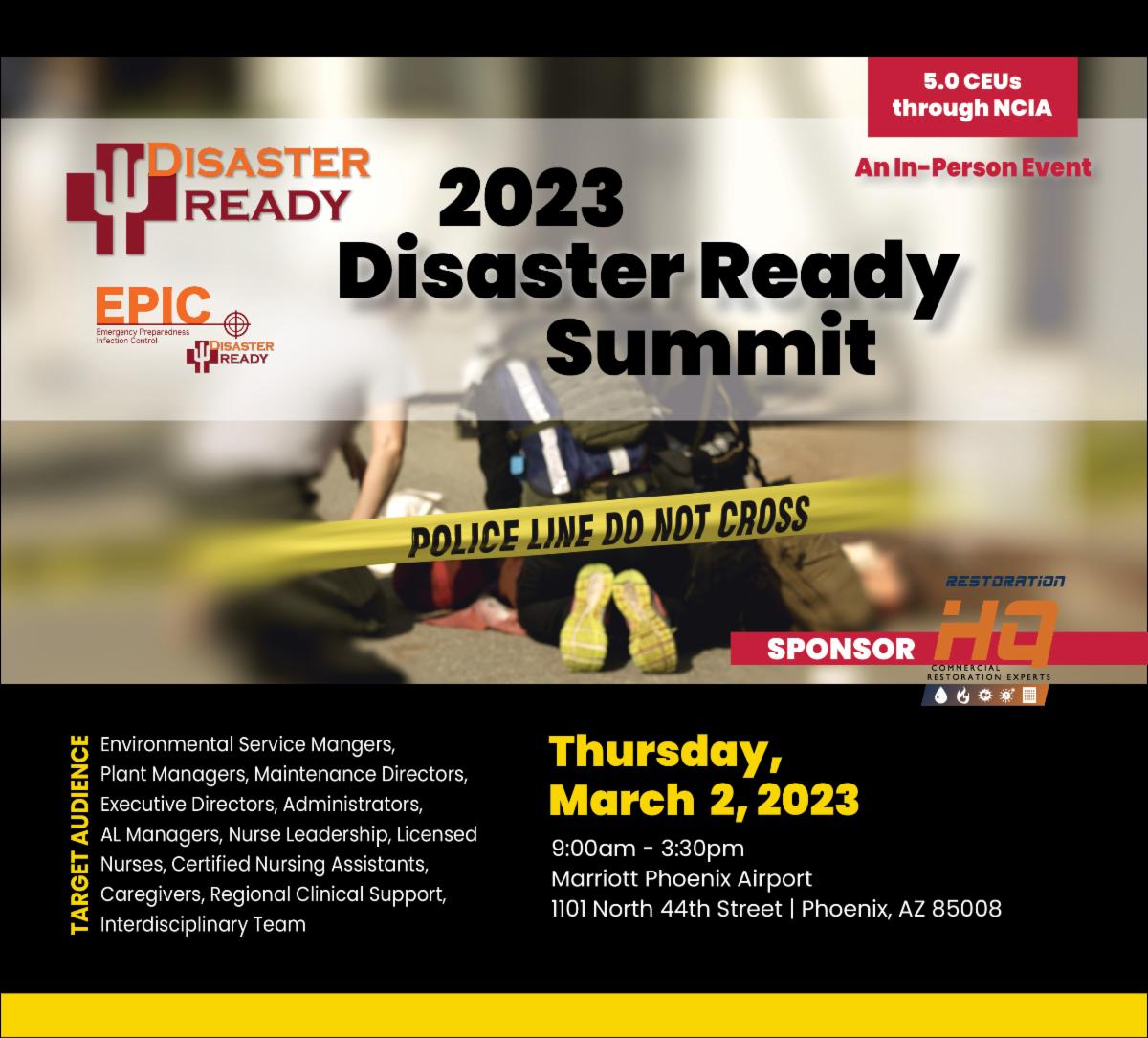
Now is the time to decide which members of your team will attend this year's Disaster Ready Summit on March 2nd at the Marriott- Phoenix Airport.
One of the main themes of the 2023 program is to promote a "team approach" to emergency management. Simply put, it takes the entire team to prepare, respond and recover from emergencies and disasters while maintaining continuity of care and services in a long term care facility.
The Disaster Ready Summit is not just for administrators, maintenance directors or executive staff. This full day program of learning and collaboration is designed for all levels of facility operations and promotes compliance with E-009 (Cooperation and Collaboration with others in the health care continuum). Mark your calendar and prepare to be educated, inspired and empowered to make sure that your facility is Disaster Ready.
|
|
ADHS AHCA Town Hall Meeting
Boosters for Seniors
AHCA is partnering with ADHS Office of Health Equity to bring you a Town Hall Meeting starring ADHS’ Dr. Karen Lewis on February 22 from 12 noon to 1 pm (AZ). There’s no registration, just log on at the time of the meeting and join us!
This FREE program is for all AL, SNF and public health professionals statewide. COVID-19 vaccination guidance is ever-evolving. ADHS wants to ensure you have the latest and most accurate information! Achieving high vaccination coverage is critical to preventing outbreaks of COVID-19.
You’ll be able to ask your clinical questions about the new COVID-19 bivalent boosters. Also, you’ll learn how to host a FREE mobile or pop-up vaccination clinic for your residents and staff.
Wednesday, February 22 | 12:00 – 1:00pm
Google Meet joining info
Or dial: (US) +1 262-885-7039 PIN: 936 043 793#
|
|
Infection Preventionist Call
The EPIC Infection Preventionist call is scheduled for Wednesday, February 22nd at 1:00 pm.
Please email Kay Huff with any questions or to receive the zoom link for the monthly calls.
|
|
|
Monitoring your Kitchen and Laundry Room is Important in Infection Control
When was the last time you went into your facility's kitchen, and not just to pick up a meal tray? The kitchen is extremely important when it comes to infection prevention and control, yet it is one of the most commonly missed areas! Food services impacts every single person in your building. Here are some tips to prevent the spread of food-borne illnesses within your facility:
1. Ensure there is a clear distinction between the clean, food prep area and the dirty, receiving area.
2. How is your dishwasher being serviced? Is it a hot water temperature or a cold-water temperature that has chemicals? Is this being monitored and logged every single meal service?
3. How are the food carts that deliver the trays to the residents being cleaned, disinfected, and sanitized? Is this happening every meal service?
4. Check with staff. Are they wearing masks appropriately and conducting hand hygiene?
Make sure to meet with your dietary manager to ensure proper policies and procedures are in place in the kitchen, and don’t be afraid to pop your head in there to conduct audits and identify any potential gaps. To find more information on food service guidelines visit Food Service Guidelines | Nutrition | CDC.
Another area commonly overlooked area of IPC in long term care is the laundry rooms. Like the kitchen, it is important to ensure that there is a clear distinction between the soiled linen and clean linen area. Check in on your staff and make sure that they are preventing potential contamination. Is your laundry staff wearing or re-wearing personal protective equipment (PPE) when they are sorting soiled linen? If you have a gown hanging up in the soiled linen area, chances are they are re-using the same gown all day. Need a simple solution to discourage this practice? Simply remove the hook from the wall. It is also incredibly important to observe the functioning of the washing and drying machines. The appropriate water temperature is between 158–176°F to effectively kill microorganisms.
Do you have a vendor coming in monthly to evaluate the washing machine chemical dispensers? The tubing can get clogged or break, therefore having a professional evaluate and service this equipment monthly is the key to success. The laundry room is a big part of infection control, and it is something we don’t want to overlook.
|
Some people who have been infected with COVID-19 can experience long term effects, known as post-COVID conditions or long COVID. The Centers for Disease Control and Prevention has a website devoted to long COVID, including the science behind long COVID.
|
PHE ends May 11, 2023
Pres. Biden let members of Congress know that he will end the Public Health Emergency (PHE) on May 11, 2023, which is a month after the current extension is set to expire. The current extension will need to be extended by one month past the current April 11 deadline by US HHS. Since Congress detached the federal match increase of 6.2% from the PHE, this expiration will have no bearing on that, but it will have on the 3-day stay and other PHE waivers. In other words, the waivers will end with the PHE, while the FMAP increase will be phased out by the end of the year. US HHS Secretary Becerra had confirmed that they would give at least a 60-day notice before ending the PHE.
|
|
Bivalent Booster Resources
- An informational flyer and outreach card in both English and Spanish are available.
- There is no “minimum” requirement to host a mobile clinic.
-
Vaccination clinic will come to you and can administer vaccines in-room, as needed, for homebound/bed bound residents.
-
All vaccination services are free and available to all Arizonans, regardless of insurance or immigration status.
- All on-site vaccine administration is done through contracted vendors and not ADHS staff.
-
Access COVID-19 vaccine doses through enrolled pharmacy providers for direct administration by LTCFs to their residents and staff.
- Find posters, flyers, a letter template, on-demand podcasts, and webinars.
If you have any questions about the ADHS Boosters for Seniors program, please contact:
Jessie Barbosa, MS, Vaccine Equity Manager
602.542.4664
|
New CDC Respiratory Disease Dashboard
A new respiratory disease dashboard released by the CDC can provide LTC providers with an early warning system to prepare against viruses circulating in the community.
The National Syndromic Surveillance Program (NSSP) is a joint effort between the CDC and other public health organizations. The dashboard provides a combined view of emergency department visits for multiple respiratory conditions tracked through a nationwide network of federal partners, state and local health departments, and academic and private-sector collaborators.
The system provides an early warning alert to identify unusual levels of certain illness or outbreaks in real time.
|
Monitor Community Transmission Levels
The community transmission levels for most of the counties in Arizona are in the substantial and moderate levels with just a few in still in high. This is great news as the lower the community transmission level the low the risk our residents will be exposed to COVID-19. However, facilities should remain cautious as there are a large number of out of state travelers this February. With an increase in visitors there is also the risk of our community transmission levels for COVID-19 to rise.
|
|
Understanding F-887; COVID-19 Immunizations
The requirement of F-887 COVID-19 Immunizations requires facilities to develop and implement policies and procedures to ensure that the COVID-19 vaccine is offered to each resident and staff member. It also requires that prior to offering the vaccine to residents and staff, the facility must educate them and the resident representative about the benefits, risks and potential side effects associated with the vaccine. The resident/resident representative or staff member must also be provided the opportunity to accept or refuse the COVID-19 vaccine.
Prior to offering the vaccination the facility must screen residents and staff for prior immunization, medical precautions, and contraindications to determine whether they are appropriate candidates for vaccination. The compete requirement for F887 can be found in QSO-21-19-NH.
How will surveyors determine compliance with F-887? They will use the Infection Prevention, Control & Immunizations task form/CE Pathway. Surveyors will review the facility’s policy for COVID-19 immunization policy and interview staff, residents/resident representatives to determine:
-
How residents and/or resident representatives receive education on the benefits and potential side effects before being offered a vaccine. If multiple doses are required, how residents and/or resident representatives will again receive education on the benefits and potential side effects before being offered the vaccine.
- How residents’ vaccination status is tracked.
- How screening is conducted for eligibility (e.g., medical contraindications, previous vaccination), the vaccines are offered, and consent or refusal is obtained.
The complete Infection Prevention, Control and Immunizations task form/CE Pathway can be found in Survey Resources.
|
|
Certified Food Protection Manager:
Enforcement Underway
In July 2020, the State of Arizona adopted the 2017 FDA Food Code, with an added addendum. This was the first time that the code has been updated since 2001 when 1999 Food Code was adopted. One of the changes outlined in the 2017 FDA Food Code is the requirement for food establishments (AL and SNF kitchens) to have a Certified Food Protection Manager (CFPM) onsite during operating hours.
Because of the staffing crisis caused by the pandemic, county health departments gave us an 18-month moratorium on enforcement of the CFPM provisions. Mostly they provided technical assistance. That moratorium ended in December. They are enforcing the CFPM provision.
In SNFs, CMS is allowing alternative paths for directors to become a director of food and nutrition services as per definition by CMS (click here). If a director or manager has two or more years of experience in the position of the director in a nursing facility and they successfully complete a food manager course by October 1, 2023, they are considered a Director of Food and Nutrition Services by CMS.
Bottom line: While your AL or SNF kitchen is in operation, a person in the building must be CFPM certified.
|
|
Influenza Vaccination Data Reporting
The CDC has provided additional guidance and clarification regarding the December 2022 NHSN Influenza Vaccination Data Reporting through NHSN.
The CDC is aware that there is some confusion regarding LTC reporting of influenza vaccination data through NHSN. Below are a few clarifying points.
1. Please note that facilities that are required to report annual health care personnel influenza vaccination data into NHSN must do so using the Healthcare Personnel Safety (HPS) Component. Reporting weekly influenza vaccination data through the NHSN LTC Facility Component does not fulfill this reporting requirement.
- CDC is not collecting weekly influenza vaccination data for LTC residents and health care personnel covering the 2022-2023 influenza season.
-
Please ignore tabs for reporting weekly influenza vaccination data for residents and health care personnel in the LTC Facility Component.
2. The deadline to report the annual health care personnel influenza vaccination summary data through the NHSN HPS Component is May 15, 2023.
3. CDC training materials can be accessed here.
4. The data reporting protocol can be accessed here.
|
|
|
AZ Bed Poll is a Resource
The Arizona Department of Health Services recently conducted a joint, multi-state Significant Event Readiness Forum (SERF) with the Western Region Alliance Pediatric for Emergency Management (WRAP-EM) centered around an earthquake in southern California. The issues of treating and transporting people with access and functional needs (ADFN) were discussed at length. A segment of the forum focused on transferring people in all healthcare facilities to other facilities that were not affected by the incident. A major task was identifying facilities that could properly care for those transferred. Accessing that information rapidly and in real time is crucial to a successful outcome.
Arizona has a tool that can help identify locations as potential reception sites across the region/State EM Resource (AZ Bed Poll). This tool is only effective if data is entered in a consistent manor on a regular timeframe (daily). While there is no requirement to enter information in the database daily, it is a logical emergency preparedness practice to do so. Please take a moment to consider the benefits of utilizing these available tools.
|
|
Check out our DR EPIC Helpline!
To submit questions, email the DR EPIC online helpline at EPIC@azhca.org. You can also call the DR EPIC phone Helpline at 602-241-4644 and we will assist you. or valuable infection prevention resources! Go to: EPIC.DisasterReadyaz.org to explore these tools.
|
|
Questions? Contact EPIC@azhca.org |This program is funded by ADHS
The Disaster Ready Emergency Preparedness Infection Control (DR EPIC) program provides education and technical assistance for skilled nursing providers throughout the state. Individual providers will need to exercise their independent discretion in how to apply this information and technical assistance to the unique operation of each facility. For that reason, a facility’s of its professional judgment and due diligence in utilizing the program for infection control and risk management practices is solely within the facility’s control for which it is entirely responsible.
Copyright 2022.
|
|
|
|
|
|
|